Page 303 of 420

�µ�µ �µ
If you exceed the maximum speed
f or the gear you are in, the engine
speed will enter into the tachometer’s
red zone. If this occurs, you may f eel
the engine cut in and out. This is
caused by a limiter in the engine’s
computer controls. The engine will
run normally when you reduce the
rpm below the red zone.
To use D , press the
D button when the shif t lever is in
the ‘‘D’’ position. This position is simi-
lartoD,exceptonlythefirstthree
gears are selected instead of all f ive.
Use D when towing a trailer in hilly
terrain, or to provide engine braking
when going down a steep hill. D can
also keep the transmission f rom
cycling between third and f ourth
gears in stop-and-go driving.
This position locks
the transmission in second gear. It
does not downshif t to f irst gear
when you come to a stop.
Use second gear: For more power when climbing.
To increase engine braking when
going down steep hills.
For starting out on a slippery
surf ace or in deep snow.
When driving downhill with a
trailer. This position locks the
transmission in f irst gear. By
upshif ting and downshif ting through
1, 2, and D, you can operate this
transmission much like a manual
transmission without a clutch pedal.3
3
3 3
Automatic Transmission
Engine Speed L imiter
Drive (D )
Second (2) First (1)3
302
Page 304 of 420
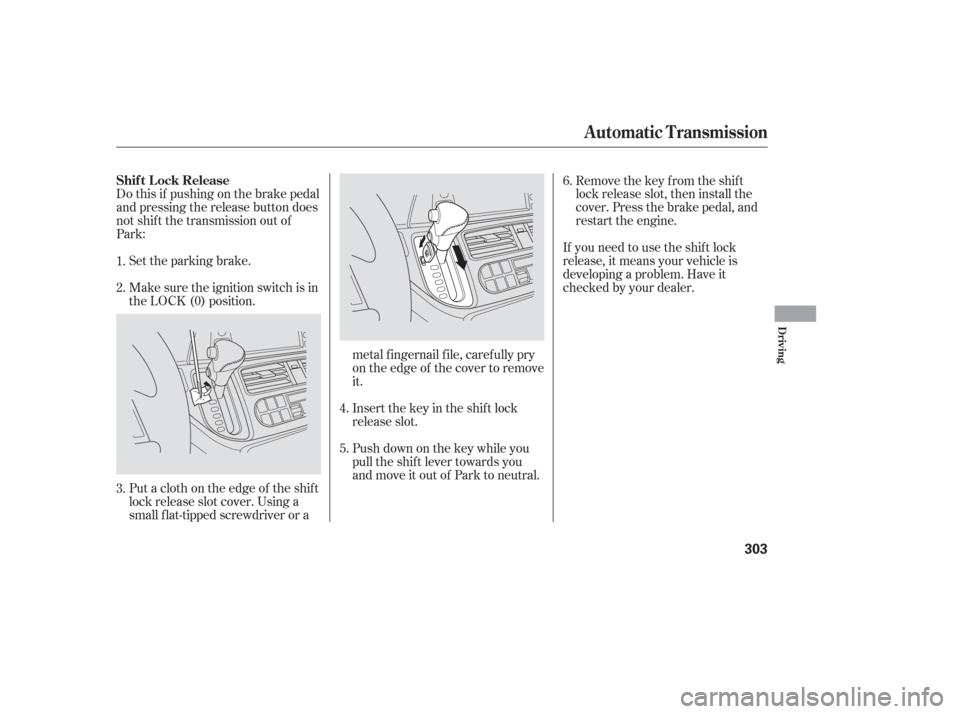
Do this if pushing on the brake pedal
and pressing the release button does
not shif t the transmission out of
Park:Set the parking brake.
Make sure the ignition switch is in
the LOCK (0) position.
Put a cloth on the edge of the shif t
lock release slot cover. Using a
small f lat-tipped screwdriver or a metal f ingernail f ile, caref ully pry
on the edge of the cover to remove
it.Remove the key from the shift
lock release slot, then install the
cover. Press the brake pedal, and
restart the engine.
If you need to use the shif t lock
release, it means your vehicle is
developing a problem. Have it
checked by your dealer.
Push down on the key while you
pull the shif t lever towards you
and move it out of Park to neutral. Insert the key in the shift lock
release slot.
5. 6.
4.
3. 1.
2.
Automatic Transmission
Shif t L ock Release
Driving
303
Page 308 of 420

CONT INUED
If the VSA system indicator comes
on while driving, pull to the side of
theroadwhenitissafe,andturnoff
the engine. Reset the system by
restarting the engine. If the VSA
system indicator stays, or comes
back on while driving, have the VSA
system inspected by your dealer.
If the indicator does not come on
when the ignition switch is turned to
the ON (II) position, there may be a
problem with the VSA system. Have
your dealer inspect your vehicle as
soon as possible.You will also see a ‘‘CHECK VSA
SYSTEM’’ message on the multi-
inf ormation display if there is a
problem with the VSA system.
The vehicle stability assist (VSA)
system helps to stabilize the vehicle
during cornering if the vehicle turns
more or less than desired. It also
assists you in maintaining traction
while accelerating on loose or
slippery road surf aces. It does this
by regulating the engine’s output,
and by selectively applying the
brakes.
The VSA system cannot enhance the
vehicle’s driving stability in all
situations and does not control your
vehicle’s entire braking system. It is
still your responsibility to drive and
corner at reasonable speeds and to
leave a sufficient margin of safety. When VSA activates, you may notice
that the engine does not respond to
the accelerator in the same way it
does at other times. When VSA activates, you will see the
VSA activation indicator blink.
If the low tire pressure indicator
comes on (see page ), or the
multi-inf ormation display shows a
‘‘CHECK TPMS SYSTEM’’ message
(see page ), the VSA system
automatically turns on even if you
turn it off with the VSA OFF button.66
85
On Touring models only
Vehicle Stability Assist (VSA) System
VSA A ctivation Indicator
VSA System Indicator
Driving
307
Page 312 of 420

For more inf ormation on the
Michelin PAX system, ref er to page.
If there is a problem with the TPMS,
you will see the above message in
the multi-information display.
If you see this message, the system
is of f and is not monitoring the tire
pressures. Have the system checked
by your dealer as soon as possible. The tires on your vehicles are PAX
tires, and you cannot replace or
repair a f lat tire. Replacement or
repair of tires must be perf ormed by
a Honda dealer or an authorized
Michelin PAX system dealer. If the low tire pressure indicator
comes on, or the multi-inf ormation
display shows a ‘‘CHECK TPMS
SYSTEM’’ message, the VSA system
automatically turns on even when
the VSA system is turned of f by
pressing the VSA OFF button (see
page ). If this happens, you
cannot turn the VSA system of f by
pressing the VSA OFF button again.
362
308As required by the FCC:This device complies with Part 15 of theFCC rules. Operation is subject to thef ollowing two conditions: (1) This devicemay not cause harmf ul interf erence, and(2) this device must accept anyinterf erence received, includinginterf erence that may cause undesiredoperation.
Changes or modif ications not expresslyapproved by the party responsible f orcompliance could void the user’sauthority to operate the equipment.
This device complies with IndustryCanada Standard RSS-210.Operation is subject to the f ollowing twoconditions: (1) this device may not causeinterf erence, and (2) this device mustaccept any interf erence that may causeundesired operation of the device.
Tire Pressure Monitoring System (TPMS)
TPMS System Failure
Changing a T ire with T PMS
Driving
311
Page 319 of 420
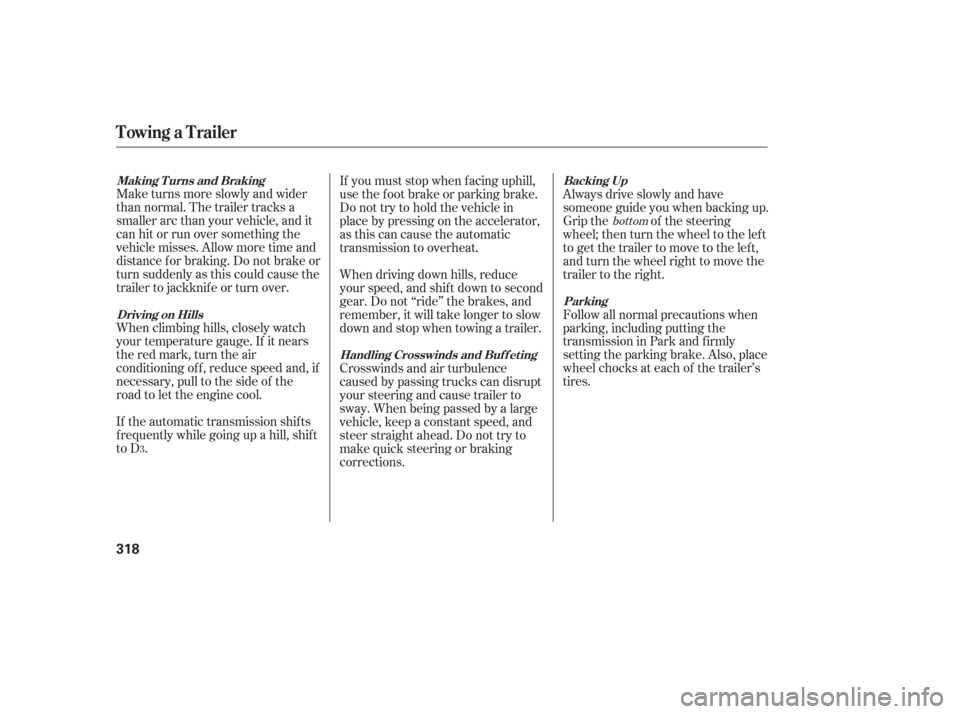
Maketurnsmoreslowlyandwider
than normal. The trailer tracks a
smaller arc than your vehicle, and it
canhitorrunoversomethingthe
vehicle misses. Allow more time and
distance f or braking. Do not brake or
turn suddenly as this could cause the
trailer to jackknif e or turn over.
When climbing hills, closely watch
your temperature gauge. If it nears
the red mark, turn the air
conditioning of f , reduce speed and, if
necessary, pull to the side of the
road to let the engine cool.
If the automatic transmission shif ts
f requently while going up a hill, shif t
to D .Always drive slowly and have
someone guide you when backing up.
Grip the of the steering
wheel; then turn the wheel to the lef t
to get the trailer to move to the lef t,
andturnthewheelrighttomovethe
trailer to the right.
Follow all normal precautions when
parking, including putting the
transmission in Park and f irmly
setting the parking brake. Also, place
wheel chocks at each of the trailer’s
tires.
If you must stop when f acing uphill,
use the f oot brake or parking brake.
Do not try to hold the vehicle in
placebypressingontheaccelerator,
as this can cause the automatic
transmission to overheat.
When driving down hills, reduce
your speed, and shif t down to second
gear. Do not ‘‘ride’’ the brakes, and
remember, it will take longer to slow
downandstopwhentowingatrailer.
Crosswinds and air turbulence
caused by passing trucks can disrupt
your steering and cause trailer to
sway. When being passed by a large
vehicle, keep a constant speed, and
steer straight ahead. Do not try to
make quick steering or braking
corrections.
3
bottom
Towing a Trailer
Making T urns and Braking
Driving on Hills Backing Up
Parking
Handling Crosswinds and Buf f et ing
318
Page 320 of 420

This section explains why it is
important to keep your vehicle well
maintained and how to f ollow basic
maintenance saf ety precautions.
This section also includes
instructions on how to read the
maintenance messages in the
odometer/trip meter display or
multi-Inf ormation display, a
maintenance record, and instructions
for simple maintenance tasks you
may want to take care of yourself.
If you have the skills and tools to
perf orm more complex maintenance
tasks on your vehicle, you may want
to purchase the service manual. See
page f or inf ormation on how to
obtain a copy, or see your dealer.......................
Maintenance Saf ety .320
....................
Maintenance Minder .321
....................
Maintenance Record .331
..............................
Fluid Locations .333
........................
Adding Engine Oil .334
.........
Changing the Oil and Filter .335
..............................
Engine Coolant .337
....................
Windshield Washers .339
....
Automatic Transmission Fluid .340
....................................
Brake Fluid .341
....................
Power Steering Fluid .342
....................................
Timing Belt .342
.............................................
Lights .343
................
Cleaning the Seat Belts .349
.....................................
Floor Mats .349
.................................
Wiper Blades .350
...............................................
Tires .352
...................
Checking the Battery .359
.............................
Vehicle Storage .360
407
Maintenance
Maint enance
319
Page 330 of 420

�µ
�µ
�µ
�µ
�µ
�µ
�Ì
U.S. Vehicles:
Youshouldcheckthefollowing
items at the specif ied intervals. If
you are unsure of how to perf orm
any check, turn to the appropriate
page listed. Lights Check the operation of
the headlights, parking lights,
taillights, high-mount brake light,
and license plate lights monthly.
See page .
Engine coolant level Check the
radiator reserve tank every time
you f ill the f uel tank. See page . Engine oil level Check every
time you fill the fuel tank. See
page .
Automatic transmission Check
the f luid level monthly. See page .
Brakes Check the f luid level
monthly. See page .
Tires Check the tire pressure
monthly. Examine the tread f or
wear and foreign objects. See page .
According to state and federal
regulations, f ailure to perf orm
maintenance on the items marked
with will not void your emissions
warranties. However, all
maintenance services should be
perf ormed in accordance with the
intervals indicated by the odometer/
trip meter display or the multi-
inf ormation display.
287
288
340 341 343
354
Maintenance, replacement, or
repair of emissions control
devices and systems may be done
by any automotive repair
establishment or individual using
parts that are ‘‘certif ied’’ to EPA
standards.
Owner’s Maintenance Checks
Maintenance Minder
Maint enance
329
Page 334 of 420
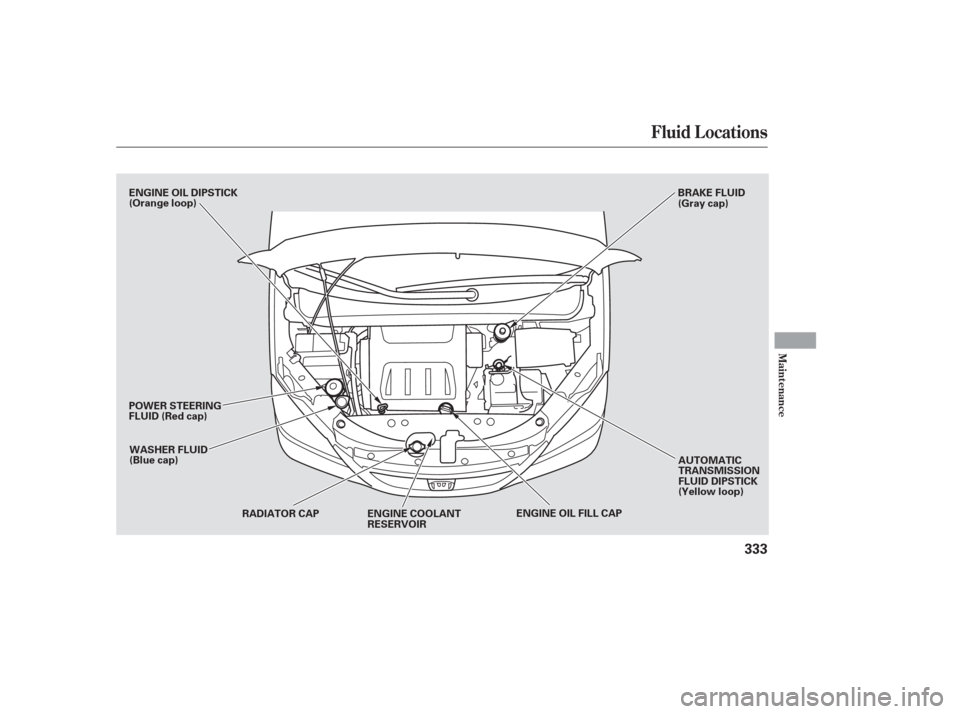
Fluid Locations
Maint enance
333
ENGINE OIL DIPSTICK
(Orange loop)WASHER FLUID
(Blue cap)
POWER STEERING
FLUID (Red cap)
RADIATOR CAP ENGINE OIL FILL CAPAUTOMATIC
TRANSMISSION
FLUID DIPSTICK
(Yellow loop)
BRAKE FLUID
(Gray cap)
ENGINE COOLANT
RESERVOIR