Page 39 of 420
�µ
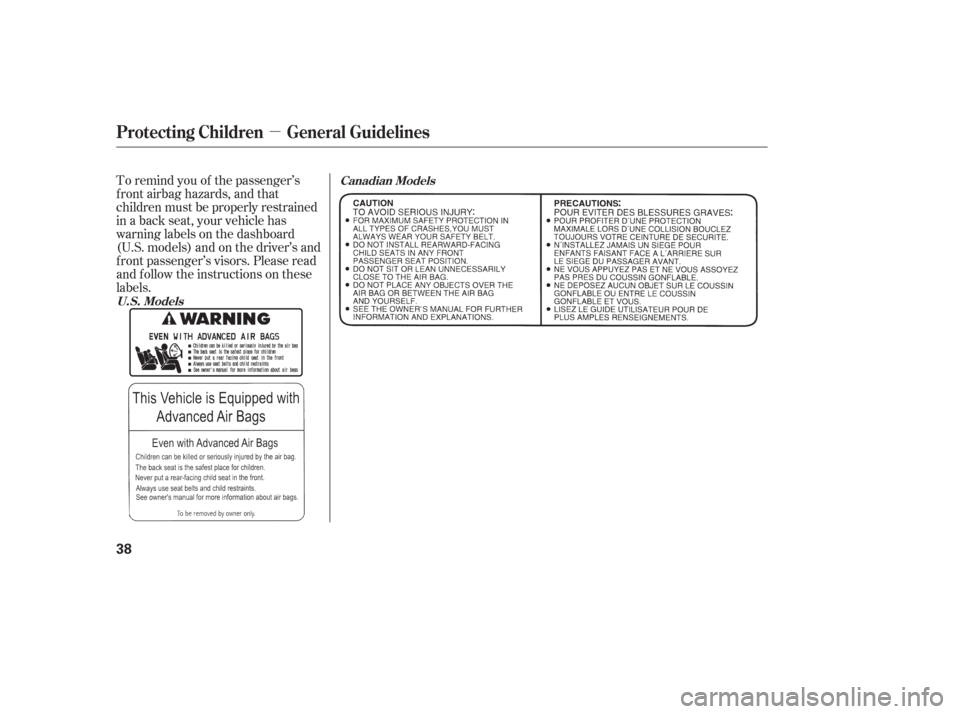
To remind you of the passenger’s
f ront airbag hazards, and that
children must be properly restrained
in a back seat, your vehicle has
warninglabelsonthedashboard
(U.S. models) and on the driver’s and
f ront passenger’s visors. Please read
and f ollow the instructions on these
labels.Canadian Models
U.S. Models
Protecting Children General Guidelines
38
Page 42 of 420
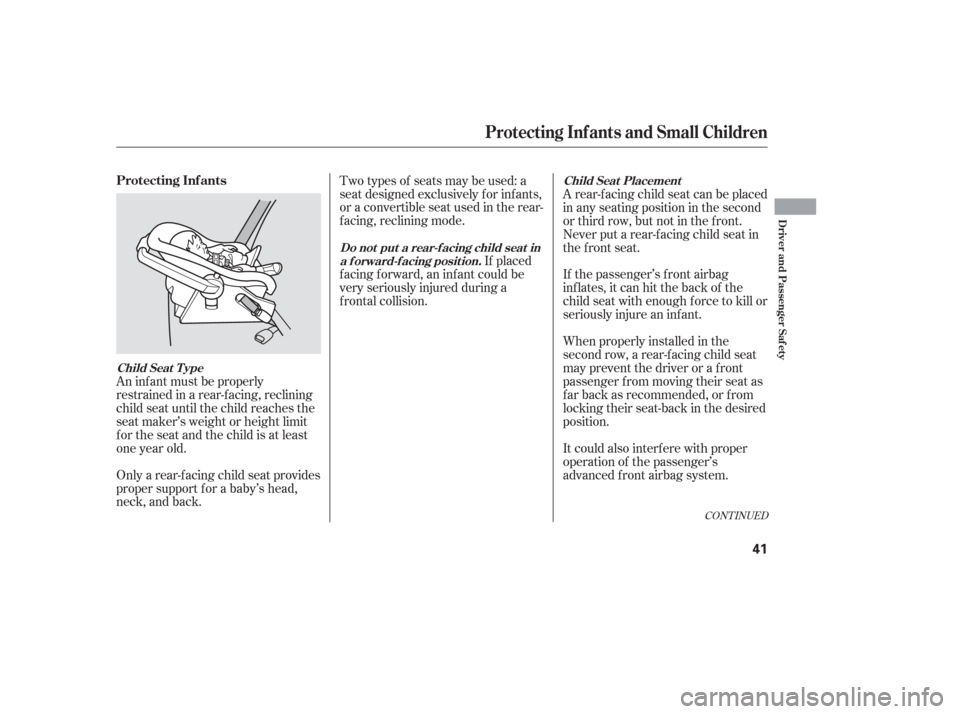
An inf ant must be properly
restrained in a rear-f acing, reclining
child seat until the child reaches the
seat maker’s weight or height limit
for the seat and the child is at least
one year old.
Only a rear-f acing child seat provides
proper support f or a baby’s head,
neck, and back.Two types of seats may be used: a
seat designed exclusively f or inf ants,
or a convertible seat used in the rear-
f acing, reclining mode.
If placed
f acing f orward, an inf ant could be
very seriously injured during a
f rontal collision. If the passenger’s front airbag
inflates, it can hit the back of the
child seat with enough f orce to kill or
seriously injure an inf ant. A rear-f acing child seat can be placed
in any seating position in the second
or third row, but not in the f ront.
Never put a rear-f acing child seat in
the front seat.
When properly installed in the
second row, a rear-f acing child seat
maypreventthedriverorafront
passenger f rom moving their seat as
f ar back as recommended, or f rom
locking their seat-back in the desired
position.
It could also interf ere with proper
operation of the passenger’s
advanced front airbag system.
CONT INUED
Protecting Inf ants
Child Seat T ype Child Seat Placement
Do not put a rear-f acing child seat in a f orward-f acing position.
Protecting Inf ants and Small Children
Driver and Passenger Saf ety
41
Page 43 of 420
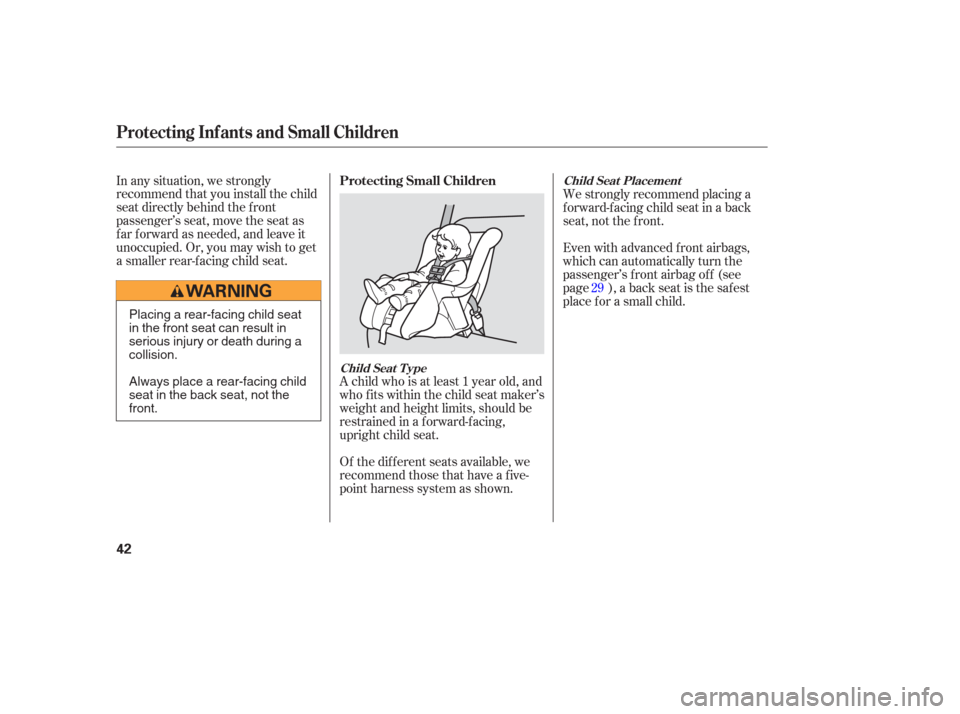
Of the different seats available, we
recommend those that have a f ive-
point harness system as shown.
In any situation, we strongly
recommend that you install the child
seat directly behind the f ront
passenger’s seat, move the seat as
f ar f orward as needed, and leave it
unoccupied. Or, you may wish to get
a smaller rear-f acing child seat.
A child who is at least 1 year old, and
who f its within the child seat maker’s
weight and height limits, should be
restrained in a f orward-f acing,
upright child seat.We strongly recommend placing a
forward-facing child seat in a back
seat, not the f ront.
Even with advanced front airbags,
which can automatically turn the
passenger’s front airbag off (see
page ), a back seat is the saf est
place f or a small child.
29
Protecting Small Children
Child Seat T ype Child Seat Placement
Protecting Inf ants and Small Children
42
Placing a rear-facing child seat
in the front seat can result in
serious injury or death during a
collision.
Always place a rear-facing child
seat in the back seat, not the
front.
Page 44 of 420
When buying a child seat, you need
to choose either a conventional child
seat, or one designed f or use with
the lower anchors and tethers for
children (LATCH) system.In seating positions and vehicles not
equipped with LATCH, a LATCH-
compatible child seat can be installed
using a seat belt. We also recommend selecting a
LATCH-compatible seat with a rigid,
rather than a f lexible, anchor (see
page ).
Conventional child seats must be
secured to a vehicle with a seat belt,
whereas LATCH-compatible seats
are secured by attaching the seat to
hardware built into the rear seating
positions.
Since LATCH-compatible child seats
are easier to install and reduce the
possibility of improper installation,
we recommend selecting this style.
If it is necessary to put a f orward-
f acing child seat in the f ront, move
the vehicle seat as far to the rear as
possible, be sure the child seat is
f irmly secured to the vehicle, and the
child is properly strapped in the seat. 45
CONT INUED
Selecting a Child Seat
Protecting Inf ants and Small Children, Selecting a Child Seat
Driver and Passenger Saf ety
43
Placing a forward-facing child
seat in the front seat can result
in serious injury or death if the
front airbag inflates.
Ifyoumustplaceaforward-
facing child seat in front, move
the vehicle seat as far back as
possible, and properly restrain
the child.
Page 53 of 420
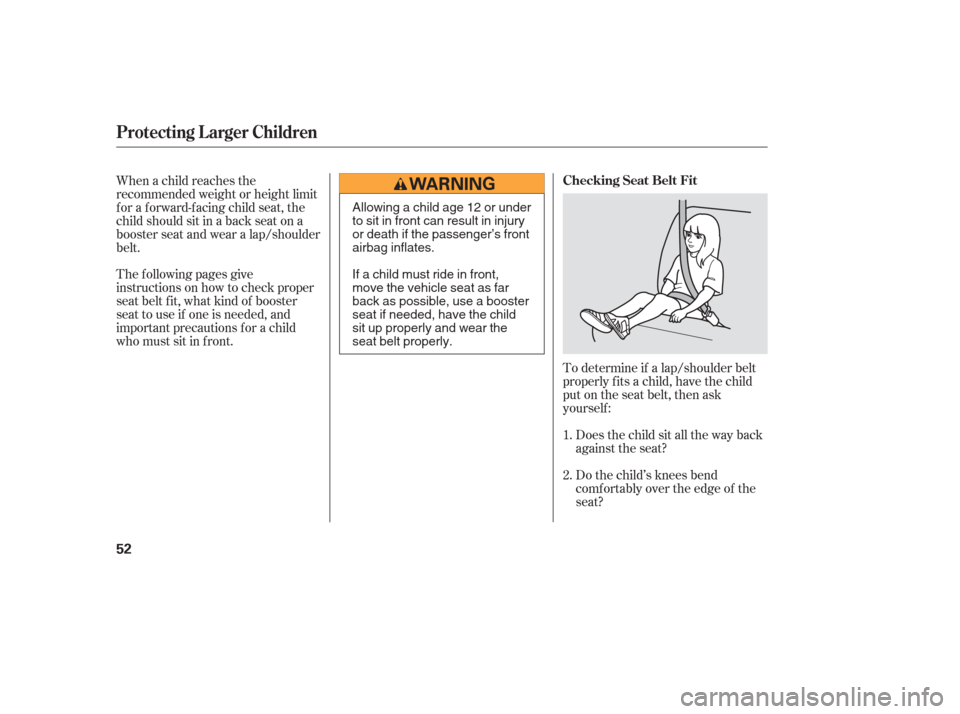
To determine if a lap/shoulder belt
properly f its a child, have the child
put on the seat belt, then ask
yourself :Does the child sit all the way back
against the seat?
Do the child’s knees bend
comf ortably over the edge of the
seat?
When a child reaches the
recommended weight or height limit
for a forward-facing child seat, the
child should sit in a back seat on a
booster seat and wear a lap/shoulder
belt.
The f ollowing pages give
instructions on how to check proper
seat belt f it, what kind of booster
seat to use if one is needed, and
important precautions f or a child
who must sit in f ront.
1.
2.
Protecting L arger Children
Checking Seat Belt Fit
52
Allowing a child age 12 or under
to sit in front can result in injury
or death if the passenger’s front
airbag inflates.
If a child must ride in front,
move the vehicle seat as far
back as possible, use a booster
seat if needed, have the child
sit up properly and wear the
seat belt properly.
Page 55 of 420
If you decide that a child can saf ely
ride up f ront, be sure to:Caref ully read the owner’s manual,
and make sure you understand all
seat belt instructions and all saf ety
inf ormation.
Move the vehicle seat to the rear-
most position.
Have the child sit up straight, back
against the seat, and feet on or
near the f loor.
Check that the child’s seat belt is
properly and securely positioned.
Supervise the child. Even mature
children sometimes need to be
reminded to f asten the seat belts
or sit properly.
To saf ely ride in f ront, a child must
be able to f ollow the rules, including
sitting properly, and wearing the seat
belt properly throughout a ride. Of course, children vary widely. And
while age may be one indicator of
when a child can saf ely ride in the
f ront, there are other important
f actors you should consider.
Physically, a child must be large
enough f or the lap/shoulder belt to
properly f it (see page ). If the seat
belt does not f it properly, with or
without the child sitting on a booster
seat, the child should not sit in f ront.
The National Highway Traffic Safety
Administration and Transport
Canada recommend that all children
age 12 and under be properly
restrained in a back seat.
If the passenger’s airbag inf lates in a
moderate to severe f rontal collision,
the airbag can cause serious injuries
to a child who is unrestrained,
improperly restrained, sitting too
close to the airbag, or out of position.
A side airbag also poses risks. If any
part of a larger child’s body is in the
path of a deploying side airbag, the
child could receive possibly serious
injuries. 52
Protecting L arger Children
Maturity
Physical Size
When Can a L arger Child Sit in
Front
54
Page 62 of 420
�Î
�Î�Î
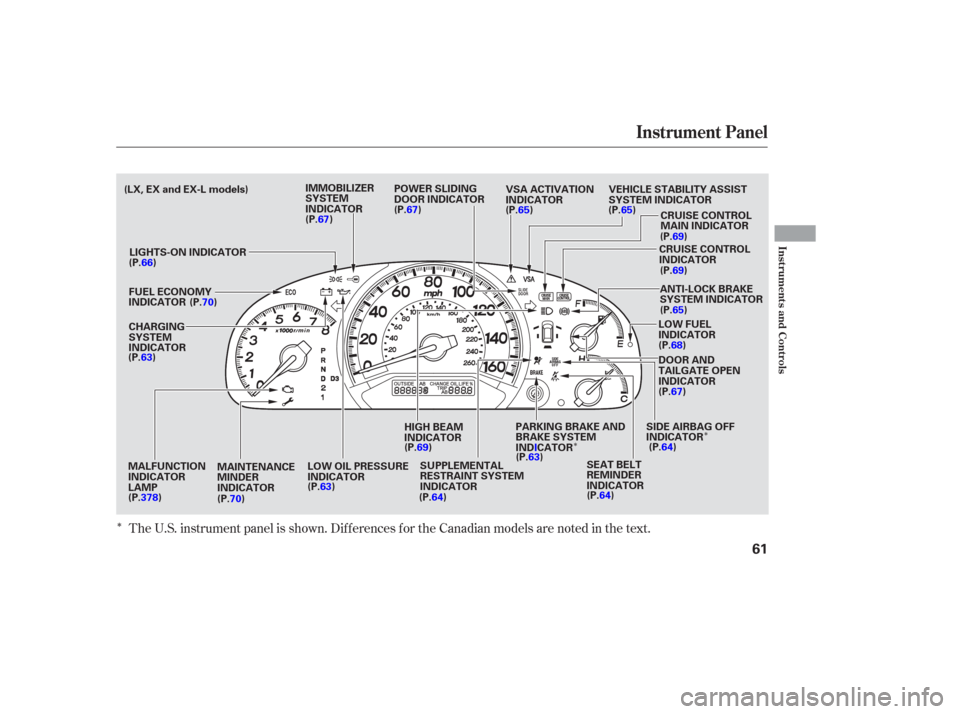
The U.S. instrument panel is shown. Dif f erences f or the Canadian models are noted in the text.
Instrument Panel
Inst rument s and Cont rols
61
SUPPLEMENTAL
RESTRAINT SYSTEM
INDICATOR
HIGH BEAM
INDICATOR
LOW OIL PRESSURE
INDICATOR
IMMOBILIZER
SYSTEM
INDICATOR
POWER SLIDING
DOOR INDICATOR
ANTI-LOCK BRAKE
SYSTEM INDICATOR
LOW FUEL
INDICATOR
DOOR AND
TAILGATE OPEN
INDICATOR
PARKING BRAKE AND
BRAKE SYSTEM
INDICATOR SEAT BELT
REMINDER
INDICATOR
CHARGING
SYSTEM
INDICATOR
CRUISE CONTROL
MAIN INDICATOR
CRUISE CONTROL
INDICATOR
LIGHTS-ON INDICATOR
SIDE AIRBAG OFF
INDICATOR
VSA ACTIVATION
INDICATOR
VEHICLE STABILITY ASSIST
SYSTEM INDICATOR
FUEL ECONOMY
INDICATOR
MALFUNCTION
INDICATOR
LAMP (P.67)
(P.67)
(P.66) (P.70)
(P.63)
(P.70) (P.63)
(P.64)
(P.69)
(P.63)
(P.64)(P.64)(P.67) (P.68)(P.69) (P.69)
(P.65)
(P.65)
(P.65)
MAINTENANCE
MINDER
INDICATOR
(LX, EX and EX-L models)
(P.378)
Page 63 of 420
�Î
�Î�Î
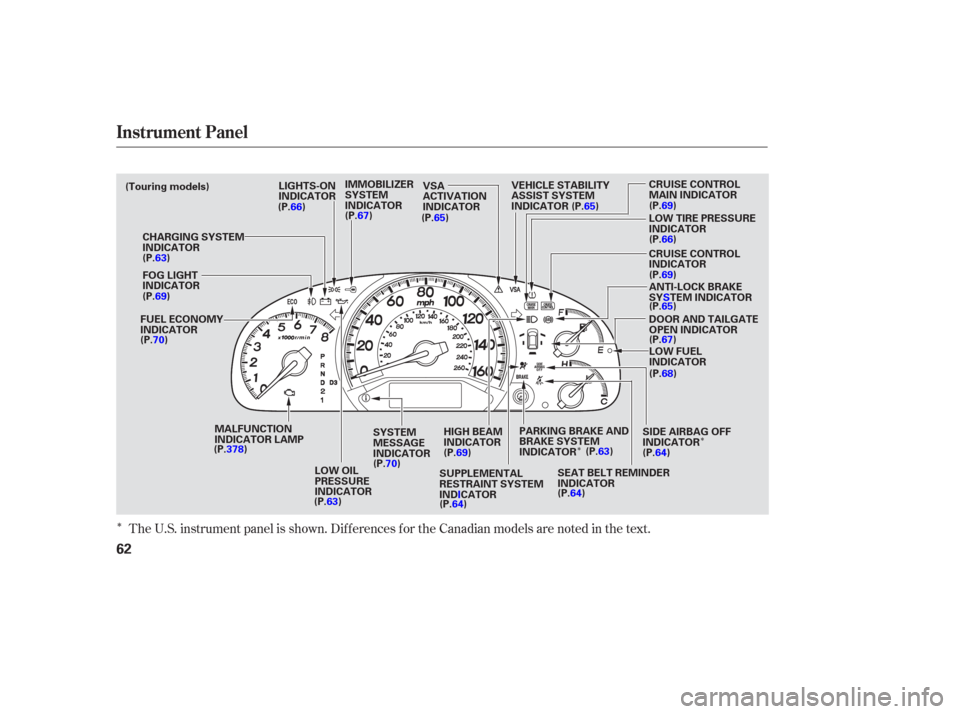
The U.S. instrument panel is shown. Dif f erences f or the Canadian models are noted in the text.
Instrument Panel
62
SEAT BELT REMINDER
INDICATORCRUISE CONTROL
INDICATOR LOW TIRE PRESSURE
INDICATOR
FOG LIGHT
INDICATOR CHARGING SYSTEM
INDICATOR
SUPPLEMENTAL
RESTRAINT SYSTEM
INDICATORCRUISE CONTROL
MAIN INDICATOR
PARKING BRAKE AND
BRAKE SYSTEM
INDICATOR
IMMOBILIZER
SYSTEM
INDICATOR
LIGHTS-ON
INDICATOR
LOW OIL
PRESSURE
INDICATOR HIGH BEAM
INDICATOR LOW FUEL
INDICATOR
DOOR AND TAILGATE
OPEN INDICATOR
VSA
ACTIVATION
INDICATOR
(Touring models)
FUEL ECONOMY
INDICATOR VEHICLE STABILITY
ASSIST SYSTEM
INDICATOR
ANTI-LOCK BRAKE
SYSTEM INDICATOR
SIDE AIRBAG OFF
INDICATOR
MALFUNCTION
INDICATOR LAMP
SYSTEM
MESSAGE
INDICATOR
(P.66)
(P.63)
(P.69)
(P.70)
(P.63)(P.70)
(P.69)
(P.64) (P.64)(P.64)
(P.63) (P.68)
(P.67)
(P.65) (P.65)
(P.69)
(P.66)
(P.69)
(P.65)
(P.67)
(P.378)