Page 64 of 234
2.8 Hydraulic Brake Actuation
2.8.1 Load Apportioning Valves
•It is not necessary or recommended to modify
the load apportioning valves, however, if a
special conversion should require modifications
–Maintain original settings
–Maintain brake certification load distribution
NOTE: For further information please contact
your local National Sales Company representative,
or Local Ford Dealer. If they are unable to help
you then please contact the Vehicle Converter
Advisory Service at [email protected].
2.8.2 Front and Rear Brakes
WARNINGS:
Do not modify the brakes
Do not modify the disc in flow and
out flow of cooling air
FordTransit 2006.5 (April 2006–)
Date of Publication: 12/2006
2 Chassis
64
Page 65 of 234
2.9 Anti-Lock Control - Stability Assist
WARNING: Do not modify any part
of the braking system, including Anti
Brake System (ABS), Traction
Control System (TCS) and
Interactive Vehicle Dynamics
(IVD)System.
NOTE: For further information please contact
your local National Sales Company
representative, or Local Ford Dealer. If they are
unable to help you then please contact the
Vehicle Converter Advisory Service at
[email protected].
FordTransit 2006.5 (April 2006–)
Date of Publication: 12/2006
2 Chassis
65
Page 75 of 234
3.2 Engine Cooling
3.2.1 Auxiliary Heater Systems
WARNINGS:
Ford coolant additives are
necessary for the complete function
of the system. Only use ford
approved or equivalent specification
component, to withstand any
detrimental effects on the materials.
Do not mount components in front
of the grille or in an area of air flow
around the engine, which could
affect the engine cooling.
CAUTIONS:
Only make connections into the
heater hose between the front cab
heater and water pump return inlet.
Do not exceed the vehicle's original
coolant volume by more than 10%
Only use the manufactures
recommended (or equivalent
specification) coolant
additives/anti-freeze. Do not mix
coolant types.
•Coolant flow to cab heater must have priority
over flow to auxiliary heater or hand wash
facility.
•Coolant tube routing must be below the base
of the degas bottle.
•Use aluminum or plastic tee junction with
swaged or beaded ends to prevent hose blow
off. Reconnect original coolant tube as shown
in view E74570 (in this section) with standard
Ford water hose clip or suitable equivalent
specification clip. Ensure interference fit
between hose and 'T' joint.
•Tube routing must be secured to the body
structure or suitable brackets avoiding
electrical components or wires, hot or moving
parts and brake or fuel system components
•Hose must be heat sleeved with appropriate
material if within 100mm of exhaust
components (for example, manifold or
exhaust gas recirculating).
•The vertical clearance between the critical
cooling components (radiator, fan shroud and
radiator brackets) and both the hood inner
and outer (assembly) panels at design position
shall not be less than 15mm.
•There shall be a minimum clearance of 7mm
between the engine assembly and flexible
components (for example, hoses or wiring
harnesses) affixed to front end sheet metal
hardware, under a maximum engine torque
roll condition.
NOTE: For further information please contact
your local National Sales Company
representative, or Local Ford Dealer. If they are
unable to help you then please contact the
Vehicle Converter Advisory service at
[email protected].
FordTransit 2006.5 (April 2006–)
Date of Publication: 12/2006
3 Powertrain
75
Page 76 of 234

Water Hoses for Auxiliary Heating System
DescriptionItem
Connector (aluminum or plastic)1
Heater hose - maintain heater fluid2
Original flow3
To ancillary equipment4
3.2.2 Auxiliary Heater Installation
For an auxiliary heating system it must be ensured
that the exhaust gas of such a system cannot be
re-circulated into the vehicle. The exhaust gases
must not pass into the engine intake system or
the air intake for the passenger compartment
ventilation. The heating system should be installed
outside the passenger compartment. The
location of the heating system should not be in
close proximity to movable components. Any
body reworks which damage the paint must be
fully protected against corrosion.
Refer to: 5.10 Corrosion Prevention (page 221).
NOTE: The installation must be in line with the
appropriate legal requirements
3.2.3 Air Flow Restrictions
WARNING: Do not mount
components in front of the grille or
in an area of air flow around the
engine, which could affect the
engine cooling performance.
CAUTION: Over heating within the
engine compartment can seriously
compromise component robustness.
NOTE: For further information please contact
your local National Sales Company representative,
or Local Ford Dealer. If they are unable to help
you then please contact the Vehicle Converter
Advisory Service at [email protected].
FordTransit 2006.5 (April 2006–)
Date of Publication: 12/2006
3 Powertrain
76E745701234
Page 83 of 234
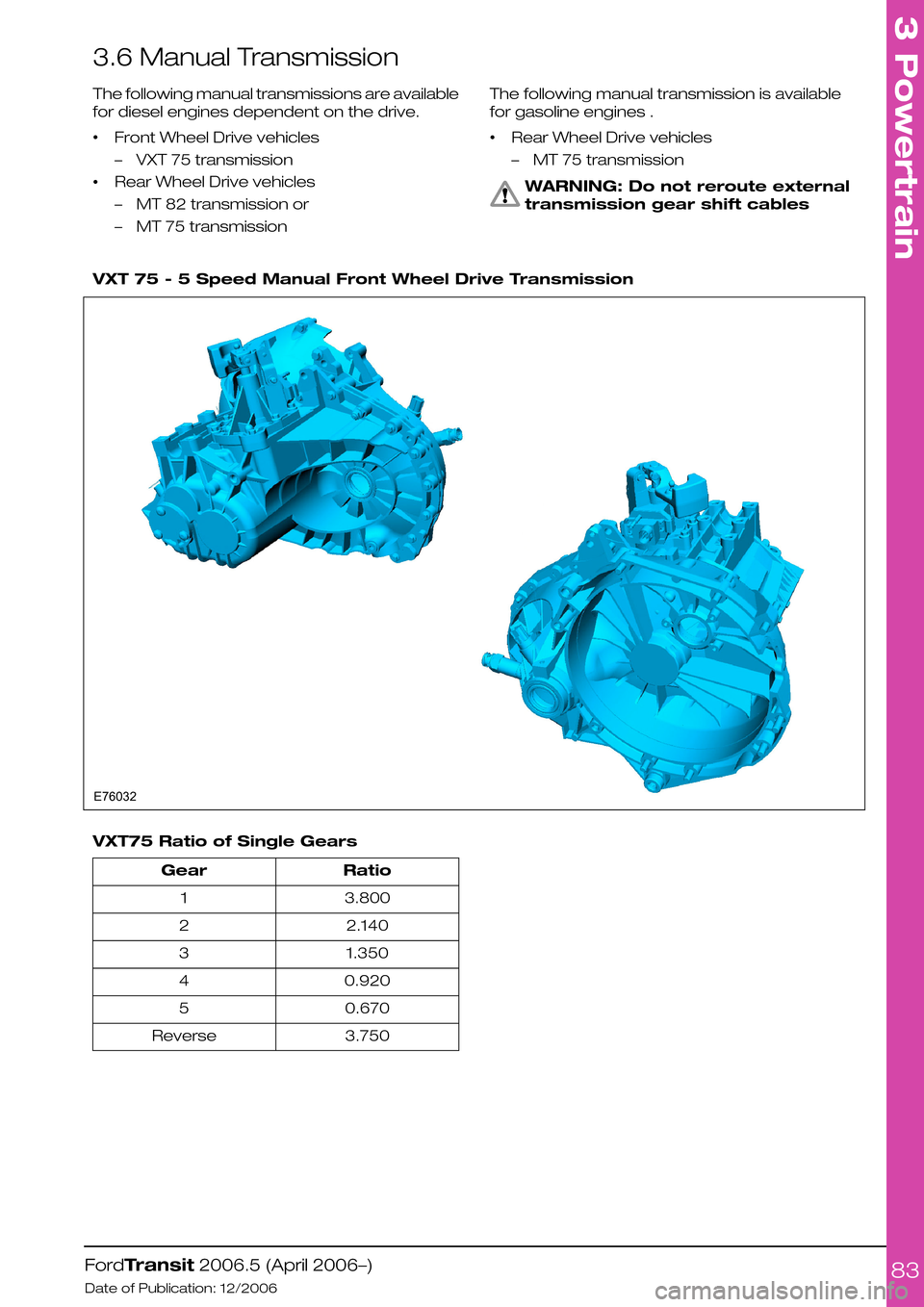
3.6 Manual Transmission
The following manual transmissions are available
for diesel engines dependent on the drive.
•Front Wheel Drive vehicles
–VXT 75 transmission
•Rear Wheel Drive vehicles
–MT 82 transmission or
–MT 75 transmission
The following manual transmission is available
for gasoline engines .
•Rear Wheel Drive vehicles
–MT 75 transmission
WARNING: Do not reroute external
transmission gear shift cables
VXT 75 - 5 Speed Manual Front Wheel Drive Transmission
VXT75 Ratio of Single Gears
RatioGear
3.8001
2.1402
1.3503
0.9204
0.6705
3.750Reverse
FordTransit 2006.5 (April 2006–)
Date of Publication: 12/2006
3 Powertrain
83E76032
Page 88 of 234

3.8 Fuel System
WARNINGS:
Do not cut into the original fuel
supply lines
Make sure that the modified vehicle
complies with all relevant legal
requirements.
For auxiliary applications requiring a fuel supply,
it is advisable to use the auxiliary fuel supply port
as shown in the figure below.
•The auxiliary fuel supply port is mounted on
the top of the fuel sender unit located on the
top of the fuel tank, for applications such as
an auxiliary heater or fuel fired hand wash
facility.
•Ensure that a suitable fuel shut-off is fitted in
any unique system.
•Refit the Ford hose assembly from the fuel
pump to the fuel line.
•The tube and/or line must be routed
independently and secured to the body
structure or to suitable brackets.
CAUTION: Make sure that sufficient
clearance is maintained for all
driving conditions to all hot and
moving components.
NOTE: Do not fasten anything to existing
electrical components or wires
FordTransit 2006.5 (April 2006–)
Date of Publication: 12/2006
3 Powertrain
88
Page 90 of 234
4.1 Communications Network
4.1.1 CAN-Bus System Description
and Interface
WARNING: Do not tamper with, cut
into or connect to any of the
CAN-Bus interface wiring or
connectors. The addition of
unapproved CAN-Based modules
could impact the safe operation of
the vehicle.
CAN uses propriety message sets to
communicate between the devices shown, via
Medium Speed (MS), High Speed (HS), Private
and Public Buses. In addition there is localised
application of LIN and ISO 9141 K-line serial links.
CAN-Bus System
DescriptionItem
High Speed CAN1
Medium Speed CAN2
Medium Speed CAN(Multimedia)3
ISO9141 K-line4
LIN BUS5
Private High Speed CAN6
FordTransit 2006.5 (April 2006–)
Date of Publication: 12/2006
4 Electrical
90BQP1RSLKMNEFGHJA23456E74853
Page 91 of 234

CAN-Bus System (Architecture)
Antilock Brake SystemKCentral Junction Box (Passenger Junction
Box)
A
Powertrain Control ModuleLVoice Recognition Module/Wireless
connection (blue tooth)
B
Steering Angle SensorMAudio Control Unit (Radio/CD)C*
Yaw Rate SensorNNavigation (Radio/CD)D*
Diagnostic ConnectorPRemote Keyless EntryE
Park Aid ModeQPassive Anti-Theft SystemF
Restraints Control ModuleRRain SensorG
Hybrid Electronic ClusterSBattery Backed Sounder (BBS)H
Interior Motion Sensing (IMS)J
* Either Audio Control Unit or Navigation
4.1.2 Central Junction Box (CJB)
WARNING: Unapproved and/or
incorrect connection to any of the
mating wiring can cause either the
associated systems to shut down
(overload protection), or permanent
damage to the Central Junction Box
itself.
Basic vehicle functions (for example: headlights,
front wipers) are available on all Central Junction
Boxes (CJBs). Increased vehicle features are
available on the mid- and high-level CJBs, as per
the following list:
Incremental FunctionalityCentral Junction Box (CJB)
6C1T-14A073-A_ (low)
(in addition to low level CJB)6C1T-14A073-B_ (mid)
Reverse CyclingRemote Keyless Entry
Slam LockingVIN Identification
Front Fog LightsPerimeter Alarm
Theatre Dimming (Interior Lights)Central and double Locking
Heated WindscreenZonal unlocking
Heated MirrorsAuto Locking on drive away
Rear WipersAuto Relocking on time out
Heated Rear Window(s)Crash Activated unlocking
Mis-locking feedback (audible
and visual)
(in addition to mid-level CJB)6C1T-14A073-C_ (high)
Ambient air temperature meas-
urement
Battery Backed Sounder (BBS)
Rain SensorInterior Motion Sensor (IMS)
Daytime Running LightsZonal opposite door relocking
AutolampsConfigurable unlocking
Fuel Pump Control (petrol only)CAT 1 Alarm (BBS, IMS & Rear
Glass Breakage)
Cruise control
FordTransit 2006.5 (April 2006–)
Date of Publication: 12/2006
4 Electrical
91