Page 111 of 198
Downloaded from www.Manualslib.com manuals search engine MANUAL TRANSMISSION
WARNINGS
Engage reverse gear only whenthe vehicle is stationary.
Do not apply any undue lateralforce to the gear lever whenchanging from 5th to 4th gear as thiscould lead to the inadvertentselection of 2nd gear.
To avoid shifting noises whenengaging the reverse gear, waitapproximately three seconds withthe clutch depressed when thevehicle is stationary.
Vehicles with 1.8 l Duratec-SCi enginereach the maximum speed only infifth gear.
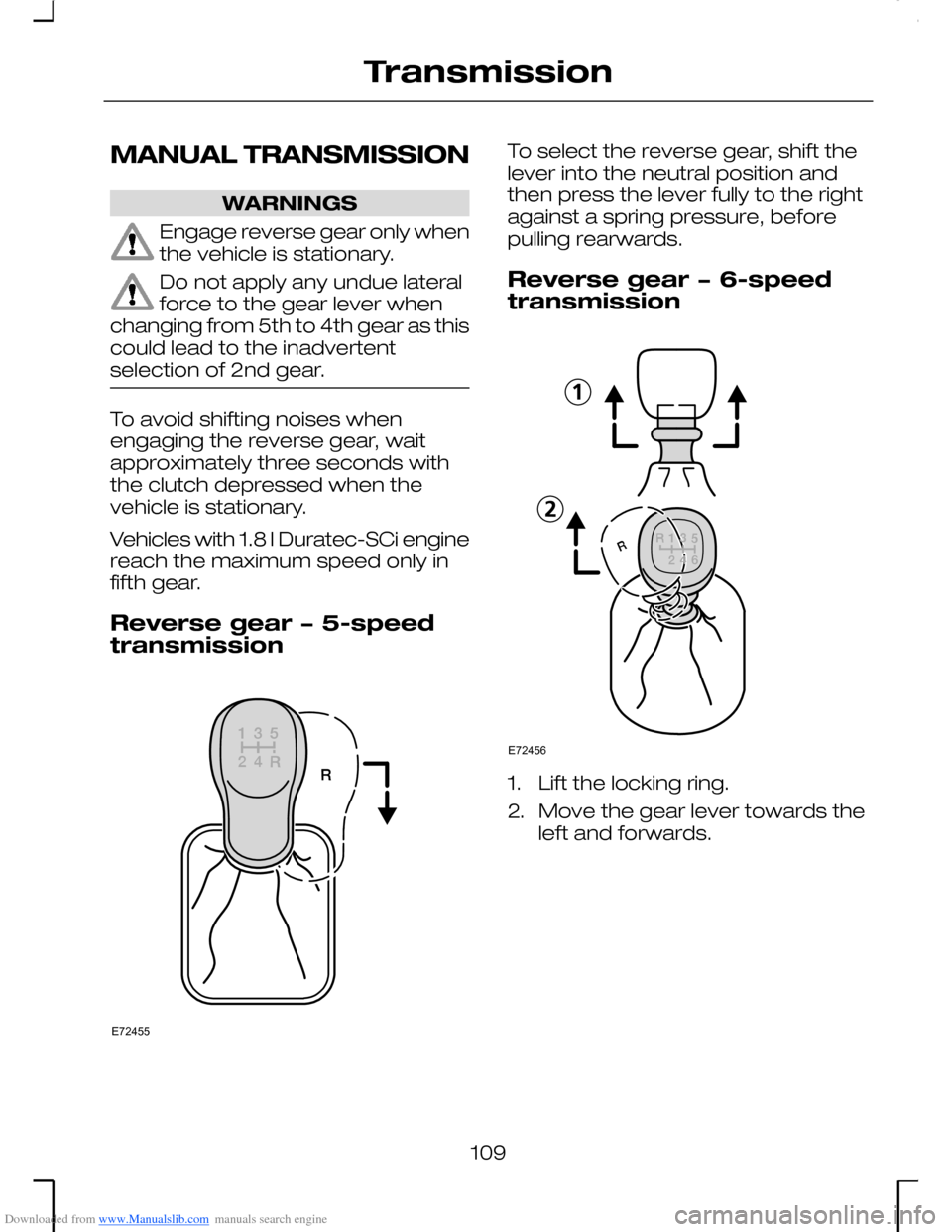
Reverse gear − 5-speedtransmission
To select the reverse gear, shift thelever into the neutral position andthen press the lever fully to the rightagainst a spring pressure, beforepulling rearwards.
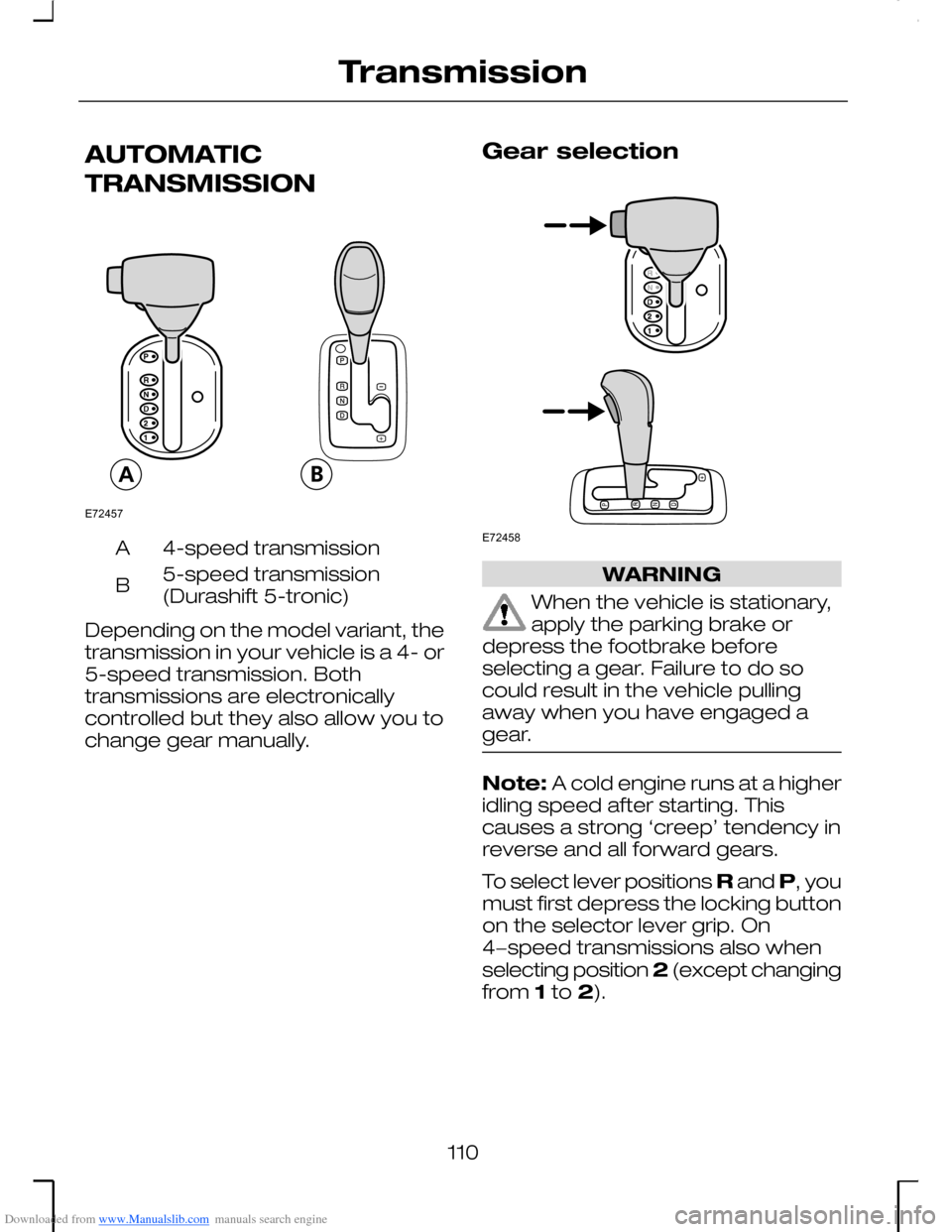
Reverse gear − 6-speedtransmission
1.Lift the locking ring.
2.Move the gear lever towards theleft and forwards.
109
TransmissionE72455 E72456
Page 112 of 198
Downloaded from www.Manualslib.com manuals search engine AUTOMATIC
TRANSMISSION
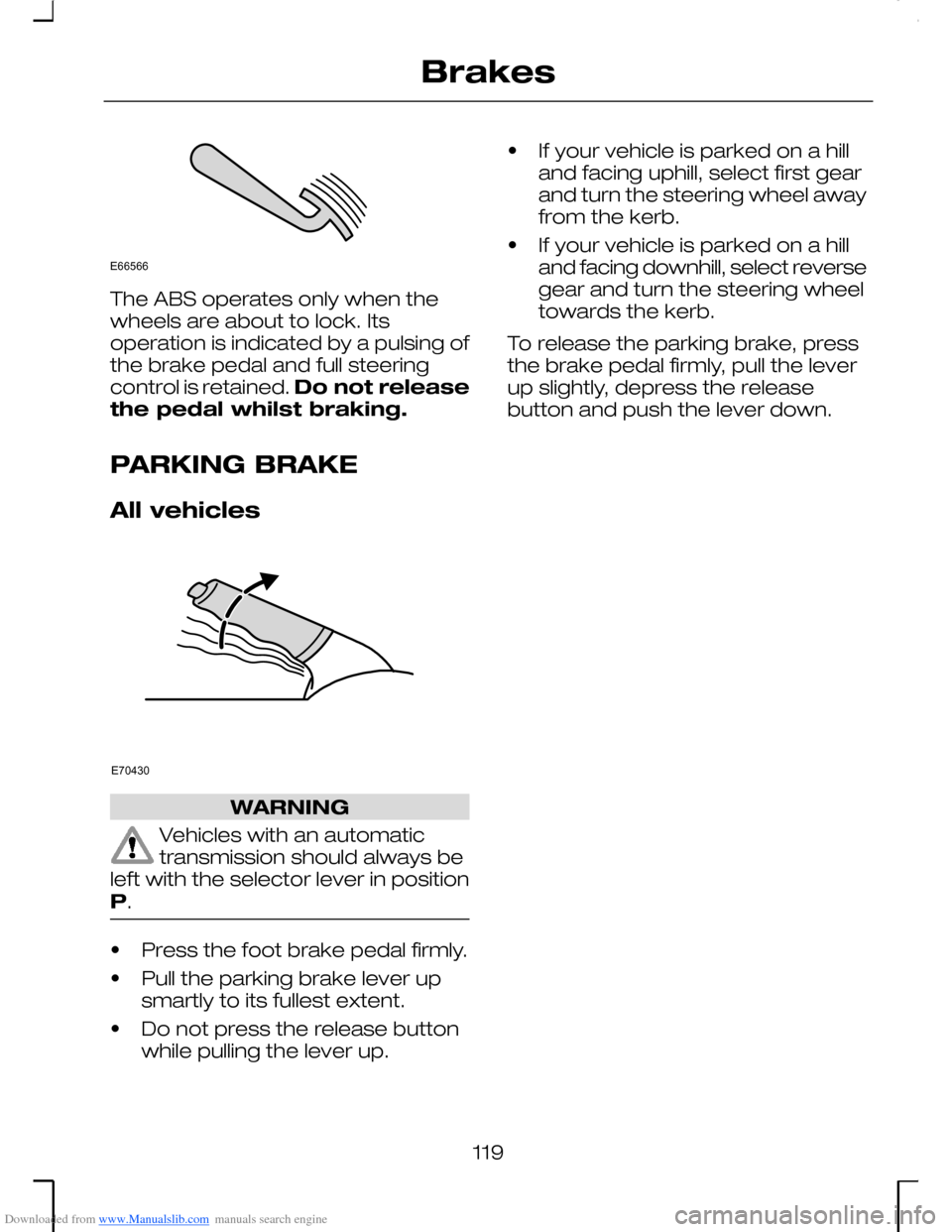
4-speed transmissionA
5-speed transmission(Durashift 5-tronic)B
Depending on the model variant, thetransmission in your vehicle is a 4- or5-speed transmission. Bothtransmissions are electronicallycontrolled but they also allow you tochange gear manually.
Gear selection
WARNING
When the vehicle is stationary,apply the parking brake ordepress the footbrake beforeselecting a gear. Failure to do socould result in the vehicle pullingaway when you have engaged agear.
Note: A cold engine runs at a higheridling speed after starting. Thiscauses a strong ‘creep’ tendency inreverse and all forward gears.
To select lever positions R and P, youmust first depress the locking buttonon the selector lever grip. On4−speed transmissions also whenselecting position 2 (except changingfrom 1 to 2).
110
TransmissionE72457 E72458
Page 113 of 198
Downloaded from www.Manualslib.com manuals search engine P = Park
WARNINGS
This position should be selectedonly when the vehicle isstationary.
Always apply the parking brakeand make sure that the selectorlever is securely latched in P. Turn offthe ignition whenever you leave thevehicle.
If position P is not selected, awarning chime will sound whenthe driver’s door is opened.
In this position, the transmission islocked.
The engine should be started withthe selector lever in position P. Ifnecessary, it can also be started inposition N.
After starting the engine, the levercan be moved out of this positiononly when the foot brake isdepressed and the lockingbutton pressed in.
R = Reverse
WARNING
This position should be selectedonly when the vehicle isstationary and the engine is idling.
Depress the brake pedal whenselecting R.
N = Neutral
WARNING
In this position, you have todepress the brake pedal orapply the parking brake to preventthe vehicle from moving.
In this position no power istransmitted to the drive wheels.
D = Drive
This is the normal driving position.When the brake is released, thevehicle will creep. All forward gearsare selected automatically dependingon driving conditions.
+/− = Gears 1−5 (5-speedtransmission)
When shifting manually, gears 1, 2,3, 4 and 5 can be selected.
2 = Gear 2 (4-speedtransmission)
The transmission remainspermanently in second gear. Thisposition should be selected on downhill gradients to avoid unnecessaryuse of the brakes, and on long uphillgradients and twisty roads. It can alsobe used for initial start-off on icyroads.
111
TransmissionE66565
Page 120 of 198
Downloaded from www.Manualslib.com manuals search engine PRINCIPLE OF
OPERATION
Dual circuit braking system
WARNING
If a brake circuit fails, you will atfirst experience a softer feel tothe brake pedal. You will then needto exert a greater force on the brakepedal, and make allowance forincreased stopping distances. Havethe braking system checked by anexpert before continuing yourjourney.
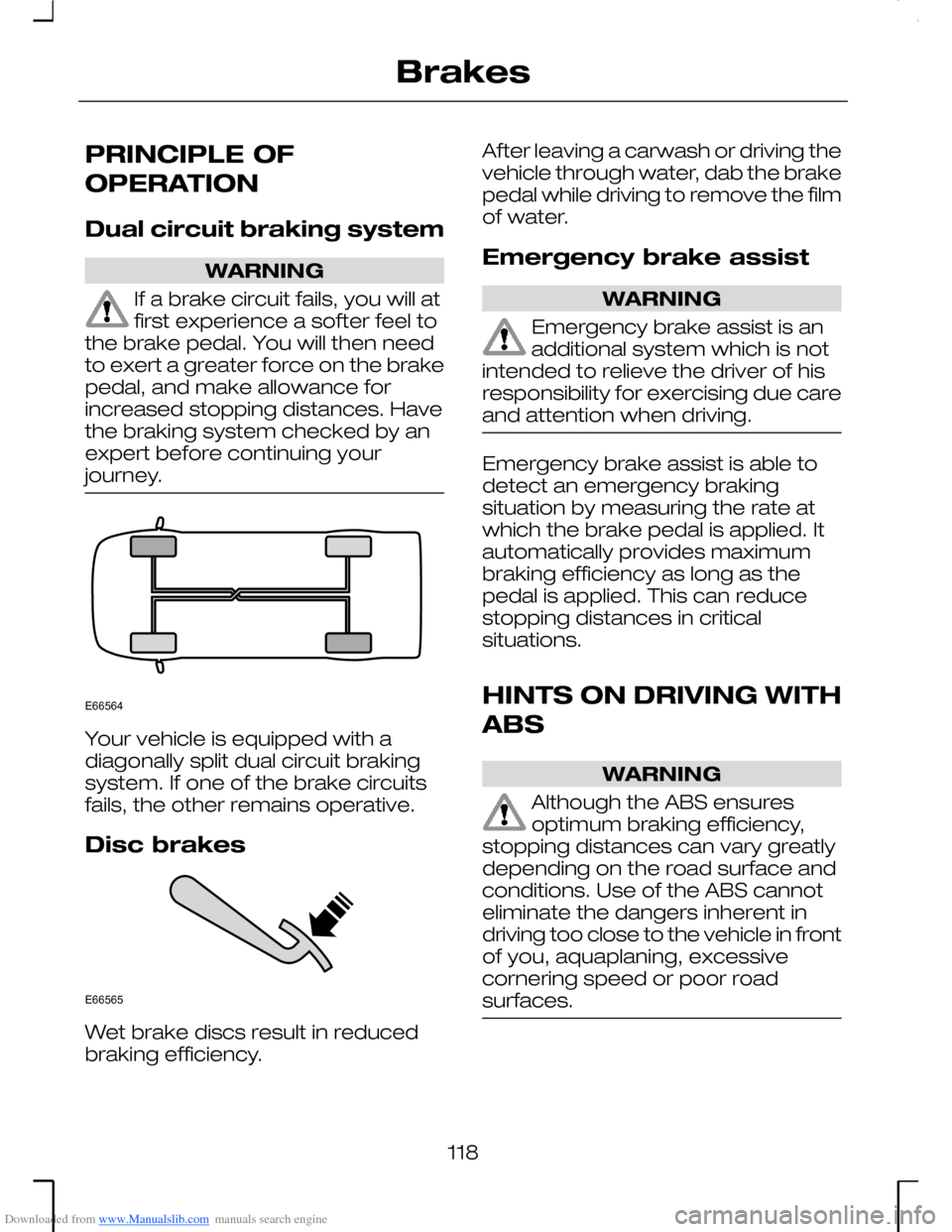
Your vehicle is equipped with adiagonally split dual circuit brakingsystem. If one of the brake circuitsfails, the other remains operative.
Disc brakes
Wet brake discs result in reducedbraking efficiency.
After leaving a carwash or driving thevehicle through water, dab the brakepedal while driving to remove the filmof water.
Emergency brake assist
WARNING
Emergency brake assist is anadditional system which is notintended to relieve the driver of hisresponsibility for exercising due careand attention when driving.
Emergency brake assist is able todetect an emergency brakingsituation by measuring the rate atwhich the brake pedal is applied. Itautomatically provides maximumbraking efficiency as long as thepedal is applied. This can reducestopping distances in criticalsituations.
HINTS ON DRIVING WITH
ABS
WARNING
Although the ABS ensuresoptimum braking efficiency,stopping distances can vary greatlydepending on the road surface andconditions. Use of the ABS cannoteliminate the dangers inherent indriving too close to the vehicle in frontof you, aquaplaning, excessivecornering speed or poor roadsurfaces.
118
BrakesE66564 E66565
Page 121 of 198
Downloaded from www.Manualslib.com manuals search engine The ABS operates only when thewheels are about to lock. Itsoperation is indicated by a pulsing ofthe brake pedal and full steeringcontrol is retained. Do not releasethe pedal whilst braking.
PARKING BRAKE
All vehicles
WARNING
Vehicles with an automatictransmission should always beleft with the selector lever in positionP.
•Press the foot brake pedal firmly.
•Pull the parking brake lever upsmartly to its fullest extent.
•Do not press the release buttonwhile pulling the lever up.
•If your vehicle is parked on a hilland facing uphill, select first gearand turn the steering wheel awayfrom the kerb.
•If your vehicle is parked on a hilland facing downhill, select reversegear and turn the steering wheeltowards the kerb.
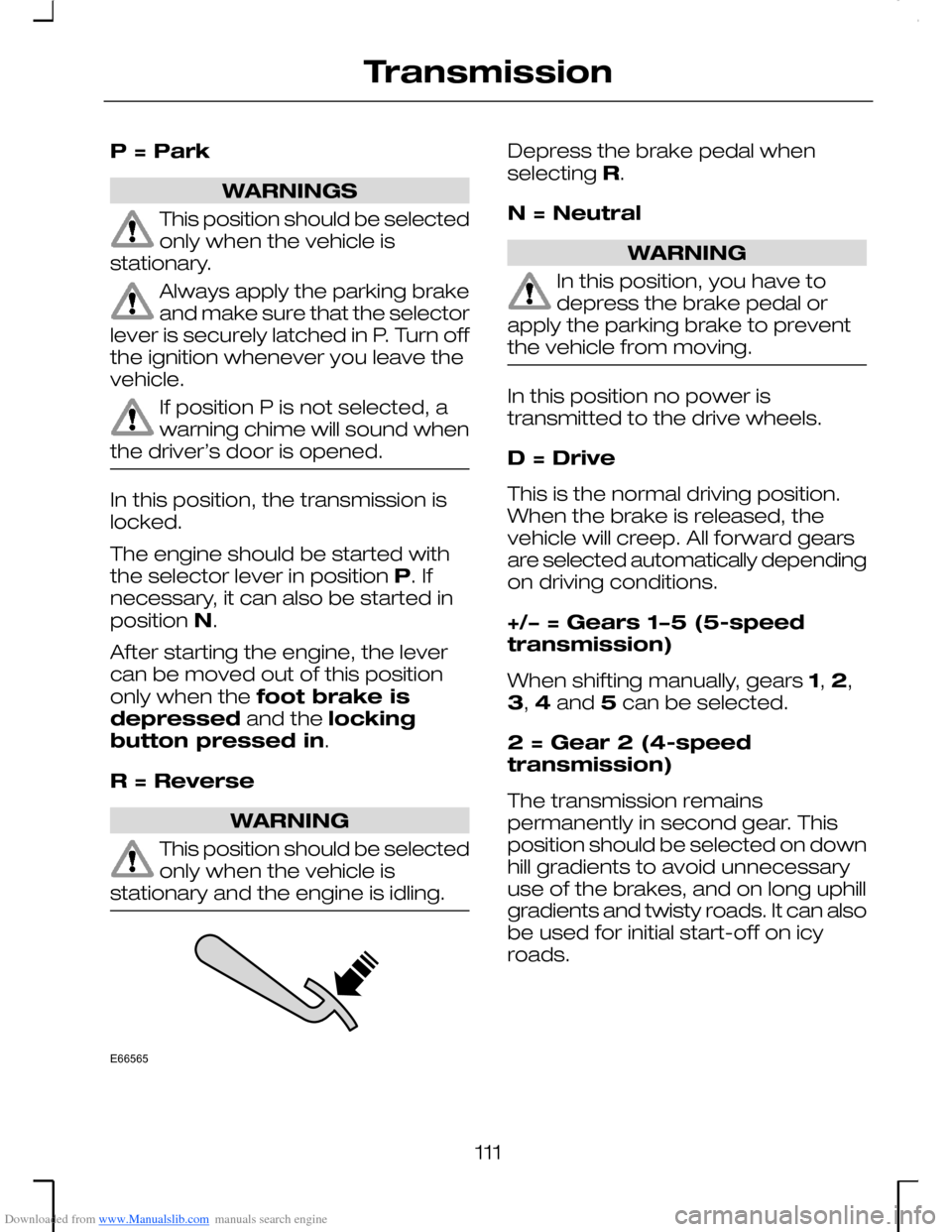
To release the parking brake, pressthe brake pedal firmly, pull the leverup slightly, depress the releasebutton and push the lever down.
119
BrakesE66566 E70430
Page 122 of 198
Downloaded from www.Manualslib.com manuals search engine PRINCIPLE OF
OPERATION
Electronic stability program(ESP)
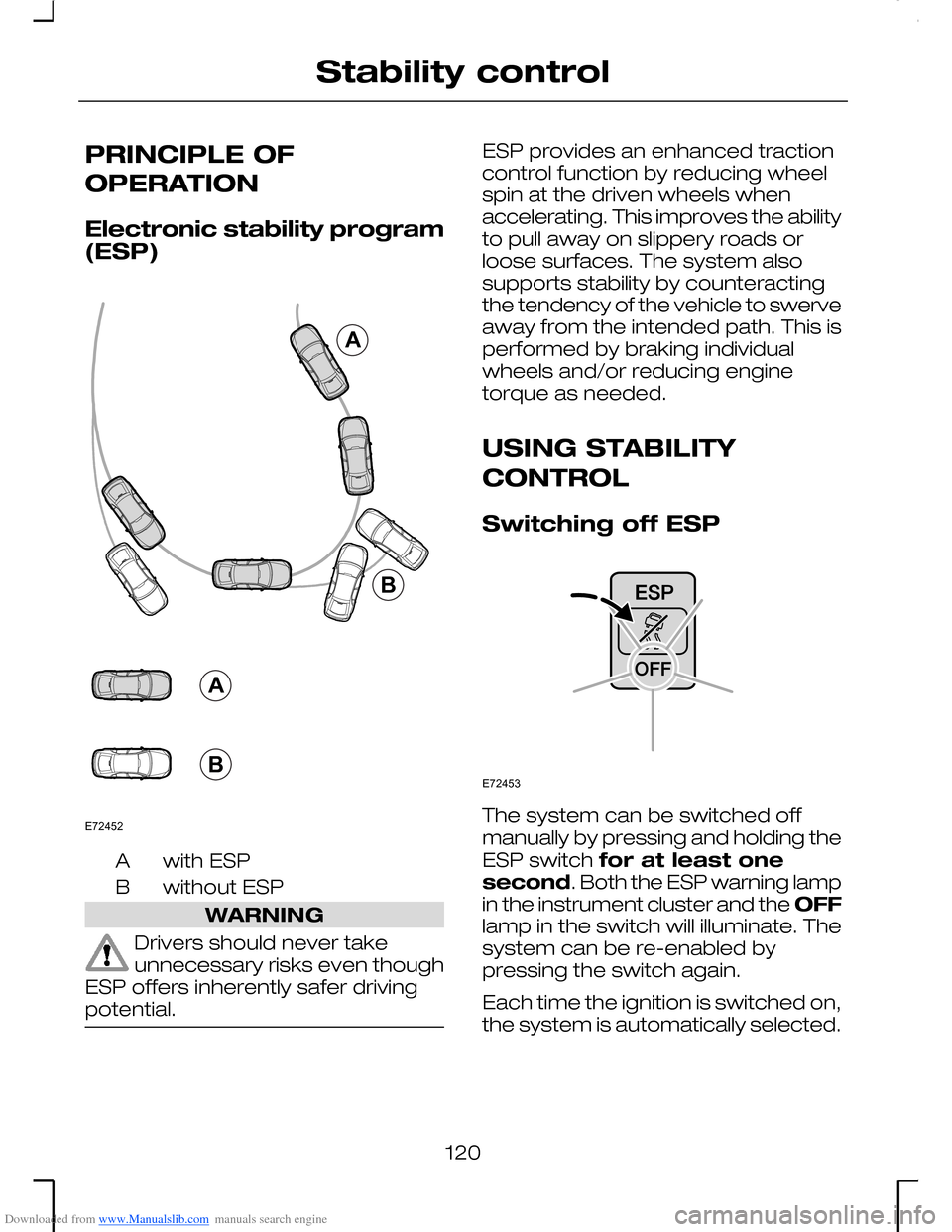
with ESPA
without ESPB
WARNING
Drivers should never takeunnecessary risks even thoughESP offers inherently safer drivingpotential.
ESP provides an enhanced tractioncontrol function by reducing wheelspin at the driven wheels whenaccelerating. This improves the abilityto pull away on slippery roads orloose surfaces. The system alsosupports stability by counteractingthe tendency of the vehicle to swerveaway from the intended path. This isperformed by braking individualwheels and/or reducing enginetorque as needed.
USING STABILITY
CONTROL
Switching off ESP
The system can be switched offmanually by pressing and holding theESP switch for at least onesecond. Both the ESP warning lampin the instrument cluster and the OFFlamp in the switch will illuminate. Thesystem can be re-enabled bypressing the switch again.
Each time the ignition is switched on,the system is automatically selected.
120
Stability controlAABBE72452 E72453
Page 123 of 198
Downloaded from www.Manualslib.com manuals search engine PRINCIPLE OF
OPERATION
WARNING
Drivers should never takeunnecessary risks even thoughthe system offers inherently saferdriving potential.
The system reduces wheel spin atthe driven wheels at speeds up to 40km/h (25 mph).
The system may become activewhen accelerating on a slippery roador loose surface, or when pullingaway on a hill.
USING TRACTION
CONTROL
Note: If the indicator lamp does notilluminate when the ignition isswitched on or stays illuminatedwhilst driving, it indicates amalfunction. During a malfunction thesystem will be switched off. Have thesystem checked by an expert.
When the ignition is switched on(position II), the system isautomatically enabled and the lampin the switch illuminates briefly toconfirm that the system isoperational.
When the traction control system isactivated, as indicated by the flashingindicator lamp, reduce engine speedimmediately. Otherwise vehicledamage might occur, particularly onlow friction surfaces such as snow orice.
Switching off the BTCS
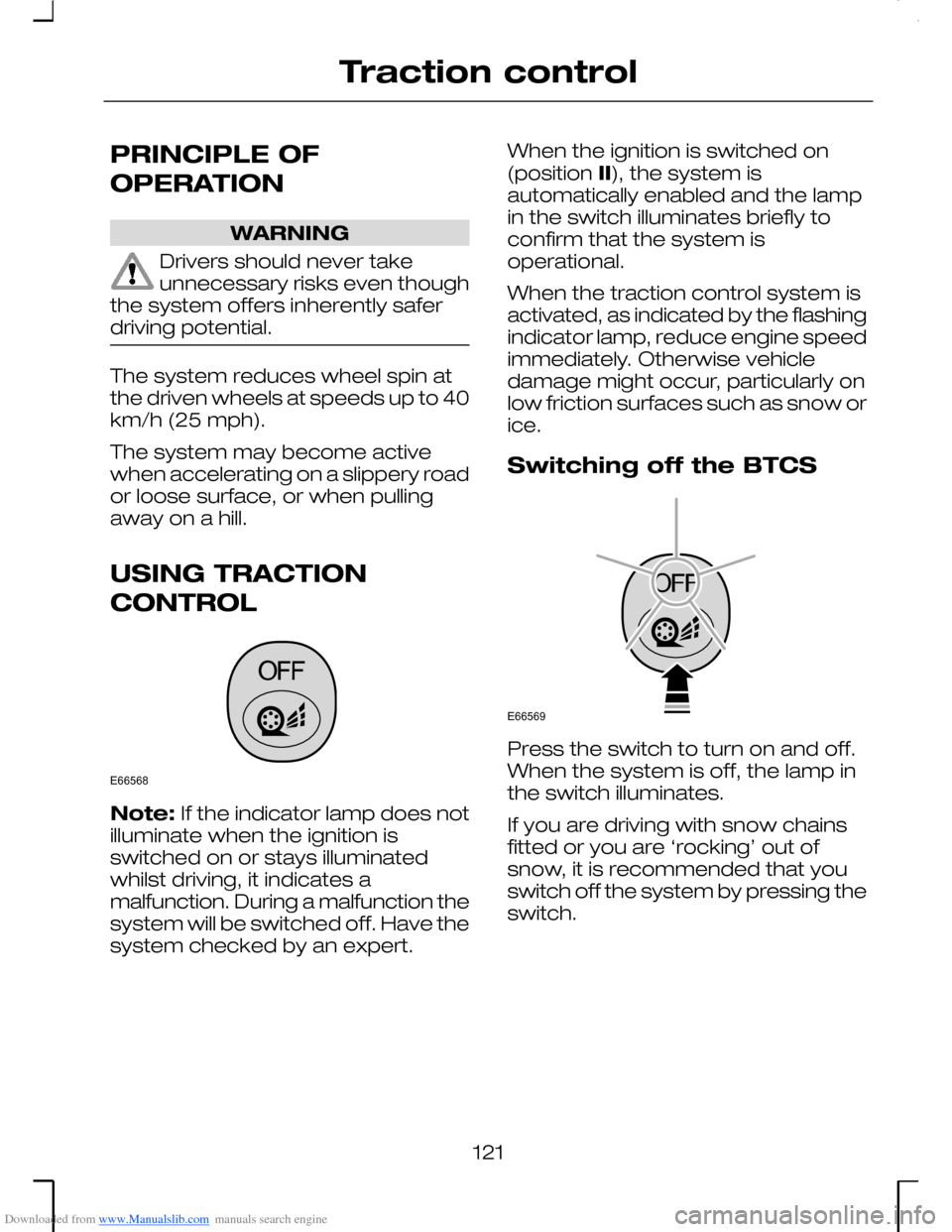
Press the switch to turn on and off.When the system is off, the lamp inthe switch illuminates.
If you are driving with snow chainsfitted or you are ‘rocking’ out ofsnow, it is recommended that youswitch off the system by pressing theswitch.
121
Traction controlE66568 E66569
Page 125 of 198
Downloaded from www.Manualslib.com manuals search engine PRINCIPLE OF
OPERATION
WARNING
The parking aid is an auxiliarysystem which is not intended torelieve the driver of his responsibilityfor exercising due care and attentionwhen reversing. In particular, someobjects close to the vehicle (approx.30 cm) and above or below thesensors may not be detected by thepark distance sensor and causedamage to the vehicle. Ultrasonicwaves, heavy rain and/or conditionscausing disruptive reflections maylead to objects not being detectedby the sensors. In addition, objectswhich absorb ultrasonic waves maynot always be detected due to theirunfavourable surface characteristics.
USING THE PARKING AID
WARNING
Be careful when a tow bar isinstalled.
Note: If the vehicle is fitted with anoriginal Ford fixed tow bar, particularcare must be taken when reversing.
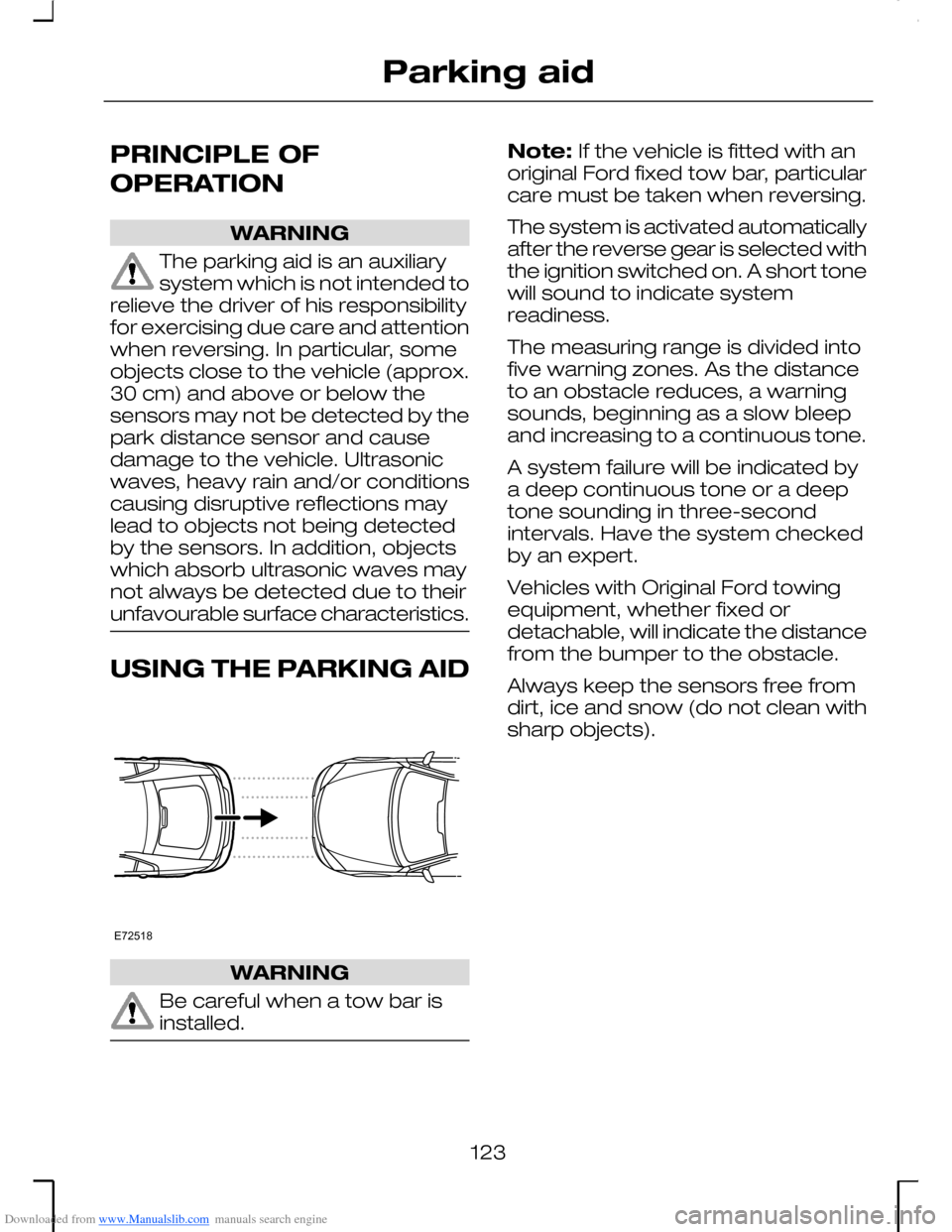
The system is activated automaticallyafter the reverse gear is selected withthe ignition switched on. A short tonewill sound to indicate systemreadiness.
The measuring range is divided intofive warning zones. As the distanceto an obstacle reduces, a warningsounds, beginning as a slow bleepand increasing to a continuous tone.
A system failure will be indicated bya deep continuous tone or a deeptone sounding in three-secondintervals. Have the system checkedby an expert.
Vehicles with Original Ford towingequipment, whether fixed ordetachable, will indicate the distancefrom the bumper to the obstacle.
Always keep the sensors free fromdirt, ice and snow (do not clean withsharp objects).
123
Parking aidE72518