Page 146 of 198
Downloaded from www.Manualslib.com manuals search engine GENERAL INFORMATION
WARNINGS
The electronic ignition systemworks with high voltage. Nevertouch these components with theengine running or the ignitionswitched on.
The ignition must be switchedoff before working in the enginecompartment. Under some operatingconditions, the cooling system fanmay continue to run for severalminutes after the engine has beenswitched off. This is quite normal.Take care not to get any fingers orclothing such as ties or scarvescaught in the fan.
•Check and top up fluid levelsregularly.
•Check tyre pressure.
•Check brakes and lamps areoperating correctly.
•Check warning and indicatorlamps.
Every day check
•Operation of all exterior andinterior lamps and make sure thatall lenses are clean.
When filling up check
•Engine oil level
•Brake fluid level
•Washer fluid level
•Tyre pressures and condition (onlywhen cold)
Once a month check
•Coolant level (engine cold)
•Assemblies, pipes, hoses andreservoirs for leaks
•Power steering fluid level
•Operation of the air conditioning
•Operation of the parking brake
•Operation of the horn
144
Maintenance
Page 151 of 198
Downloaded from www.Manualslib.com manuals search engine OPENING AND CLOSING
THE BONNET
Opening the bonnet
WARNING
Remove the key immediatelyafter opening the bonnet.
The bonnet must be opened fromthe outside.
Swivel the Ford badge in the radiatorgrille to the side. Insert the key in thelock on the radiator grille.
Turn the key first anticlockwise 1.Raise the bonnet slightly and turn thekey fully clockwise 2 to open thebonnet. It is held by gas filled liftcylinders.
Closing the bonnet
To close, lower the bonnet and allowit to drop into the catch for the last20 – 30 cm.
Always check to ensure that thebonnet lock is fully engaged.
ENGINE OIL CHECK
WARNING
Do not use oil additives or otherengine treatments. They areunnecessary and could, undercertain conditions, lead to enginedamage which is not covered byFord Warranty.
The oil consumption of new enginesreaches the normal value only afterapproximately 5 000 km (3 000miles).
149
MaintenanceE73406 E73407
Page 154 of 198
Downloaded from www.Manualslib.com manuals search engine WARNING
To avoid scalding, never removethe cap from the coolantreservoir when the engine is hot. Donot restart the engine until theproblem has been eliminated.
The coolant level is visible throughthe translucent reservoir. The coolantlevel should be between the MINand the MAX mark when the engineis cold. Hot coolant expands andmay, therefore, extend beyond theMAX mark.
WARNING
Take great care when addingcoolant. Avoid spillage on anypart of the engine.
The coolant should be added whenthe engine is cold. If coolant has tobe added when the engine is hot, firstwait 10 minutes for the engine tocool. Unscrew the cap slowly. Anypressure will escape while you areturning the cap. Fully remove the cap.
WARNING
Do not allow this fluid to makecontact with the skin or eyes. Ifthis should happen rinse the affectedareas immediately with plenty ofwater and contact your doctor.
When the vehicle is new, the coolingsystem is filled with coolant whichoffers anti−freeze protection downto approximately –25 ºC.
Add coolant that meets the FordSpecification.
AUTOMATIC
TRANSMISSION FLUID
CHECK
Your dealer checks the fluid level inthe automatic transmission whencarrying out routine maintenancework on your vehicle.
BRAKE AND CLUTCH
FLUID CHECK
WARNING
Do not allow this fluid to makecontact with the skin or eyes. Ifthis should happen rinse the affectedareas immediately with plenty ofwater and contact your doctor.
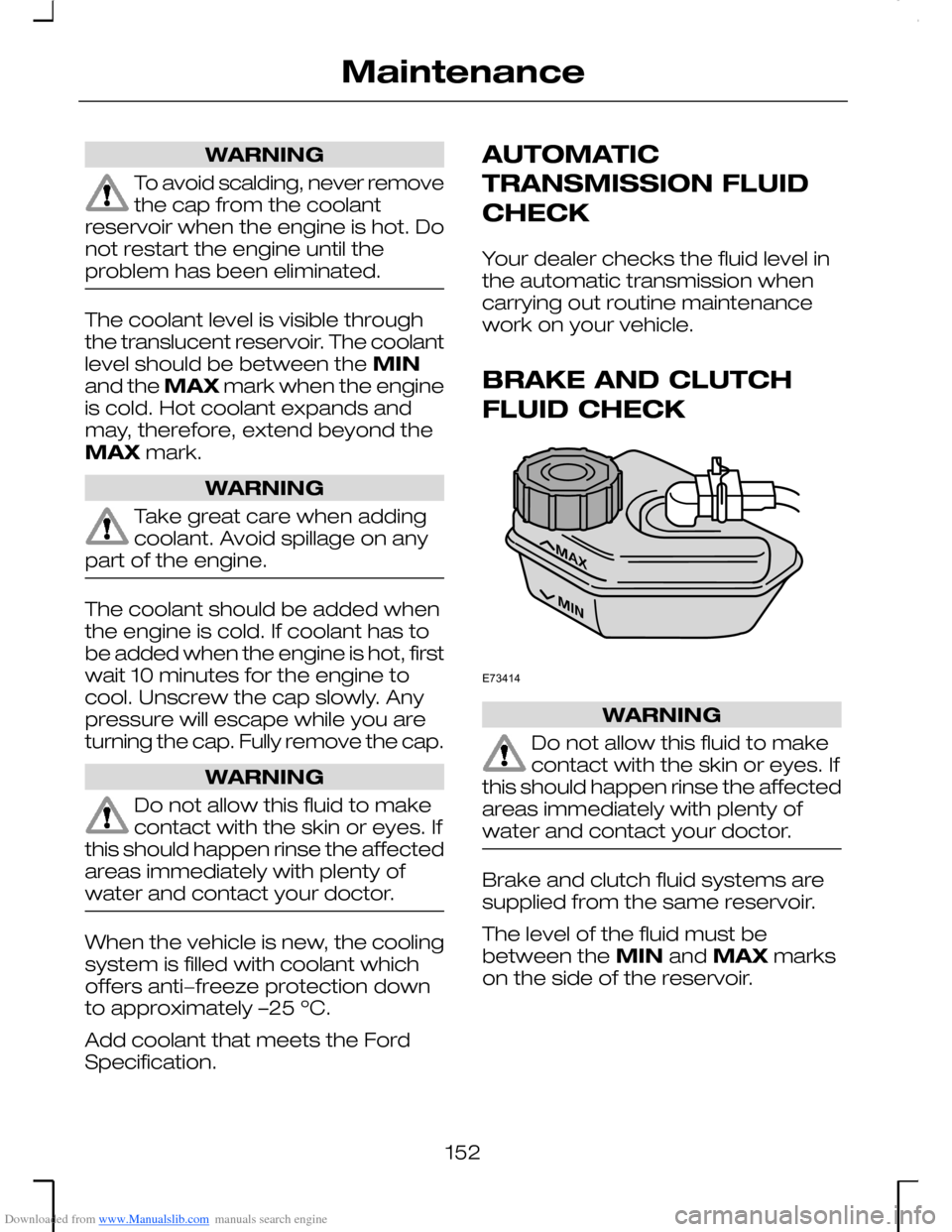
Brake and clutch fluid systems aresupplied from the same reservoir.
The level of the fluid must bebetween the MIN and MAX markson the side of the reservoir.
152
MaintenanceE73414
Page 158 of 198
Downloaded from www.Manualslib.com manuals search engine CLEANING THE
EXTERIOR
WARNINGS
In installations operating withhigh water pressure, watermight be forced into the vehicle’sinterior or parts may get damaged.
Unscrew and remove the radioaerial before entering anautomatic car wash. Switch off theheater blower to preventcontamination of the fresh air filter.
The best procedure is brushlesswashing in a good car washinstallation.
If a waxing cycle is selected, pleaseensure that the wax is removed fromthe windscreen afterwards.
Cleaning the headlamps
To avoid damaging the clear plasticheadlamp lens do not use aggressiveabrasives or chemical solvents. Donot wipe the headlamps when theyare dry or use sharp objects to cleanthe lenses.
Cleaning the rear window
To avoid damaging the heatingelements when cleaning the insideof the rear window use only a softcloth or a damp chamois leather. Donot use solvent or sharp objects toclean the glass.
Body paintworkpreservation
WARNING
When polishing your vehicleensure that polish does notcome into contact with the plasticsurfaces as it may prove difficult toremove. Do not polish the vehicle instrong sunshine.
Wax the body paintwork of yourvehicle once or twice a year. This willhelp retain the glossy paintwork finishand water droplets will run off moreeasily.
Do not apply polish to windscreen orrear window, as this may result inpoor or noisy wiper action.
CLEANING THE INTERIOR
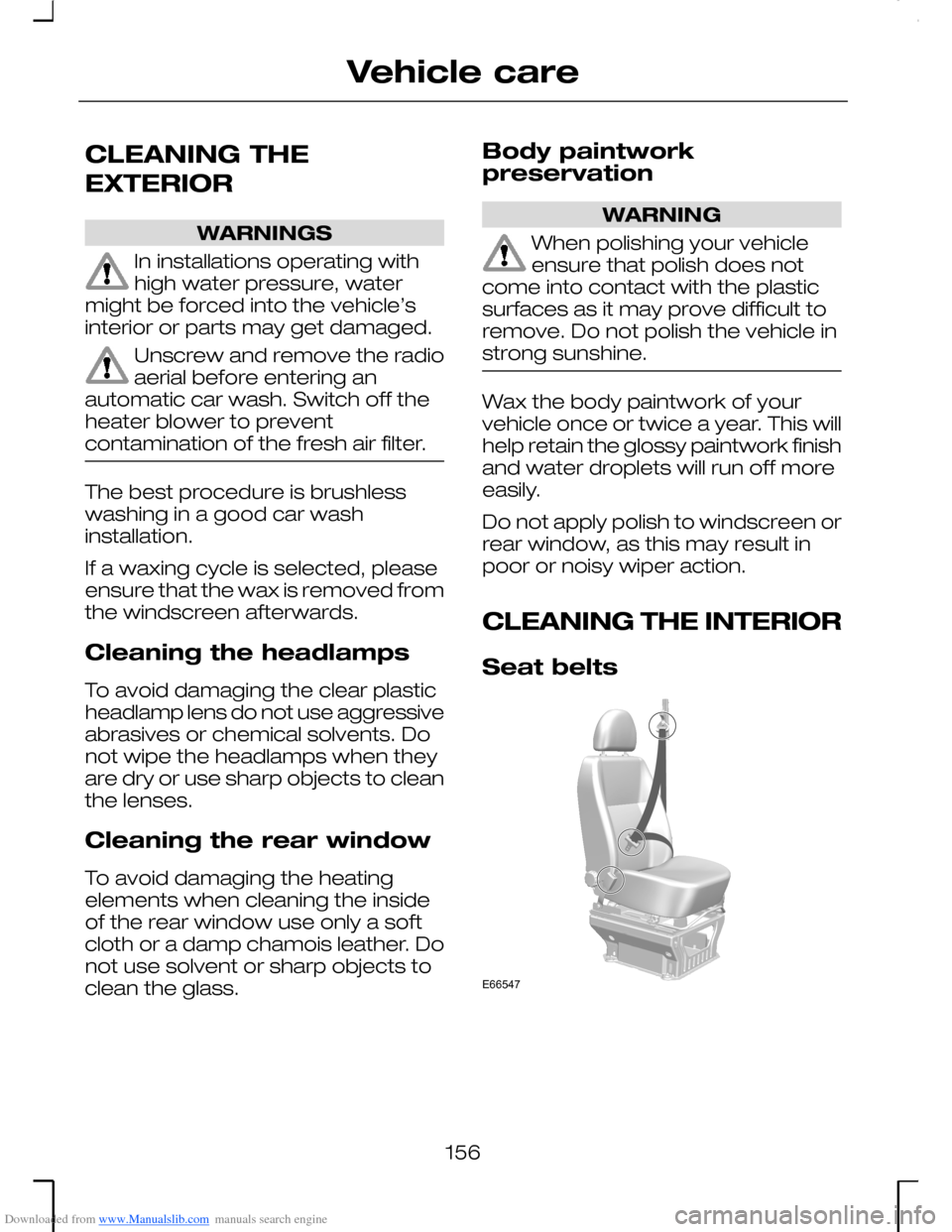
Seat belts
156
Vehicle careE66547
Page 159 of 198
Downloaded from www.Manualslib.com manuals search engine WARNING
Do not attempt to repair orlubricate retractor or bucklemechanisms or to modify the beltsin any way.
Periodically check the belts fordamage or fraying.
Use interior cleaner or clean warmwater. Dry naturally, away fromartificial heat.
Do not use chemical cleaners, boilingwater, bleach, or dye. Do not allowmoisture to penetrate the seat beltretractor mechanism.
REPAIRING MINOR PAINT
DAMAGE
WARNING
To retain vehicle warranty onpaintwork, remove apparentlyharmless looking but oftenaggressive particles from thepaintwork immediately − e.g. birddroppings, tree resins, insectremains, tar spots, road salt andindustrial fall-out.
Paint damage from road chippingsor minor scratches can be dealt withusing aerosol paint spray or touch-uppaint. Observe the applicationinstruction on each product. The FordAccessory range is recommended.
157
Vehicle care
Page 161 of 198
Downloaded from www.Manualslib.com manuals search engine •Connect the positive (+) terminalof the flat battery A to the positive(+) terminal of the booster batteryB.
•Connect the negative (−) terminalof the booster battery B as faraway from the battery as possibleto the engine block or the enginemount of the engine to be started.Do not connect to thenegative (–) terminal of theflat battery.
•Make sure that the booster cablesare clear of any moving parts.
To start the engine
•Run the engine of the vehicle withthe booster battery at moderatelyhigh speed.
•Start the engine of the vehicle withthe flat battery.
•Run both vehicles for a minimumof 3 minutes before disconnectingthe leads.
WARNING
Do not switch on the headlampswhen disconnecting the cables.The peak voltage could blow thebulbs.
•Disconnect the cables in thereverse order.
159
Vehicle battery
Page 162 of 198
Downloaded from www.Manualslib.com manuals search engine CHANGING A ROAD
WHEEL
Spare wheel
All vehicles
WARNING
Use only approved wheel andtyre sizes. Using other sizescould damage the vehicle and willmake the National Type Approvalinvalid.
Vehicles with a temporaryspare wheel
WARNINGS
If the spare wheel differs fromthe other fitted wheels, theserules must be followed:
Do not exceed 80 km/h (50mph).
Drive the shortest possibledistances.
Do not fit more than one sparewheel on your vehicle at anyone time.
Do not use snow chains on thistype of wheel.
Do not drive through anautomatic car wash.
Vehicles with stability assist
Vehicles with ESP may exhibit someunusual driving characteristics. Switchthe ESP off. See Using stabilitycontrol (page 120).
4-door and 5-door
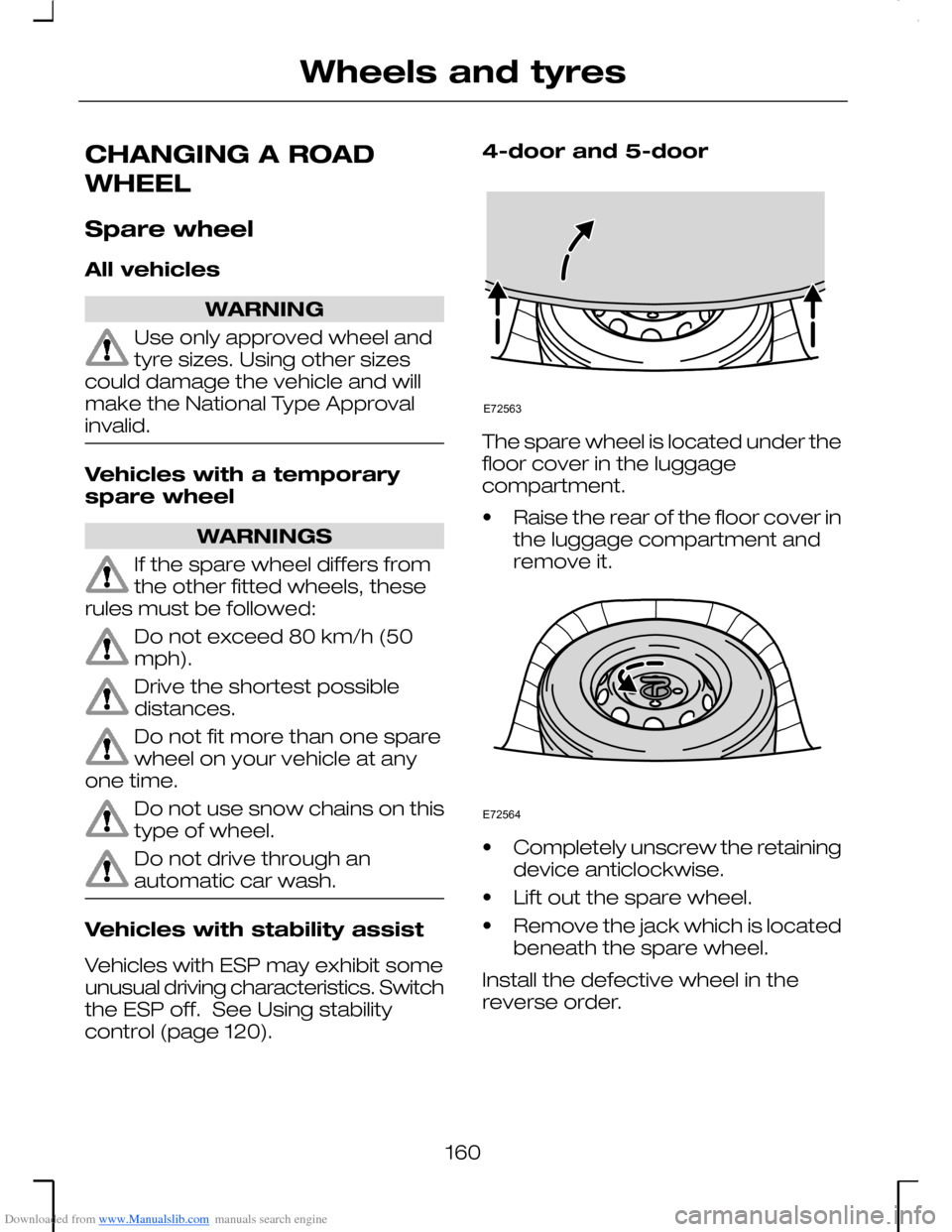
The spare wheel is located under thefloor cover in the luggagecompartment.
•Raise the rear of the floor cover inthe luggage compartment andremove it.
•Completely unscrew the retainingdevice anticlockwise.
•Lift out the spare wheel.
•Remove the jack which is locatedbeneath the spare wheel.
Install the defective wheel in thereverse order.
160
Wheels and tyresE72563 E72564
Page 164 of 198
Downloaded from www.Manualslib.com manuals search engine WARNING
The jack must only be used onthe jacking points specifiedbelow.
The front jacking point 1 is locatedapproximately 27 cm from the frontend of the sill. If you open up theOwner’s handbook, it isapproximately 27 cm wide.
The rear jacking point 2 is locatedapproximately 10 cm from the rearend of the sill.
Vehicles with side skirts
On vehicles with side skirts, the covermust be removed before placing thejack under the vehicle.
To remove pull the lower edge of thecover and rotate upwards, then pullit off.
Additional jacking points
WARNINGS
Positioning at other points maycause considerable damage tothe body, steering, suspension,engine, braking system and fuel lines.
Vehicles with side skirts requirespecial rubber pads to avoiddamaging the side skirts or thevehicle.
Points 1 and 2 can be used for trolleyjacks, workshop hoists or jack stands.
162
Wheels and tyresE72569 E72570