2006 FORD MONDEO coolant level
[x] Cancel search: coolant levelPage 5 of 198
Downloaded from www.Manualslib.com manuals search engine Brakes.......................118
Principle of operation.....................118
Hints on driving with ABS..............118
Parking brake..................................119
Stability control.........120
Principle of operation....................120
Using stability control....................120
Traction control.........121
Principle of operation.....................121
Using traction control....................121
Self-levelling
suspension.............122
Principle of operation....................122
Parking aid................123
Principle of operation....................123
Using the parking aid....................123
Cruise control...........124
Principle of operation....................124
Using cruise control......................124
Load carrying...........126
General information......................126
Cargo nets......................................126
Luggage covers.............................127
Roof racks and load carriers........127
Towing......................129
Towing a trailer...............................129
Essential towing checks...............129
Detachable tow ball......................130
Driving hints..............133
Running-in......................................133
Emergency
equipment..............134
First aid kit.......................................134
Warning triangle.............................134
Status after a
collision..................135
Fuel cut-off switch.........................135
Inspecting safety systemcomponents...............................135
Fuses........................136
Fuse box locations........................136
Changing a fuse.............................137
Fuse specification chart................137
Vehicle recovery.......141
Towing points..................................141
Transporting the vehicle...............142
Towing the vehicle on fourwheels.........................................143
Maintenance.............144
General information......................144
Engine compartmentoverview......................................145
Opening and closing thebonnet.........................................149
Engine oil check.............................149
Engine coolant check....................151
Automatic transmission fluidcheck...........................................152
Brake and clutch fluid check.......152
3
Table of Contents
Page 82 of 198
Downloaded from www.Manualslib.com manuals search engine PRINCIPLE OF
OPERATION
Outside air
Always keep the air intakes forwardof the front windscreen free of snow,leaves etc., to allow the system tofunction effectively.
Recirculated air
Note: It is not recommended to userecirculated air for more than 30minutes as there is no air exchangeand the windows may mist up.
When recirculated air is selected, onlythe air currently in the passengercompartment will be circulated.Outside air will not enter the vehicle.
Fresh air filter/activecarbon filter
The fresh air filter removes mostpotentially harmful particles such aspollen, industrial fallout and road dustfrom the air entering the vehicle’sinterior. The active carbon filterremoves odours.
In an automatic car wash, you shouldswitch off the ventilation blower toprevent the filter collecting waxdeposits.
Blower
The blower motor may emit noises.
Heating
The heating depends upon thecoolant temperature and is thereforeonly effective when the engine iswarm.
Air conditioning
Note: The air conditioning systemonly operates when the temperatureis above +5 ºC, the engine is runningand the blower is switched on.Operating the air conditioning leadsto higher fuel consumption.
The air is directed through thecoolant heat exchanger where it iscooled if the air conditioning isswitched on. In addition, humidity isextracted from the air to help keepthe windows free of mist.
The resulting condensation isdirected to the outside of the vehicle.It is therefore quite normal if younotice a small pool of waterunderneath the parked vehicle.
General notes oncontrolling the climate inthe vehicle’s interior
Close all the windows completely.
To warm the interior effectively, directthe heated air to the footwell area. Incold or humid weather, direct someof the air towards the frontwindscreen and side windows.
To cool the interior effectively, directthe cooled air towards the face level.
80
Climate control
Page 146 of 198
Downloaded from www.Manualslib.com manuals search engine GENERAL INFORMATION
WARNINGS
The electronic ignition systemworks with high voltage. Nevertouch these components with theengine running or the ignitionswitched on.
The ignition must be switchedoff before working in the enginecompartment. Under some operatingconditions, the cooling system fanmay continue to run for severalminutes after the engine has beenswitched off. This is quite normal.Take care not to get any fingers orclothing such as ties or scarvescaught in the fan.
•Check and top up fluid levelsregularly.
•Check tyre pressure.
•Check brakes and lamps areoperating correctly.
•Check warning and indicatorlamps.
Every day check
•Operation of all exterior andinterior lamps and make sure thatall lenses are clean.
When filling up check
•Engine oil level
•Brake fluid level
•Washer fluid level
•Tyre pressures and condition (onlywhen cold)
Once a month check
•Coolant level (engine cold)
•Assemblies, pipes, hoses andreservoirs for leaks
•Power steering fluid level
•Operation of the air conditioning
•Operation of the parking brake
•Operation of the horn
144
Maintenance
Page 153 of 198
Downloaded from www.Manualslib.com manuals search engine Engine oil filler cap
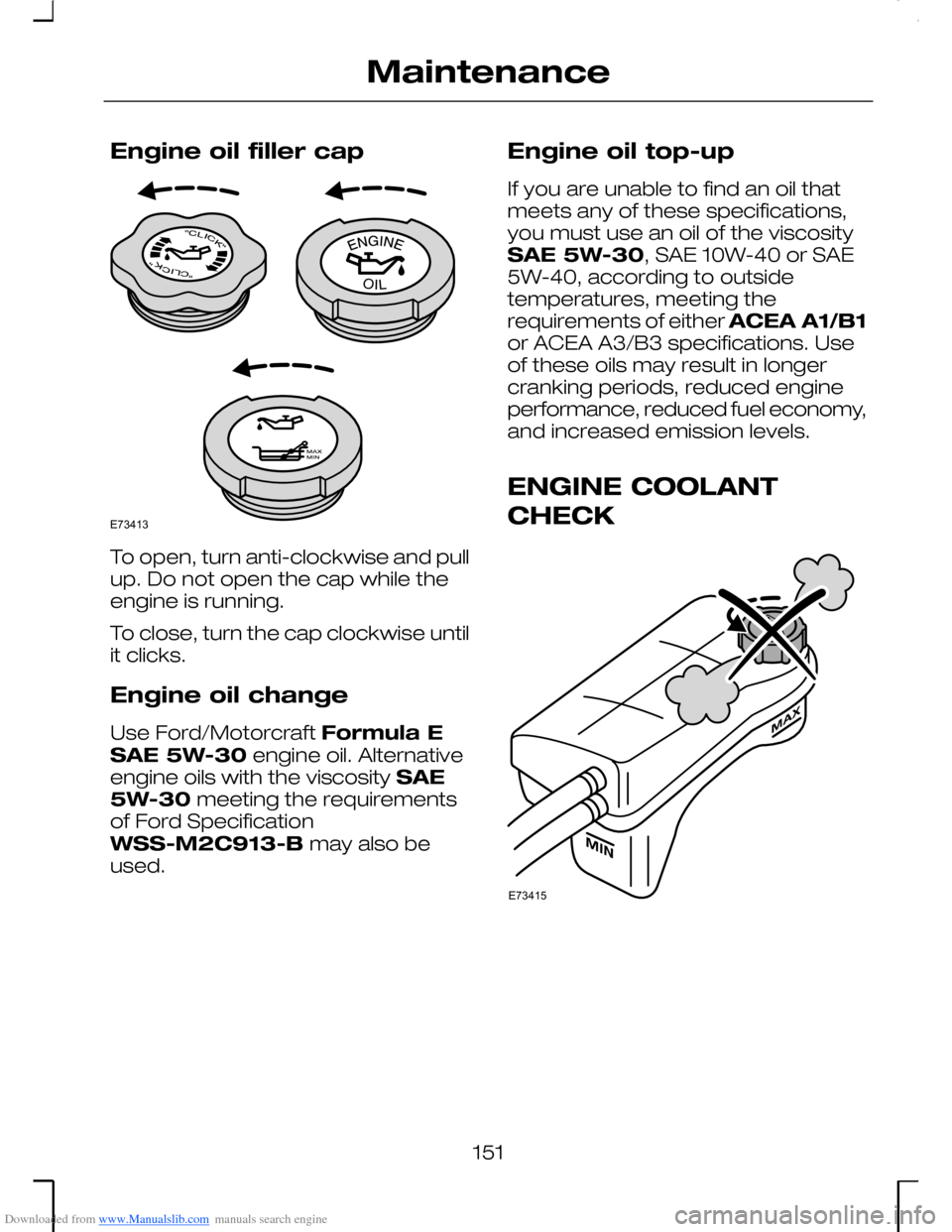
To open, turn anti-clockwise and pullup. Do not open the cap while theengine is running.
To close, turn the cap clockwise untilit clicks.
Engine oil change
Use Ford/Motorcraft Formula ESAE 5W-30 engine oil. Alternativeengine oils with the viscosity SAE5W-30 meeting the requirementsof Ford SpecificationWSS-M2C913-B may also beused.
Engine oil top-up
If you are unable to find an oil thatmeets any of these specifications,you must use an oil of the viscositySAE 5W-30, SAE 10W-40 or SAE5W-40, according to outsidetemperatures, meeting therequirements of either ACEA A1/B1or ACEA A3/B3 specifications. Useof these oils may result in longercranking periods, reduced engineperformance, reduced fuel economy,and increased emission levels.
ENGINE COOLANT
CHECK
151
MaintenanceE73413 E73415
Page 154 of 198
Downloaded from www.Manualslib.com manuals search engine WARNING
To avoid scalding, never removethe cap from the coolantreservoir when the engine is hot. Donot restart the engine until theproblem has been eliminated.
The coolant level is visible throughthe translucent reservoir. The coolantlevel should be between the MINand the MAX mark when the engineis cold. Hot coolant expands andmay, therefore, extend beyond theMAX mark.
WARNING
Take great care when addingcoolant. Avoid spillage on anypart of the engine.
The coolant should be added whenthe engine is cold. If coolant has tobe added when the engine is hot, firstwait 10 minutes for the engine tocool. Unscrew the cap slowly. Anypressure will escape while you areturning the cap. Fully remove the cap.
WARNING
Do not allow this fluid to makecontact with the skin or eyes. Ifthis should happen rinse the affectedareas immediately with plenty ofwater and contact your doctor.
When the vehicle is new, the coolingsystem is filled with coolant whichoffers anti−freeze protection downto approximately –25 ºC.
Add coolant that meets the FordSpecification.
AUTOMATIC
TRANSMISSION FLUID
CHECK
Your dealer checks the fluid level inthe automatic transmission whencarrying out routine maintenancework on your vehicle.
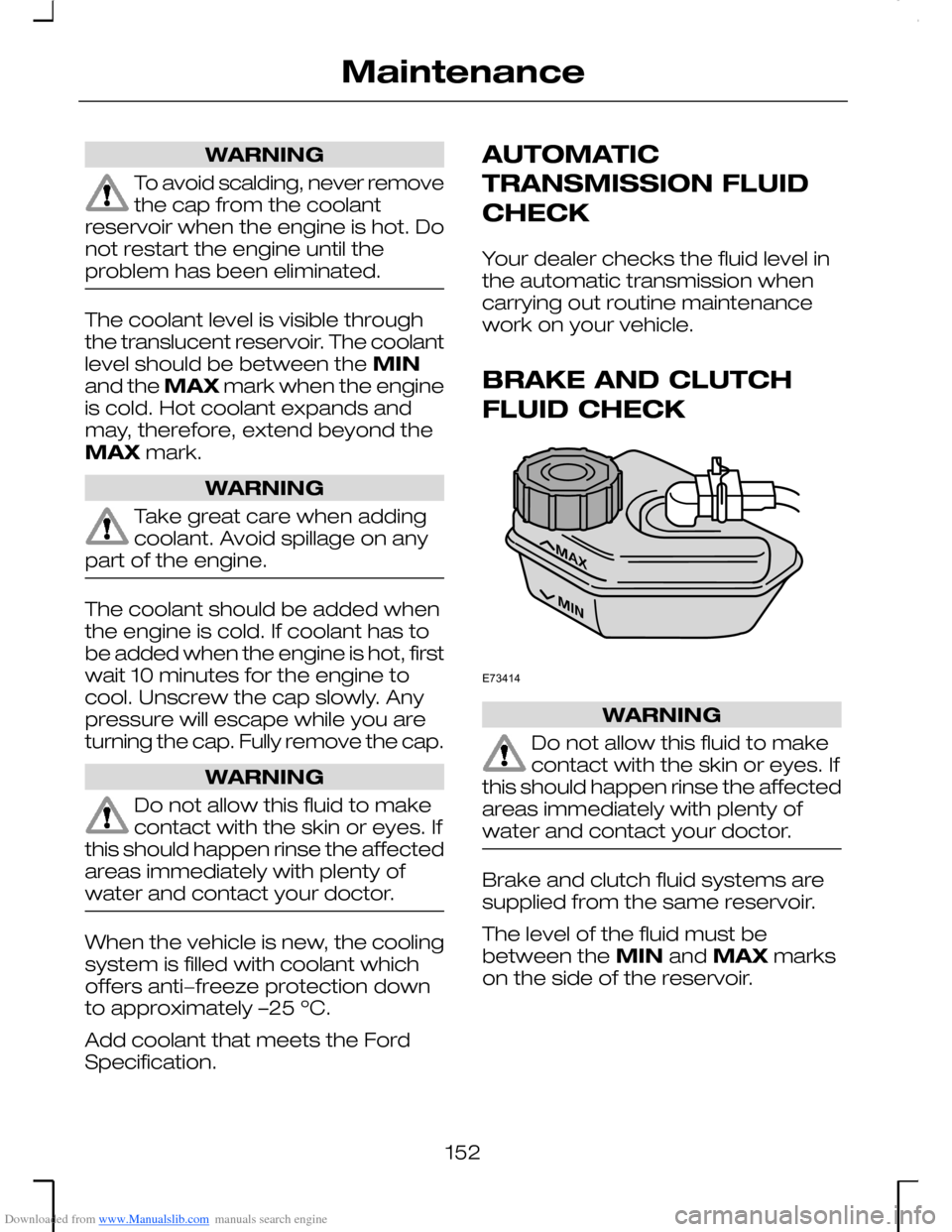
BRAKE AND CLUTCH
FLUID CHECK
WARNING
Do not allow this fluid to makecontact with the skin or eyes. Ifthis should happen rinse the affectedareas immediately with plenty ofwater and contact your doctor.
Brake and clutch fluid systems aresupplied from the same reservoir.
The level of the fluid must bebetween the MIN and MAX markson the side of the reservoir.
152
MaintenanceE73414