2006 FORD EXPLORER airbag disable
[x] Cancel search: airbag disablePage 140 of 328
To reduce the risk of injury, do not deactivate/activate the
BeltMinderyfeature while driving the vehicle.
1. Turn the ignition switch to the RUN (or ON) position. (DO NOT
START THE ENGINE)
2. Wait until the safety belt warning light turns off. (Approximately 1
minute)
²Step 3 must be completed within 50 seconds after the safety belt
warning light turns off.
3. For the seating position being disabled, at a moderate speed, buckle
then unbuckle the safety belt 9 times, ending in the unbuckled state.
(Step 3 must be completed within 50 seconds after the safety belt
warning light turns off.)
²After Step 3, the restraint system warning light (airbag light) will be
turned on for three seconds.
4. Within 10 seconds of the light turning on, at a moderate speed, buckle
then unbuckle the safety belt.
²This will disable the BeltMinderyfeature for that seating position if it
is currently enabled. As confirmation, the restraint system warning
light will flash 4 times per second for 3 seconds.
²This will enable the BeltMinderyfeature for that seating position if it
is currently disabled. As confirmation, the restraint system warning
light will flash 4 times per second for 3 seconds, followed by 3
seconds with the light off, then followed by the restraint system
warning light flashing 4 times per second for 3 seconds again.
Safety belt maintenance
Inspect the safety belt systems periodically to make sure they work
properly and are not damaged. Inspect the safety belts to make sure
there are no nicks, tears or cuts. Replace if necessary. All safety belt
assemblies, including retractors, buckles, front safety belt buckle
assemblies, buckle support assemblies (slide bar-if equipped), shoulder
belt height adjusters (if equipped), shoulder belt guide on seatback (if
equipped), child safety seat LATCH and tether anchors, and attaching
hardware, should be inspected after a collision. Ford Motor Company
recommends that all safety belt assemblies in use in vehicles involved in
a collision be replaced. However, if the collision was minor and an
authorized dealer finds that the belts do not show damage and continue
to operate properly, they do not need to be replaced. Safety belt
Seating and Safety Restraints
140
Page 145 of 328

²one or more impact and safing sensors.
²a readiness light and tone.
²diagnostic module.
²and the electrical wiring which connects the components.
²Front passenger sensing system. Refer toFront passenger sensing
system.later in this chapter.
²ªPassenger airbag offº or ªpass airbag offº indicator lamp. Refer to
Front passenger sensing systemlater in this chapter.
The diagnostic module monitors its own internal circuits and the
supplemental airbag electrical system wiring (including the impact
sensors), the system wiring, the airbag system readiness light, the airbag
back up power and the airbag ignitors.
Front passenger sensing system
The front passenger sensing system is designed to meet the regulatory
requirements of Federal Motor Vehicle Safety Standard (FMVSS) 208
and is designed to disable (will not inflate) the front passenger's frontal
air bag under certain conditions.
The front passenger sensing system works with sensors that are part of
the front passenger's seat and safety belt. The sensors are designed to
detect the presence of a properly seated occupant and determine if the
front passenger's frontal air bag should be enabled (may inflate) or
disabled (will not inflate).
The front passenger sensing system will disable (will not inflate) the
front passenger's frontal air bag if:
²the front passenger seat is unoccupied, or has small/medium objects in
the front seat,
²the system determines that an infant is present in a rear-facing infant
seat that is installed according to the manufacturer's instructions,
²the system determines that a small child is present in a forward-facing
child restraint that is installed according to the manufacturer's
instructions,
²the system determines that a small child is present in a booster seat,
²a front passenger takes his/her weight off of the seat for a period of
time,
Seating and Safety Restraints
145
Page 146 of 328
For side airbag equipped vehicles, the front passenger sensing system
will turn off the passenger seat side airbag if:
²the seat is empty and safety belt is unbuckled.
²a child or small person occupies the front passenger seat and the child
or small person is unbuckled.
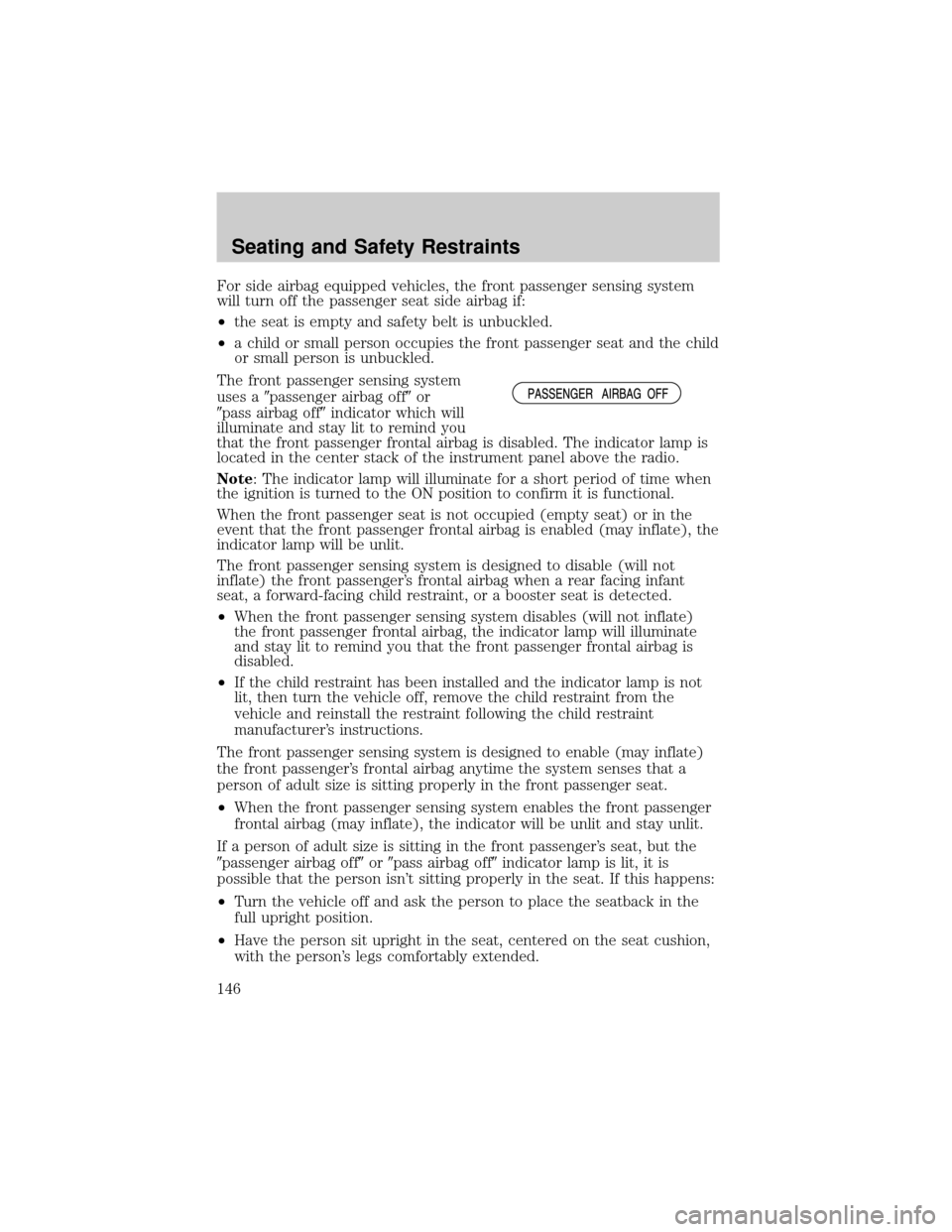
The front passenger sensing system
uses a9passenger airbag off9or
9pass airbag off9indicator which will
illuminate and stay lit to remind you
that the front passenger frontal airbag is disabled. The indicator lamp is
located in the center stack of the instrument panel above the radio.
Note: The indicator lamp will illuminate for a short period of time when
the ignition is turned to the ON position to confirm it is functional.
When the front passenger seat is not occupied (empty seat) or in the
event that the front passenger frontal airbag is enabled (may inflate), the
indicator lamp will be unlit.
The front passenger sensing system is designed to disable (will not
inflate) the front passenger's frontal airbag when a rear facing infant
seat, a forward-facing child restraint, or a booster seat is detected.
²When the front passenger sensing system disables (will not inflate)
the front passenger frontal airbag, the indicator lamp will illuminate
and stay lit to remind you that the front passenger frontal airbag is
disabled.
²If the child restraint has been installed and the indicator lamp is not
lit, then turn the vehicle off, remove the child restraint from the
vehicle and reinstall the restraint following the child restraint
manufacturer's instructions.
The front passenger sensing system is designed to enable (may inflate)
the front passenger's frontal airbag anytime the system senses that a
person of adult size is sitting properly in the front passenger seat.
²When the front passenger sensing system enables the front passenger
frontal airbag (may inflate), the indicator will be unlit and stay unlit.
If a person of adult size is sitting in the front passenger's seat, but the
9passenger airbag off9or9pass airbag off9indicator lamp is lit, it is
possible that the person isn't sitting properly in the seat. If this happens:
²Turn the vehicle off and ask the person to place the seatback in the
full upright position.
²Have the person sit upright in the seat, centered on the seat cushion,
with the person's legs comfortably extended.
Seating and Safety Restraints
146
Page 147 of 328
²Restart the vehicle and have the person remain in this position for
about two minutes. This will allow the system to detect that person
and enable the passenger's frontal air bag.
²If the indicator lamp remains lit even after this, the person should be
advised to ride in the rear seat.
OccupantPass Airbag Off
Indicator LampPassenger Airbag
Empty seat Unlit Disabled
Small child in child
safety seat or boosterLit Disabled
Small child with safety
belt buckled or
unbuckledLit Disabled
Adult Unlit Enabled
Even with Advanced Restraints Systems, children 12 and under
should be properly restrained in the back seat.
After all occupants have adjusted their seats and put on safety belts, it's
very important that they continue to sit properly. A properly seated
occupant sits upright, leaning against the seat back, and centered on the
seat cushion, with their feet comfortably extended on the floor. Sitting
improperly can increase the chance of injury in a crash event. For
example, if an occupant slouches, lies down, turns sideways, sits forward,
leans forward or sideways, or puts one or both feet up, the chance of
injury during a crash is greatly increased.
Sitting improperly out of position or with the seat back reclined
too far can take off weight from the seat cushion and affect the
decision of the front passenger sensing system, resulting in serious
injury or death in a crash.
Always sit upright against your seatback, with your feet on the floor.
Seating and Safety Restraints
147
Page 148 of 328
The front passenger sensing system may detect small or medium objects
placed on the seat cushion. For most objects that are in the front
passenger seat, the passenger airbag will be disabled. Even though the
passenger airbag is disabled, the9pass airbag off9lamp may or may not
be illuminated according to the table below.
ObjectsPass Airbag Off
Indicator LampPassenger Airbag
Small (i.e. 3 ring
binder, small purse,
bottled water)Unlit Disabled
Medium (i.e. heavy
briefcase, fully packed
luggage)Lit Disabled
Empty seat, Small or
medium object with
safety belt buckledLit Disabled
If you think that the status of the passenger airbag off indicator lamp is
incorrect, check for the following:
²Objects lodged underneath the seat
²Objects between the seat cushion and the center console (if
equipped)
²Objects hanging off the seat back
²Objects stowed in the seatback map pocket (if equipped)
²Objects placed on the occupant's lap
²Cargo interference with the seat
²Other passengers pushing or pulling on the seat
²Rear passenger feet and knees resting or pushing on the seat
The conditions listed above may cause the weight of a properly seated
occupant to be incorrectly interpreted by the front passenger sensing
system. The person in the front passenger seat may appear heavier or
lighter due to the conditions described in the list above.
Seating and Safety Restraints
148
Page 320 of 328

A
Accessory delay ..........................58
AdvanceTrac ..............................212
Air cleaner filter ...............306±307
Air conditioning ..........................37
Airbag supplemental
restraint system ........141, 150, 152
and child safety seats ............143
description ..............141, 150, 152
disposal ....................................155
driver airbag ............143, 151, 153
indicator light .................150, 155
operation .................143, 151, 153
passenger airbag .....143, 151, 153
side airbag ...............................150
Ambulance packages ....................8
Antifreeze
(see Engine coolant) ................288
Anti-lock brake system
(see Brakes) ..............................210
Audio system
(see Radio) ......................21, 25, 29
Automatic transmission
driving an automatic
overdrive .........................218, 221
fluid, adding ............................305
fluid, checking ........................305
fluid, refill capacities ..............308
fluid, specification ..................313
Auxiliary power point .................55
Axle
lubricant specifications ..310, 313
refill capacities ........................308
B
Battery .......................................286acid, treating emergencies .....286
jumping a disabled battery ....256
maintenance-free ....................286
replacement, specifications ...307
servicing ..................................286
BeltMinder .................................136
Brakes ........................................210
anti-lock ...................................210
anti-lock brake system (ABS)
warning light ...........................210
fluid, checking and adding ....305
fluid, refill capacities ..............308
fluid, specifications .........310, 313
lubricant specifications ..310, 313
parking ....................................211
shift interlock ..........................217
C
Calculating load ........................199
Capacities for refilling fluids ....308
Cargo cover ...........................94±95
Cassette tape player .............21, 25
Cell phone use ..............................8
Changing a tire .........................246
Child safety restraints ..............156
child safety belts ....................156
Child safety seats ......................160
attaching with tether straps ..164
in front seat ............................161
in rear seat ..............................161
Cleaning your vehicle
engine compartment ..............270
instrument panel ....................272
interior .....................................273
interior trim ............................273
plastic parts ............................272
washing ....................................269
waxing .....................................269
Index
320