2006 DODGE RAM SRT-10 service indicator
[x] Cancel search: service indicatorPage 4944 of 5267
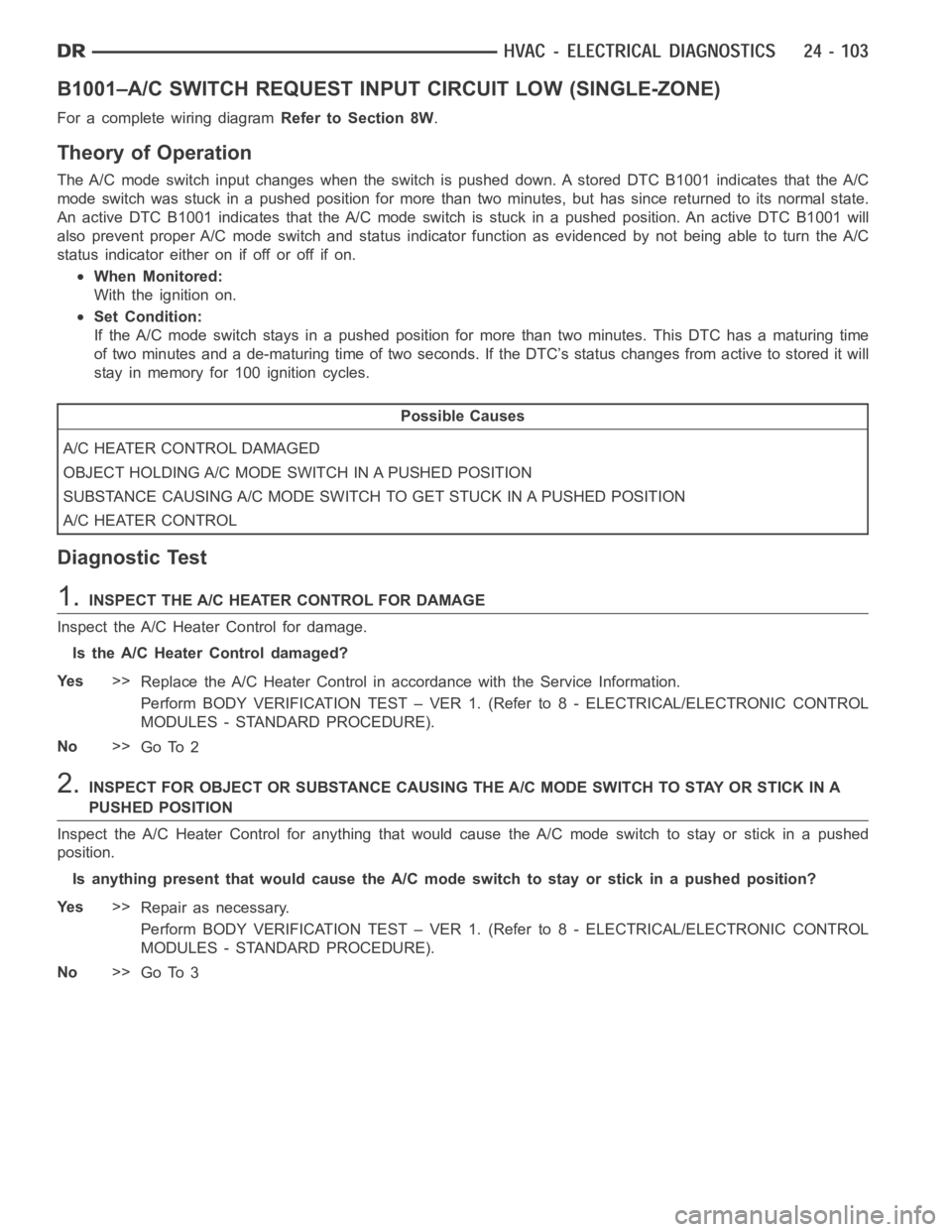
B1001–A/C SWITCH REQUEST INPUT CIRCUIT LOW (SINGLE-ZONE)
For a complete wiring diagramRefer to Section 8W.
Theory of Operation
The A/C mode switch input changes when the switch is pushed down. A stored DTC B1001 indicates that the A/C
mode switch was stuck in a pushed position for more than two minutes, but hassince returned to its normal state.
An active DTC B1001 indicates that the A/C mode switch is stuck in a pushed position.AnactiveDTCB1001will
also prevent proper A/C mode switch and status indicator function as evidenced by not being able to turn the A/C
status indicator either on if off or off if on.
When Monitored:
With the ignition on.
Set Condition:
If the A/C mode switch stays in a pushed position for more than two minutes. This DTC has a maturing time
of two minutes and a de-maturing time of two seconds. If the DTC’s status changes from active to stored it will
stay in memory for 100 ignition cycles.
Possible Causes
A/C HEATER CONTROL DAMAGED
OBJECT HOLDING A/C MODE SWITCH IN A PUSHED POSITION
SUBSTANCE CAUSING A/C MODE SWITCH TO GET STUCK IN A PUSHED POSITION
A/C HEATER CONTROL
Diagnostic Test
1.INSPECT THE A/C HEATER CONTROL FOR DAMAGE
Inspect the A/C Heater Control for damage.
Is the A/C Heater Control damaged?
Ye s>>
Replace the A/C Heater Control in accordance with the Service Information.
Perform BODY VERIFICATION TEST – VER 1. (Refer to 8 - ELECTRICAL/ELECTRONIC CONTROL
MODULES - STANDARD PROCEDURE).
No>>
Go To 2
2.INSPECT FOR OBJECT OR SUBSTANCE CAUSING THE A/C MODE SWITCH TO STAY OR STICKIN A
PUSHED POSITION
Inspect the A/C Heater Control for anything that would cause the A/C mode switch to stay or stick in a pushed
position.
Is anything present that would cause the A/C mode switch to stay or stick in apushed position?
Ye s>>
Repair as necessary.
Perform BODY VERIFICATION TEST – VER 1. (Refer to 8 - ELECTRICAL/ELECTRONIC CONTROL
MODULES - STANDARD PROCEDURE).
No>>
Go To 3
Page 4945 of 5267
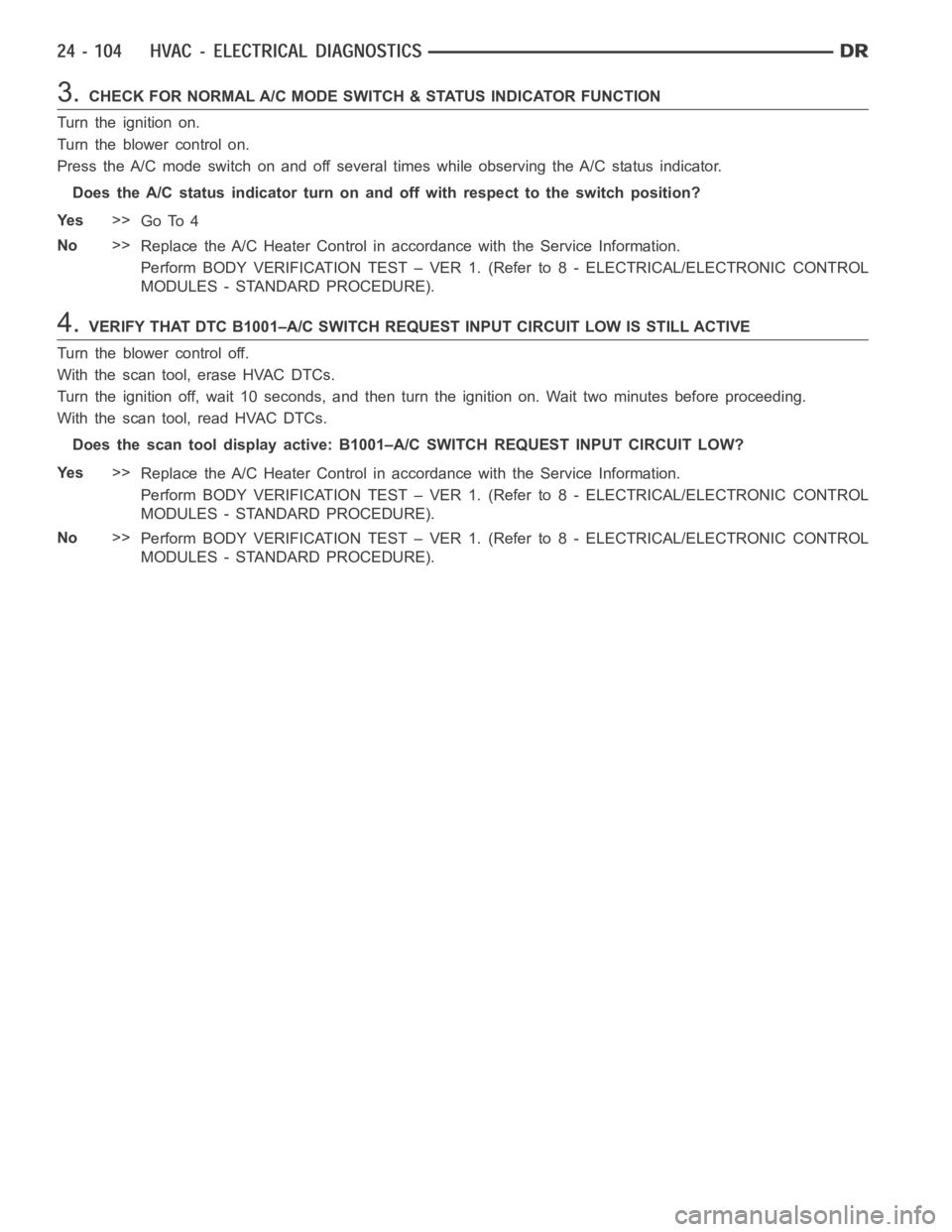
3.CHECK FOR NORMAL A/C MODE SWITCH & STATUS INDICATOR FUNCTION
Turn the ignition on.
Turn the blower control on.
Press the A/C mode switch on and off several times while observing the A/C status indicator.
Does the A/C status indicator turn on and off with respect to the switch position?
Ye s>>
Go To 4
No>>
Replace the A/C Heater Control in accordance with the Service Information.
Perform BODY VERIFICATION TEST – VER 1. (Refer to 8 - ELECTRICAL/ELECTRONIC CONTROL
MODULES - STANDARD PROCEDURE).
4.VERIFY THAT DTC B1001–A/C SWITCH REQUEST INPUT CIRCUIT LOW IS STILL ACTIVE
Turn the blower control off.
With the scan tool, erase HVAC DTCs.
Turn the ignition off, wait 10 seconds, and then turn the ignition on. Wait two minutes before proceeding.
With the scan tool, read HVAC DTCs.
Does the scan tool display active: B1001–A/C SWITCH REQUEST INPUT CIRCUITLOW?
Ye s>>
Replace the A/C Heater Control in accordance with the Service Information.
Perform BODY VERIFICATION TEST – VER 1. (Refer to 8 - ELECTRICAL/ELECTRONIC CONTROL
MODULES - STANDARD PROCEDURE).
No>>
Perform BODY VERIFICATION TEST – VER 1. (Refer to 8 - ELECTRICAL/ELECTRONIC CONTROL
MODULES - STANDARD PROCEDURE).
Page 4946 of 5267
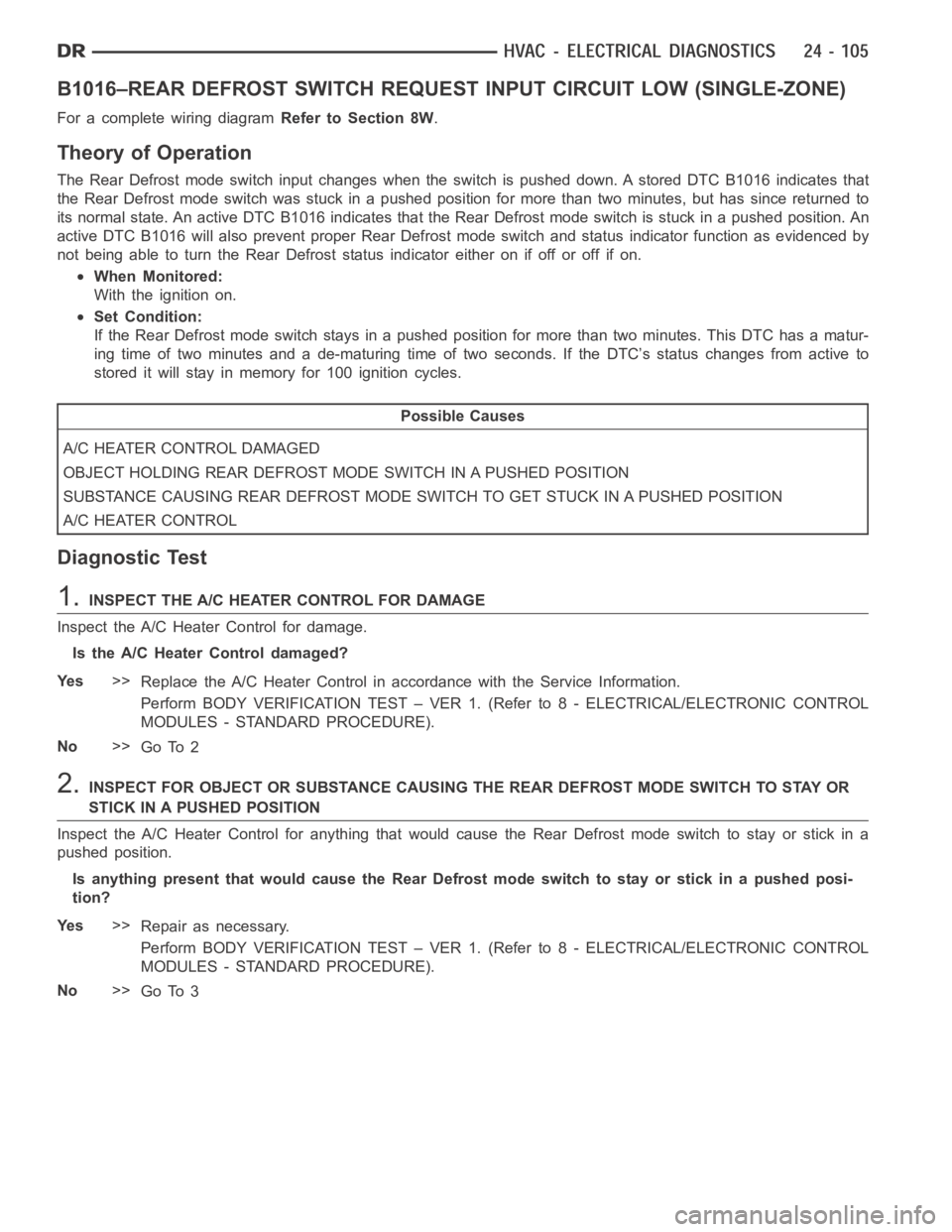
B1016–REAR DEFROST SWITCH REQUEST INPUT CIRCUIT LOW (SINGLE-ZONE)
For a complete wiring diagramRefer to Section 8W.
Theory of Operation
The Rear Defrost mode switch input changes when the switch is pushed down. Astored DTC B1016 indicates that
the Rear Defrost mode switch was stuck in a pushed position for more than twominutes, but has since returned to
its normal state. An active DTC B1016 indicates that the Rear Defrost mode switch is stuck in a pushed position. An
active DTC B1016 will also prevent proper Rear Defrost mode switch and status indicator function as evidenced by
not being able to turn the Rear Defrost status indicator either on if off or off if on.
When Monitored:
With the ignition on.
Set Condition:
If the Rear Defrost mode switch stays in a pushed position for more than two minutes. This DTC has a matur-
ing time of two minutes and a de-maturing time of two seconds. If the DTC’s status changes from active to
stored it will stay in memory for 100 ignition cycles.
Possible Causes
A/C HEATER CONTROL DAMAGED
OBJECT HOLDING REAR DEFROST MODE SWITCH IN A PUSHED POSITION
SUBSTANCE CAUSING REAR DEFROST MODE SWITCH TO GET STUCK IN A PUSHED POSITION
A/C HEATER CONTROL
Diagnostic Test
1.INSPECT THE A/C HEATER CONTROL FOR DAMAGE
Inspect the A/C Heater Control for damage.
Is the A/C Heater Control damaged?
Ye s>>
Replace the A/C Heater Control in accordance with the Service Information.
Perform BODY VERIFICATION TEST – VER 1. (Refer to 8 - ELECTRICAL/ELECTRONIC CONTROL
MODULES - STANDARD PROCEDURE).
No>>
Go To 2
2.INSPECT FOR OBJECT OR SUBSTANCE CAUSING THE REAR DEFROST MODE SWITCH TO STAYOR
STICK IN A PUSHED POSITION
Inspect the A/C Heater Control for anything that would cause the Rear Defrost mode switch to stay or stick in a
pushed position.
Is anything present that would cause the Rear Defrost mode switch to stay orstick in a pushed posi-
tion?
Ye s>>
Repair as necessary.
Perform BODY VERIFICATION TEST – VER 1. (Refer to 8 - ELECTRICAL/ELECTRONIC CONTROL
MODULES - STANDARD PROCEDURE).
No>>
Go To 3
Page 4947 of 5267
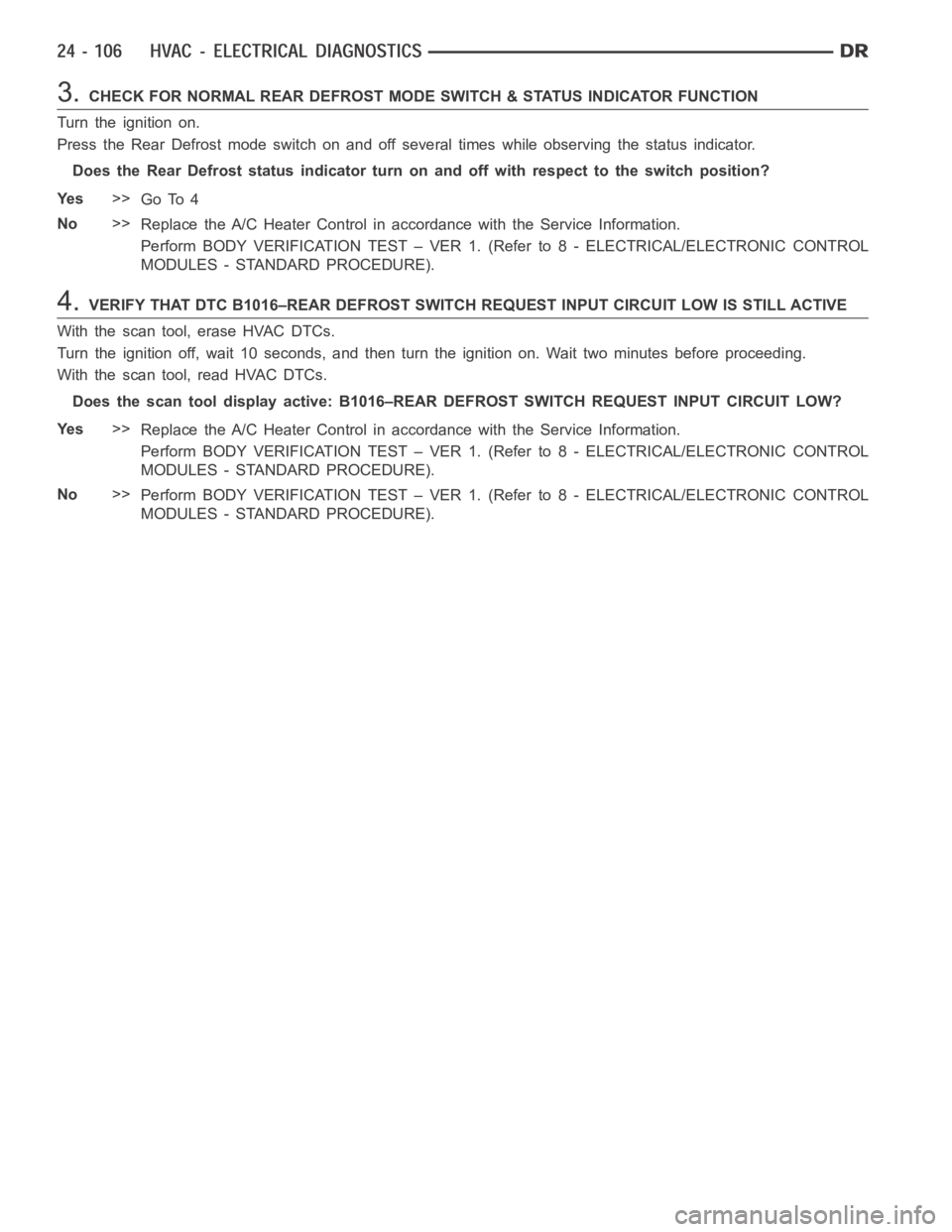
3.CHECK FOR NORMAL REAR DEFROST MODE SWITCH & STATUS INDICATOR FUNCTION
Turn the ignition on.
Press the Rear Defrost mode switch on and off several times while observingthe status indicator.
Does the Rear Defrost status indicator turn on and off with respect to the switch position?
Ye s>>
Go To 4
No>>
Replace the A/C Heater Control in accordance with the Service Information.
Perform BODY VERIFICATION TEST – VER 1. (Refer to 8 - ELECTRICAL/ELECTRONIC CONTROL
MODULES - STANDARD PROCEDURE).
4.VERIFY THAT DTC B1016–REAR DEFROST SWITCH REQUEST INPUT CIRCUIT LOW IS STILL ACTIVE
With the scan tool, erase HVAC DTCs.
Turn the ignition off, wait 10 seconds, and then turn the ignition on. Wait two minutes before proceeding.
With the scan tool, read HVAC DTCs.
Does the scan tool display active: B1016–REAR DEFROST SWITCH REQUEST INPUT CIRCUIT LOW?
Ye s>>
Replace the A/C Heater Control in accordance with the Service Information.
Perform BODY VERIFICATION TEST – VER 1. (Refer to 8 - ELECTRICAL/ELECTRONIC CONTROL
MODULES - STANDARD PROCEDURE).
No>>
Perform BODY VERIFICATION TEST – VER 1. (Refer to 8 - ELECTRICAL/ELECTRONIC CONTROL
MODULES - STANDARD PROCEDURE).
Page 5047 of 5267
With the scan tool in HVAC, select System Tests and then select Cooldown test. Allow the test to run to completion.
Does the scan tool display a status message that indicates a fault has occurred?
Yes, Conditions Too Cold - Test Not Run
If running, turn the A/C compressor off. Verify that the work area ambient temperature is above 15.6°C
(60°F). If not, move the vehicle to a warmer work area. Verify that the evaporator temperature is above
13°C (55°F). If not, set the blower to high speed and allow the blower to run for five minutes. Then, run
the Cooldown Test again.
Yes, Blowers Not On High - Test Not Run
Set the blower speed to high speed and then run the Cooldown Test again.
Yes, No Results Stored/Test Not Complete
Verify that power is not interrupted while rerunning the Cooldown Test.
Yes, Refrigerant Temperature Sensor Error
For Dual-Zone HVAC systems, refer to B10B2–A/C COOL DOWN TEST PERFORMANCEfor the diag-
nostic test procedure. For Single-Zone HVAC systems, refer to B1079–CLIMATE CONTROL COOL
DOWN TEST EXCESSIVE TIME for the diagnostic test procedure.
Yes, DTC Set During Routine - Test Not Passed
For Dual-Zone HVAC systems, refer to B10B2–A/C COOL DOWN TEST PERFORMANCEfor the diag-
nostic test procedure. For Single-Zone HVAC systems, refer to B1079–CLIMATE CONTROL COOL
DOWN TEST EXCESSIVE TIME for the diagnostic test procedure.
No>>
Asnecessary,eitherGoTo3,4,or5,or Perform BODY VERIFICATION TEST - VER1. (Refer to 8 -
ELECTRICAL/ELECTRONIC CONTROL MODULES - STANDARD PROCEDURE).
3.MODE SWITCH & DOOR ACTUATOR CIRCUIT TEST
NOTE: If at anytime a DTC becomes active during this test, proceed to the conclusion question.
NOTE: If multiple DTCs are active, diagnose those that relate to a short circuit first.
NOTE: Dual-Zone A/C Heater Controls do not set DTCs for stuck mode switches. Therefore, verify that the
A/C Heater Control is not damaged and that the mode switches and status indicators function properly and
repair as necessary before proceeding.
If not done so previously, start the engine.
Turn the Blower control to the low speed position.
Set the Blend control (single-zone) or Driver Blend control (dual-zone) to the full cold position.
If equipped, set the Passenger Blend control to the full cold position.
Monitor the scan tool for active HVAC DTCs while performing the following test steps.
If equipped, press the A/C mode switch on, wait 30 seconds, and then press itoff.
On Dual-Zone systems, press the Recirc mode switch on, wait 30 seconds, andthen press it off.
If equipped, press the EBL mode switch on, wait 30 seconds, and then press itoff.
Move the Blend control (single-zone) or Driver Blend control (dual-zone)from full cold to full hot, wait 30 seconds,
and then move it back to full cold.
If equipped, move the Passenger Blend control from full cold to full hot, wait 30 seconds, and then moved it back
to full cold.
Turn the Mode select control to the defrost position, wait 30 seconds, and then turn it to the panel position (dual-
zone) or panel / recirc position (single-zone). Wait 30 seconds before proceeding.
Does the scan tool display any active DTCs?
Ye s>>
Diagnose and repair the DTC(s). Refer to the Table of Contents in this Section for a complete list of
HVAC related symptoms.
No>>
If you are here due to a stored DTC, it is possible that a technician may not have erased the DTC
following a repair. If possible, verify if the vehicle was recently in for this type of service. Otherwise,
either Go To 4 or 5, or visually inspect the related wiring harness for chafed, pierced, pinched, and
partially broken wires and the wiring harness connectors for broken, bent, pushed out, and corroded
terminals, and repair as necessary.
Perform BODY VERIFICATION TEST - VER 1. (Refer to 8 - ELECTRICAL/ELECTRONIC CONTROL
MODULES - STANDARD PROCEDURE).
Page 5048 of 5267
4.ACTUATOR DTC DETECTION TEST
NOTE: The Actuator DTC Detection Test clears all door actuator related DTCs when the test is actuated.
If not done so previously, start the engine.
With the scan tool, select System Tests and then select Actuator DTC Detection. When the test is complete, select
View DTCs.
Does the scan tool display any DTCs?
Yes, Dual-Zone
Diagnose and repair the DTC(s). If multiple DTCs are present, beginning with the passenger blend door,
diagnose and repair all short high DTCs and then all short low DTCs. Refer tothe Table of Contents in
this Section for a complete list of HVAC related symptoms.
Yes, Single-Zone
Diagnose and repair the DTC(s). If multiple DTCs are present, beginning with the common circuit, diag-
nose and repair all short high DTCs and then all short low DTCs. Refer to the Table of Contents in this
Section for a complete list of HVAC related symptoms.
No>>
If you are here due to a stored DTC, it is possible that a technician may not have erased the DTC
following a repair. If possible, verify if the vehicle was recently in for this type of service. Otherwise,
either Go To 5 or visually inspect the related wiring harness for chafed, pierced, pinched, and partially
broken wires and the wiring harness connectors for broken, bent, pushed out, and corroded terminals,
and repair as necessary.
Perform BODY VERIFICATION TEST - VER 1. (Refer to 8 - ELECTRICAL/ELECTRONIC CONTROL
MODULES - STANDARD PROCEDURE).
5.ACTUATOR CALIBRATION TEST
NOTE: For vehicles equipped with EBL, running the HVAC Door Recalibrationwill cause the EBL status
indicator to flash.
NOTE: The Actuator Calibration Test clears all door actuator related DTCswhen the test is actuated.
If not done so previously, start the engine.
With the scan tool, select System Tests and then select Actuator Calibration Test. When the test is complete, select
View DTCs.
Does the scan tool display any DTCs?
Ye s>>
Diagnose and repair the DTC(s). Refer to the Table of Contents in this Section for a complete list of
HVAC related symptoms.
No>>
No problem found. However, if you are here due to a stored DTC, it is possiblethat a technician may
not have erased the DTC following a repair. If possible, verify if the vehicle was recently in for this type
of service. Otherwise, visually inspect the related wiring harness for chafed, pierced, pinched, and par-
tially broken wires and the wiring harness connectors for broken, bent, pushed out, and corroded ter-
minals, and repair as necessary.
Perform BODY VERIFICATION TEST - VER 1. (Refer to 8 - ELECTRICAL/ELECTRONIC CONTROL
MODULES - STANDARD PROCEDURE).
Page 5129 of 5267
DIAGNOSIS AND TESTING
REFRIGERANT SYSTEM LEAKS
WARNING: R-134a service equipment or vehicle A/C system should not be pressure tested or leak tested
with compressed air. Mixture of air and R-134a can be combustible at elevated pressures. These mixtures
are potentially dangerous and may result in fire or explosion causing property damage, personal injury or
death.
Avoid breathing A/C refrigerant and lubricant vapor or mist. Exposure mayirritate eyes, nose and throat.
Use only approved service equipment meeting SAE requirements to discharge R-134a system. If accidental
system discharge occurs, ventilate work area before resuming service.
NOTE: If the A/C refrigerant system charge is empty or low, a leak in the A/C system is likely. Visually
inspect all A/C lines, fittings and components for an oily residue. Oil residue can be an indicator of an A/C
system leak location.
NOTE: The only way to correctly determine if the refrigerant system is fully charged with R-134a is to com-
pletely evacuate and recharge the A/C system.
Connect a suitable manifold gauge setand determine if the static A/C system pressure is above or below 345 kPa
(50 psi) (refer to 24 - HEATING & AIR CONDITIONING/PLUMBING - STANDARD PROCEDURE - REFRIGERANT
SYSTEM SERVICE EQUIPMENT). If less than 345 kPa (50 psi), proceed to SYSTEMEMPTY . If greater than 345
kPa (50 psi), go to SYSTEM LOW .
SYSTEM EMPTY
1. Evacuate the refrigerant system to the lowest degree of vacuum possible(approximately -88 kPa (- 26 in. Hg) or
greater vacuum) (Refer to 24 - HEATING & AIR CONDITIONING/PLUMBING - STANDARD PROCEDURE -
REFRIGERANT SYSTEM EVACUATE). Determine if the system holds a vacuum for 15 minutes. If vacuum is
held, a leak is probably not present. If system will not maintain vacuum level, proceed to Step 2.
2. Prepare and dispense 0.284 kilograms (10 ounces) of R-134a refrigerantinto the evacuated refrigerant system
(Refer to 24 - HEATING & AIR CONDITIONING/PLUMBING - STANDARD PROCEDURE - REFRIGERANT SYS-
TEM CHARGE) and proceed to Step 1 of the System Low procedure.
SYSTEM LOW
1. Position the vehicle in a wind-freework area. This will aid in detectingsmall leaks.
2. Operate the heating-A/C system with the engine at idle under the following conditions for at least five minutes.
Doors or windows open
Transmission in Park or Neutral with the parking brake set (depending on application)
A/C-heater controls set to outside air, full cool, panel mode, high blowerand with A/C compressor engaged
CAUTION: A leak detector only designed for R-12 refrigerant will not detect leaks in an R-134a refrigerant
system.
3. Shut the vehicle Off and wait 2-7 minutes. Then use an electronic leak detector that is designed to detect R-134a
refrigerant and search for leaks. Fittings, lines or components that appear to be oily usually indicate a refrigerant
leak. To inspect the A/C evaporator for leaks, insert the leak detector probe into the drain tube opening or an air
outlet. A dye for R-134a is available to aid in leak detection. Use only DaimlerChrysler approved refrigerant dye.