Page 77 of 496
seat belt is tucked behind the child restraint and out of
reach. If the buckled seat belt interferes with the child
restraint installation, instead of tucking the seat belt
behind the child restraint, route the seat belt through the
child restraint belt path and then buckle it. This should
stow the seat belt out of the reach of an inquisitive child.
Remind all children in the vehicle that the seat belts are
not toys and should not be played with, and never leave
your child unattended in the vehicle.
Installing the Child Restraint System
If your fleet vehicle is equipped with LATCH anchorages
on the 3-passenger bench seat, do not install three child
restraints at the same time in this seat. The anchorages in
this seat are not designed to restrain three child restraints
at one time. Instead, you may install one child restraint at
the center position, or one child restraint at each of the
right and left positions.
WARNING!
Fleet Vehicles Only:
Do not install child restraint systems equipped with
LATCH attachments at all three seating positions in
the seat at one time. The LATCH anchorages in this
seat are designed to restrain no more than two child
restraints at a time in the event of a collision. Failure
to follow this may result in serious or fatal injury.
We urge that you carefully follow the directions of the
manufacturer when installing your child restraint. Many,
but not all, restraint systems will be equipped with
separate straps on each side, with each having a hook or
connector and a means for adjusting the tension in the
strap. Forward-facing toddler restraints and some
rearward-facing infant restraints will also be equipped
with a tether strap, a hook and means for adjusting the
tension in the strap.
THINGS TO KNOW BEFORE STARTING YOUR VEHICLE 77
2
Page 78 of 496

In general, you will first loosen the adjusters on the lower
straps and tether straps so that you can more easily attach
the hook or connector to the lower anchorages and tether
anchorages. Then tighten all three straps as you push the
child restraint rearward and downward into the seat.
Not all child restraint systems will be installed as we
have described here. Again, carefully follow the instruc-
tions that come with the child restraint system.
WARNING!
Improper installation of a child restraint to the
LATCH anchorages can lead to failure of an infant or
child restraint. The child could be badly injured or
killed. Follow the manufacturer’s directions exactly
when installing an infant or child restraint.
Transporting Pets
Airbags deploying in the front seat could harm your pet.
An unrestrained pet could be thrown about and possibly
injured, or injure a passenger during panic braking or in
a collision.
Pets should be restrained in the rear seat in pet harnesses
or pet carriers that are secured by seat belts.
REAR SEAT DELETE FEATURE (COMMERCIAL
VEHICLES ONLY) — IF EQUIPPED
Commercial cargo vehicles are not designed for use as a
family vehicle and are not intended for carrying children
in the front passenger seat. However, if you must carry a
child in a vehicle without a rear seat, the passenger seat
should be moved to the full rearward position and the
child must be in a proper restraint system based on it’s
age, size and weight. NEVER carry a child in a rear facing
78 THINGS TO KNOW BEFORE STARTING YOUR VEHICLE
Page 79 of 496
infant carrier in a vehicle without rear seats. In an
accident, serious injury or death may occur from the
deploying passenger air bag.
This vehicle is equipped with a child restraint tether
anchor located on the floor, behind the front passenger
seat. Use this tether anchor to secure only forward
facing child restraints equipped with an upper tether
strap.
WARNING!
Rear Facing Infant restraints must never be secured
in the passenger seat of a vehicle with a passenger
airbag. In an accident a passenger airbag may deploy
causing severe injury or death to infants riding in
rear facing infant restraints.
Restraining Infants and Small Children with Seat
Delete Feature (Commercial Vehicles Only)
There are different sizes and types of restraints for
children from newborn size to the child almost large
enough for an adult safety belt. Use the restraint that is
correct for your child:
•The rearward-facing infant carrier is for babies weigh-
ing up to about 20 lbs (9 kg), and less than one year
old. THIS TYPE OF SEAT CANNOT BE USED IN A
VEHICLE EQUIPPED WITH THE REAR SEAT DE-
LETE FEATURE (Commercial Vehicles Only).
•The forward-facing child seat is for children from
about 20 to 40 lbs (9 to 18 kg), and more than one year
old.
•A “convertible” child seat, one that is designed to be
used for children who are too heavy for a rear facing
infant seat, may be used IN THE FORWARD FACING
POSITION ONLY, IT MUST NEVER BE INSTALLED
THINGS TO KNOW BEFORE STARTING YOUR VEHICLE 79
2
Page 82 of 496
6. Using the hook attached to the child restraint tether
strap, attach the child restraint tether strap to the metal
ring on the vehicle tether anchor.
7. Following the child seat manufacturer’s instructions,
tighten the child restraint tether strap.
8. If necessary, reposition the seat head restraint.
9. Inspect the tether anchor strap for nicks, abrasions,
discoloration, and loose threads. If these, or any other
condition that might effect the performance of the strap is
observed, DO NOT USE. Contact your local
DaimlerChrysler dealership for a replacement part.
NOTE: Stow the child restraint tether strap in its
original position when not in use.WARNING!
The vehicle tether anchor is designed to be used
with a child restraint only. It should not be used for
any other purpose. Before use inspect the tether
anchor strap for nicks, abrasions, discoloration, and
loose threads. If these or any other condition that
might effect the performance of the strap is ob-
served, DO NOT USE, personal injury may result.
Contact your local DaimlerChrysler dealership for a
replacement part.
ENGINE BREAK-IN RECOMMENDATIONS
A long break-in period is not required for the engine in
your new vehicle.
Drive moderately during the first 300 miles (500 km).
After the initial 60 miles (100 km), speeds up to 50 or 55
mph (80 or 90 km/h) are desirable.
82 THINGS TO KNOW BEFORE STARTING YOUR VEHICLE
Page 83 of 496
While cruising, brief full-throttle acceleration, within the
limits of local traffic laws, contributes to a good break-in.
Wide open throttle acceleration in low gear can be
detrimental and should be avoided.
The engine oil installed in the engine at the factory is a
high quality energy conserving type lubricant. Oil
changes should be consistent with anticipated climate
conditions under which vehicle operations will occur.
The recommended viscosity and quality grades are
shown in Section 7 of this manual. NON-DETERGENT
OR STRAIGHT MINERAL OILS MUST NEVER BE
USED.
A new engine may consume some oil during its first few
thousand miles (kilometers) of operation. This should be
considered as a normal part of the break-in and not
interpreted as an indication of difficulty.SAFETY TIPS
Exhaust Gas
WARNING!
Exhaust gases can injure or kill. They contain carbon
monoxide (CO) which is colorless and odorless.
Breathing it can make you unconscious and can
eventually poison you. To avoid breathing (CO)
follow the safety tips below.
Do not run the engine in a closed garage or in confined
areas any longer than needed to move your vehicle in or
out of the area.
If it is necessary to sit in a parked vehicle with the engine
running, adjust your heating or cooling controls to force
outside air into the vehicle. Set the blower at high speed.
THINGS TO KNOW BEFORE STARTING YOUR VEHICLE 83
2
Page 84 of 496
WARNING!
If you are required to drive with the deck lid/liftgate
open, make sure that all windows are closed, and the
climate control blower switch is set at high speed.
DO NOT use the recirculation mode.
Safety Checks You Should Make Inside The
Vehicle
Seat Belts
Inspect the belt system periodically, checking for cuts,
frays and loose parts. Damaged parts must be replaced
immediately. Do not disassemble or modify the system.
Front seat belt buckle pretensioners must be replaced
after a collision. Rear seat belt assemblies must be re-
placed after a collision if they have been damaged (bent
retractor, torn webbing, etc. If there is any question
regarding belt or retractor condition, replace the belt.
Airbag Light
The light should come on and remain on for 6
to 8 seconds as a bulb check when the ignition
switch is first turned ON. If the LED is not lit
during starting, have it checked. If the light
stays on or comes on while driving, have the system
checked by an authorized dealer.
Defroster
Check operation by selecting the defrost mode and place
the blower control on high speed. You should be able to
feel the air directed against the windshield.
84 THINGS TO KNOW BEFORE STARTING YOUR VEHICLE
Page 94 of 496
Outside Mirror — Driver’s Side
Adjust the outside mirror to center on the adjacent lane of
traffic, with a slight overlap of the view obtained on the
inside mirror.
Outside Mirror — Passenger’s Side
Adjust the convex outside mirror so you can just see the
side of your vehicle in the portion of the mirror closest to
the vehicle. This type of mirror will give a much wider
view to the rear, and especially of the lane next to your
vehicle.
WARNING!
Vehicles and other objects seen in the right side
convex mirror will look smaller and farther away
than they really are. Relying too much on your right
side mirror could cause you to collide with another
vehicle or other object.
Use your inside mirror when judging the size or
distance of a vehicle seen in this convex mirror.
Power Remote-Control Mirrors
Use the mirror select switch, located on the instrument
panel to the left of the steering column, to adjust the view
obtained in the outside mirrors. Press the rocker switch to
the L or R for Left or Right mirror selection. Use the
center off position to guard against accidentally moving
a mirror position.
94 UNDERSTANDING THE FEATURES OF YOUR VEHICLE
Page 120 of 496
Using body pressure, move forward and rearward on the
seat to be sure the seat adjusters have latched.
WARNING!
Adjust the seat only while the vehicle is parked.
Adjusting a seat while the vehicle is moving is
dangerous. The sudden movement of the seat could
cause you to lose control. The seat belt might not be
properly adjusted and you could be injured.
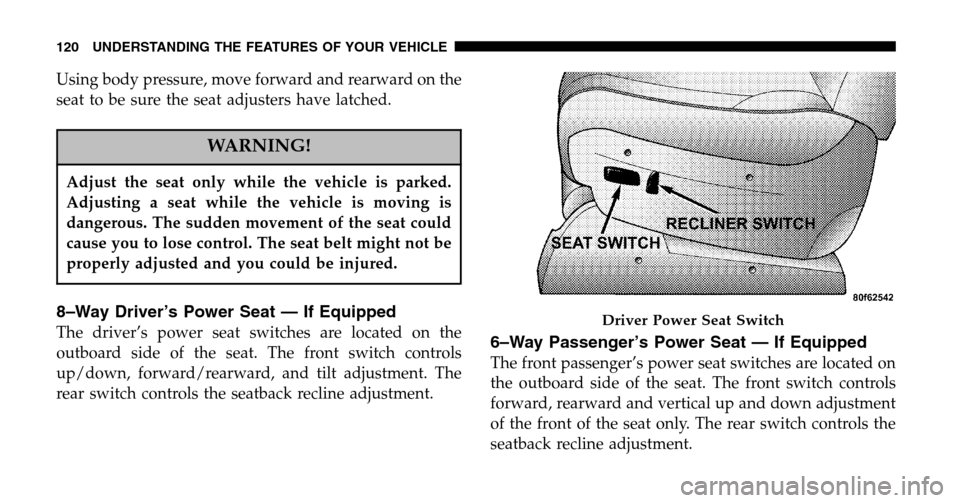
8–Way Driver’s Power Seat — If Equipped
The driver’s power seat switches are located on the
outboard side of the seat. The front switch controls
up/down, forward/rearward, and tilt adjustment. The
rear switch controls the seatback recline adjustment.6–Way Passenger’s Power Seat — If Equipped
The front passenger’s power seat switches are located on
the outboard side of the seat. The front switch controls
forward, rearward and vertical up and down adjustment
of the front of the seat only. The rear switch controls the
seatback recline adjustment.
Driver Power Seat Switch
120 UNDERSTANDING THE FEATURES OF YOUR VEHICLE