2006 CHEVROLET SILVERADO seats
[x] Cancel search: seatsPage 45 of 594
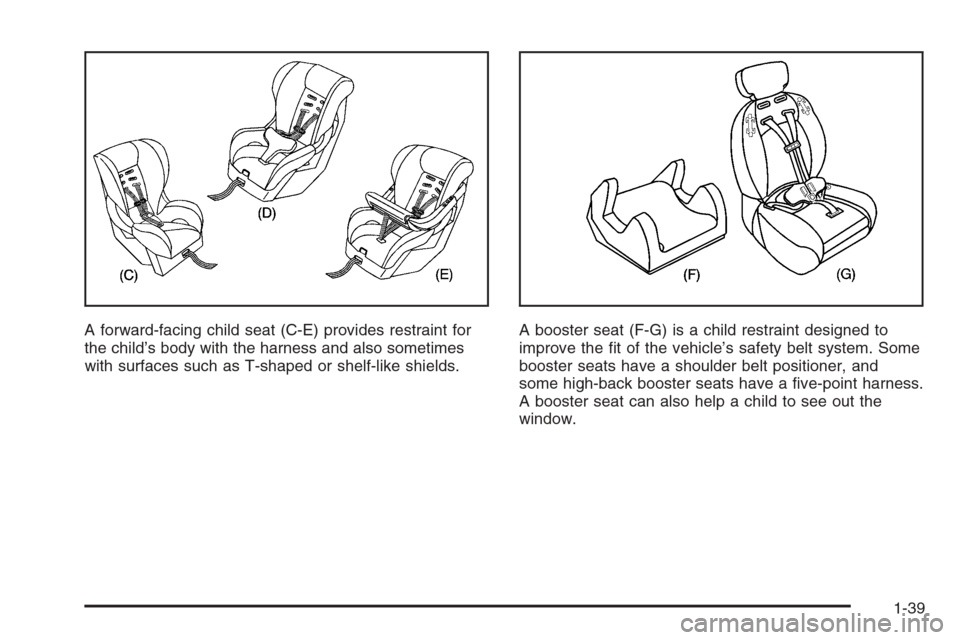
A forward-facing child seat (C-E) provides restraint for
the child’s body with the harness and also sometimes
with surfaces such as T-shaped or shelf-like shields.A booster seat (F-G) is a child restraint designed to
improve the t of the vehicle’s safety belt system. Some
booster seats have a shoulder belt positioner, and
some high-back booster seats have a ve-point harness.
A booster seat can also help a child to see out the
window.
1-39
Page 47 of 594
To help reduce the chance of injury, the child restraint
must be secured in the vehicle. Child restraint systems
must be secured in vehicle seats by lap belts or the
lap belt portion of a lap-shoulder belt, or by the LATCH
system. SeeLower Anchors and Tethers for Children
(LATCH) on page 1-44for more information. A child can
be endangered in a crash if the child restraint is not
properly secured in the vehicle.
When securing an add-on child restraint, refer to the
instructions that come with the restraint which may be on
the restraint itself or in a booklet, or both, and to this
manual. The child restraint instructions are important, so
if they are not available, obtain a replacement copy
from the manufacturer.
Keep in mind that an unsecured child restraint can
move around in a collision or sudden stop and injure
people in the vehicle. Be sure to properly secure
any child restraint in your vehicle — even when no child
is in it.Securing the Child Within the Child
Restraint
There are several systems for securing the child within
the child restraint. One system, the three-point
harness, has straps that come down over each of the
infant’s shoulders and buckle together at the crotch. The
ve-point harness system has two shoulder straps,
two hip straps, and a crotch strap. A shield may take the
place of hip straps. A T-shaped shield has shoulder
straps that are attached to a at pad which rests
low against the child’s body. A shelf- or armrest-type
shield has straps that are attached to a wide, shelf-like
shield that swings up or to the side.
{CAUTION:
A child can be seriously injured or killed in a
crash if the child is not properly secured in the
child restraint. Make sure the child is properly
secured, following the instructions that came
with that restraint.
Because there are different systems, it is important to
refer to the instructions that come with the restraint.
A child can be endangered in a crash if the child is not
properly secured in the child restraint.
1-41
Page 53 of 594
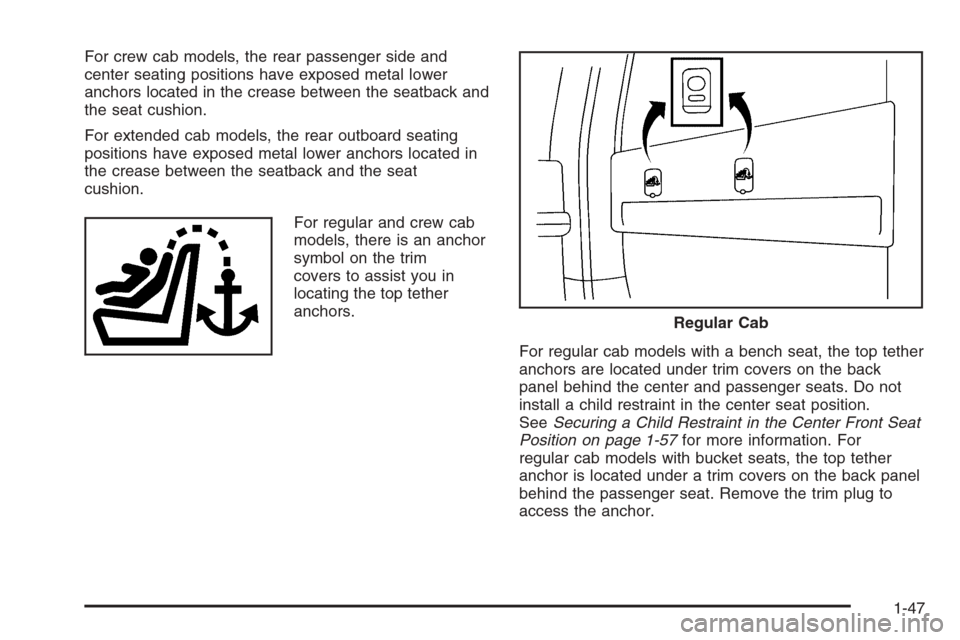
For crew cab models, the rear passenger side and
center seating positions have exposed metal lower
anchors located in the crease between the seatback and
the seat cushion.
For extended cab models, the rear outboard seating
positions have exposed metal lower anchors located in
the crease between the seatback and the seat
cushion.
For regular and crew cab
models, there is an anchor
symbol on the trim
covers to assist you in
locating the top tether
anchors.
For regular cab models with a bench seat, the top tether
anchors are located under trim covers on the back
panel behind the center and passenger seats. Do not
install a child restraint in the center seat position.
SeeSecuring a Child Restraint in the Center Front Seat
Position on page 1-57for more information. For
regular cab models with bucket seats, the top tether
anchor is located under a trim covers on the back panel
behind the passenger seat. Remove the trim plug to
access the anchor.
Regular Cab
1-47
Page 54 of 594
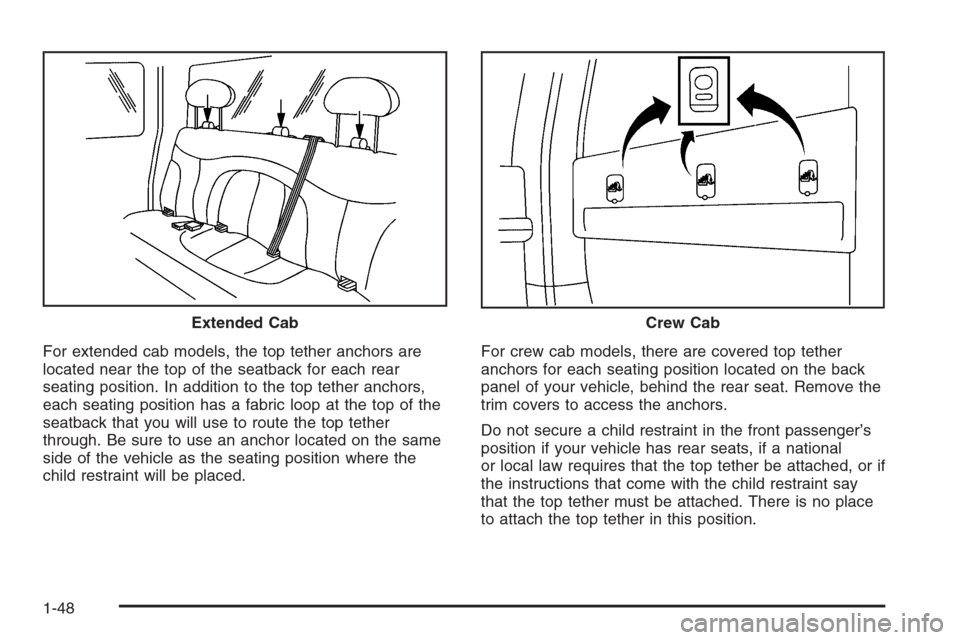
For extended cab models, the top tether anchors are
located near the top of the seatback for each rear
seating position. In addition to the top tether anchors,
each seating position has a fabric loop at the top of the
seatback that you will use to route the top tether
through. Be sure to use an anchor located on the same
side of the vehicle as the seating position where the
child restraint will be placed.For crew cab models, there are covered top tether
anchors for each seating position located on the back
panel of your vehicle, behind the rear seat. Remove the
trim covers to access the anchors.
Do not secure a child restraint in the front passenger’s
position if your vehicle has rear seats, if a national
or local law requires that the top tether be attached, or if
the instructions that come with the child restraint say
that the top tether must be attached. There is no place
to attach the top tether in this position. Extended Cab
Crew Cab
1-48
Page 64 of 594
Securing a Child Restraint in the
Right Front Seat Position
(Crew Cab)
Your vehicle has a right front passenger airbag.
Neverput a rear-facing child restraint in the right
front passenger’s seat. Here is why:
{CAUTION:
A child in a rear-facing child restraint can be
seriously injured or killed if the right front
passenger’s airbag inates. This is because
the back of the rear-facing child restraint
would be very close to the inating airbag.
Always secure a rear-facing child restraint in
a rear seat.
A rear seat is a safer place to secure a forward-facing
child restraint. If you need to secure a forward-facing
child restraint in the right front seat position, see
Where to Put the Restraint on page 1-42.If your child restraint is equipped with the LATCH
system, seeLower Anchors and Tethers for Children
(LATCH) on page 1-44.
There is no top tether anchor in the right front
passenger’s position. Do not secure a child seat in this
position if a national or local law requires that the
top tether be anchored, or if the instructions that come
with the child restraint say that the top tether must
be anchored. SeeLower Anchors and Tethers
for Children (LATCH) on page 1-44if your child restraint
has a top tether.
You will be using the lap-shoulder belt to secure the
restraint in this position. Be sure to follow the
instructions that came with the child restraint. Secure
the child in the child restraint when and as the
instructions say.
1. Because your vehicle has a right front passenger’s
frontal airbag, always move the seat as far back as
it will go before securing a forward-facing child
restraint. SeeManual Seats on page 1-3orPower
Seats on page 1-4.
2. Put the child restraint on the seat.
3. Pick up the latch plate, and run the lap and shoulder
portions of the vehicle’s safety belt through or
around the restraint. The child restraint instructions
will show you how.
1-58
Page 68 of 594
Never put a rear facing child restraint in the right front
passenger’s seat unless the airbag is off. Here is why:
{CAUTION:
A child in a rear-facing child restraint can be
seriously injured or killed if the right front
passenger’s airbag inates. This is because
the back of the rear-facing child restraint
would be very close to the inating airbag. Be
sure the airbag is off before using a rear-facing
child restraint in the right front seat position. If
you secure a forward-facing child restraint in
the right front seat, always move the right front
passenger seat as far back as it will go.
A rear seat is a safer place to secure a forward facing
child restraint. SeeWhere to Put the Restraint on
page 1-42. If you need to secure a forward-facing child
restraint in the right front seat position, move the
seat as far back as it will go before securing a
forward-facing child restraint. SeeManual Seats on
page 1-3orPower Seats on page 1-4.
{CAUTION:
If the airbag readiness light in the instrument
panel cluster ever comes on when you have
turned off the airbag, it means that something
may be wrong with the airbag system. The
right front passenger’s airbag could inate
even though the switch is off. If this ever
happens, have the vehicle serviced promptly.
Until you have the vehicle serviced, do not let
anyone whom the national government has
identied as a member of a passenger airbag
risk group sit in the right front passenger’s
position (for example, do not secure a
rear-facing child restraint in the right front
passenger’s seat). SeeAirbag Off Switch on
page 1-78.
If your child restraint is equipped with the LATCH
system, seeLower Anchors and Tethers for Children
(LATCH) on page 1-44.
1-62
Page 69 of 594
If your vehicle has a rear seat, there is no top tether
anchor at the right front seating position. Do not secure
a child seat in this position if a national or local law
requires that the top tether be anchored or if the
instructions that come with the child restraint say that
the top tether must be anchored. SeeLower Anchors
and Tethers for Children (LATCH) on page 1-44if
the child restraint has a top tether.
You will be using the lap-shoulder belt to secure the
child restraint in this position. Be sure to follow the
instructions that came with the child restraint. Secure
the child in the child restraint when and as the
instructions say.
1. Your vehicle has a right front passenger’s frontal
airbag. SeeAirbag Off Switch on page 1-78.If
your child restraint is forward-facing, move the seat
as far back as it will go before securing the
restraint in this seat. SeeManual Seats on page 1-3
orPower Seats on page 1-4. If you need to use a
rear-facing child restraint in this seat, make sure the
airbag is off once the child restraint has been
installed.
When the airbag off switch has turned off the right
front passenger’s frontal airbag, the off indicator
in the airbag off light should light and stay lit when
you turn the ignition to RUN or START. See
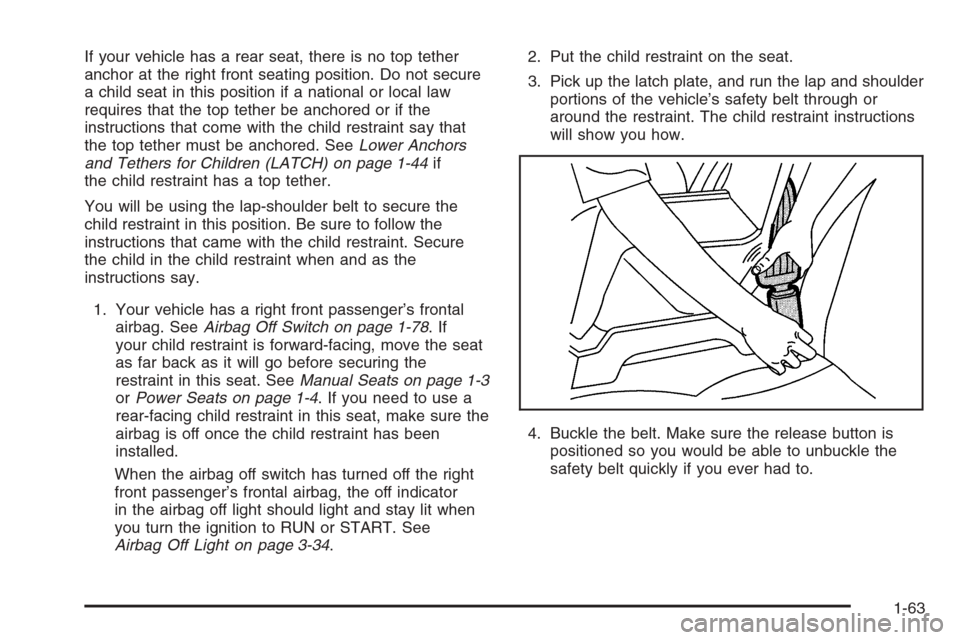
Airbag Off Light on page 3-34.2. Put the child restraint on the seat.
3. Pick up the latch plate, and run the lap and shoulder
portions of the vehicle’s safety belt through or
around the restraint. The child restraint instructions
will show you how.
4. Buckle the belt. Make sure the release button is
positioned so you would be able to unbuckle the
safety belt quickly if you ever had to.
1-63
Page 74 of 594
If you need to secure a forward-facing child restraint in
the right front seat position, move the seat as far
back as it will go before securing the forward-facing
child restraint. SeePower Seats on page 1-4orManual
Seats on page 1-3.
If your child restraint is equipped with the LATCH
system, seeLower Anchors and Tethers for Children
(LATCH) on page 1-44.
If your vehicle has a rear seat, there is no top tether
anchor at the right front seating position. Do not secure
a child seat in this position if a national or local law
requires that the top tether be anchored or if the
instructions that come with the child restraint say that
the top tether must be anchored. SeeLower Anchors
and Tethers for Children (LATCH) on page 1-44if
the child restraint has a top tether.You will be using the lap-shoulder belt to secure the
child restraint in this position. Be sure to follow the
instructions that came with the child restraint. Secure
the child in the child restraint when and as the
instructions say.
1. Your vehicle has a right front passenger’s frontal
airbag. SeePassenger Sensing System on
page 1-80. General Motors recommends that
rear-facing child restraints be secured in a rear seat,
even if the airbag is off. If your child restraint is
forward-facing, move the seat as far back as it will
go before securing the child restraint in this
seat. SeePower Seats on page 1-4orManual
Seats on page 1-3.
When the passenger sensing system has turned off
the right front passenger’s frontal airbag, the off
indicator in the passenger airbag status indicator
should light and stay lit when you turn the ignition to
RUN or START. SeePassenger Airbag Status
Indicator on page 3-36.
2. Put the child restraint on the seat.
3. Pick up the latch plate, and run the lap and shoulder
portions of the vehicle’s safety belt through or
around the restraint. The child restraint instructions
will show you how.
1-68