2006 CHEVROLET HHR CD player
[x] Cancel search: CD playerPage 208 of 394
Now the album name is displayed on the second line
between the arrows and songs from the current album
will begin to play. Once all songs from that album are
played, the player will move to the next album in
alphabetic order on the CD-R and begin playing MP3 les
from that album.
To exit music navigator mode, press the pushbutton
below the Back label to return to normal MP3 playback.
BAND:Press this button to listen to the radio while a
CD is playing. The CD will remain safely inside the radio
for future listening.
CD/AUX (CD/Auxiliary):Press this button to play a
CD while listening to the radio. The CD icon and
a message showing disc and/or track number will
appear on the display while a CD is in the player. Press
this button again and the system will automatically
search for an auxiliary input device such as a portable
audio player. If a portable audio player is not connected,
“no input device found” will be displayed.CD Messages
CHECK DISC:If this message appears on the display
and/or the CD comes out, it could be for one of the
following reasons:
It is very hot. When the temperature returns to
normal, the CD should play.
You are driving on a very rough road. When the
road becomes smoother, the CD should play.
The CD is dirty, scratched, wet, or upside down.
The air is very humid. If so, wait about an hour and
try again.
There may have been a problem while burning
the CD.
The label may be caught in the CD player.
If the CD is not playing correctly, for any other reason,
try a known good CD.
If any error occurs repeatedly or if an error cannot be
corrected, contact your dealer. If the radio displays
an error message, write it down and provide it to your
dealer while reporting the problem.
3-76
Page 209 of 394
Using the Auxiliary Input Jack
Your radio system has an auxiliary input jack located on
the lower right side of the faceplate. This is not an
audio output; do not plug the headphone set into the
front auxiliary input jack. You can however, connect
an external audio device such as an iPod, laptop
computer, MP3 player, CD changer, or cassette tape
player, etc. to the auxiliary input jack for use as another
source for audio listening.
To use a portable audio player, connect a 3.5 mm
(1/8 inch) cable to the radio’s front auxiliary input jack.
When a device is connected, press the radio CD/AUX
button to begin playing audio from the device over
the car speakers.
O(Power/Volume):Turn this knob clockwise or
counterclockwise to increase or decrease the volume of
the portable player. You may need to do additional
volume adjustments from the portable device if
the volume does not go loud or soft enough.BAND:Press this button to listen to the radio while a
portable audio device is playing. The portable audio
device will continue playing, so you may want to stop it
or turn it off.
CD/AUX (CD/Auxiliary):Press this button to play a CD
while a portable audio device is playing. Press this
button again and the system will begin playing audio
from the connected portable audio player. If a portable
audio player is not connected, “no input device
found” will be displayed.
Theft-Deterrent Feature
THEFTLOCK®is designed to discourage theft of your
vehicle’s radio. The feature works automatically by
learning a portion of the Vehicle Identication
Number (VIN). If the radio is moved to a different
vehicle, it will not operate and LOCK or LOCKED will
appear on the display.
With THEFTLOCK
®activated, the radio will not operate
if stolen.
3-77
Page 211 of 394
Radio Reception
You may experience frequency interference and static
during normal radio reception if items such as cellphone
chargers, vehicle convenience accessories, and
external electronic devices are plugged into the
accessory power outlet. If there is interference or static,
unplug the item from the accessory power outlet.
AM
The range for most AM stations is greater than for FM,
especially at night. The longer range can cause station
frequencies to interfere with each other. For better radio
reception, most AM radio stations will boost the power
levels during the day, and then reduce these levels during
the night. Static can also occur when things like storms
and power lines interfere with radio reception. When this
happens, try reducing the treble on your radio.
FM Stereo
FM stereo will give the best sound, but FM signals
will reach only about 10 to 40 miles (16 to 65 km).
Tall buildings or hills can interfere with FM signals,
causing the sound to fade in and out.
XM™ Satellite Radio Service
XM™ Satellite Radio Service gives digital radio
reception from coast-to-coast in the 48 contiguous
United States, and in Canada (if available). Just as with
FM, tall buildings or hills can interfere with satellite
radio signals, causing the sound to fade in and out.
In addition, traveling or standing under heavy foliage,
bridges, garages, or tunnels may cause loss of
XM signal for a period of time. The radio may display
NO XM SIGNAL to indicate interference.
Care of Your CDs
Handle CDs carefully. Store them in their original cases
or other protective cases and away from direct
sunlight and dust. The CD player scans the bottom
surface of the disc. If the surface of a CD is damaged,
such as cracked, broken, or scratched, the CD will
not play properly or not at all. If the surface of a CD is
soiled, take a soft, lint free cloth or dampen a clean, soft
cloth in a mild, neutral detergent solution mixed with
water, and clean it. Make sure the wiping process starts
from the center to the edge.
Do not touch the bottom side of a CD while handling it;
this could damage the surface. Pick up CDs by
grasping the outer edges or the edge of the hole and
the outer edge.
3-79
Page 212 of 394
Care of the CD Player
The use of CD lens cleaners for CD players is not
advised, due to the risk of contaminating the internal
lens of the CD optics with lubricants.
Fixed Mast Antenna
This type of antenna is called a xed mast antenna.
It is mounted at the center of the roof, just behind
the windshield.
The mast antenna can withstand most car washes
without being damaged. If the mast should ever become
slightly bent, straighten it out by hand. If the mast is
badly bent, replace it.
Check occasionally to make sure the mast is still
tightened to the roof. If tightening is required,
tighten by hand.
If you are putting a protective cover over the vehicle,
remove the mast by hand.
XM™ Satellite Radio Antenna
System
The XM™ Satellite Radio antenna is located on the roof
of your vehicle. Keep this antenna clear of snow and
ice build up for clear radio reception.
If your vehicle has a sunroof, the performance of the
XM™ system may be affected if the sunroof is open.
Loading items onto the roof of your vehicle can interfere
with the performance of the XM™ system. Make sure
the XM™ Satellite Radio antenna is not obstructed.
3-80
Page 381 of 394
A
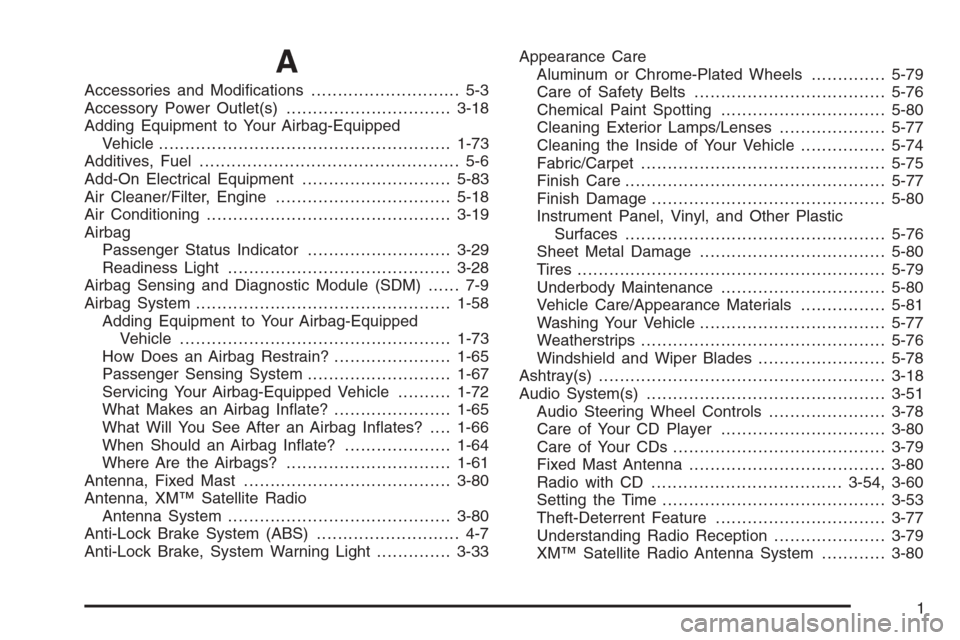
Accessories and Modications............................ 5-3
Accessory Power Outlet(s)...............................3-18
Adding Equipment to Your Airbag-Equipped
Vehicle.......................................................1-73
Additives, Fuel................................................. 5-6
Add-On Electrical Equipment............................5-83
Air Cleaner/Filter, Engine.................................5-18
Air Conditioning..............................................3-19
Airbag
Passenger Status Indicator...........................3-29
Readiness Light..........................................3-28
Airbag Sensing and Diagnostic Module (SDM)...... 7-9
Airbag System................................................1-58
Adding Equipment to Your Airbag-Equipped
Vehicle...................................................1-73
How Does an Airbag Restrain?......................1-65
Passenger Sensing System...........................1-67
Servicing Your Airbag-Equipped Vehicle..........1-72
What Makes an Airbag Inate?......................1-65
What Will You See After an Airbag Inates?....1-66
When Should an Airbag Inate?....................1-64
Where Are the Airbags?...............................1-61
Antenna, Fixed Mast.......................................3-80
Antenna, XM™ Satellite Radio
Antenna System..........................................3-80
Anti-Lock Brake System (ABS)........................... 4-7
Anti-Lock Brake, System Warning Light..............3-33Appearance Care
Aluminum or Chrome-Plated Wheels..............5-79
Care of Safety Belts....................................5-76
Chemical Paint Spotting...............................5-80
Cleaning Exterior Lamps/Lenses....................5-77
Cleaning the Inside of Your Vehicle................5-74
Fabric/Carpet..............................................5-75
Finish Care.................................................5-77
Finish Damage............................................5-80
Instrument Panel, Vinyl, and Other Plastic
Surfaces.................................................5-76
Sheet Metal Damage...................................5-80
Tires..........................................................5-79
Underbody Maintenance...............................5-80
Vehicle Care/Appearance Materials................5-81
Washing Your Vehicle...................................5-77
Weatherstrips..............................................5-76
Windshield and Wiper Blades........................5-78
Ashtray(s)......................................................3-18
Audio System(s).............................................3-51
Audio Steering Wheel Controls......................3-78
Care of Your CD Player...............................3-80
Care of Your CDs ........................................3-79
Fixed Mast Antenna.....................................3-80
Radio with CD....................................3-54, 3-60
Setting the Time..........................................3-53
Theft-Deterrent Feature................................3-77
Understanding Radio Reception.....................3-79
XM™ Satellite Radio Antenna System............3-80
1
Page 382 of 394
Automatic Door Lock.......................................2-11
Automatic Headlamp System............................3-15
Automatic Transaxle
Fluid..........................................................5-19
Operation...................................................2-27
B
Battery..........................................................5-32
Run-Down Protection...................................3-17
Before Leaving on a Long Trip.........................4-23
Brake
Anti-Lock Brake System (ABS)........................ 4-7
Emergencies................................................ 4-9
Parking......................................................2-32
System Warning Light..................................3-32
Brakes..........................................................5-30
Braking........................................................... 4-6
Braking in Emergencies..................................... 4-9
Break-In, New Vehicle.....................................2-21
Bulb Replacement...........................................5-41
Center High-Mounted Stoplamp (CHMSL)........5-43
Halogen Bulbs............................................5-41
Headlamp Aiming........................................5-38
Headlamps, Front Turn Signal, and
Parking Lamps.........................................5-42Bulb Replacement (cont.)
Replacement Bulbs......................................5-45
Taillamps, Turn Signal, Stoplamps and
Back-up Lamps........................................5-44
Buying New Tires...........................................5-55
C
Calibration.............................................2-38, 2-40
California Fuel.................................................. 5-6
California Proposition 65 Warning....................... 5-3
Canadian Owners................................................ ii
Capacities and Specications............................5-88
Carbon Monoxide...................2-13, 2-36, 4-26, 4-39
Care of
Safety Belts................................................5-76
Your CD Player...........................................3-80
Your CDs ...................................................3-79
Center High-Mounted Stoplamp (CHMSL)...........5-43
Chains, Tire...................................................5-60
Charging System Light....................................3-31
Check
Engine Light...............................................3-35
Checking Things Under the Hood......................5-10
Chemical Paint Spotting...................................5-80
2
Page 390 of 394
Q
Questions and Answers About Safety Belts.........1-17
R
Radios..........................................................3-51
Care of Your CD Player...............................3-80
Care of Your CDs ........................................3-79
Radio with CD....................................3-54, 3-60
Setting the Time..........................................3-53
Theft-Deterrent............................................3-77
Understanding Reception..............................3-79
Rear Compartment Storage Panel/Cover............2-46
Rear Door Security Locks................................2-12
Rear Reading Lamps......................................3-17
Rear Safety Belt Comfort Guides......................1-30
Rear Seat Passengers, Safety Belts..................1-27
Rear Storage Area..........................................2-45
Rear Windshield Washer/Wiper.........................3-10
Rearview Mirror, Automatic Dimming with
OnStar
®and Compass.................................2-38
Rearview Mirror, Automatic Dimming with
OnStar
®, Compass and Temperature Display . . . 2-40
Rearview Mirrors.............................................2-38Reclining Seatbacks.......................................... 1-5
Recommended Fluids and Lubricants.................6-11
Recreational Vehicle Towing.............................4-37
Remote Keyless Entry System............................ 2-4
Remote Keyless Entry System, Operation............ 2-5
Removing the Flat Tire and Installing the
Spare Tire..................................................5-65
Removing the Spare Tire and Tools...................5-63
Replacement Bulbs.........................................5-45
Reporting Safety Defects
Canadian Government..................................7-14
General Motors...........................................7-14
United States Government............................7-13
Restraint System Check
Checking the Restraint Systems....................1-74
Replacing Restraint System Parts
After a Crash..........................................1-74
Retained Accessory Power (RAP)......................2-24
Right Front Passenger Position, Safety Belts......1-27
Roadside
Assistance Program....................................... 7-6
Rocking Your Vehicle to Get it Out....................4-31
Roof Rack System..........................................2-48
Running the Engine While Parked.....................2-37
10