Page 282 of 394

Checking Coolant
The coolant recovery tank
cap has this symbol on it.
The tank is located in
the engine compartment
toward the front of the
engine on the passenger’s
side of the vehicle.
SeeEngine Compartment Overview on page 5-12for
more information on location.
The vehicle must be on a level surface when checking
the coolant level.
When the engine is cold, the coolant level should be
at the COLD FILL line or a little higher. The COLD FILL
line is near the bottom of the tank and sticks out
from the rear of the tank.
Adding Coolant
If more coolant is needed, add the proper DEX-COOL®
coolant mixture at the coolant recovery tank, but
only when the engine is cool.
If the coolant recovery tank is completely empty, a
special ll procedure is necessary. SeeCooling System
on page 5-25for more information.
{CAUTION:
Turning the radiator pressure cap when the
engine and radiator are hot can allow steam
and scalding liquids to blow out and burn
you badly. With the coolant recovery tank,
you will almost never have to add coolant at
the radiator. Never turn the radiator pressure
cap — even a little — when the engine and
radiator are hot.
5-22
Page 285 of 394
Cooling System
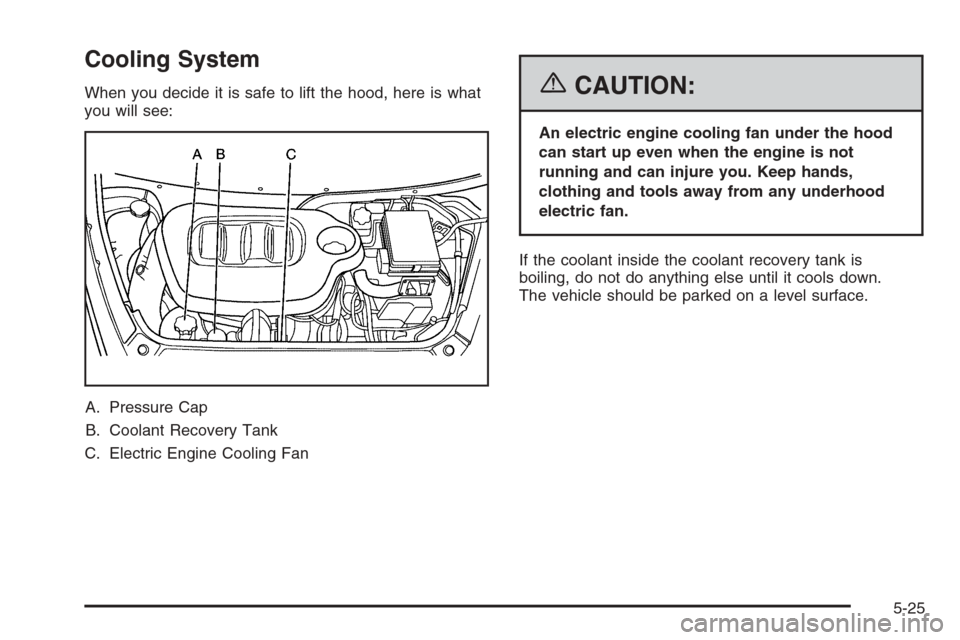
When you decide it is safe to lift the hood, here is what
you will see:
A. Pressure Cap
B. Coolant Recovery Tank
C. Electric Engine Cooling Fan{CAUTION:
An electric engine cooling fan under the hood
can start up even when the engine is not
running and can injure you. Keep hands,
clothing and tools away from any underhood
electric fan.
If the coolant inside the coolant recovery tank is
boiling, do not do anything else until it cools down.
The vehicle should be parked on a level surface.
5-25
Page 286 of 394

When the engine is cold, the coolant level should
be at or above the COLD FILL line. If it is not, you
may have a leak at the pressure cap or in the radiator
hoses, heater hoses, radiator, water pump, or
somewhere in the cooling system.
{CAUTION:
Heater and radiator hoses, and other engine
parts, can be very hot. Do not touch them.
If you do, you can be burned.
Do not run the engine if there is a leak. If you
run the engine, it could lose all coolant. That
could cause an engine re, and you could be
burned. Get any leak xed before you drive
the vehicle.
If there seems to be no leak, with the engine on, check
to see if the electric engine cooling fan is running. If
the engine is overheating, the fan should be running.
If it is not, your vehicle needs service.Notice:Engine damage from running your engine
without coolant is not covered by your warranty.
Notice:Using coolant other than DEX-COOL
®may
cause premature engine, heater core or radiator
corrosion. In addition, the engine coolant may
require changing sooner, at 30,000 miles (50 000 km)
or 24 months, whichever occurs rst. Any repairs
would not be covered by your warranty. Always use
DEX-COOL
®(silicate-free) coolant in your vehicle.
How to Add Coolant to the Cooling
System
Notice:Your engine has a specic cooling system
drain and ll procedure. Failure to follow this
procedure could cause your engine to overheat
and be severely damaged. If your engine’s cooling
system needs to be drained and re-lled, please
see your dealer.
If you have not found a problem yet, but the coolant
level in the coolant recovery tank is below the COLD
FILL line, add a 50/50 mixture of clean, drinkable
water and DEX-COOL
®engine coolant at the coolant
recovery tank. SeeEngine Coolant on page 5-20
for more information.
5-26
Page 287 of 394

If no coolant is visible in the coolant recovery tank,
add coolant at the pressure cap as follows:
{CAUTION:
Steam and scalding liquids from a hot cooling
system can blow out and burn you badly.
They are under pressure, and if you turn the
pressure cap — even a little — they can come
out at high speed. Never turn the cap when the
cooling system, including the pressure cap, is
hot. Wait for the cooling system and pressure
cap to cool if you ever have to turn the
pressure cap.
{CAUTION:
Adding only plain water to your cooling
system can be dangerous. Plain water, or
some other liquid such as alcohol, can boil
before the proper coolant mixture will. Your
vehicle’s coolant warning system is set for the
proper coolant mixture. With plain water or the
wrong mixture, your engine could get too hot
but you would not get the overheat warning.
Your engine could catch re and you or others
could be burned. Use a 50/50 mixture of clean,
drinkable water and DEX-COOL
®coolant.
Notice:In cold weather, water can freeze and crack
the engine, radiator, heater core and other parts.
Use the recommended coolant and the proper
coolant mixture.
5-27
Page 288 of 394

{CAUTION:
You can be burned if you spill coolant on hot
engine parts. Coolant contains ethylene glycol
and it will burn if the engine parts are hot
enough. Do not spill coolant on a hot engine.
1. You can remove the
pressure cap when
the cooling system,
including the pressure
cap and upper
radiator hose, is no
longer hot. Turn
the pressure cap slowly
counterclockwise.
If you hear a hiss, wait for that to stop. A hiss
means there is still some pressure left to be vented.
2. Then keep turning the pressure cap and remove it.
3. Add the proper DEX-COOL
®coolant mixture to
the coolant ll port, up to the base of the port.
SeeEngine Coolant on page 5-20for more
information about the proper coolant mixture.4. Rinse or wipe any spilled coolant from the engine
and the compartment.
5. Then ll the coolant recovery tank to the COLD
FILL line.
6. Put the cap back on the coolant recovery tank,
but leave the pressure cap off.
7. Start the engine and let it run until you can feel
the upper radiator hose getting hot. Watch out
for the engine cooling fan.
8. By this time, the coolant level inside the radiator
ller port may be lower. If the level is lower, add
more of the proper DEX-COOL
®coolant mixture
through the ll port until the level reaches the
base of the ll port.
9. Then replace the pressure cap. At any time during
this procedure, if coolant begins to ow out of the
ll port, reinstall the pressure cap. Be sure the
pressure cap is hand-tight and fully seated.
10. When the engine has cooled, check the coolant in
the coolant recovery tank. The level in the coolant
recovery tank should be at the COLD FILL line
when the engine is cold.
5-28
Page 319 of 394
Wheel Replacement
Replace any wheel that is bent, cracked, or badly
rusted or corroded. If wheel nuts keep coming loose,
the wheel, wheel bolts, and wheel nuts should be
replaced. If the wheel leaks air, replace it (except some
aluminum wheels, which can sometimes be repaired).
See your dealer if any of these conditions exist.
Your dealer will know the kind of wheel you need.
Each new wheel should have the same load-carrying
capacity, diameter, width, offset and be mounted
the same way as the one it replaces.
If you need to replace any of your wheels, wheel
bolts, or wheel nuts, replace them only with new GM
original equipment parts. This way, you will be sure to
have the right wheel, wheel bolts, and wheel nuts
for your vehicle.{CAUTION:
Using the wrong replacement wheels, wheel
bolts, or wheel nuts on your vehicle can be
dangerous. It could affect the braking and
handling of your vehicle, make your tires lose
air and make you lose control. You could have
a collision in which you or others could be
injured. Always use the correct wheel, wheel
bolts, and wheel nuts for replacement.
Notice:The wrong wheel can also cause problems
with bearing life, brake cooling, speedometer or
odometer calibration, headlamp aim, bumper height,
vehicle ground clearance, and tire or tire chain
clearance to the body and chassis.
SeeChanging a Flat Tire on page 5-62for more
information.
5-59
Page 346 of 394
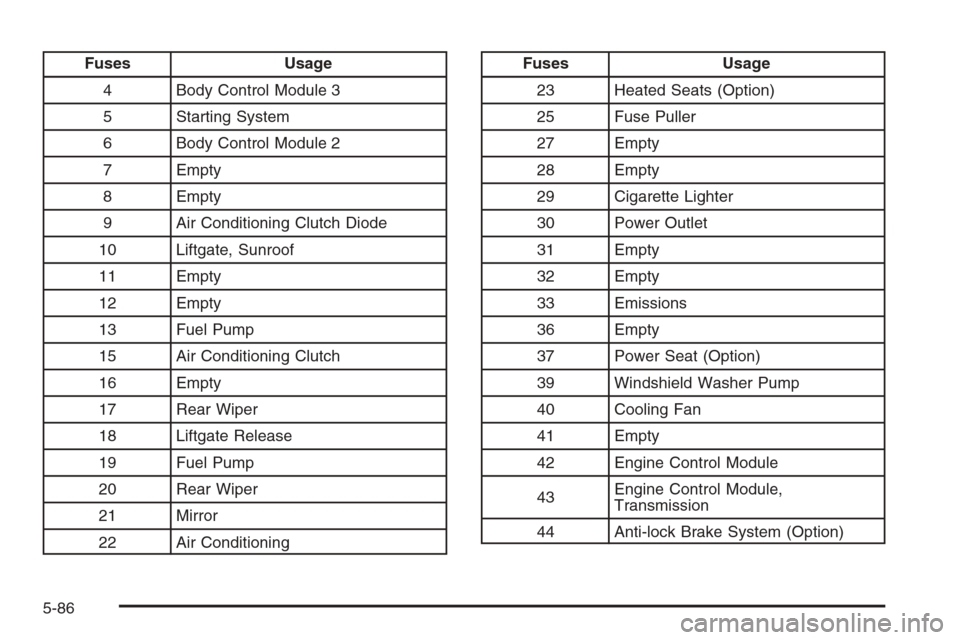
Fuses Usage
4 Body Control Module 3
5 Starting System
6 Body Control Module 2
7 Empty
8 Empty
9 Air Conditioning Clutch Diode
10 Liftgate, Sunroof
11 Empty
12 Empty
13 Fuel Pump
15 Air Conditioning Clutch
16 Empty
17 Rear Wiper
18 Liftgate Release
19 Fuel Pump
20 Rear Wiper
21 Mirror
22 Air ConditioningFuses Usage
23 Heated Seats (Option)
25 Fuse Puller
27 Empty
28 Empty
29 Cigarette Lighter
30 Power Outlet
31 Empty
32 Empty
33 Emissions
36 Empty
37 Power Seat (Option)
39 Windshield Washer Pump
40 Cooling Fan
41 Empty
42 Engine Control Module
43Engine Control Module,
Transmission
44 Anti-lock Brake System (Option)
5-86
Page 347 of 394
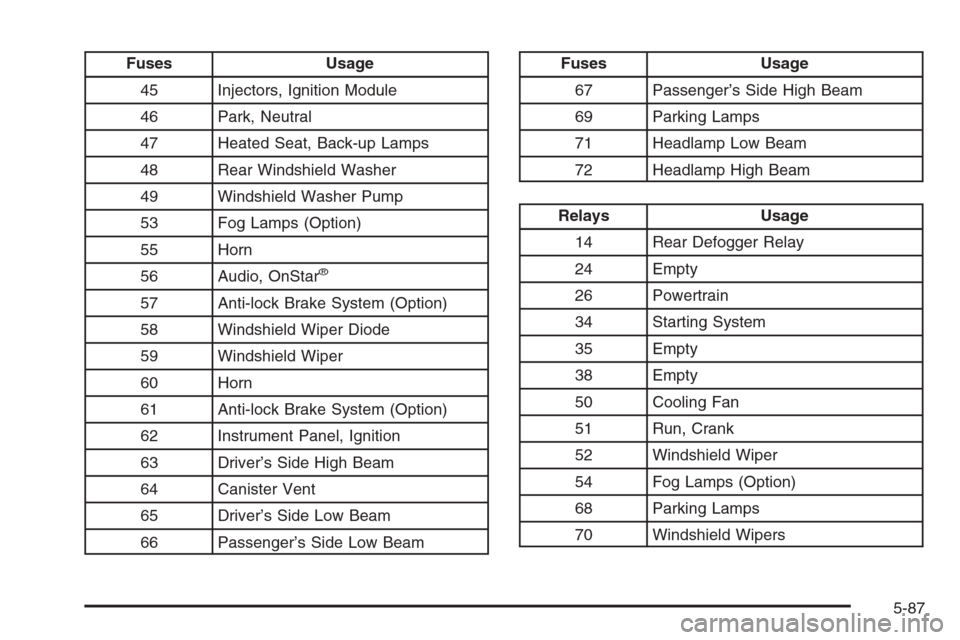
Fuses Usage
45 Injectors, Ignition Module
46 Park, Neutral
47 Heated Seat, Back-up Lamps
48 Rear Windshield Washer
49 Windshield Washer Pump
53 Fog Lamps (Option)
55 Horn
56 Audio, OnStar
®
57 Anti-lock Brake System (Option)
58 Windshield Wiper Diode
59 Windshield Wiper
60 Horn
61 Anti-lock Brake System (Option)
62 Instrument Panel, Ignition
63 Driver’s Side High Beam
64 Canister Vent
65 Driver’s Side Low Beam
66 Passenger’s Side Low Beam
Fuses Usage
67 Passenger’s Side High Beam
69 Parking Lamps
71 Headlamp Low Beam
72 Headlamp High Beam
Relays Usage
14 Rear Defogger Relay
24 Empty
26 Powertrain
34 Starting System
35 Empty
38 Empty
50 Cooling Fan
51 Run, Crank
52 Windshield Wiper
54 Fog Lamps (Option)
68 Parking Lamps
70 Windshield Wipers
5-87