2005 SKODA OCTAVIA tow
[x] Cancel search: towPage 66 of 315

Lights and Visibility65
Using the systemSafetyDriving TipsGeneral MaintenanceBreakdown assistanceTechnical Data
WARNING
The automatic driving lamp control only operates as a support. The
driver is not released from his responsibility to inspect the light
and if necessary to switch on the light depending on the light
conditions. The light sensor cannot detect for example rain or
snow. Always switch on the low beam
under these conditions
as well as when driving in the dark!
Note
•Do not affix any stickers in front of the light sensor, so that you do not
impair its function or put it out of operation.
•The same principles as for using the automatic driving lamp control
also apply to the light which is switched on manually ⇒page 63.
Fog lights*
Switching on the fog lights
– First of all turn the light switch ⇒fig. 43 into position
or .
– After this pull the light switch out to the first detent .
When the fog lights are operating, the symbol next to the light switch is
illuminated more intensely.
The rear fog light
Switching on the rear fog light
– First of all turn the light switch ⇒fig. 43 into position
or .
– Pull the light switch out to the second detent .
The rear fog light warning light ⇒ page 30 lights up in the instrument
cluster when the fog light is switched off.
Only the rear fog light of the trailer lights up automatically when you are
towing a trailer using a factory-fitted towing device which is fitted with
the rear fog light.
The rear fog light is located in the rear light array on the driver's side.
Caution
The rear fog light should only be switched on if visibility is particularly poor
(conform with any varying legal provisions) to avoid dazzling vehicles
behind your vehicle.
Fig. 43 Dash panel:
Light switch
A1
A2
s24s.book Page 65 Thursday, November 24, 2005 12:27 PM
Page 73 of 315

Lights and Visibility
72
Entry lighting*
The lighting is positioned on the bottom edge of the exterior mirror.
The light beam is directed towards the entry area of the front door.
The light comes on after the doors have been locked or on opening the
boot lid. The light goes out after switching on the ignition or up to 30
seconds after closing all the doors, the bonnet and the boot lid.
If a door, the bonnet or the boot lid remains open, the light goes out within
2 minutes if the ignition is switched off.
WARNING
If the entry light comes on, do not touch its cover - risk of burns!
Visibility
Rear window heater
– You can switch the rear window heater on or off by pressing
the switch
⇒ fig. 51 - the indicator light in the switch comes
on or goes out.
The rear window heater only operates when the engine is running.
The rear window heater switches off automatically after 10 minutes.
For the sake of the environment
You should switch off the rear window heater as soon as the rear window
is clear. The reduced current consumption will have a favourable effect on
fuel economy ⇒page 227, “Saving electricity”.
Fig. 51 Switch for rear
window heater
s24s.book Page 72 Thursday, November 24, 2005 12:27 PM
Page 74 of 315

Lights and Visibility73
Using the systemSafetyDriving TipsGeneral MaintenanceBreakdown assistanceTechnical Data
Note
•The position and the shape of the switch can differ depending on
equipment installed in the vehicle.
•If the on-board voltage drops, the rear window heater is switched off
automatically, in order to provide sufficient electrical energy for the engine
control.
Sun visors
You can pull the sun visor for the driver or front passenger out of the fixture
and swivel it toward the door in the direction of the arrow ⇒fig. 52 .
The vanity mirrors* in the sun visors are provided with covers. Push the
cover in direction of arrow .
WARNING
The sun visors must not be swivelled to the side windows into the
deployment area of the head airbags if any objects, such as ball-
point pens etc. are attached to them. This might result in injuries to
the occupants if the head airbag is deployed.
Fig. 52 Sun visor:
swivelling out
A1
A2
s24s.book Page 73 Thursday, November 24, 2005 12:27 PM
Page 76 of 315
Lights and Visibility75
Using the systemSafetyDriving TipsGeneral MaintenanceBreakdown assistanceTechnical Data
Windshield wiper and wash system
Windscreen wipers
You can operate the windscreen wipers and automatic
wipe/wash using the windscreen wiper lever.
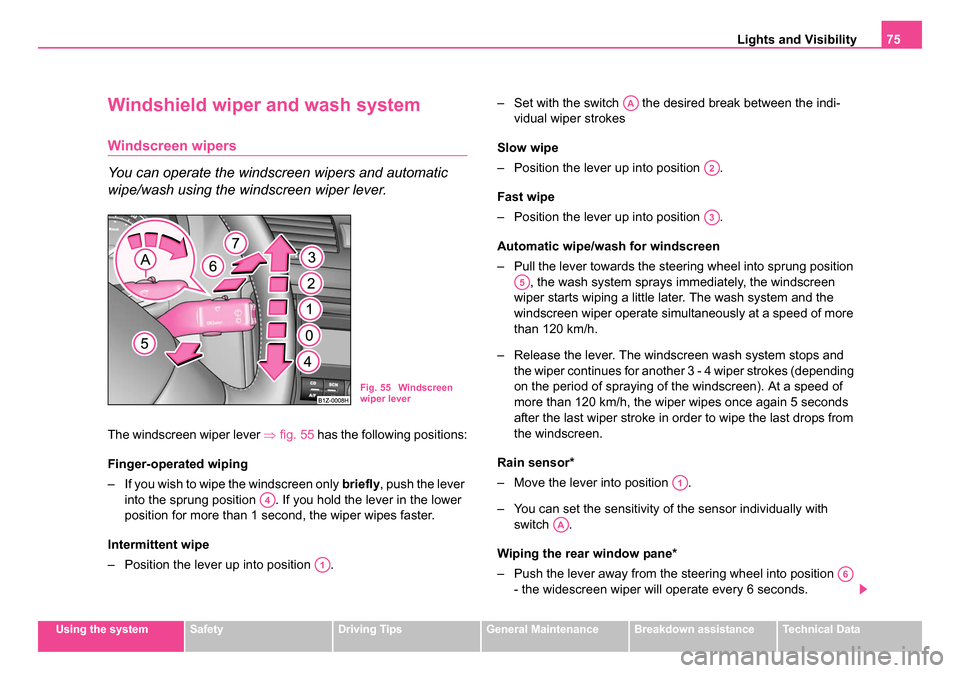
The windscreen wiper lever ⇒fig. 55 has the following positions:
Finger-operated wiping
– If you wish to wipe the windscreen only briefly, push the lever
into the sprung position . If you hold the lever in the lower
position for more than 1 second, the wiper wipes faster.
Intermittent wipe
– Position the lever up into position . – Set with the switch the desired break between the indi-
vidual wiper strokes
Slow wipe
– Position the lever up into position .
Fast wipe
– Position the lever up into position .
Automatic wipe/w ash for windscreen
– Pull the lever towards the steering wheel into sprung position , the wash system sprays immediately, the windscreen
wiper starts wiping a little later. The wash system and the
windscreen wiper operate simultaneously at a speed of more
than 120 km/h.
– Release the lever. The windscreen wash system stops and the wiper continues for another 3 - 4 wiper strokes (depending
on the period of spraying of the windscreen). At a speed of
more than 120 km/h, the wiper wipes once again 5 seconds
after the last wiper stroke in order to wipe the last drops from
the windscreen.
Rain sensor*
– Move the lever into position .
– You can set the sensitivity of the sensor individually with switch .
Wiping the rear window pane*
– Push the lever away from the steering wheel into position - the widescreen wiper will operate every 6 seconds.
Fig. 55 Windscreen
wiper lever
A4
A1
AA
A2
A3
A5
A1
AA
A6
s24s.book Page 75 Thursday, November 24, 2005 12:27 PM
Page 83 of 315
Seats and Stowage
82
Seats and Stowage
Front seats
Basic information
The front seats have a wide range of different settings and can thus be
matched to the physical characteristics of the driver and front passenger.
Correct adjustment of the seats is particularly important for
•safely and quickly reaching the controls,
•a relaxed, fatigue-free body position,
•achieving the maximum protection offered by the seat belts and
the airbag system.
WARNING
•Never transport more occupants than the maximum seating in
the vehicle.
•Each occupant must correctly fasten the seat belt belonging to
the seat. Children must be fastened ⇒page 202, “Transporting chil-
dren safely” with a suitable restraint system.
•The front seats and the head restraints must always be adjusted
to match the body size of the seat occupant as well as the seat belts
must always be correctly fastened in order to provide an optimal
protection for you and your occupants.
•Always keep your feet in the footwell when the car is being
driven - never place your feet on the instrument panel, out of the
window or on the surfaces of the seats. This is particularly impor-
tant for the front seat passenger. You will be exposed to increased
risk of injury if it becomes necessary to apply the brake or in the event of an accident. If an airbag is deployed, you may suffer fatal
injuries when adopting an incorrect seated position!
•It is important for the driver and front passenger to maintain a
distance of at least 25 cm from the steering wheel or dash panel.
Not maintaining this minimum distance will mean that the airbag
system will not be able to properly protect you - hazard! The front
seats and the head restraints must always also be correctly
adjusted to match the body size of the occupant.
•Ensure that there are no objects in the footwell as any objects
may get behind the pedals during a driving or braking manoeuvre.
You would then no longer be able to operate the clutch, to brake or
accelerate.
WARNING (continued)
s24s.book Page 82 Thursday, November 24, 2005 12:27 PM
Page 84 of 315

Seats and Stowage83
Using the systemSafetyDriving TipsGeneral MaintenanceBreakdown assistanceTechnical Data
Adjusting the front seats
Adjusting a seat in a forward/back direction
– Pull the lever ⇒page 83, fig. 60 up and push the seat into
the desired position.
– Release the lever and push the seat further until the lock is heard to engage.
Adjusting height of seat*
– Lift the seat if required by pulling or pumping lever upwards.
– Lower the seat if required by pushing or pumping lever downwards. Adjusting angl
e of backrest
– Relieve any pressure on the backrest (do not lean on it) and turn the handwheel ⇒page 83, fig. 60 to adjust the desired
angle of the backrest.
Adjusting lumbar support*
– Turn the handwheel until you have set the most comfort- able curvature of the seat upholstery in the area of your spine.
The driver's seat should be adjusted in such a way that the pedals can be
pressed to the floor with slightly bent legs.
The backrest on the driver's seat should be adjusted in such a way that
the upper point of the steering wheel can be easily reached with slightly
bent arms.
WARNING
•Only adjust the driver seat when the vehicle is stationary - risk
of injury!
•Take care when adjusting the sea t! Adjusting the seat without
care can lead to bruises or injuries.
•The backrests must not be angled too far back when driving
otherwise this will affect proper operation of the seat belts and of
the airbag system - risk of injury!
Fig. 60 Controls at
seat
A1
A1
A2
A2
A3
A4
s24s.book Page 83 Thursday, November 24, 2005 12:27 PM
Page 85 of 315

Seats and Stowage
84
Adjusting front seats electrically*
Adjusting seats
Adjusting seat
– Adopt the correct seated position ⇒page 82.
– Press switch or ⇒page 84, fig. 61 in the direction of the
desired setting.
Adjusting lumbar support
– Press the switch front ⇒page 84, fig. 61 in order to enlarge
the curvature of the lumbar support.
– Press the switch rear in order to reduce the curvature of the lumbar support. – Press the switch top in order to adjust the curvature of the
lumbar support higher.
– Press the switch bottom in order to adjust the curvature of the lumbar support lower.
Switch is operated in order to move the seat up/down and
forward/back, while switch is operated in order to move the backrest
forward or back.
WARNING
•Only adjust the driver seat when the vehicle is stationary - risk
of injury!
•Caution when adjusting the seat! You may suffer injuries or
bruises as a result of adjusting the seat without paying proper
attention.
•In view of the fact that the seats can also be adjusted when the
ignition is switched off (even when ignition key withdrawn), you
should never leave children unattended in the car.
•The backrests must not be angled too far back when driving
otherwise this will affect proper operation of the seat belts and of
the airbag system - risk of injury!
Note
If the movement of the seat is inadvertently interrupted during an adjust-
ment, once again press the switch in the appropriate direction and
continue with the adjustment of the seat to the end.
Fig. 61 Side view:
Controls for adjusting
the seat
AAAB
AC
AC
AC
AC
AAAB
s24s.book Page 84 Thursday, November 24, 2005 12:27 PM
Page 86 of 315

Seats and Stowage85
Using the systemSafetyDriving TipsGeneral MaintenanceBreakdown assistanceTechnical Data
Storing setting
Storing seat and exterior mirror settings for driving forward
– Switch on the ignition.
– Adjust the seat ⇒page 84.
– Adjust both exterior mirrors ⇒page 80.
– Press button SET ⇒page 85, fig. 62 .
– Press one of the memory buttons within 10 seconds after pressing the button SET - an acknowledgement signal
confirms that the seat setting is stored..
Storing exterior mirror setting for reversing*
– Switch on the ignition.
– Turn the exterior mirror control to position
⇒ page 80. – Engage reverse gear.
– Move the right exterior mirror into the desired position
⇒page 80.
– Switch back into its original position. The set position of the exterior mirror is stored in the current memory.
Memory buttons
Memory for the seat offers the possibility to store the individual driver seat
and external mirror position. An individual position can be allocated to
each of the three memory buttons ⇒page 85, fig. 62 , that is three in
total. After pressing the corresponding memory button , the seat and
the exterior mirror are automatically moved into the positions which have
been allocated to this button ⇒page 86.
Emergency Off
You can interrupt the setting operation at any time, if you operate any
button of the driver seat.
Note
•When storing settings with the memory buttons, we recommend that
you begin with the front button and assign a memory button to each addi-
tional driver.
•Each new setting stored with the same button erases the previous
setting.
•Each time you store the seat and exterior mirror settings for driving
forward you also have to re-store the individual setting of the exterior
mirror on the passenger side for reversing.
Fig. 62 Driver seat:
Memory buttons and
SET button
AA
AB
ABAB
s24s.book Page 85 Thursday, November 24, 2005 12:27 PM