2005 SKODA FABIA ECU
[x] Cancel search: ECUPage 174 of 260

Towing a trailer173
Using the systemSafetyDriving TipsGeneral MaintenanceBreakdown assist-
anceTechnical DataFabia Praktik
Distribution of the load
Distribute the load in the trailer in such a way that any heavy items are
located as close as possible to the axle. Secure the items to prevent them
slipping.
Tyre pressure
Correct the tyre inflation pressure on your vehicle for that of “fully laden”,
⇒
page 209. The inflation pressure of the tyres fitted to the trailer adjust
in accordance with the manufacturer's recommendation.
Exterior mirrors
You have to have additional exterior mirrors fitted if you are not able to see
the traffic behind the trailer with the standard rear-view mirrors. Both exte-
rior mirrors should be attached to folding arms. Adjust the mirrors so that
they provide you with an adequate field of view to the rear.
Headlights
Before starting off with a hitched trailer, also check the setting of the head-
lights. Alter the setting as necessary with the aid of the headlight beam
adjuster ⇒page 57.
Detachable ball head
The ball rod is detachable on vehicles which feature a factory-fitted towing
device. It is stowed together with separate fitting instructions in the spare
wheel well in the luggage compartment of the vehicle.
Further information on the towing device ⇒page 174.
Note
•We recommend that you also have your vehicle inspected between
service intervals if you tow a trailer frequently.
•The handbrake on the towing vehicle must be put on when coupling
and decoupling the trailer.
Driving Tips
Particular caution is required when towing a trailer.
– Do not, as far as possible, drive with your vehicle unladen and the trailer laden.
– Do not make full use of the legal maximum speeds. This applies in particular to downhill sections.
– Apply the brakes in good time.
– Keep a check on the coolant temperature gauge if the outside temperature is high.
Distribution of weight
The distribution of the weight is very poor if your vehicle is unladen and
the trailer is laden. Maintain a particularly low speed if you cannot avoid
driving with this combination.
Driving speed
Do not drive faster than 80 km/hour for safety reasons. This also applies
for countries in which higher speeds are allowed.
The fact that the driving stability of the vehicle + trailer combination
reduces with increasing speed means that the legally allowed speed
should not be used when there are unfavourable road, weather or wind
conditions, particularly near accident black spots.
You must always reduce your speed immediately as soon as you detect
even just the slightest swaying of the trailer. On no account attempt to
stop the trailer from “swaying” by accelerating.
Apply the brakes in good time! If the trailer is fitted with a trailer brake,
apply the brakes gently at first, then brake firmly. This will avoid brake jolts
resulting from the trailer wheels locking. Shift down gears in good time
sqc.1.book Seite 173 Mittwoch, 13. April 2005 1:09 13
Page 189 of 260

Fuel
188
below 0°C can result in operational problems because the diesel becomes
viscous as a result of paraffin separation.
It is therefore the case that DIN EN 590 prescribes diesel fuel class for
certain periods of the year which can also be purchased at the corre-
sponding time during the year. “Winter-grade diesel fuel” will still operate
properly even at a temperature of -20°C.
It is often the case in countries with different climatic conditions that diesel
fuels available have a different temperature characteristic. Škoda dealers
and filling stations in the country concerned will be able to provide you with
information regarding the diesel fuels available.
Prewarming fuel
The vehicle is fitted with a fuel filter prewarming system. This secures
operation of a vehicle using diesel fuel down to an environmental temper-
ature of -25°C.
Biofuel
We recommend refuelling with diesel fuel at temperatures below -10°C.
Caution
It is not permitted to add the various fuel additives on the market, including
petrol, to diesel fuel in order to improve its flow properties.
Refuelling
Fig. 136 Opening lever
for the fuel tank flap
Fig. 137 Fuel filler flap
sqc.1.book Seite 188 Mittwoch, 13. April 2005 1:09 13
Page 191 of 260

Inspecting and Replenishing
190
Inspecting and Replenishing
Engine compartment
Bonnet remote release
Bonnet remote release
– Pull the unlocking lever below the dash panel on the driver's
side ⇒fig. 138.
The bonnet jumps out of its lock as a result of the spring force. A handle
appears at the same time in the radiator grille.
Opening and closing the bonnet.
Fig. 138 Bonnet
release lever
Fig. 139 Radiator
grille: handle
Fig. 140 Securing the
bonnet with the bonnet
support
sqc.1.book Seite 190 Mittwoch, 13. April 2005 1:09 13
Page 193 of 260

Inspecting and Replenishing
192
•If your vehicle is fitted with a manual gearbox, move the gear-
shift lever into Neutral, or if it is fitted with automatic gearbox, move
the selector leve r into position P.
•Allow the engine to cool down.
•Keep children clear of the engine compartment.
•Do not touch any hot engine parts - risk of burns!
•Never spill oil and other fluids over the hot engine. Such fluids
(e.g. the antifreeze contained in the coolant) may ignite!
•Avoid short circuits in the electrical system - particularly on the
battery.
•Never place your hand into the radiator fan as long as the
engine is still warm. The fan might suddenly start running!
•Never open the cap of the coolant expansion bottle as long as
the engine is still warm. The cooling system is pressurized!
•Cover over the cap of the coolant expansion reservoir with a
large cloth when opening it as protection for your face, hands and
arms from hot steam or hot coolant.
•Do not let objects, such as e.g cl eaning cloth or tools lie in the
engine compartment.
•If you wish to work under the vehicle, you must secure the
vehicle from rolling away and support it with suitable supporting
blocks: the car jack is not sufficient for this - risk of injury!
•In cases where it be necessary to carry out inspection work
when the engine is running there is an additional risk from rotating
parts (e.g. the V-ribbed belt, alternator, radiator fan) and from the
high-voltage ignition system. Pl ease observe in addition the
following:
−Never touch the electrical cables of the ignition system.
− Absolutely avoid any jewellery, loose items of clothing or
long hair from getting into the rotating parts of the engine - Hazard! Therefore remove any jewellery beforehand, tie up your
hair and wear tight fitting clothing.
•Please also comply with the warning instructions stated below
when carrying out any essential work on the fuel system or on the
electrical system:
−Always separate the car battery from the electrical system.
− Do not smoke.
− Never carry out any work close to naked flames.
− Always keep a working fire extinguisher at hand.
Caution
When replenishing fluids in the engine, always ensure that the fluids are
on no account mixed up. This may result in major operating problems and
also vehicle damage!
WARNING (continued)WARNING (continued)
sqc.1.book Seite 192 Mittwoch, 13. April 2005 1:09 13
Page 222 of 260

Breakdown assistance221
Using the systemSafetyDriving TipsGeneral MaintenanceBreakdown assist-
anceTechnical DataFabia Praktik
– If a trailer is coupled, uncouple it.
– Take the vehicle tool kit and the spare wheel ⇒ page 218
out of the luggage compartment.
WARNING
•If you find yourself in flowing traffic switch on the hazard
warning lights system and place the warning triangle on the side of
the road at the prescribed distance from your vehicle while
observing all national legal provisions. In this way you are
protecting not only yourself but also other road users.
•Never start the engine with the vehicle sitting on the raised jack
- danger of suffering injury!
Caution
If you have to change a wheel on a slope first block the opposite wheel
with a stone or similar object in order to secure the vehicle from unexpect-
edly rolling away.
Note
Comply with the national legal regulations.
Changing a wheel
Always change a wheel on a level surface as far as possible.
– Take off the full wheel trim* ⇒page 222 or the caps
⇒ page 223. – In the case of light alloy wheels remove the wheel trim cap
⇒page 223.
– Slacken the wheel bolts ⇒page 224.
– Jack up the vehicle until the wheel to be changed is clear of the ground ⇒page 224.
– Unscrew the wheel bolts and place them on a clean surface (cloth, paper etc.).
– Take off the wheel.
– Fit on the spare wheel and tighten the wheel bolts slightly.
– Lower the car.
– Tighten the wheel bolts firmly, alternately and diagonally using the wheel wrench ⇒page 224.
– Mount the full wheel trim/wheel trim cap or the caps.
Note
•All bolts must be clean and must turn easily.
•You must never grease or oil the wheel bolts!
•When fitting on unidirectional tyres, ensure that the tyres rotate in the
correct direction ⇒page 208.
Subsequent steps
After changing the wheel, you must perform the following steps.
sqc.1.book Seite 221 Mittwoch, 13. April 2005 1:09 13
Page 224 of 260

Breakdown assistance223
Using the systemSafetyDriving TipsGeneral MaintenanceBreakdown assist-
anceTechnical DataFabia Praktik
Caution
•Use the pressure of your hand, do not knock on the full wheel trim!
Heavy knocks mainly on the points where the full wheel trim has not been
inserted into the wheel, can result in damage to the guide and centering
elements of the full wheel trim.
•First check for yourself that the theft-deterrent wheel bolt is located
⇒ page 225, “Securing wheels against being stolen*” in the hole in the
area of the valve before fitting the full wheel trim onto a steel wheel which
is attached with a theft-deterrent wheel bolt.
Wheel trim caps*
Removing
– Carefully ⇒fig. 158 lever off the wheel trim cap using the
removal hook .
Wheel bolts with caps*
The caps are designed to protect the wheel bolts.
Removing
– Insert the plastic clip (in the car tool kit) sufficiently far onto
the cap until the inner catches of the clip are positioned at the
collar of the cap.
– Pull the cap off with the plastic clip ⇒ fig. 159.
Installing
– Insert the caps onto the bolts.
Fig. 158 Pulling off the
wheel trim cap
Fig. 159 Changing a
wheel: Removing the
cap
sqc.1.book Seite 223 Mittwoch, 13. April 2005 1:09 13
Page 226 of 260

Breakdown assistance225
Using the systemSafetyDriving TipsGeneral MaintenanceBreakdown assist-
anceTechnical DataFabia Praktik
– Position the lifting jack by selecting the jacking point - lower sill
- which is closest to the wheel to be removed ⇒page 224,
fig. 161.
– Position the lifting jack below the jacking point and move it up until its claw is positioned directly below the vertical web of the
lower sill.
– Align the lifting jack so that its claw grasps the web of the lower sill and the moving base plate of the jack is resting flat
against firm ground.
– Turn the lifting jack up further until the wheel is just clear of the ground.
Ground below the lifting jack which is soft and slippery can cause the
vehicle to slip off the jack. It is therefore always necessary to place the
lifting jack on a solid surface or use a wide and stable base. Use a non-
slip base (e.g. a rubber foot mat) if the surface is smooth, such as
cobbled stones, a tiled floor,etc.
WARNING
•Always raise the vehicle with th e doors closed - risk of injury.
•Take suitable measures to prevent the base of the lifting jack
from slipping off - risk of injury!
•Place the lifting jack only on a solid and even surface.
•Not positioning the lifting jack at the specified points can result
in damage to the vehicle. The jack can also slip off if it does not
have sufficient grip - risk of injury!
•Never start the engine if the vehicle is lifted - risk of accident.
•Never lie under the vehicle if the vehicle is only lifted with the
vehicle lifting jack.
•It is important to support the vehicle with suitable supporting
blocks if you wish to work under the lifted vehicle - risk of injury!
Securing wheels against being stolen*
You need a special adapter for slackening the safety
wheel bolts.
– Pull off the full wheel trim/cap from the wheel hub or cap from the safety wheel bolt.
– Insert the adapter with its toothed side fully into the inner toothing of the safety wheel bolt right down in such a way
that only the outer hexagon is jutting out ⇒ fig. 162.
– Insert the wheel wrench fully onto the adapter .
AAAB
WARNING (continued)
Fig. 162 Safety wheel
bolt with adapter
AB
AA
AB
sqc.1.book Seite 225 Mittwoch, 13. April 2005 1:09 13
Page 240 of 260
Fuses and light bulbs239
Using the systemSafetyDriving TipsGeneral MaintenanceBreakdown assist-
anceTechnical DataFabia Praktik
WARNING
•Bulbs H7 and H3 are pressurised and may burst when changing
the bulb - risk of injury!
•It is recommended to wear gloves and eye protection when
changing a light bulb.
•Gas discharge bulbs* (xenon bulbs) operate with a high voltage,
professional knowledge is required - danger to life!
Note
This Owner's Manual only describes the replacement of bulbs where it is
assumed that no major complications will arise. Other light bulbs should
be changed by your specialist garage.
Front headlight
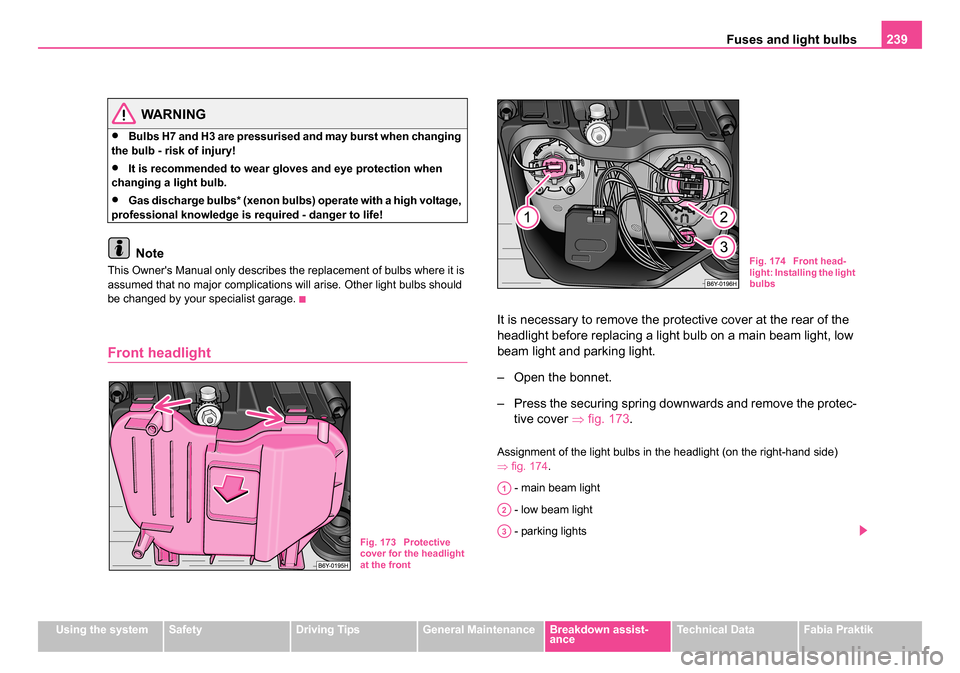
It is necessary to remove the protective cover at the rear of the
headlight before replacing a light bulb on a main beam light, low
beam light and parking light.
– Open the bonnet.
– Press the securing spring downwards and remove the protec- tive cover ⇒fig. 173 .
Assignment of the light bulbs in the headlight (on the right-hand side)
⇒fig. 174 .
- main beam light
- low beam light
- parking lights
Fig. 173 Protective
cover for the headlight
at the front
Fig. 174 Front head-
light: Installing the light
bulbs
A1
A2
A3
sqc.1.book Seite 239 Mittwoch, 13. April 2005 1:09 13