2005 SKODA FABIA ECU
[x] Cancel search: ECUPage 50 of 260
Unlocking and locking49
Using the systemSafetyDriving TipsGeneral MaintenanceBreakdown assist-
anceTechnical DataFabia Praktik
Anti-theft alarm system*
The anti-theft alarm system increases the level of protection against
people seeking to break into the vehicle. The system triggers audible and
visual warning signals if an attempt is made to break into the vehicle.
How is the alarm system switched on?
The anti-theft alarm system is activated automatically when the vehicle is
locked with the key on the closed driver's door or by using the remote
control. It is activated 30 seconds after closing the door.
How is the alarm system switched off?
The anti-theft alarm system is switched off if the vehicle is unlocked by
only using the remote control. The vehicle is automatically locked again if
the vehicle is not opened within 30 seconds after reactivating the anti-theft
alarm system.
Once you unlock the vehicle by inserting the key into the driver door you
then have to insert the key into the ignition lock and switch the ignition on
within 15 seconds after unlocking the door in order to deactivate the anti-
theft alarm system. The alarm will be triggered if you do not switch on
the ignition within 15 seconds.
When is the alarm triggered?
The following security areas of the locked vehicle are monitored:
•Bonnet;
•Boot lid;
•Doors;
•Ignition lock;
•Vehicle interior*3);
•A drop in voltage of the on-board power supply.
An alarm is immediately triggered if either of the two battery terminals is
disconnected while the anti-theft alarm system is activated.
How is the alarm switched off?
You switch the alarm off if you unlock the car with the radio remote control
in the key or if you switch the ignition on.
Deactivation of interior monitor
The process of switching off and switching on the interior monitoring
system is the same as for switching off and switching on the safe securing
system ⇒page 42.
This function allows one to leave animals in the vehicle, for example.
Note
•The working life of the alarm siren is 5 years. More detailed information
is available from your Škoda dealer.
•Before leaving the car, check that all the doors, windows and the elec-
tric sliding/tilting roof* are properly closed in order to ensure that the anti-
theft alarm system is fully operational.
•Coding of the radio remote control and the receptor part precludes the
use of the radio remote control from other vehicles.
3)The alarm will be triggered through movement within the interior of the vehicle or
an attempt to steal the radio. The rear part of the interior of the vehicle is not fully
monitored under certain circumstances.
sqc.1.book Seite 49 Mittwoch, 13. April 2005 1:09 13
Page 66 of 260

Lights and Visibility65
Using the systemSafetyDriving TipsGeneral MaintenanceBreakdown assist-
anceTechnical DataFabia Praktik
Taking off the wiper blade
– Fold windscreen wiper arm away from the windscreen and
position the wiper blade at right angles to the wiper arm
⇒page 64, fig. 43 .
– Press the securing spring in the direction of arrow and press the wiper blade to the windscreen at the same time in
the direction of arrow ⇒.
Attaching a wiper blade
– Push the wiper blade onto the wiper arm. The securing spring must click into place audibly.
Windscreen wiper blades in proper condition are essential to obtain good
visibility. Wiper blades should not be allowed to become dirtied by dust,
insect remains and preserving wax.
Juddering or smearing of the wiper blades could then be due to wax resi-
dues left on the windscreen by vehicle washing in automatic vehicle wash
systems. It is therefore important to degrease the lips of the winscreen
wiper blades after every pass through an automatic vehicle wash
system .
WARNING
•If the windscreen wipers are handled carelessly, there is a risk
of damage to the windscreen.
•You should clean the wiper blades regularly with a windscreen
cleaner in order to avoid any smears. Clean a wiper blade with a
sponge or cloth if it is very dirty, for example from insect residues.
•Replace the windscreen wiper blades once or twice a year for
safety reasons. We recommend having the windscreen wiper
blades purchased at a Škoda dealer.
Replacing the wiper blade on the rear window wiper
Taking off the wiper blade
– Fold the window wiper arm away ⇒fig. 44 .
– Hold the window wiper arm at the top end with one hand.
– Take hold of the wiper blade with the other hand and pull the wiper blade in the direction of arrow .
Attaching a wiper blade
– Interlock the wiper blade into the window wiper arm - see arrow .
The same remarks apply here as for ⇒page 64, “Replacing wiper blades
for the windscreen wipers”.
AA
AB
Fig. 44 Wiper blade for
the rear window
AA
AB
sqc.1.book Seite 65 Mittwoch, 13. April 2005 1:09 13
Page 71 of 260

Seats and Stowage
70
You must always press the securing button ⇒page 69, fig. 48 when
pushing the tilting head restraints* out of the upper setting into the lower
setting.
WARNING
•The head restraints must be correctly adjusted in order to offer
effective protection for the occupants in the event of an accident.
•Do not drive under any circumstance with removed head
restraints - risk of injury!
Middle rear head restraint*
The middle head restraints can be adjusted to two settings, the upper one
and the lower one. The upper setting is interlocked into place. You must always press the securing button
⇒fig. 49 when removing the
head restraint and when pushing it out of the upper setting into the lower
setting.
WARNING
The head restraint on the middle re ar seat must always be in the
upper locked position when someone is sitting there.
Heating the front seats*
The seating and leaning surfaces of the front seats can be heated
when the ignition is switched on.
Fig. 49 Rear seats: the
position of the middle
head restraints
Fig. 50 Dash panel:
Control dial for heating
the front seats
sqc.1.book Seite 70 Mittwoch, 13. April 2005 1:09 13
Page 73 of 260

Seats and Stowage
72
The rear seats and the seat backrest can be folded forwards to
increase the volume of the luggage compartment ⇒page 73.
Both rear seats can be folded forward individually on vehicles
with divided rear seats*.
Folding the rear seat forwards
– In order to avoid causing any damage when folding the rear seat forward it is important to adjust the front seats so that no
damage can occur when this is done.
– Pull up the rear seats in the direction of arrow ⇒page 71,
fig. 51 and fold forwards in direction of arrow .
– Pull the unlocking knob and fold the rear seat backrest forwards ⇒page 71, fig. 52.
– Pull the head restraints out of the seat backrest.
– The head restraints can be inserted into the relevant holes of the folded forwards rear seats ⇒page 73, fig. 53 .
– Fold the seat backrest forwards completely.
Folding the rear seat back into position
– Install the head restraint in the partially lifted rear seat back- rest.
– Then push the seat backrest back into the upright position until it clicks into place - check by pulling on it.
– Make sure that the red part of the securing knob is not visible ⇒page 71, fig. 52 .
– Fold the rear seats back into its original position.
The rear seat is equipped with an audible signalling of the rear seat back-
rest securing system. If you unlock the rear seat backrest, the securing
knob ⇒page 71, fig. 52 pushes out from it with a red surface. If you
have correctly interlocked the rear seat backrest, the securing knob slides
back into the rear seat backrest and is no longer visible.
WARNING
•The belt lock and pelvic belt must be in their original position
after folding back the rear seats and seat backrest - they must be
ready to use.
•The seat backrests must be securely interlocked in position so
that no objects in the luggage compartment can slide forward if
there is sudden braking - risk of injury.
•Ensure that the seat backrest on the rear seats is securely inter-
locked in position when the vehicle is fitted with three-point safety
belts for the middle rear seat. It is only then that the three-point seat
belt can reliably fulfil its function.
A1
A2
AA
AA
AA
sqc.1.book Seite 72 Mittwoch, 13. April 2005 1:09 13
Page 76 of 260

Seats and Stowage75
Using the systemSafetyDriving TipsGeneral MaintenanceBreakdown assist-
anceTechnical DataFabia Praktik
•Never drive with the boot lid slightly ajar or even fully opened
otherwise exhaust gases may get into the interior of the vehicle -
risk of poisoning!
•On no account exceed the permissible axle loads and the
permissible gross weight of the vehicle - risk of accident!
•Never transport occupants in the luggage compartment.
Caution
Please ensure that the heating elements of the rear window heater are not
damaged as a result of objects sliding in this area.
Note
•Tyre pressure must be adjusted to the load ⇒page 209, fig. 150 .
•The air circulation in the interior of the car helps to prevent the
windows from misting up. Stale air is diverted via the outlet nozzles into
the lateral trim panels of the luggage compartment. Check for yourself that
the outlet nozzles are not covered.
Lashing eyes
Eyes are located on the sides of the loading area for lashing the goods to
be loaded ⇒ fig. 55.
You can also attach a securing net* to these eyes for lashing small objects.
The securing net* and the fixing instruction is located in the well under the
floor covering of the lugagge compartment behind the spare wheel.
WARNING
•The load to be transported must be fixed in place in such a way
that it cannot move during the journey and when braking.
•If the items of luggage or objects are attached to the lashing
eyes with unsuitable or damaged lashing straps, injuries can occur
in the event of braking manoeuvres or accidents. In order to
prevent the items of luggage being thrown forward, always use
WARNING (continued)
Fig. 55 Luggage
compartment: Lashing
eyes
sqc.1.book Seite 75 Mittwoch, 13. April 2005 1:09 13
Page 78 of 260

Seats and Stowage77
Using the systemSafetyDriving TipsGeneral MaintenanceBreakdown assist-
anceTechnical DataFabia Praktik
Luggage net*
The luggage net is designed for the tranportation of lighter objects.
WARNING
•In the luggage net you must only store objects (up to a weight
of 1.5 kg). Heavy objects are not secured sufficiently - risk of injury!
•No objects with sharp edges should be stored in the luggage
net, because they can damage the luggage net.
The luggage compartment cover*
You can use the luggage compartment cover behind the
head restraints for storing light and soft items.
The luggage compartment cover can be removed as required if
one must transport bulky goods.
– Unhook the support straps on the tailgate.
– Place the cover on the side supports.
– Pull the cover horizontally to the rear out of the front holders ⇒fig. 59 .
– Install again by pushing it forwards into the holders and hanging the support straps on the tailgate.
Fig. 58 Luggage
compartment: Luggage
net
Fig. 59 Removing the
luggage compartment
cover
sqc.1.book Seite 77 Mittwoch, 13. April 2005 1:09 13
Page 80 of 260
Seats and Stowage79
Using the systemSafetyDriving TipsGeneral MaintenanceBreakdown assist-
anceTechnical DataFabia Praktik
Net partition (Estate)*
Use behind the rear seats
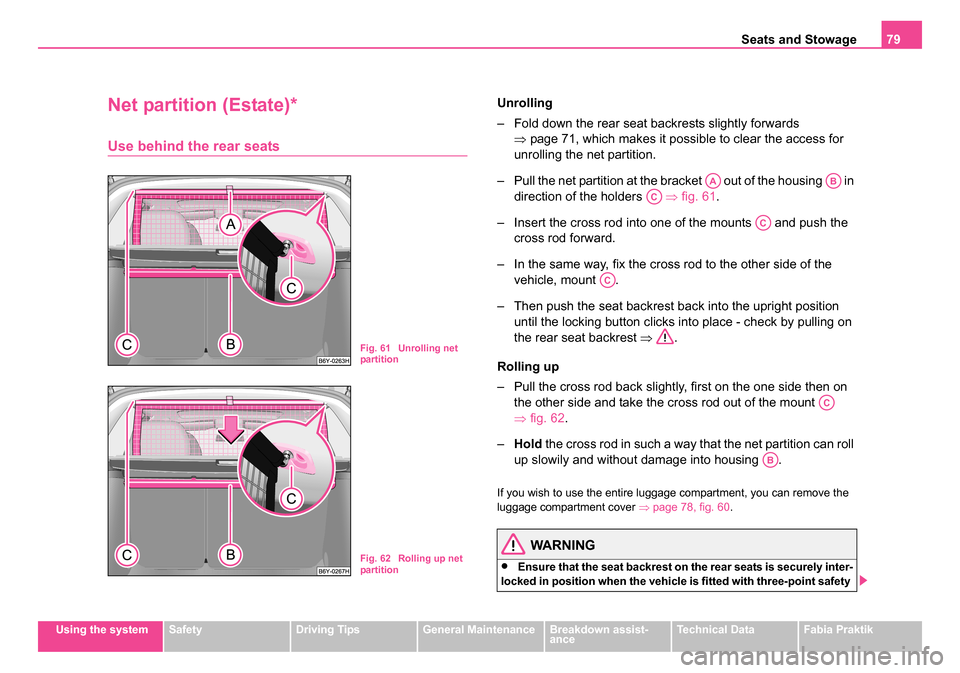
Unrolling
– Fold down the rear seat backrests slightly forwards
⇒page 71, which makes it possible to clear the access for
unrolling the net partition.
– Pull the net partition at the bracket out of the housing in direction of the holders ⇒fig. 61.
– Insert the cross rod into one of the mounts and push the cross rod forward.
– In the same way, fix the cross rod to the other side of the vehicle, mount .
– Then push the seat backrest back into the upright position until the locking button clicks into place - check by pulling on
the rear seat backrest ⇒.
Rolling up
– Pull the cross rod back slightly, first on the one side then on the other side and take the cross rod out of the mount
⇒fig. 62 .
– Hold the cross rod in such a way that the net partition can roll
up slowily and without damage into housing .
If you wish to use the entire luggage compartment, you can remove the
luggage compartment cover ⇒page 78, fig. 60 .
WARNING
•Ensure that the seat backrest on the rear seats is securely inter-
locked in position when the vehicle is fitted with three-point safety
Fig. 61 Unrolling net
partition
Fig. 62 Rolling up net
partition
AAAB
AC
AC
AC
AC
AB
sqc.1.book Seite 79 Mittwoch, 13. April 2005 1:09 13
Page 148 of 260
Transporting children safely 147
Using the systemSafetyDriving TipsGeneral MaintenanceBreakdown assist-
anceTechnical DataFabia Praktik
Transporting children safely
What you should know about
transporting children!
An introduction to the subject
Accident statistics have revealed that children are gener-
ally more safely transported on the rear seats than on the
front passenger seat.
Children younger than 12 years of age should normally travel on the rear
seat of the vehicle (take note of any national legal provisions which differ
from this). They should be secured there by means of a child restraint
system or by using the existing seat belts depending on their age, body
size and weight. The child seat should be mounted behind the front
passenger seat for safety reasons.
The physical principle of an accident does, of course, also apply to chil-
dren ⇒page 130, “The physical principle of a frontal collision”. They differ
from adults in that their muscles and bone structure of children are not yet
fully developed. Thus children are exposed to increased risk of injury.
Children should be transported by using special child safety seats in order
to reduce this risk of injury.
Only use child safety seats which are officially approved, suitable for chil-
dren and which comply with the ECE-R 44 standard, which classifies child
safety seats into 5 groups ⇒page 151, “Classification of child seats into
groups”. Child restraint systems which have been tested for conformity
with ECE-R 44 have a non-detachable test seal (a large E within a circle
and below this the test number) attached to the seat. We recommend that you use child safety seats from the Škoda genuine
accessories. These child seats were developed and also tested for use in
Škoda vehicles. They fulfil the standard ECE-R 44.
WARNING
Always comply with national lega
l provisions and instructions
from the relevant child safety seat manufacturer when installing
and using a child seat ⇒ in “Important safety information on
using child safety seats”.
Note
Any national legal provisions which vary from the information contained in
this Owner's Manual take precedence over the information contained
herein.
Important safety informat ion on using child safety
seats
Correct use of child safety seats considerably reduces the
risk of injury!
WARNING
•All the occupants of the car - in particular children - must wear
a seat belt when the car is moving!
•Children less than 1.50 m in height or younger than 12 years
must not use a normal seat belt without a child restraint system
sqc.1.book Seite 147 Mittwoch, 13. April 2005 1:09 13