2005 SAAB 9-5 fuel
[x] Cancel search: fuelPage 216 of 276
214 Car care and technical information
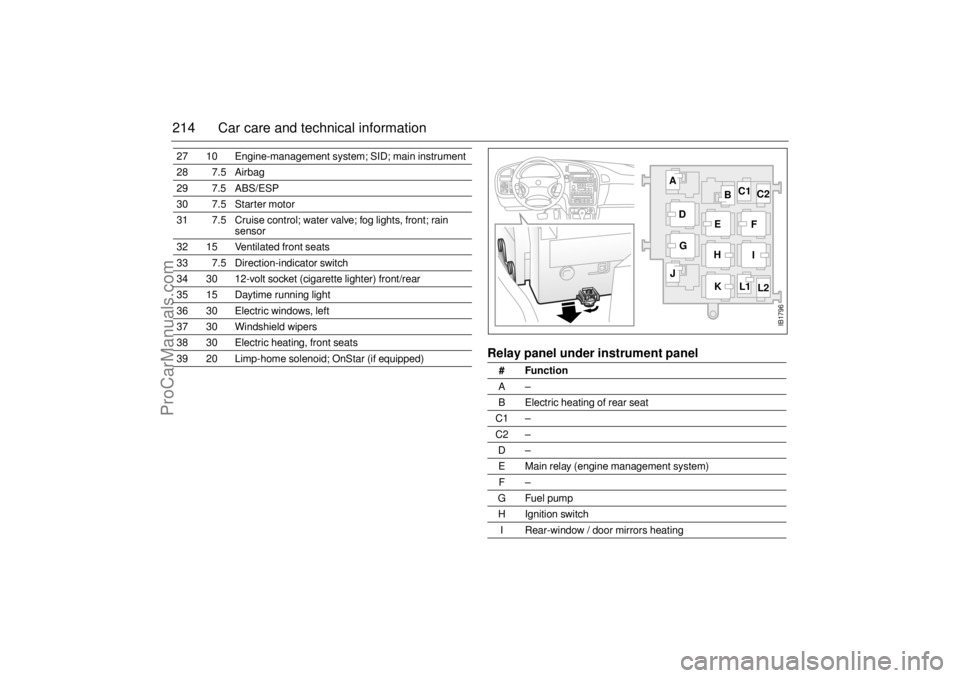
Relay panel under instrument panel
27 10 Engine-management system; SID; main instrument
28 7.5 Airbag
29 7.5 ABS/ESP
30 7.5 Starter motor
31 7.5 Cruise control; water valve; fog lights, front; rain
sensor
32 15 Ventilated front seats
33 7.5 Direction-indicator switch
34 30 12-volt socket (cigarette lighter) front/rear
35 15 Daytime running light
36 30 Electric windows, left
37 30 Windshield wipers
38 30 Electric heating, front seats
39 20 Limp-home solenoid; OnStar (if equipped)
# Function A –
B Electric heating of rear seat
C1 –
C2 –
D–
E Main relay (engine management system)
F–
G Fuel pump
H Ignition switch
I Rear-window / door mirrors heating
IB1796
A
BC1
C2
L2 L1 D
GE
F
H
I
K J
ProCarManuals.com
Page 219 of 276

217 Car care and technical information
Tires Your new vehicle comes with high-quality
tires made by a leading tire manufacturer. If
you ever have questions about your tire
warranty and where to obtain service, see
your Saab Warranty and Service Record
Booklet for details.
Inflation - Tire PressureThe Tire-Loading Information label shows
the correct inflation pressures for your tires
when they’re cold. “Cold” means your
vehicle has been sitting for at least three
hours or driven no more than 1 mile (1.6
km).Notice:
Don’t let anyone tell you that
underinflation or overinflation is all
right. It’s not. If your tires don’t have
enough air (underinflation), you can get
the following:
Too much flexingToo much heatTire overloadingBad wearBad handlingBad fuel economy
If your tires have too much air (overinfla-
tion), you can get the following:Unusual wearBad handlingRough ride
Needless damage from road hazards
Adjust the tire pressure to match the current
load and speed of the car (see page 261).
The stated tire pressures apply to cold tires,
i.e. tires that are the same temperature as
the outside air temperature. Tire pressure
increases as the tires become warm (e.g.
during highway driving) by approximately
0.3 bar (4 psi). When the temperature of the
tires changes by 50°F (10°C), the tire pres-
sure will change 0.1 bar (2 psi).
Never reduce the pressure of a hot tire. If the
tires are hot when you check them, only
increase the pressure, if necessary.
WARNING
Poorly maintained and improperly used
tires are dangerous.
Overloading your tires can cause
overheating as a result of too much
friction. You could have an blow-out
and a serious accident. See “Loading
Your Vehicle” on page 226.
Underinflated tires pose the same
danger as overloaded tires. The
resulting accident could cause serious
injury. Check all tires frequently to
maintain the recommended pressure.
Tire pressure should be checked
when your tires are cold.
Overinflated tires are more likely to be
cut, punctured or broken by a sudden
impact – such as when you hit a
pothole. Keep tires at the recom-
mended pressure.
Worn, old tires can cause accidents. If
your tread is badly worn, or if your tires
have been damaged, replace them.
ProCarManuals.com
Page 228 of 276

226 Car care and technical informationLoading Your VehicleThis is an example of what your vehicle´s
Tire-Loading Information/Certification label
might look like. It is located on the B-pillar
and shows how much weight your vehicle
may properly carry. The label tells you the
proper size, and recommended inflation
pressures for the tires on your vehicle. It
also gives you important information about
the number of people that can be in your
vehicle and the total weight that you can
carry. This weight is called the Vehicle
Capacity Weight, and includes the weight of
all occupants, cargo and all nonfactory-
installed options.
Tire Terminology and DefinitionsAir Pressure:
The amount of air inside the
tire pressing outward on each square inch of
the tire. Air pressure is expressed in pounds
per square inch (psi) or kilopascal (kPa).
Accessory Weight:
This means the combi-
ned weight of optional accessories, for
example, automatic transmission, power
steering, power brakes, power windows,
power seats, radio and air conditioning.
Aspect Ratio:
The relationship of a tire´s
height to its width.
Belt:
A rubber coated layer of cords that is
located between the plies and the tread.
Cords may be made from steel or other rein-
forcecing materials.
Bias Ply Tire:
A pneumatic tire in which the
ply cords that extend to the beads are laid at
alternate angles substantially less than 90
degrees to the centerline of the tread.
Cold Inflation Pressure:
The amount of air
pressure in a tire, measured in pounds per
square inch (psi) or kilopascal (kPa), before
a tire have built up heat from driving. See
“Inflation - Tire Pressure” on page 217.
Curb weight:
This means the weight of a
motor vehicle with standard and optional
equipment including the maximum capacity
of fuel, oil and coolant, without passengers
and cargo.
DOT Markings:
A code molded into the
sidewall of a tire signifying that the tire is in
compliance with the U.S. Department of
Transportation motor vehicle safety stan-
dards. The DOT code includes the Tire
Identification Number (TIN), an alphanume-
ric designator which can also indentify the
tire manufacturer, production plant, brand
and date of production.
GVWR:
Gross Vehicle Weight Rating see
“Loading Your Vehicle” on page 226.
GAWR FRT:
Gross Axle Weight Rating for
the front axle, see “Loading Your Vehicle”
on page 226.
GAWR RR:
Gross Axle Weight Rating for
the rear axle, see “Loading Your Vehicle” on
page 226.
Intended Outboard Sidewall:
The side of
an asymmetrical tire that must always face
outward when mounted on a vehicle.
Kilopascal (kPa):
The metric unit for air
pressure. There are 6.9 kPa to one psi.
Light Truck (LT-Metric) Tire:
A tire used
on light duty trucks and some multipurpose
passenger vehicles.
Load Index:
An assigned number ranging
from 1 to 279 that corresponds to the load
carrying capacity of a tire.
This label can only be found on vehicles
sold in the U.S.
Vehicles sold in Canada have the tire
information label in the glovebox, see
page 262.
ProCarManuals.com
Page 244 of 276

242 Car care and technical informationRecovery and/or
recycling of automotive
materialsA typical car consists of metals (65–75 %),
plastics (10–15 %), rubber (5 %) and small
quantities of glass, wood, paper and texti-
les. The recycling of metals has been com-
monplace for a long time now.
To facilitate sorting of other materials for
recycling, plastic parts, for instance, have
been marked to identify the precise nature
of the plastic.
The quantity of materials in the car that can
be recycled or recovered depends on the
scrapping facilities in different countries. EU
legislation that comes into force in 2006 will
require a minimum of 85 % of the total
weight of materials to be recycled. Howe-
ver, every major car salvage yard in each
market will receive details from Saab of how
the highest percentage of materials can be
reclaimed.
Headlight aimingThe vehicle has a visual optical headlight
aiming system equipped with vertical
aiming device. The aim has been preset at
the factory and should normally not need
further adjustments.
If your headlights are damaged in a crash,
the headlight aim may be affected. If you
believe your headlights need to be re-
aimed, we recommend that you take it to
your Saab dealer for service, however, it is
possible for you to re-aim your headlights as
described in the following procedure.To check the aim, the vehicle should be pro-
perly prepared as follows:
The vehicle shall be placed so that the
headlights are 25 ft (7.6 m) from a light
colored wall or other flat surface. The
aiming area should be darkened, this will
improve your ability to see the beam of the
low beam headlight being aimed.
The vehicle must have all four wheels on
a perfectly level surface which is level all
the way to the wall or other flat surface.
The vehicle should be placed so it is per-
pendicular to the wall or other flat surface.
The vehicle should be unloaded and fuel
tank full, and one person or 160 lbs.
(75 kg) on the drivers seat.
WARNING
Before checking/adjusting the headlight
aiming, switch off the engine to avoid
danger of fingers and hands being injured
by moving parts.
The radiator fan can start up even when
the engine is switched off.NOTICETo make sure that your headlights are
aimed properly read all instructions
before beginning. Failure to follow these
instructions could cause damage to
headlight parts or a not correctly aimed
headlight.
ProCarManuals.com
Page 251 of 276

249 Customer Assistance and Information
Vehicle Data Collection and
Event Data RecordersYour vehicle, like other modern motor vehi-
cles, has a number of sophisticated com-
puter systems that monitor and control sev-
eral aspects of the vehicle’s performance.
Your vehicle uses on-board vehicle comput-
ers to monitor emission control components
to optimize fuel economy, to monitor condi-
tions for air bag deployment and, if so
equipped, to provide anti-lock braking and
to help the driver control the vehicle in diffi-
cult driving situations. Some information
may be stored during regular operations to
facilitate repair of detected malfunctions;
other information is stored only in a crash
event by computer systems commonly
called event data recorders (EDR).
In a crash event, computer systems, such
as the Air Bag Sensing and Diagnostic
Module (SDM) in your vehicle may record
information about the condition of the vehi-
cle and how it was operated, such as data
related to engine speed, brake application,
throttle position, vehicle speed, steering
wheel angle, lateral acceleration, safety belt
usage, air bag readiness, air bag perfor-
mance, and the severity of a collision. This
information has been used to improve vehi-
cle crash performance and may be used to
improve crash performance of future vehi-
cles and driving safety. Unlike the data
recorders on many airplanes, these on-
board systems do not record sounds, such
as conversation of vehicle occupants.To read this information, special equipment
is needed and access to the vehicle or the
SDM is required.
Saab will not access information about a
crash event or share it with others other than
with the consent of the vehicle owner or, if
the vehicle is leased, with the consent of
the lessee,
in response to an official request of police
or similar government office,
as part of Saab’s defense of litigation
through the discovery process, or
as required by law.
In addition, once Saab collects or receives
data, Saab may
use the data for Saab research needs,
make it available for research where
appropriate confidentiality is to be main-
tained and need is shown, or
share summary data which is not tied to a
specific vehicle with non-Saab organiza-
tions for research purposes.
Others, such as law enforcement, may have
access to the special equipment that can
read the information if they have access to
the vehicle or SDM.
If your vehicle is equipped with OnStar®,
please check lthe OnStar® subscription
service agreement or manual for informa-
tion on its operations and data collection.
ProCarManuals.com
Page 253 of 276

251 Specifications
General_______________ 252
Engine _______________ 254
Fuel__________________ 254
Engine oil _____________ 255
Engine variants ________ 256
Electrical system_______ 257
Drive belts ____________ 257
Manual gearbox________ 258
Automatic transmission _ 258
Suspension ___________ 259
Steering ______________ 259
Brake system__________ 259
Wheels and tires _______ 260
Plates and labels _______ 262
IB603
Specifications
ProCarManuals.com
Page 254 of 276

252 SpecificationsGeneral Overall length, including bumpers:
9-5 Sedan _______________________ 190.0 in (4827 mm)
9-5 SportWagon __________________ 190.1 in (4828 mm)
Overall width, including door mirrors ____ 80.4 in (2042 mm)
Maximum height:
9-5 Sedan _______________________ 58.1 in (1475 mm)
9-5 SportWagon __________________ 59.1 in (1501 mm)
Wheelbase _______________________ 106.4 in (2703 mm)
Ground clearance at gross vehicle weight approx. 4.6 in
(116 mm)
Tr a c k :
Front __________________________ 59.9 in (1522 mm) *)
Rear ___________________________ 59.9 in (1522 mm) *)
Turning circle (curb to curb) ___________ 37,1 ft (11.3 m)
Turning circle (measured at vehicle extremi-
ties) ____________________________ 39,0 ft (11.9 m)
Number of seats (incl. driver) _________ 5
*) Specified track applies to wheel sizes:
6 x 15 & 6.5 x 16
Permissible load (in addition to driver) = GVW minus curb weight
The maximum permissible axle load, front or rear, must not be exceeded.
The maximum permissible axle load, front or rear, must not be exceeded. Chassis number in engine bay Weight ready for driving (i.e. with full fuel
tank, washer-fluid reservoir, standard tools
and spare wheel) ___________________ 3460–3780 lbs.
(1570–1715 kg)
Gross vehicle weight (GVW) ___________ 4390–4710 lbs.
(1990–2135 kg)
Maximum axle load:
Front ___________________________ 2590 lbs. (1175 kg)
Rear, 9-5 Sedan ___________________ 2310 lbs. (1050 kg)
Rear, 9-5 SportWagon ______________ 2480 lbs. (1125 kg)
Weight distribution:
Curb weight, front/rear ______________ 60/40 %
GVW, front/rear ___________________ 50/50 %
Maximum roof load __________________ 220 lbs (100 kg)
ProCarManuals.com
Page 256 of 276

254 SpecificationsEngine
Fuel
4-cylinder ________________________ Four cylinders, twin
overhead cams-
hafts, 16 valves and
two balancer shafts.
Cylinder bores _____________________ 3.54 in (90 mm)
Stroke ___________________________ 3.54 in (90 mm)
Swept volume _____________________ 139.7 cu.in
(2.290 litres)
Idling speed _______________________ 825 rpm (man.)
860 rpm (aut.)
Antifreeze_________________________ Saab-approved
antifreeze
Coolant capacity ___________________ 7.8 qts (7.4 litres)Fuel-tank capacity ____________ 18.5 gal. (70 litres)
For optimum performance Saab
recommends: _______________ 2.3t 185 hp (Linear) –
AON 90.
2.3T 220 hp (Arc) and
2.3 Turbo 250 hp (Aero) –
AON 93.*
* If AON 90 is used some decrease in engine power can occur.
Gasoline with a lower octane rating can be used, although not
lower than AON 87. However, engine performance will fall
slightly and heavy loading and laboring should be avoided. For
optimum performance, use the recommended grade of fuel.
For further information on fuel, see page 140.
ProCarManuals.com