2005 SAAB 9-5 fuel
[x] Cancel search: fuelPage 140 of 276

138 Starting and drivingRefueling
WARNING
If you spill fuel and then something ignites
it, you could be badly burned. Fuel can
spray out on you if you open the fuel cap
too quickly. This spray can happen if your
tank is nearly full, and is more likely in hot
weather. Open the fuel cap slowly and
wait for any “hiss” noise to stop. Then
unscrew the cap all the way.
Gasoline fumes are highly explosive.
Therefore:
never
smoke while refueling
never
use gasoline for any purpose
other than as engine fuel
gasoline is extremely flammable and
can cause severe burns. No open or
exposed flames near gasoline
do not
use a mobile phone at the
same time as refueling.
NOTICE Do not overfill. Fuel should not come
right up the filler pipe as room for
expansion is needed for when the
temperature rises.
The use of fuel with too low an octane
rating can cause serious engine
damage.
Clean fuel from painted surfaces as
soon as possible.
NOTICEThe engine control module (ECM) moni-
toring the engine parameters also stores
fault codes.
Under certain circumstances, this may
cause constant illumination of the ”Eng-
ine malfunction (CHECK ENGINE)”
lamp , thus indicating a fault that
must be checked by your Saab dealer,
see page 55.
NOTE: always observe the following two
measures:
Make sure that the fuel filler cap is
screwed on correctly before the
engine is started. Screw on the fuel
filler cap until you hear 3 distinct
clicks.
Avoid driving with the fuel low level
indicator illuminated. The symbol
illuminates when less than approx-
imately 2 gallons (8 litres) of fuel
remains in the tank.
ProCarManuals.com
Page 141 of 276

139 Starting and driving
Refueling1 Switch off the engine.
2 Open the filler cap, located in the right-
hand rear fender.
3 Insert the fuel pump nozzle beyond the
flange on the filler pipe and let the first
mark (a ring, a pimple or the first spring-
coil) rest on the flange. Do not withdraw
the nozzle while filling is in progress.
4 Cease refueling the first time the pump
stops, and wait a few seconds after
you´ve finished pumping before you
remove the nozzle.
Filler capWhen you put the filler cap back on, turn it
to the right (clockwise) until you hear
three
clicks. Make sure you fully install the cap.
The most effective way to prevent conden-
sation forming in the tank (and thus avoid
possible running problems) is to keep the
tank well filled.
Before the onset of freezing temperatures in
winter, it may be advisable to add gasoline
anti-freeze to the fuel a few times to dispel
any condensation in the system..The fuel door has a built in filler cap holder
slot located on the fuel door. Slide the white
ring on the cap into the slot.
Notice:
If you need a new fuel cap, be sure
to get the right type. Your dealer can get one
for you. If you get the wrong type, it may not
fit properly
WARNING
If a fire starts while you are refueling, do
not remove the nozzle. Shut off the flow of
fuel by shutting off the pump or by notify-
ing the station attendant. Leave the area
immediately.
NOTICE Fill to maximum filling capacity
Stop filling after the first time that the
nozzle trips to shut off the flow of fuel.
Filling capacity can differ between
different fuel stations and outside
temperature. Fuel tank volume when
nozzle trips to shut off, may vary by
0.5 gal. (2 liters).
Do not fill fuel all the way up the filler
pipe. The gasoline must be allowed
room for expansion especially during
hot weather.
When refueling, hang the filler cap inside
the fuel door
ProCarManuals.com
Page 142 of 276

140 Starting and drivingFilling a portable fuel container Fuel (Gasoline Engine)
FuelUse of the recommended fuel is an impor-
tant part of the proper maintenance of your
vehicle.
For optimum performance Saab recom-
mends:
2.3t 185 hp (Linear) – AON 90.2.3T 220 hp (Arc) and
2.3 Turbo 250 hp (Aero) – AON 93.
Gasoline OctaneFor the 2.3T and 2.3 Turbo, use premium
unleaded gasoline with a posted octane of
93 or higher for best performance. For the
2.3t, use a mid-grade with a posted octane
of 90 for best performance. You may also
use regular unleaded gasoline rated at
87 octane or higher, but your vehicle's
acceleration may be slightly reduced. If the
octane is less than 87, you may get a heavy
knocking noise when you drive. If this
occurs, use a gasoline rated at 87 octane or
higher as soon as possible. Otherwise, you
might damage your engine. A little pinging
noise when you accelerate or drive uphill is
considered normal. This does not indicate a
problem exists or that a higher-octane fuel
is necessary. If you are using 87 octane or
higher-octane fuel and hear heavy knock-
ing, your engine needs service.
Gasoline SpecificationsIt is recommended that gasoline meet spec-
ifications which were developed by automo-
bile manufacturers around the world and
contained in the World-Wide Fuel Charter
which is available from the Alliance of Auto-
mobile Manufacturers at www.autoalli-
ance.org/fuel_charter.htm. Gasoline meet-
ing these specifications could provide
improved driveability and emission control
system performance compared to other
gasoline.California FuelIf your vehicle is certified to meet California
Emission Standards (see the underhood
emission control label), it is designed to
operate on fuels that meet California speci-
fications. If this fuel is not available in states
adopting California emissions standards,
your vehicle will operate satisfactorily on
fuels meeting federal specifications, but
emission control system performance may
be affected. The malfunction indicator lamp
may turn on and your vehicle may fail a
smog-check test. See Engine malfunction
(CHECK ENGINE) on page 55. If this
occurs, return to your authorized Saab
dealer for diagnosis. If it is determined that
the condition is caused by the type of fuel
used, repairs may not be covered by your
warranty.
WARNING
Never fill a portable fuel container while it
is in your vehicle. Static electricity
discharge from the container can ignite
the gasoline vapor. You can be badly
burned and your vehicle damaged if this
occurs. To help avoid injury to you and
others:
Dispense gasoline only into approved
containers.
Do not fill a container while it is inside
a vehicle, in a vehicle’s trunk, pickup
bed or on any surface other than the
ground.
Bring the fill nozzle in contact with the
inside of the fill opening before opera-
ting the nozzle. Contact should be
maintained until the filling is complete.
Do not smoke while pumping gaso-
line.
ProCarManuals.com
Page 143 of 276

141 Starting and driving
AdditivesTo provide cleaner air, all gasolines in the
United States are now required to contain
additives that will help prevent engine and
fuel system deposits from forming, allowing
your emission control system to work prop-
erly. You should not have to add anything to
your fuel. However, some gasolines contain
only the minimum amount of additive
required to meet U.S. Environmental Pro-
tection Agency regulations. Saab recom-
mends that you buy gasolines that are
advertised to help keep fuel injectors and
intake valves clean. If your vehicle experi-
ences problems due to dirty injectors or
valves, try a different brand of gasoline.
Gasolines containing oxygenates, such as
ethers and ethanol, and reformulated gaso-
lines may be available in your area to con-
tribute to clean air. Saab recommends that
you use these gasolines, particularly if they
comply with the specifications described
earlier.
Notice: Your vehicle was not designed
for fuel that contains methanol. Do not
use fuel containing methanol. It can cor-
rode metal parts in your fuel system and
also damage the plastic and rubber
parts. That damage would not be cove-
red under your warranty.Some gasolines that are not reformulated
for low emissions may contain an octane-
enhancing additive called methylcyclopen-
tadienyl manganese tricarbonyl (MMT); ask
the attendant where you buy gasoline
whether the fuel contains MMT. Saab does
not recommend the use of such gasolines.
Fuels containing MMT can reduce the life of
spark plugs and the performance of the
emission control system may be affected.
The malfunction indicator lamp may turn on.
If this occurs, return to your authorized Saab
dealer for service.
Fuels in Foreign CountriesIf you plan on driving in another country out-
side the United States or Canada, the
proper fuel may be hard to find. Never use
leaded gasoline or any other fuel not recom-
mended in the previous text on fuel. Costly
repairs caused by use of improper fuel
would not be covered by your warranty.
To check the fuel availability, ask an auto
club, or contact a major oil company that
does business in the country where you will
be driving.
ProCarManuals.com
Page 146 of 276

144 Starting and drivingWhen the car is stationary, the engine must
be at idling speed when the selector lever is
moved. You must have your foot on the brake
pedal to move the lever out of park.
If the accelerator is depressed while the
lever is moved, this will result in abnormal
wear in the transmission.
The detent button on the selector lever has
to be pressed before the selector can be
moved between certain positions.
Three modes for the automatic transmis-
sion can be selected: Normal, Manual and
Sport. Normal modeThe Normal mode, which provides the best
fuel economy, is the default setting when
the engine is started. Manual mode (Sentronic): see page 148.Sport mode
When the Sport mode is selected, the throt-
tle angle is altered to provide more power at
the same throttle setting. The transmission
also changes up later than in Normal mode
to provide higher performance. In this
mode, the SPORT indicator will appear on
the main instrument panel (see page 150). Adaptive gear-change patternAdaptive gear-change pattern is a transmis-
sion function in the Normal and Sport
modes which matches gear changing to
current driving conditions. The transmission
control module senses the load on the
engine and temperature of the transmis-
sion. A suitable gear change pattern is then
selected automatically to avoid unneces-
sary gear changes and undesired tempera-
ture increases in the transmission.
NOTICEAfter selecting a drive position, pause
briefly to allow the gear to engage (the car
starts to pull a little) before you accel-
erate.
Detent positions for selector movement
Selector-lever indicator on main instru-
ment panel
ProCarManuals.com
Page 147 of 276

145 Starting and driving
Lock-up function The automatic transmission has a lock-up
function, which can render the torque con-
verter inoperative in 3rd, 4th and 5th gears,
thus reducing the engine speed and fuel
consumption.
When the lock-up function comes into oper-
ation, it may give the impression of an over-
drive being engaged.Kick-downWhen the accelerator is pressed down hard,
a change-down to the next gear will be
effected to provide maximum acceleration,
e.g. for overtaking.
Following this, the next higher gear will be
selected at the optimum engine speed for
acceleration or, if you ease off the acceler-
ator, before reaching this.
Park Brake Shift LockThe transmission has a security function
known as Park Brake Shift Lock. To move
the gear selector out of the P position, the
brake pedal must be depressed at the same
time as the gear selector catch (detent) is
pressed in.Shift Lock overrideCheck fuse No. 1 (see page 213). If the
problem was cured by changing the fuse or
battery, you do not have to contact a Saab
dealer.
If the fuse blows again as soon as the Shift
Lock feature is activated you should contact
your Saab dealer.
If the fuse is OK, check the battery regarding
the voltage.
1 Apply the parking brake
2 Make sure the key is in position ON
3 Use a small tool such as a screwdriver
and push the lever (see picture) down-
wards so that the detent button can be
pressed approx. 10 mm4 Move the selector out of position P to N
5 Remove the tool
6 Release the parking brake if the car is to
be moved immediately; otherwise keep
it applied.NOTICEDue to electrical problems it may not be
possible to move the selector out of the
park position, even if the ignition is ON. If
for some reason the selector has to be
moved out of the park position (i.e. to tow
the car a short distance) do as described
below.
ProCarManuals.com
Page 159 of 276
157 Starting and driving
Economical motoringFactors affecting fuel
consumptionFuel consumption is greatly affected by the
general driving conditions, the way in which
the car is driven and at what speeds, the
weather, the state of the road, the condition
of the car, etc. Breaking-inFuel consumption may be somewhat higher
during the break-in period (the first 3,000–
4,000 miles (5,000–7,000 km) than stated.Weather conditionsFuel consumption can be as much as 10 %
lower in summer than in winter. The higher
consumption in cold weather is explained by
the longer time it takes for the engine to
reach normal operating temperature, and
for the transmission and wheel bearings to
warm up. Fuel economy is also affected by
the distance driven: short journeys of
3–5 miles (5–8 km) do not give the engine
enough time to reach normal temperature.
Strong winds can also affect fuel con-
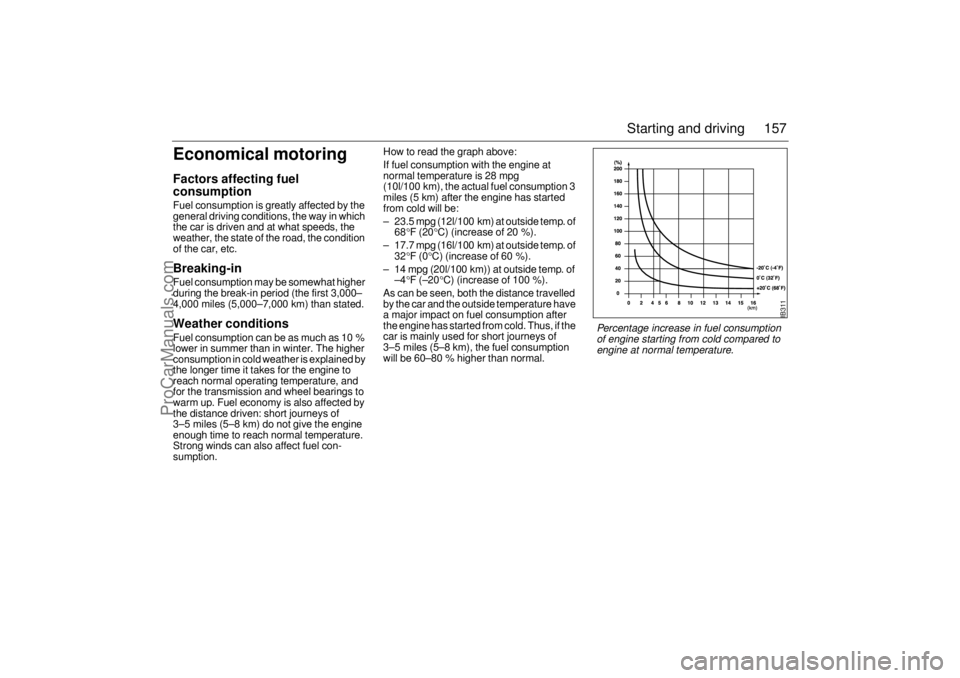
sumption. How to read the graph above:
If fuel consumption with the engine at
normal temperature is 28 mpg
(10l/100 km), the actual fuel consumption 3
miles (5 km) after the engine has started
from cold will be:
– 23.5 mpg (12l/100 km) at outside temp. of
68°F (20°C) (increase of 20 %).
– 17.7 mpg (16l/100 km) at outside temp. of
32°F (0°C) (increase of 60 %).
– 14 mpg (20l/100 km)) at outside temp. of
–4°F (–20°C) (increase of 100 %).
As can be seen, both the distance travelled
by the car and the outside temperature have
a major impact on fuel consumption after
the engine has started from cold. Thus, if the
car is mainly used for short journeys of
3–5 miles (5–8 km), the fuel consumption
will be 60–80 % higher than normal.
IB311
Percentage increase in fuel consumption
of engine starting from cold compared to
engine at normal temperature.
ProCarManuals.com
Page 160 of 276

158 Starting and drivingDriving technique To obtain the best running economy, not
only regarding fuel consumption but
general wear also, regular service is
required.
High speed, unnecessary acceleration,
heavy braking and much low gear work all
gives rise to higher fuel consumption.
Frequent gear changing in traffic, starting
in cold weather, the use of studded tires
and roof racks, and towing a trailer all
increase fuel consumption.
Do not run the engine when the car is sta-
tionary.
If idling, it will take much longer before the
engine becomes hot. Engine wear is gre-
atest during this warming-up phase. The-
refore drive away as soon as possible
after the engine is started and avoid high
revving. Driving in a low gear results in higher fuel
consumption than in a high gear because
of the higher engine speed for a given
road speed. Always change up to a higher
gear as soon as traffic conditions allow
and use the highest gear as much as pos-
sible.
Check the air pressure in the tires once a
month. Incorrect pressures increase tire
wear. It is better to have slightly higher
pressure than lower.
Check fuel consumption regularly.
Increased consumption can indicate that
something is wrong and that the car
needs to be checked by an authorized
Saab dealer.
Practical trials on the roads have demon-
strated that substantial savings in fuel con-
sumption can be made if the above advice
is heeded.
Road conditionsWet roads increase fuel consumption, as do
unpaved roads and driving in hilly country
(the amount of fuel saved driving downhill is
less than the additional amount required to
climb the hill).
WARNING
Never switch the engine off while driving
as the effect of the brakes and power ste-
ering will be greatly reduced.
ProCarManuals.com