Page 179 of 250
Downloaded from www.Manualslib.com manuals search engine
A
B
A
B
C
NU761_2_G4-FRA.qxd 14/11/05 10:10 Page 4.05
4.05
ENGINE OIL LEVEL (continued)
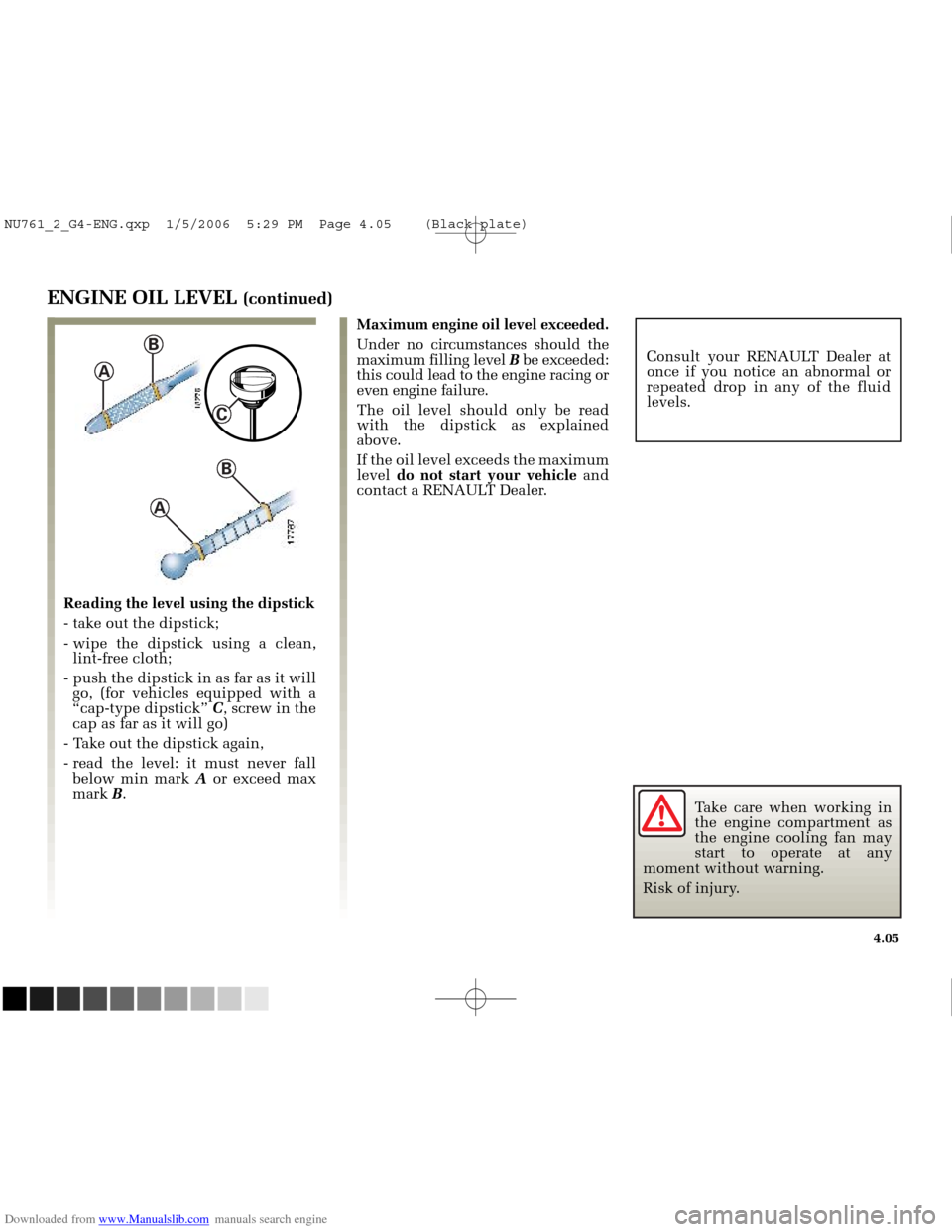
Reading the level using the dipstick
- take out the dipstick;
- wipe the dipstick using a clean,lint-free cloth;
- push the dipstick in as far as it will go, (for vehicles equipped with a
“cap-type dipstick” C, screw in the
cap as far as it will go)
- Take out the dipstick again,
- read the level: it must never fall below min mark Aor exceed max
mark B. Consult your RENAULT Dealer at
once if you notice an abnormal or
repeated drop in any of the fluid
levels.
Maximum engine oil level exceeded.
Under no circumstances should the
maximum filling level
Bbe exceeded:
this could lead to the engine racing or
even engine failure.
The oil level should only be read
with the dipstick as explained
above.
If the oil level exceeds the maximum
level do not start your vehicle and
contact a RENAULT Dealer.
Take care when working in
the engine compartment as
the engine cooling fan may
start to operate at any
moment without warning.
Risk of injury.
NU761_2_G4-ENG.qxp 1/5/2006 5:29 PM Page 4.05 (Black plate)
Page 180 of 250
Downloaded from www.Manualslib.com manuals search engine
2
2.0 T
1
2
1
2
1.4 16V - 1.6 16V
2.0 16V
1
1
2
1.5 dCi
NU761_2_G4-FRA.qxd 14/11/05 10:11 Page 4.06
4.06
ENGINE OIL LEVEL (continued)
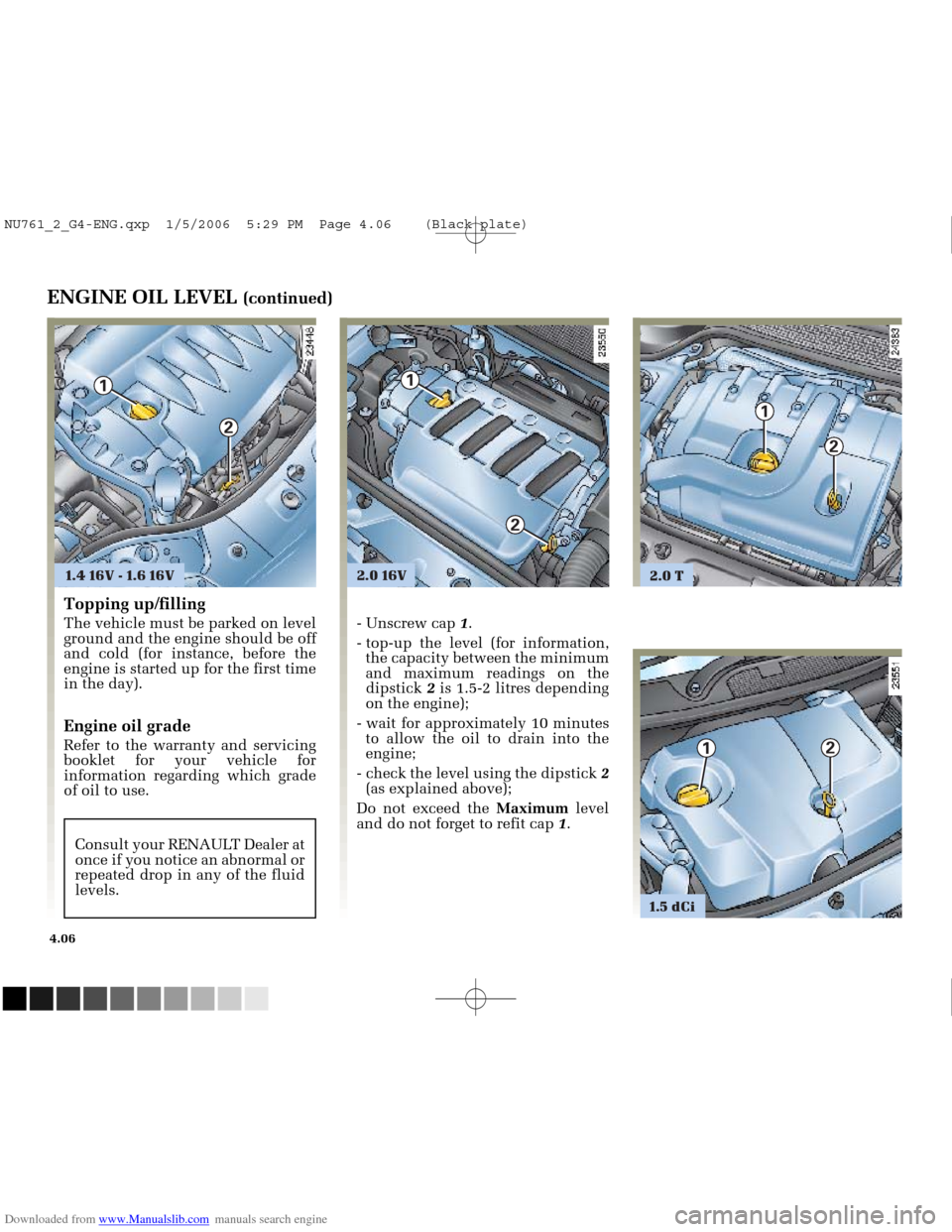
- Unscrew cap 1.
- top-up the level (for information, the capacity between the minimum
and maximum readings on the
dipstick 2is 1.5-2 litres depending
on the engine);
- wait for approximately 10 minutes to allow the oil to drain into the
engine;
- check the level using the dipstick 2
(as explained above);
Do not exceed the Maximumlevel
and do not forget to refit cap 1.
Topping up/filling
The vehicle must be parked on level
ground and the engine should be off
and cold (for instance, before the
engine is started up for the first time
in the day).
Engine oil grade
Refer to the warranty and servicing
booklet for your vehicle for
information regarding which grade
of oil to use.
Consult your RENAULT Dealer at
once if you notice an abnormal or
repeated drop in any of the fluid
levels.
NU761_2_G4-ENG.qxp 1/5/2006 5:29 PM Page 4.06 (Black plate)
Page 181 of 250
Downloaded from www.Manualslib.com manuals search engine
1
2.0 dCi
1
NU761_2_G4-FRA.qxd 14/11/05 10:11 Page 4.07
4.07
ENGINE OIL LEVEL (continued)/OIL CHANGE
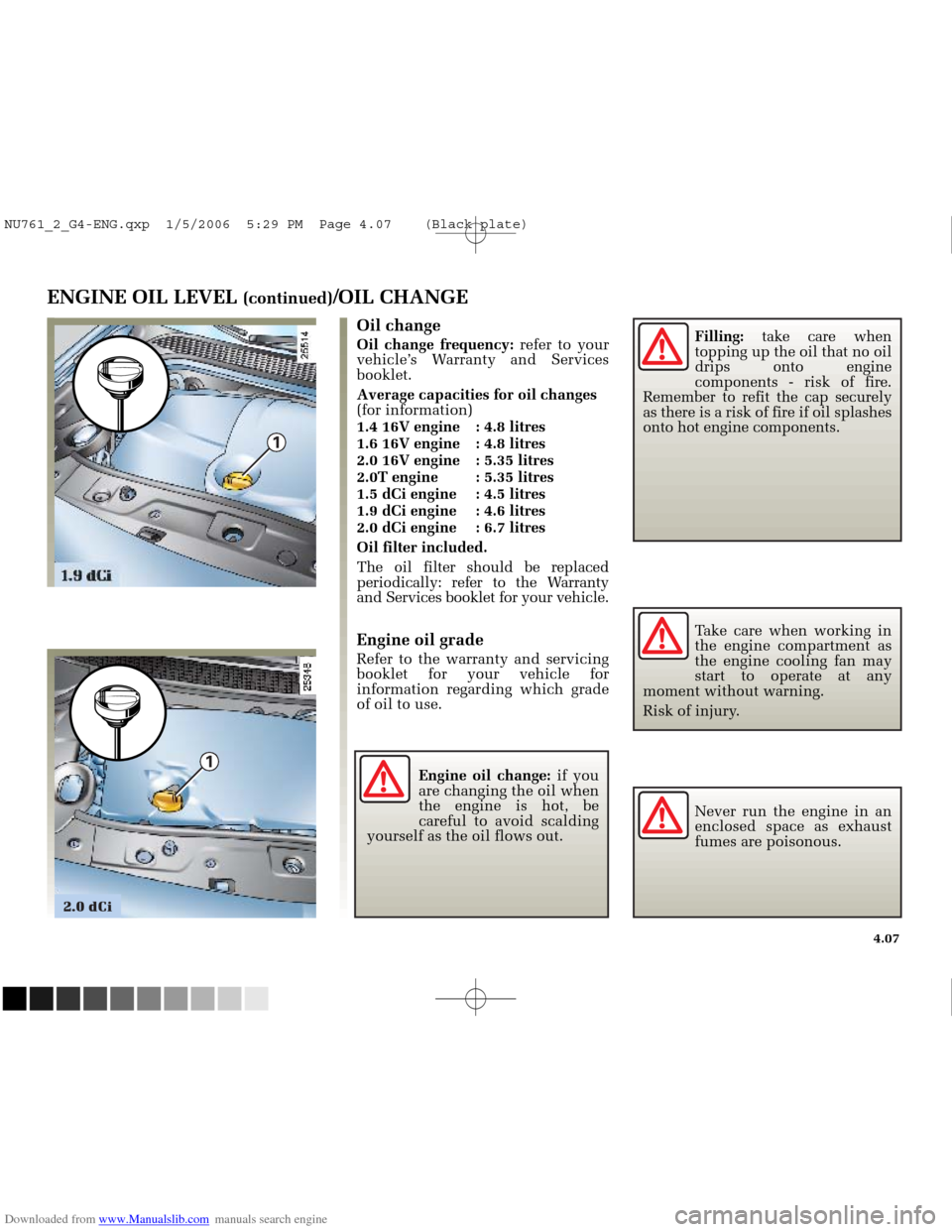
Oil change
Oil change frequency: refer to your
vehicle’s Warranty and Services
booklet.
Average capacities for oil changes
(for information)
1.4 16V engine : 4.8 litres
1.6 16V engine : 4.8 litres
2.0 16V engine : 5.35 litres
2.0T engine : 5.35 litres
1.5 dCi engine : 4.5 litres
1.9 dCi engine : 4.6 litres
2.0 dCi engine : 6.7 litres
Oil filter included.
The oil filter should be replaced
periodically: refer to the Warranty
and Services booklet for your vehicle.
Engine oil grade
Refer to the warranty and servicing
booklet for your vehicle for
information regarding which grade
of oil to use.
Engine oil change: if you
are changing the oil when
the engine is hot, be
careful to avoid scalding
yourself as the oil flows out. Never run the engine in an
enclosed space as exhaust
fumes are poisonous. Take care when working in
the engine compartment as
the engine cooling fan may
start to operate at any
moment without warning.
Risk of injury. Filling:
take care when
topping up the oil that no oil
drips onto engine
components - risk of fire.
Remember to refit the cap securely
as there is a risk of fire if oil splashes
onto hot engine components.
NU761_2_G4-ENG.qxp 1/5/2006 5:29 PM Page 4.07 (Black plate)
Page 183 of 250
Downloaded from www.Manualslib.com manuals search engine
1
NU761_2_G4-FRA.qxd 14/11/05 10:11 Page 4.09
4.09
LEVELS (continued)
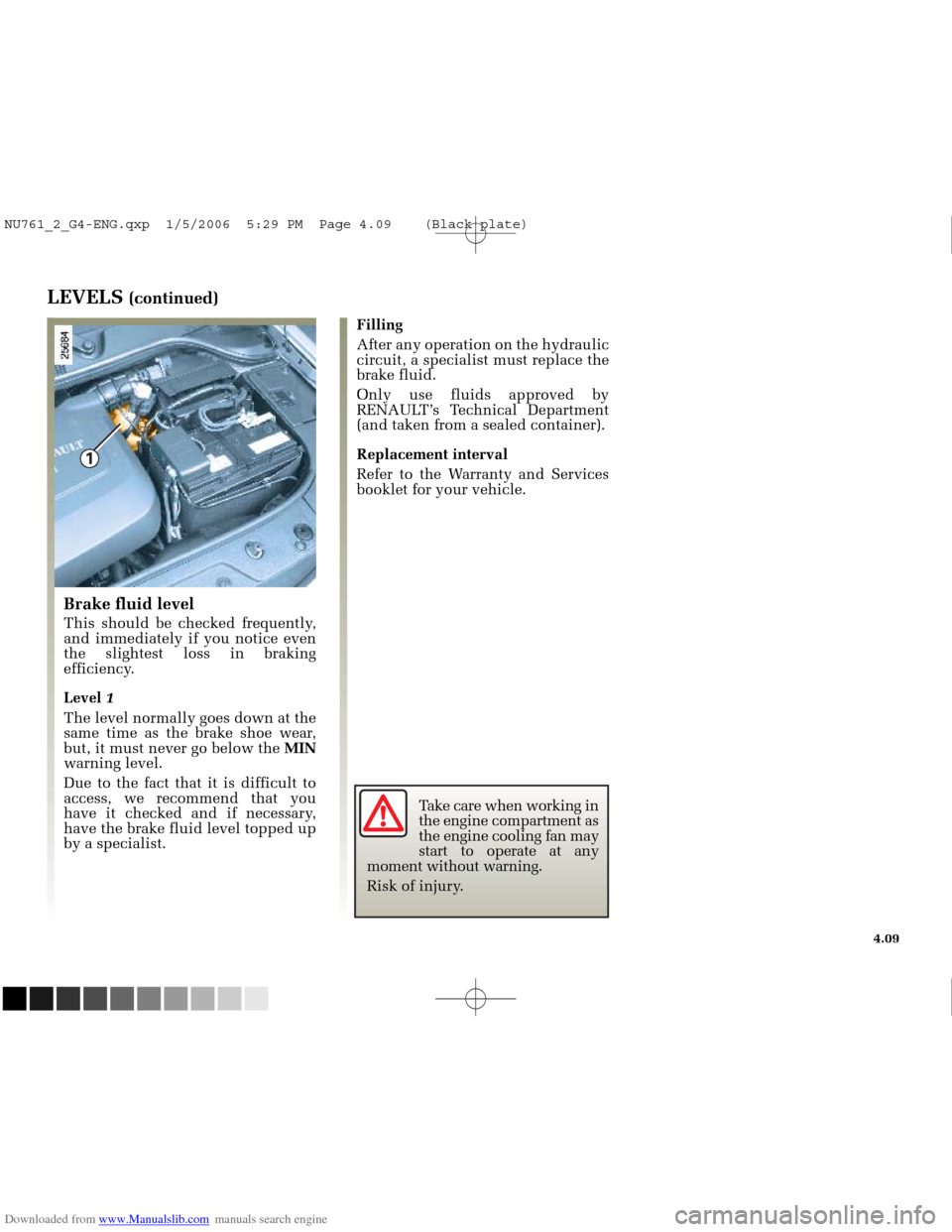
Brake fluid level
This should be checked frequently,
and immediately if you notice even
the slightest loss in braking
efficiency.
Level 1
The level normally goes down at the
same time as the brake shoe wear,
but, it must never go below the MIN
warning level.
Due to the fact that it is difficult to
access, we recommend that you
have it checked and if necessary,
have the brake fluid level topped up
by a specialist. Filling
After any operation on the hydraulic
circuit, a specialist must replace the
brake fluid.
Only use fluids approved by
RENAULT’s Technical Department
(and taken from a sealed container).
Replacement interval
Refer to the Warranty and Services
booklet for your vehicle.
Take care when working in
the engine compartment as
the engine cooling fan may
start to operate at any
moment without warning.
Risk of injury.
NU761_2_G4-ENG.qxp 1/5/2006 5:29 PM Page 4.09 (Black plate)
Page 184 of 250
Downloaded from www.Manualslib.com manuals search engine
1
NU761_2_G4-FRA.qxd 14/11/05 10:11 Page 4.10
4.10
LEVELS (continued)FILTERS
The replacement of filter elements
(air filter, passenger compartment
filter, diesel filter, etc.) is scheduled
in the servicing and maintenance
operations for your vehicle.
Frequency for replacing filter
elements: refer to the Warranty and
Services booklet for your vehicle.
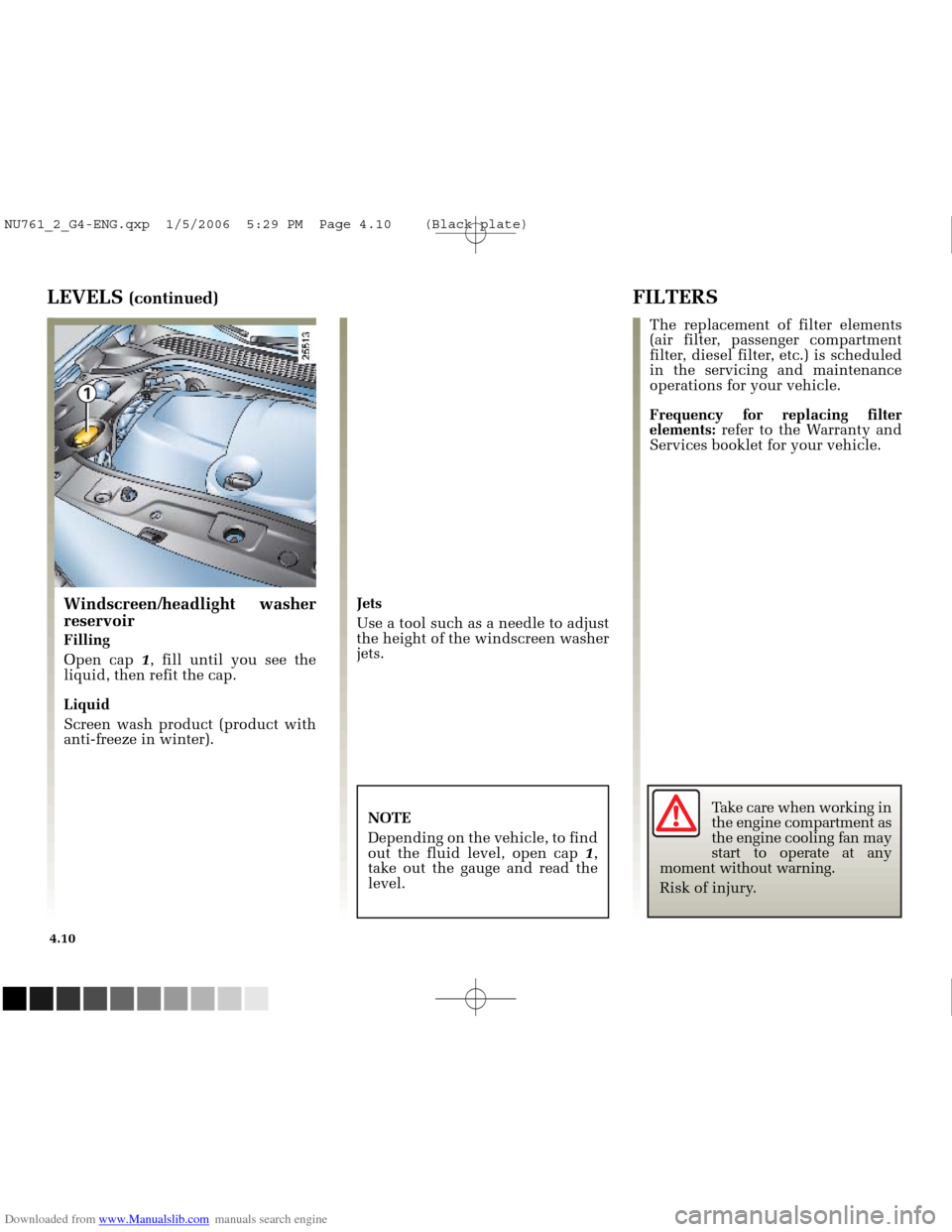
Windscreen/headlight washer
reservoir
Filling
Open cap 1, fill until you see the
liquid, then refit the cap.
Liquid
Screen wash product (product with
anti-freeze in winter). Jets
Use a tool such as a needle to adjust
the height of the windscreen washer
jets.
NOTE
Depending on the vehicle, to find
out the fluid level, open cap 1,
take out the gauge and read the
level.
Take care when working in
the engine compartment as
the engine cooling fan may
start to operate at any
moment without warning.
Risk of injury.
NU761_2_G4-ENG.qxp 1/5/2006 5:29 PM Page 4.10 (Black plate)
Page 197 of 250
Downloaded from www.Manualslib.com manuals search engine
2
1
NU761_2_G5-FRA.qxd 4/11/05 11:09 Page 5.09
5.09
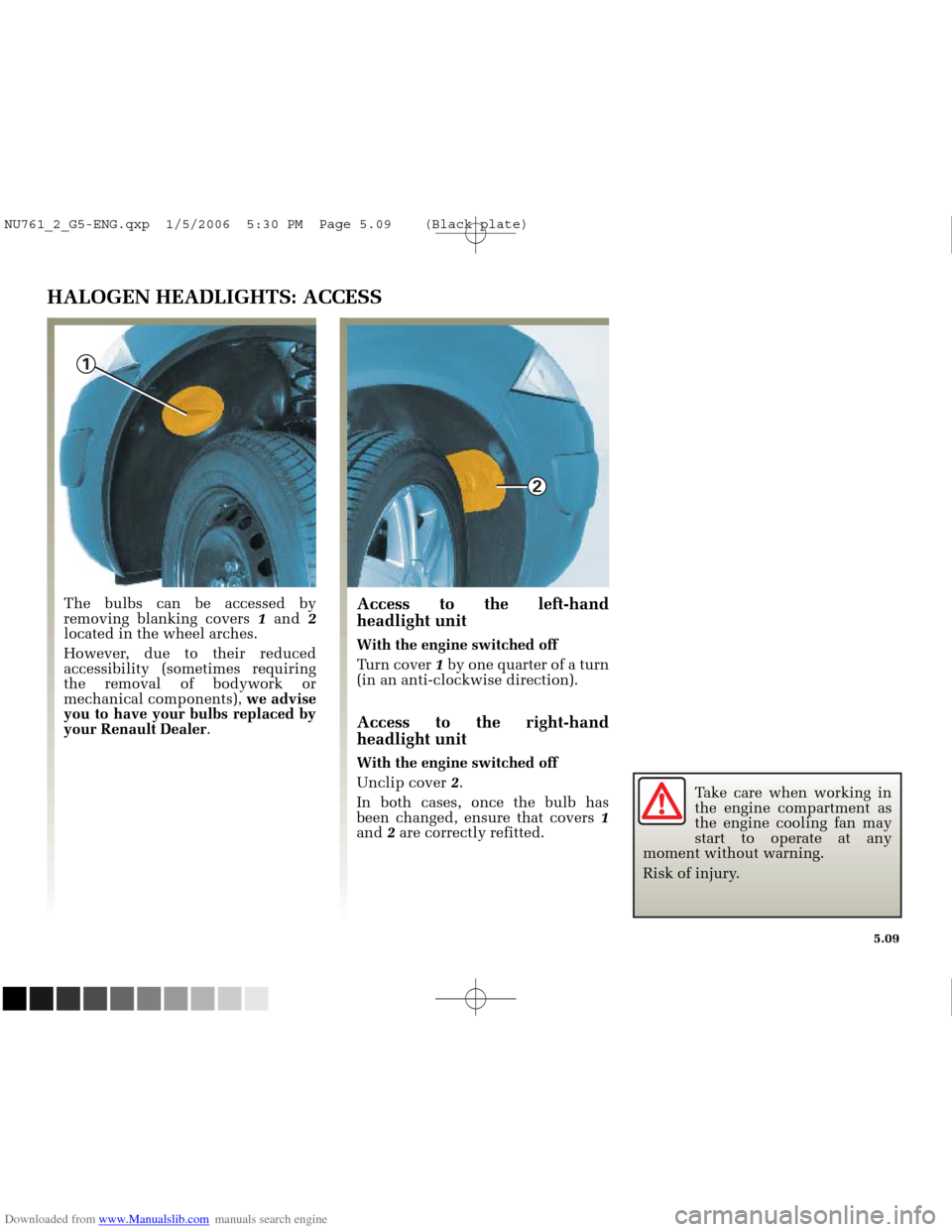
HALOGEN HEADLIGHTS: ACCESS
Access to the left-hand
headlight unit
With the engine switched off
Turn cover 1by one quarter of a turn
(in an anti-clockwise direction).
Access to the right-hand
headlight unit
With the engine switched off
Unclip cover 2.
In both cases, once the bulb has
been changed, ensure that covers 1
and 2 are correctly refitted.
The bulbs can be accessed by
removing blanking covers
1and 2
located in the wheel arches.
However, due to their reduced
accessibility (sometimes requiring
the removal of bodywork or
mechanical components), we advise
you to have your bulbs replaced by
your Renault Dealer .
Take care when working in
the engine compartment as
the engine cooling fan may
start to operate at any
moment without warning.
Risk of injury.
NU761_2_G5-ENG.qxp 1/5/2006 5:30 PM Page 5.09 (Black plate)
Page 198 of 250
Downloaded from www.Manualslib.com manuals search engine
A
B
2
7
4
1
5
6
3
NU761_2_G5-FRA.qxd 4/11/05 11:09 Page 5.10
5.10
HALOGEN HEADLIGHTS: changing bulbs
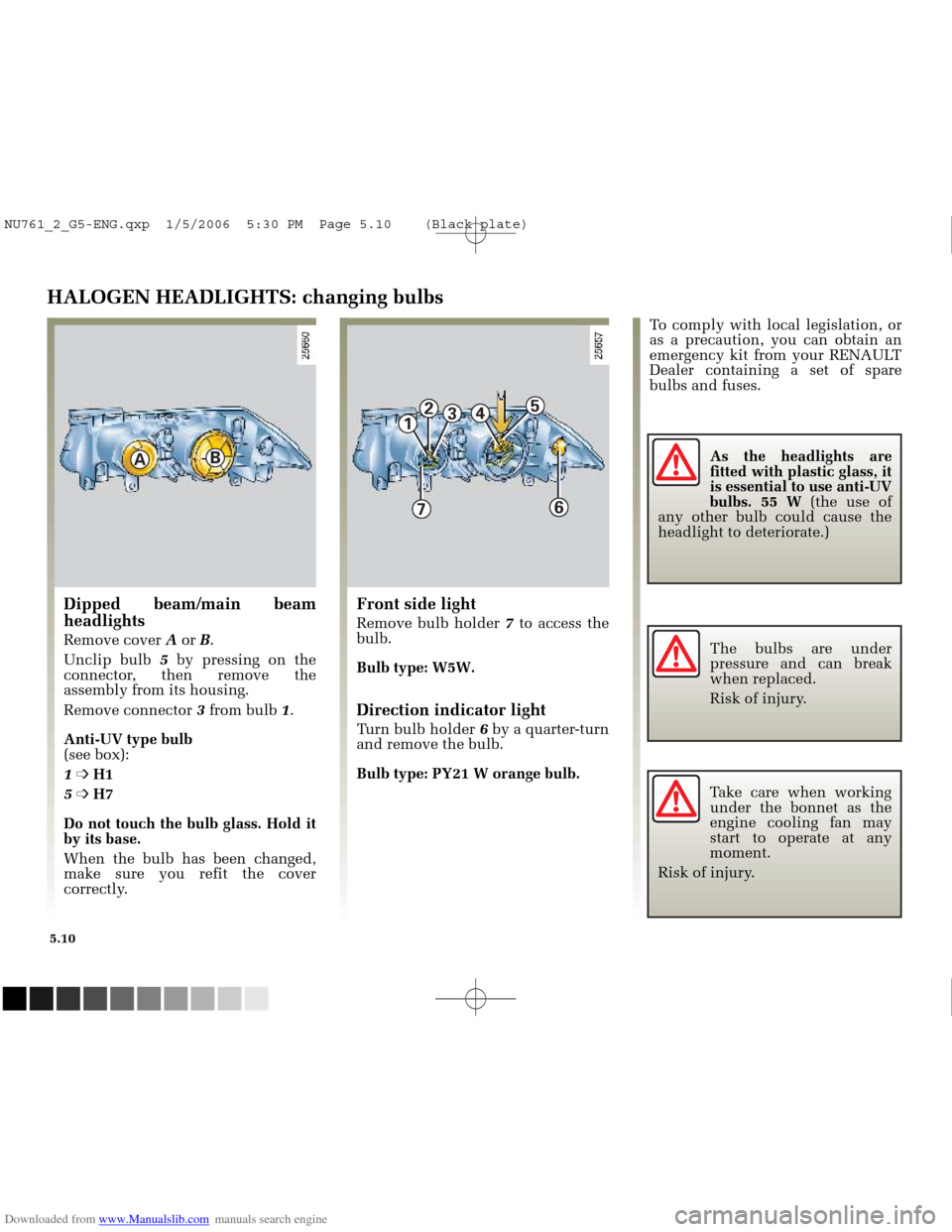
Front side light
Remove bulb holder 7to access the
bulb.
Bulb type: W5W.
Direction indicator light
Turn bulb holder 6by a quarter-turn
and remove the bulb.
Bulb type: PY21 W orange bulb.
Dipped beam/main beam
headlights
Remove cover Aor B.
Unclip bulb 5by pressing on the
connector, then remove the
assembly from its housing.
Remove connector 3 from bulb 1.
Anti-UV type bulb
(see box):
1 ➩ H1
5 ➩ H7
Do not touch the bulb glass. Hold it
by its base.
When the bulb has been changed,
make sure you refit the cover
correctly. To comply with local legislation, or
as a precaution, you can obtain an
emergency kit from your RENAULT
Dealer containing a set of spare
bulbs and fuses.
As the headlights are
fitted with plastic glass, it
is essential to use anti-UV
bulbs. 55 W (the use of
any other bulb could cause the
headlight to deteriorate.)
The bulbs are under
pressure and can break
when replaced.
Risk of injury.
Take care when working under the bonnet as the
engine cooling fan may
start to operate at any
moment.
Risk of injury.
NU761_2_G5-ENG.qxp 1/5/2006 5:30 PM Page 5.10 (Black plate)
Page 208 of 250
Downloaded from www.Manualslib.com manuals search engine
NU761_2_G5-FRA.qxd 4/11/05 11:09 Page 5.20
5.20
BATTERY: troubleshooting
To avoid all risk of sparks:
- Ensure that any consumers(courtesy lights etc.) are switched
off before disconnecting or
reconnecting the battery.
- When charging, stop the charger before connecting or disconnecting
the battery.
- Do not place metal objects on the battery to avoid creating a short
circuit between the terminals.
- Never disconnect a battery less than twenty seconds after the
engine has been switched off.
- Make sure that you reconnect the battery terminals after refitting. Handle the battery with care
as it contains sulphuric acid
which must not come into
contact with the eyes or
skin. If it does, wash the affected
area with plenty of cold water.
Ensure that naked flames, red hot
objects and sparks do not come into
contact with the battery as there is a
risk of explosion.
Take care when working in the
engine compartment as the engine
cooling fan may start to operate at
any moment without warning.
Risk of injury.
NU761_2_G5-ENG.qxp 1/5/2006 5:30 PM Page 5.20 (Black plate)