2005 RENAULT MEGANE belt
[x] Cancel search: beltPage 37 of 250
Downloaded from www.Manualslib.com manuals search engine
1
NU761_2_G1-FRA.qxd 10/11/05 15:53 Page 1.27
1.27
METHODS OF RESTRAINT IN ADDITION TO THE FRONT SEAT BELTS (continued)
Operation
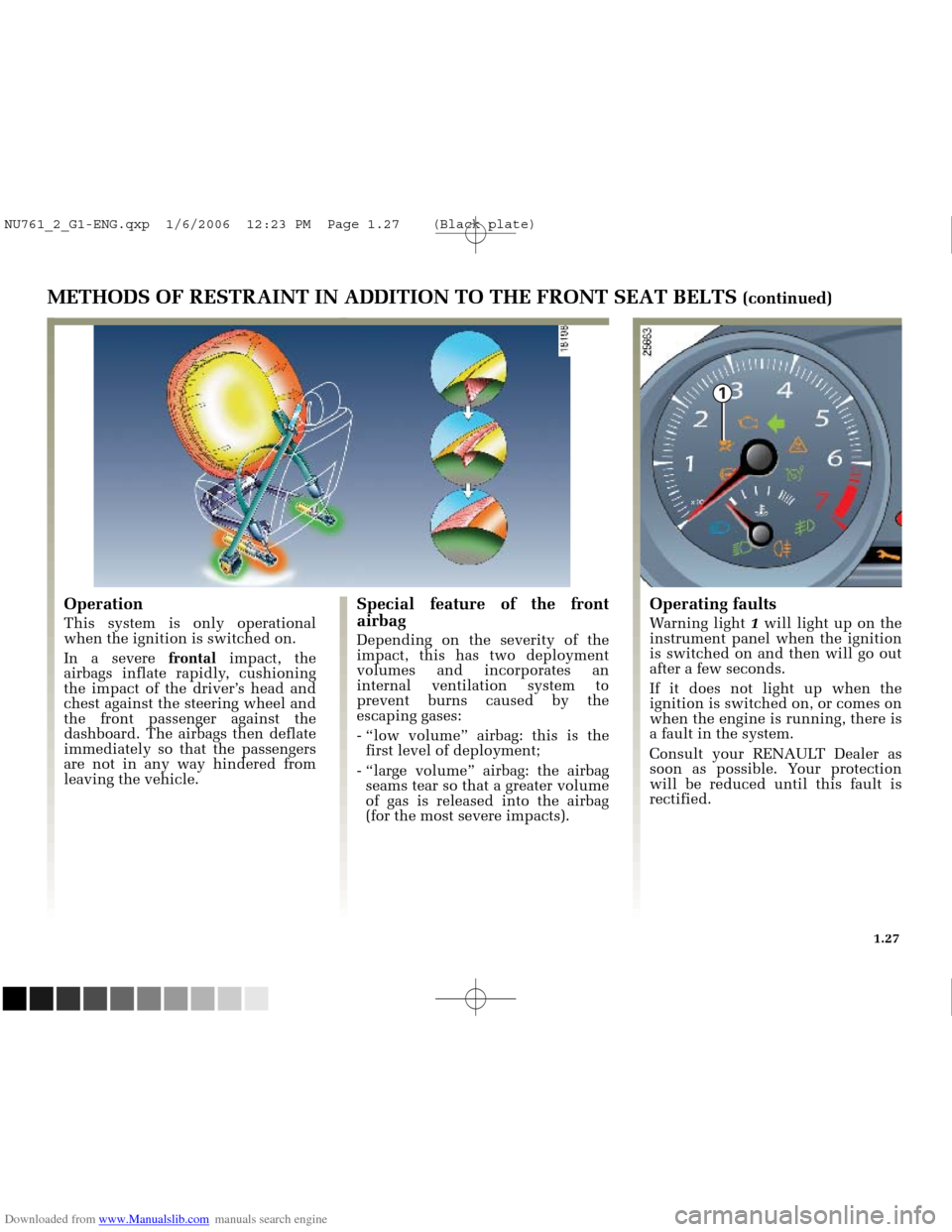
This system is only operational
when the ignition is switched on.
In a severe frontalimpact, the
airbags inflate rapidly, cushioning
the impact of the driver’s head and
chest against the steering wheel and
the front passenger against the
dashboard. The airbags then deflate
immediately so that the passengers
are not in any way hindered from
leaving the vehicle.
Special feature of the front
airbag
Depending on the severity of the
impact, this has two deployment
volumes and incorporates an
internal ventilation system to
prevent burns caused by the
escaping gases:
- “low volume” airbag: this is the first level of deployment;
- “large volume” airbag: the airbag seams tear so that a greater volume
of gas is released into the airbag
(for the most severe impacts).
Operating faults
Warning light 1will light up on the
instrument panel when the ignition
is switched on and then will go out
after a few seconds.
If it does not light up when the
ignition is switched on, or comes on
when the engine is running, there is
a fault in the system.
Consult your RENAULT Dealer as
soon as possible. Your protection
will be reduced until this fault is
rectified.
NU761_2_G1-ENG.qxp 1/6/2006 12:23 PM Page 1.27 (Black plate)
Page 38 of 250
Downloaded from www.Manualslib.com manuals search engine
NU761_2_G1-FRA.qxd 10/11/05 15:53 Page 1.28
1.28
METHODS OF RESTRAINT IN ADDITION TO THE FRONT SEAT BELTS (continued)All of the warnings below are given so that the airbag is not obstructed\
in any way when it is inflated and also to prevent
the risk of serious injuries caused by items which may be dislodged when\
the airbag inflates.Warnings concerning the driver’s airbag
Do not modify the steering wheel or the steering wheel boss.
Do not cover the steering wheel boss.
Do not attach any objects (badge, clock, telephone holder, etc.) to the steering wheel boss.
The steering wheel must not be removed (except by qualified personnel\
from the RENAULT Network).
When driving, do not sit too close to the steering wheel. Sit with your \
arms slightly bent (see the information on “Adjusting your driving position” in Section 1). This will allow \
sufficient space for the airbag to deploy correctly and
be fully effective.
Warnings concerning the passenger airbag
Do not attach or glue any objects (badge, logo, clock, telephone holder\
, etc.) to the dashboard in the proximity of the airbag housing.
Do not place anything between the dashboard and the passenger (pet, umb\
rella, walking stick, parcels, etc.).
The passenger must not put his or her feet on the dashboard or seat as t\
here is a risk that serious injuries may be sustained. In general, parts of the body should be kept away from the da\
shboard (knees, hands, head etc.)
The passenger airbags should be reactivated as soon as the child seat is\
removed, to ensure the protection of the front passenger in the event of an impact.
A REAR-FACING CHILD/BABY SEAT MUST NOT BE FITTED TO THE FRONT PASSENGER \
SEAT UNLESS THE
ADDITIONAL RESTRAINT SYSTEMS, I.E. THE PASSENGER AIRBAG, ARE DEACTIVATED\
. (Refer to the information
on “deactivating the front passenger airbags” in Section 1.)
Warnings concerning the anti-submarining airbag
When triggered, the anti-submarining airbag could project objects left o\
n the seat cushion with some force.
NU761_2_G1-ENG.qxp 1/6/2006 12:23 PM Page 1.28 (Black plate)
Page 39 of 250
Downloaded from www.Manualslib.com manuals search engine
NU761_2_G1-FRA.qxd 10/11/05 15:53 Page 1.29
1.29
Following an accident, itis necessary to have the
entire restraint system
checked by a qualified
technician.
No operation whatsoever is permitted on any part of the
system (pretensioners, airbags,
computers, wiring) and the
system components must not be
reused on any other vehicle, even
if identical.
To avoid accidental triggering of the system which may cause
injury, only qualified RENAULT
Network personnel may work on
the pretensioner and airbag
system.
Testing of the electrical trigger system may only be carried out
by a specially trained technician
using suitable equipment.
When the vehicle is scrapped, contact your RENAULT Dealer for
disposal of the pretensioner and
airbag gas generators.
METHODS OF RESTRAINT IN ADDITION TO THE REAR SEAT BELTS
Depending on the vehicle, they
comprise:
■ seat belt pretensioners built into
the inertia reels,
■ load limiter.
These systems are designed to act
independently or together when the
vehicle is subjected to a frontal
impact.
There are two possibilities,
depending on the force of the
impact:
- protection is provided by the belt only;
- the pretensioner is triggered to rectify seat belt slack.
Rear seat belt pretensioners
This system is only operational
when the ignition is switched on.
If the vehicle is subjected to a severe
frontal impact, a device retracts the
seat belt, pulling the seat belt tight
against the body and thus improving
its effectiveness.
Load limiter
Above a certain severity of impact,
this mechanism is used to limit the
force of the belt against the body so
that it is at an acceptable level.
NU761_2_G1-ENG.qxp 1/6/2006 12:23 PM Page 1.29 (Black plate)
Page 41 of 250
Downloaded from www.Manualslib.com manuals search engine
NU761_2_G1-FRA.qxd 10/11/05 15:53 Page 1.31
1.31
ADDITIONAL METHODS OF RESTRAINTAll the warnings below are given so that airbag activation is not obstru\
cted in any way and also to prevent the risk of
serious injuries caused by items which may be dislodged when the airbag \
inflates.The airbag is designed to complement the action of the seat belt. Both t\
he airbags and seat belts are integral parts
of the same protection system. It is therefore essential to wear a seat \
belt at all times. If seat belts are not worn, the
occupants are exposed to the risk of serious injury in the event of an a\
ccident. It may also increase the risk of
minor superficial injuries occurring when the airbag is deployed, althou\
gh such minor injuries are always
possible with airbags.
If the vehicle should overturn or in the event of a rear impact, however\
severe, the pretensioners and airbags are not
always triggered. These systems may, however, be triggered by impacts to the vehicle underbody, e.g. from kerbs,
potholes, stones, etc.
Any operation on or modification to any part of the Airbag system (Ai\
rbags, pretensioners, electronic unit, wiring, etc.) is strictly prohibited (except by qualified RENAULT Network personnel).
To ensure that the system is in good working order and to avoid accidenta\
l triggering of the system which may cause injury, only qualified RENAULT Network personnel may work on the airbag system.
As a safety precaution, have the airbag system checked if your vehicle h\
as been involved in an accident, stolen or broken into.
When selling or lending the vehicle, inform the user of these points and\
hand over this handbook with the vehicle.
When scrapping your vehicle, contact your RENAULT Dealer for disposal of the gas generator(s).
NU761_2_G1-ENG.qxp 1/6/2006 12:23 PM Page 1.31 (Black plate)
Page 42 of 250
Downloaded from www.Manualslib.com manuals search engine
NU761_2_G1-FRA.qxd 10/11/05 15:53 Page 1.32
1.32
Under no circumstances
should babies or children
be allowed to travel sitting
on the knees of another
passenger in the vehicle.
If a frontal impact occurs at 30 mph
(50 km/h) a child weighing 30 kg
will be transformed into a missile
equivalent to one ton: you will find
it impossible to hold the child, even
if you yourself are wearing a belt.
It is particularly dangerous to put
the belt round your child when he
or she is sitting on your lap. Never
use the belt for more than one
person at the same time.
CHILD SAFETY
Remember that a collision at 30 mph
(50 km/h) is the same as falling a
distance of 10 metres. Expressed in
other terms, transporting a child
without a restraint is the equivalent
of allowing him or her to play on a
fourth-floor balcony without
railings.In all countries there are regulations
governing the use of restraints for
children and babies.
In Europe, children under 10 years
of age
(1)must be seated in an
approved safety device which is
suitable for the weight and size of
the child.
The driver is responsible for
ensuring that this equipment is used
correctly.
Child restraints for which type
approval was obtained after January
1992 offer a level of safety much
greater than for restraints with type
approval before that date.
It is therefore advisable to select a
child restraint that complies with
European regulation ECE 44.
Restraints that comply with this
legislation must be marked with an
orange label bearing the letter E
followed by a number (which
represents the country where it is
type approved) and the year in
which the type approval was
granted.
Refer to the Child safety equipment
booklet available from the Renault
Network to choose the seat suited to
your child and recommended for
your vehicle. There are some passenger seats on
which the installation of child seats
is forbidden.
To find the authorised seats and
types of child seats that can be
installed in each of the authorised
seats, refer to the table in the
following pages.
Before installing a child seat in the
front seat
(if installation is permitted)
If fitted to the passenger seat, carry
out the following adjustments:
- move the passenger seat as far back as possible,
- set the seatback to its fully upright position,
- raise the seat base as far as possible,
- raise the headrest to its highest setting,
- move the seat belt height control to the low position.
(1) You must always comply with the
laws of the country in which you are
travelling. They may be different to
the guidelines in this handbook.
NU761_2_G1-ENG.qxp 1/6/2006 12:23 PM Page 1.32 (Black plate)
Page 44 of 250
Downloaded from www.Manualslib.com manuals search engine
NU761_2_G1-FRA.qxd 10/11/05 15:53 Page 1.34
1.34
CHILD SAFETY (continued)
X= Seat not suitable for fitting a child seat.
U = Seat which allows child seats with the “Universal” approval to be \
attached by seat belt; check that it can be fitted
correctly.
IUF = Seat which allows child seats with the “Universal” approval to be \
attached by the ISOFIX device; check that it can
be fitted correctly.
IL = Seat which allows a child seat approved as “semi-universal” or “\
vehicle specific” to be secured using the ISOFIX
child seat fixing system; check that it can be fitted correctly.
Refer to the Child safety equipment booklet available from the RENAULT N\
etwork to choose the seat suited to your child
and recommended for your vehicle.
(2) The size of the child seat with ISOFIX fittings is indicated by the symbol followed by a letter ( A, B, B1, C, D, E, F, G)
(3) Only a rear-facing child seat may be installed in this seat.
(4) It is recommended that the seat is moved back as far as possible and tha\
t the seatback is reclined by approximately 25°.
(5) A carrycot is fitted across the vehicle and occupies 2 seats - position \
the child with its head opposite the door side.
(6) Move the vehicle front seat forward as far as it will go, fit the child \
seat then move the front seat back so that it close as
possible to the child seat but without touching it.
(7) Fit the child seat seatback against the vehicle’s seatback. Adjust the headrest, or remove it if necessary.
(8) For the child’s safety, do not push the front seat more than halfway back on its runners and d\
o not recline the seatback
more than 25°.
(9) A child over 10 years of age, weighing more than 36 kg or taller than 1.\
36 m can be strapped directly into the seat like
an adult.
NU761_2_G1-ENG.qxp 1/6/2006 12:23 PM Page 1.34 (Black plate)
Page 45 of 250
Downloaded from www.Manualslib.com manuals search engine
NU761_2_G1-FRA.qxd 10/11/05 15:53 Page 1.35
1.35
To avoid any risk to your safety, we recommend that you use
RENAULT approved accessories because they are suitable for your
vehicle and are the only accessories for which RENAULT will
provide a warranty.
CHILD SAFETY (continued)
The right choice
Your vehicle is fitted with the Isofix
system, approved in accordance with
the ECE 14 and ECE 16 regulations.
The safety of your children is also
your responsibility.
To ensure that your child has the
maximum possible protection, we
recommend that you use Isofix seats
approved by the RENAULT
Network.
Refer to the information on the
Isofix system for securing child seats
in Section 1.
Restraint systems for all the
categories are available. These
systems have been developed in
consultation with the manufacturers
and have been tested in RENAULT
vehicles.
Contact your RENAULT Dealer and
ask him to help you install it.
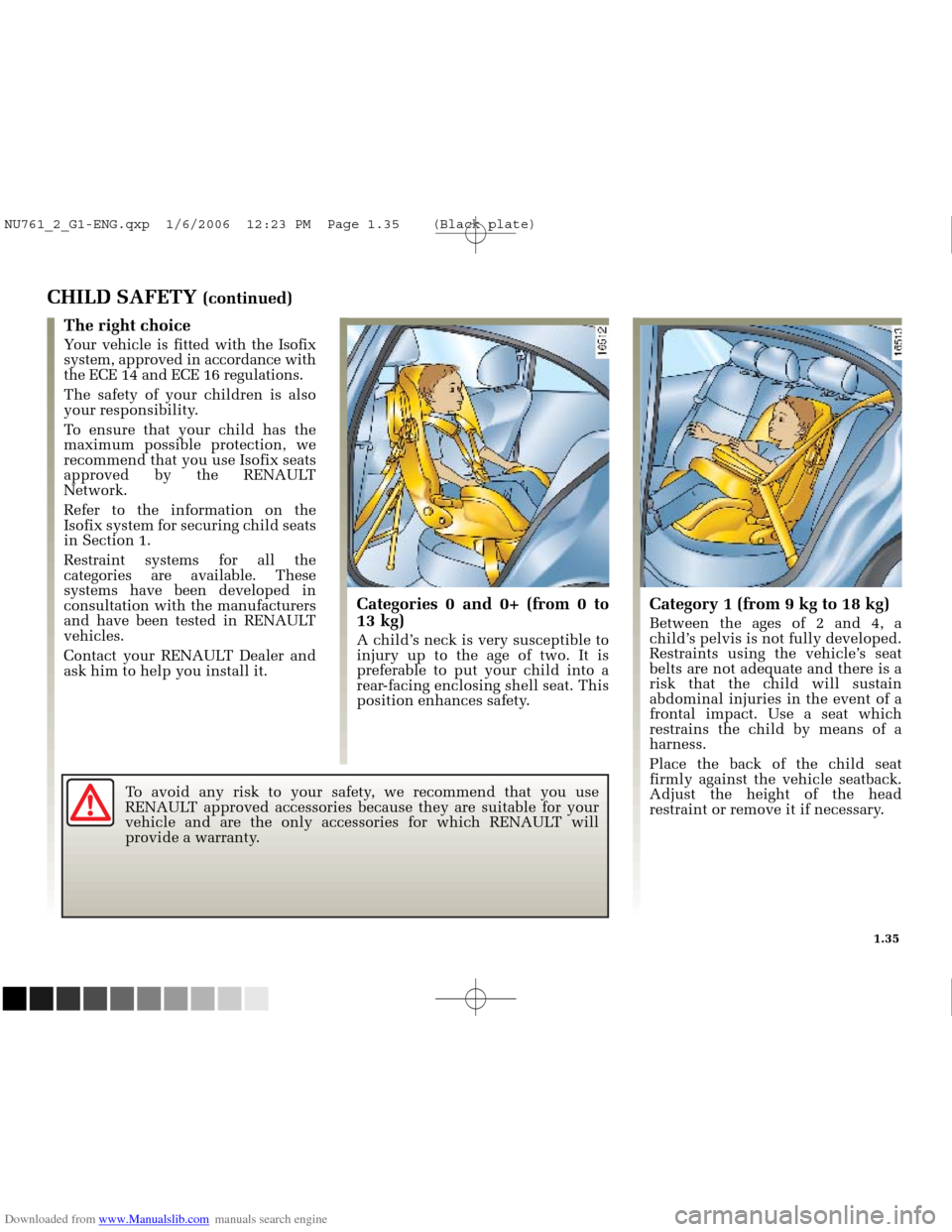
Categories 0 and 0+ (from 0 to
13 kg)
A child’s neck is very susceptible to
injury up to the age of two. It is
preferable to put your child into a
rear-facing enclosing shell seat. This
position enhances safety.
Category 1 (from 9 kg to 18 kg)
Between the ages of 2 and 4, a
child’s pelvis is not fully developed.
Restraints using the vehicle’s seat
belts are not adequate and there is a
risk that the child will sustain
abdominal injuries in the event of a
frontal impact. Use a seat which
restrains the child by means of a
harness.
Place the back of the child seat
firmly against the vehicle seatback.
Adjust the height of the head
restraint or remove it if necessary.
NU761_2_G1-ENG.qxp 1/6/2006 12:23 PM Page 1.35 (Black plate)
Page 46 of 250
Downloaded from www.Manualslib.com manuals search engine
NU761_2_G1-FRA.qxd 10/11/05 15:53 Page 1.36
1.36
CHILD SAFETY (continued)
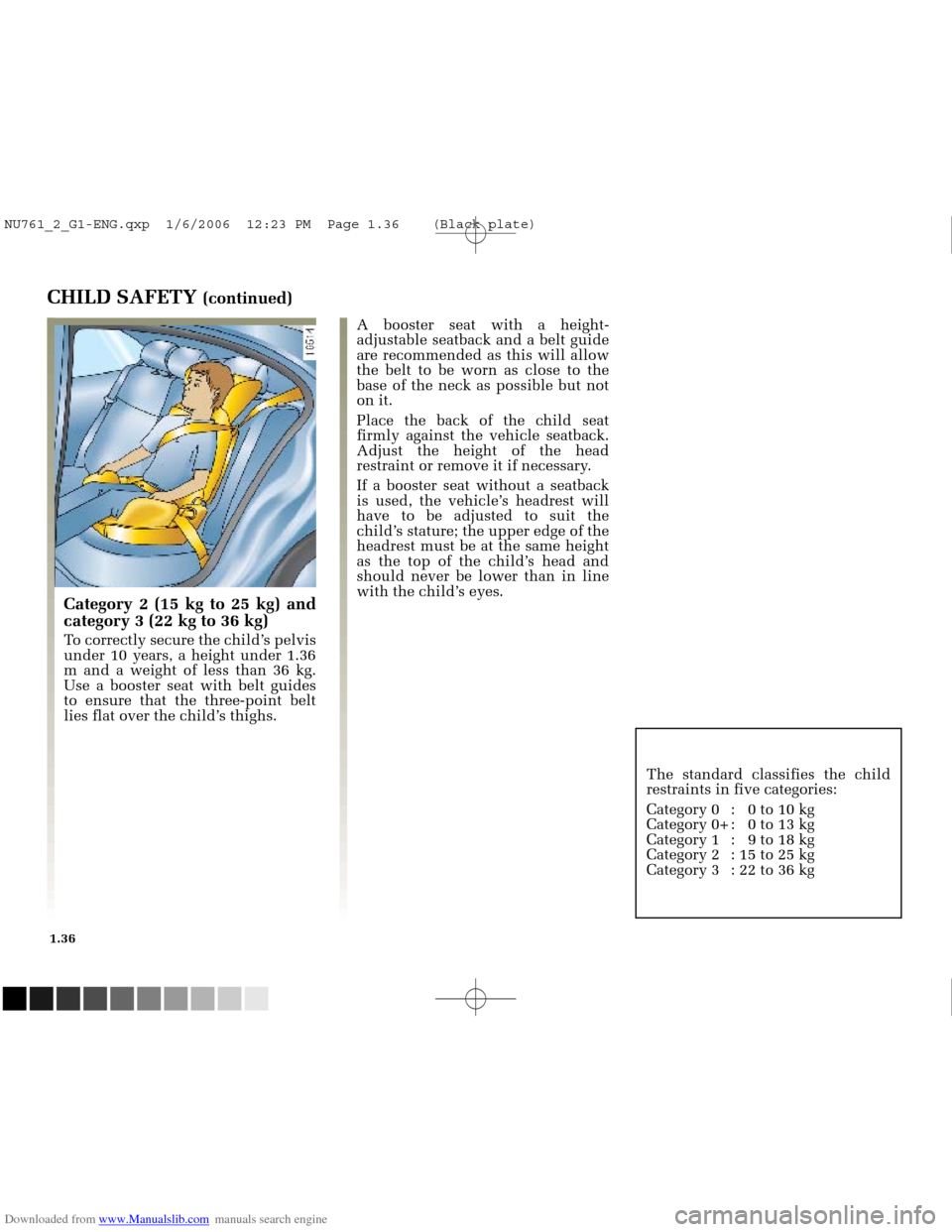
A booster seat with a height-
adjustable seatback and a belt guide
are recommended as this will allow
the belt to be worn as close to the
base of the neck as possible but not
on it.
Place the back of the child seat
firmly against the vehicle seatback.
Adjust the height of the head
restraint or remove it if necessary.
If a booster seat without a seatback
is used, the vehicle’s headrest will
have to be adjusted to suit the
child’s stature; the upper edge of the
headrest must be at the same height
as the top of the child’s head and
should never be lower than in line
with the child’s eyes.
Category 2 (15 kg to 25 kg) and
category 3 (22 kg to 36 kg)
To correctly secure the child’s pelvis
under 10 years, a height under 1.36
m and a weight of less than 36 kg.
Use a booster seat with belt guides
to ensure that the three-point belt
lies flat over the child’s thighs.The standard classifies the child
restraints in five categories:
Category 0 : 0 to 10 kg
Category 0+ : 0 to 13 kg
Category 1 : 9 to 18 kg
Category 2 : 15 to 25 kg
Category 3 : 22 to 36 kg
NU761_2_G1-ENG.qxp 1/6/2006 12:23 PM Page 1.36 (Black plate)