FRONT DISC BRAKE
BR-27
C
D
E
G
H
I
J
K
L
MA
B
BR
FRONT DISC BRAKEPFP:41000
ComponentEFS000CG
WARNING:
�Clean brake pads with a vacuum dust collector to minimize the hazard of airborne particles or
other materials.
CAUTION:
�When cylinder body is open, do not depress brake pedal because piston will pop out.
�Be careful not to damage piston boot or spill brake fluid oil on rotor. Always replace shims when
replacing pads.
�If shims are rusted or show peeling of the rubber coat, replace them with new shims.
�It is not necessary to remove torque member mounting bolt and brake hose union bolt except for
disassembly or replacement of caliper assembly. In this case, suspend cylinder body with wire so
as not to stretch brake hose.
�Burnish the brake pad contact surfaces after refinishing or replacing drums or rotors, after replac-
ing pads or linings, or if a soft pedal occurs at very low mileage. Refer to BR-31, "
BRAKE BUR-
NISHING PROCEDURE" .
InspectionEFS000CH
PAD THICKNESS
Check pad thickness by lifting vehicle, removing the wheel, and
looking through check hole on cylinder body. If necessary, use a
scale.
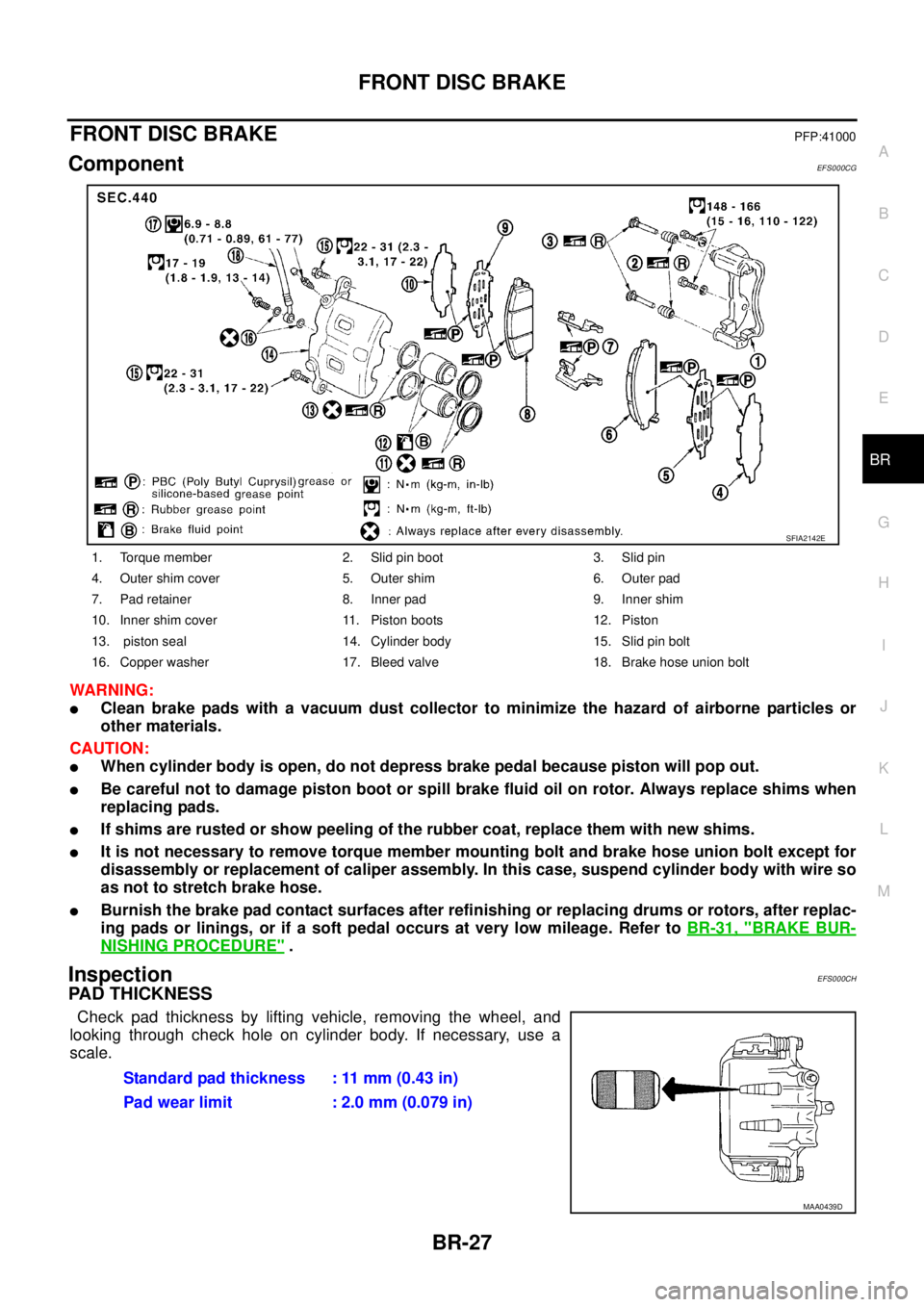
1. Torque member 2. Slid pin boot 3. Slid pin
4. Outer shim cover 5. Outer shim 6. Outer pad
7. Pad retainer 8. Inner pad 9. Inner shim
10. Inner shim cover 11. Piston boots 12. Piston
13. piston seal 14. Cylinder body 15. Slid pin bolt
16. Copper washer 17. Bleed valve 18. Brake hose union bolt
SFIA2142E
Standard pad thickness : 11 mm (0.43 in)
Pad wear limit : 2.0 mm (0.079 in)
MAA0439D
FRONT DISC BRAKE
BR-31
C
D
E
G
H
I
J
K
L
MA
B
BR
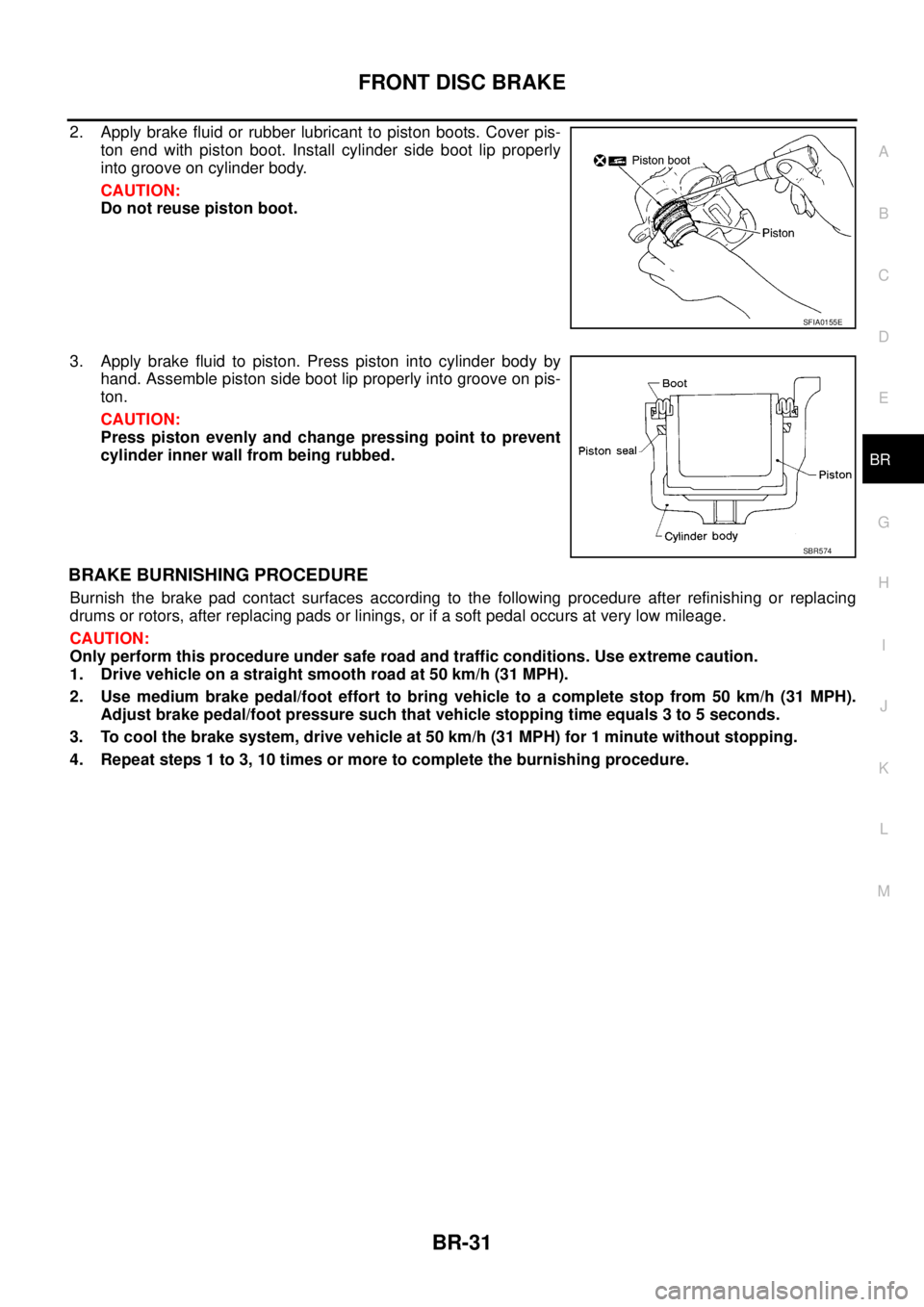
2. Apply brake fluid or rubber lubricant to piston boots. Cover pis-
ton end with piston boot. Install cylinder side boot lip properly
into groove on cylinder body.
CAUTION:
Do not reuse piston boot.
3. Apply brake fluid to piston. Press piston into cylinder body by
hand. Assemble piston side boot lip properly into groove on pis-
ton.
CAUTION:
Press piston evenly and change pressing point to prevent
cylinder inner wall from being rubbed.
BRAKE BURNISHING PROCEDURE
Burnish the brake pad contact surfaces according to the following procedure after refinishing or replacing
drums or rotors, after replacing pads or linings, or if a soft pedal occurs at very low mileage.
CAUTION:
Only perform this procedure under safe road and traffic conditions. Use extreme caution.
1. Drive vehicle on a straight smooth road at 50 km/h (31 MPH).
2. Use medium brake pedal/foot effort to bring vehicle to a complete stop from 50 km/h (31 MPH).
Adjust brake pedal/foot pressure such that vehicle stopping time equals 3 to 5 seconds.
3. To cool the brake system, drive vehicle at 50 km/h (31 MPH) for 1 minute without stopping.
4. Repeat steps 1 to 3, 10 times or more to complete the burnishing procedure.
SFIA0155E
SBR574
BRC-50
[ESP/TCS/ABS]
PRECAUTIONS
[ESP/TCS/ABS]PRECAUTIONSPFP:00001
Precautions for Supplemental Restraint System (SRS) “AIR BAG” and “SEAT
BELT PRE-TENSIONER”
EFS004H7
The Supplemental Restraint System such as “AIR BAG” and “SEAT BELT PRE-TENSIONER”, used along
with a front seat belt, helps to reduce the risk or severity of injury to the driver and front passenger for certain
types of collision. Information necessary to service the system safely is included in the SRS and SB section of
this Service Manual.
WARNING:
�To avoid rendering the SRS inoperative, which could increase the risk of personal injury or death
in the event of a collision which would result in air bag inflation, all maintenance must be per-
formed by an authorized NISSAN/INFINITI dealer.
�Improper maintenance, including incorrect removal and installation of the SRS, can lead to per-
sonal injury caused by unintentional activation of the system. For removal of Spiral Cable and Air
Bag Module, see the SRS section.
�Do not use electrical test equipment on any circuit related to the SRS unless instructed to in this
Service Manual. SRS wiring harnesses can be identified by yellow and/or orange harnesses or
harness connectors.
Precautions for Brake SystemEFS0019O
�Recommended fluid is brake fluid “DOT 3” or “DOT 4”.
�Do not reuse drained brake fluid.
�Be careful not to splash brake fluid on painted areas; it may cause paint damage. If brake fluid is splashed
on painted areas, wash it away with water immediately.
�Do not use mineral oils such as gasoline or kerosene. They will ruin rubber parts of hydraulic system.
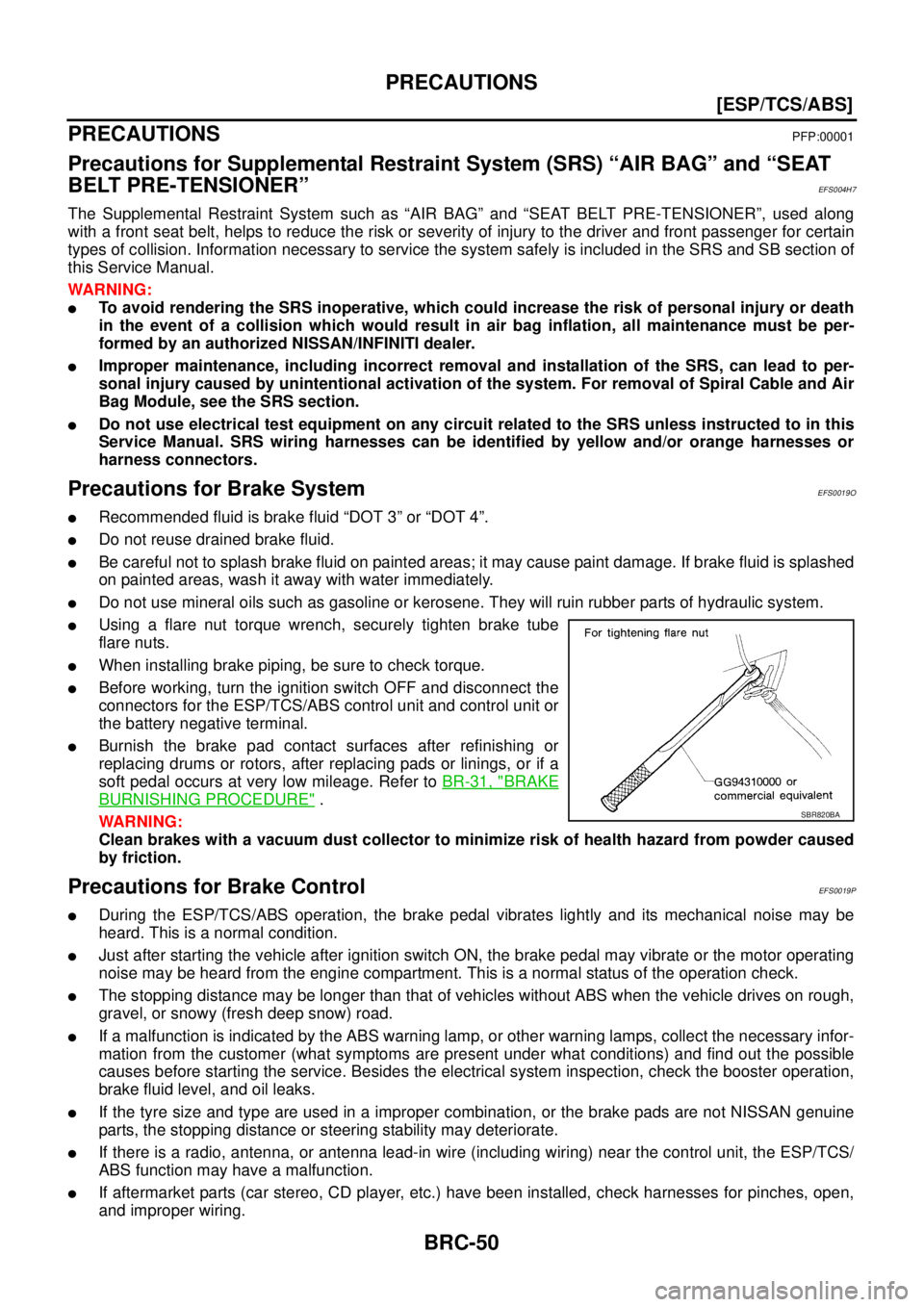
�Using a flare nut torque wrench, securely tighten brake tube
flare nuts.
�When installing brake piping, be sure to check torque.
�Before working, turn the ignition switch OFF and disconnect the
connectors for the ESP/TCS/ABS control unit and control unit or
the battery negative terminal.
�Burnish the brake pad contact surfaces after refinishing or
replacing drums or rotors, after replacing pads or linings, or if a
soft pedal occurs at very low mileage. Refer to BR-31, "
BRAKE
BURNISHING PROCEDURE" .
WARNING:
Clean brakes with a vacuum dust collector to minimize risk of health hazard from powder caused
by friction.
Precautions for Brake ControlEFS0019P
�During the ESP/TCS/ABS operation, the brake pedal vibrates lightly and its mechanical noise may be
heard. This is a normal condition.
�Just after starting the vehicle after ignition switch ON, the brake pedal may vibrate or the motor operating
noise may be heard from the engine compartment. This is a normal status of the operation check.
�The stopping distance may be longer than that of vehicles without ABS when the vehicle drives on rough,
gravel, or snowy (fresh deep snow) road.
�If a malfunction is indicated by the ABS warning lamp, or other warning lamps, collect the necessary infor-
mation from the customer (what symptoms are present under what conditions) and find out the possible
causes before starting the service. Besides the electrical system inspection, check the booster operation,
brake fluid level, and oil leaks.
�If the tyre size and type are used in a improper combination, or the brake pads are not NISSAN genuine
parts, the stopping distance or steering stability may deteriorate.
�If there is a radio, antenna, or antenna lead-in wire (including wiring) near the control unit, the ESP/TCS/
ABS function may have a malfunction.
�If aftermarket parts (car stereo, CD player, etc.) have been installed, check harnesses for pinches, open,
and improper wiring.
SBR820BA