Page 2700 of 3171
SUNROOF
RF-23
C
D
E
F
G
H
J
K
L
MA
B
RF
3. Adjust the sunroof glass. Refer toRF-20, "Fitting Adjustment".
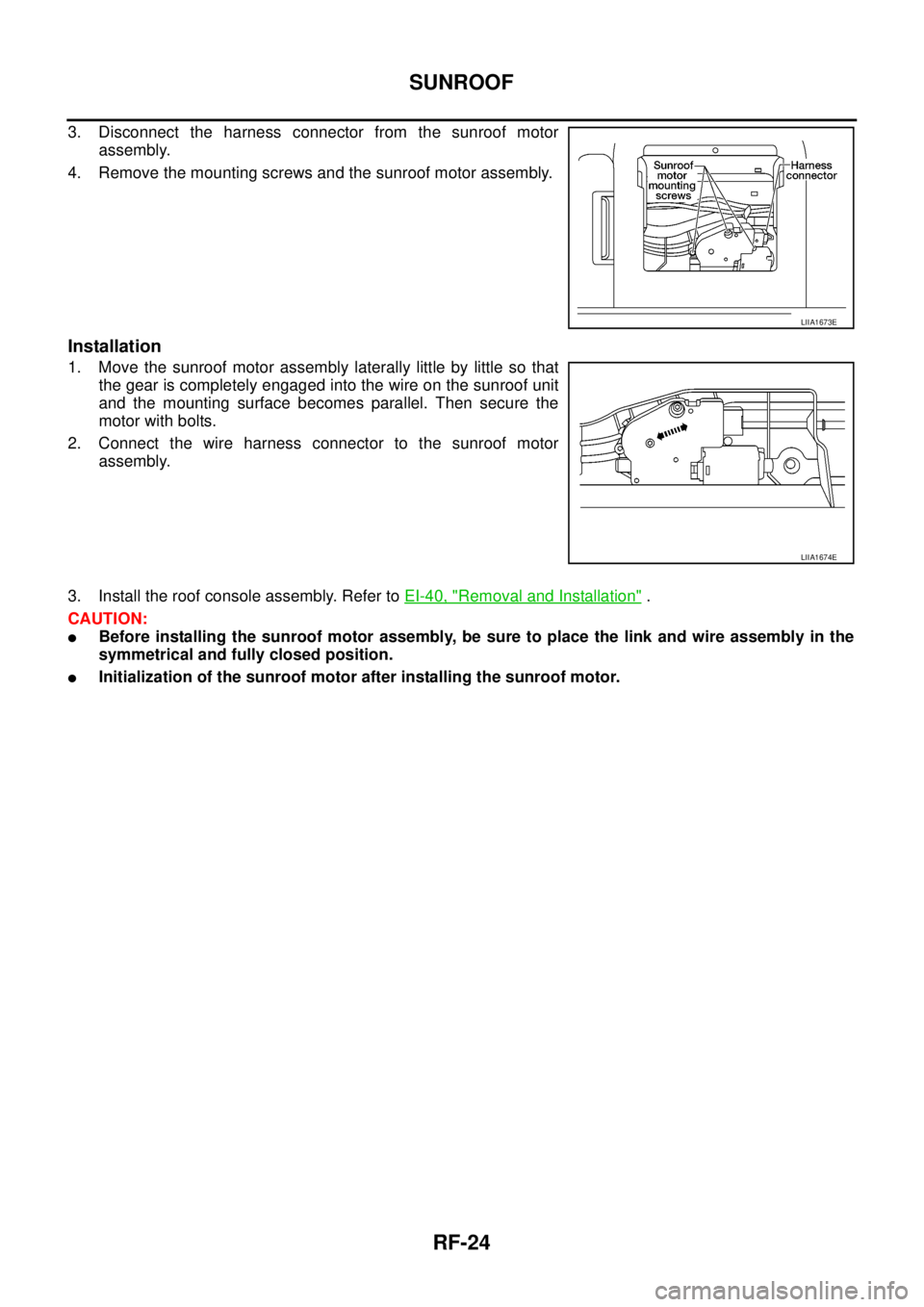
WIND DEFLECTOR
Removal
NOTE:
Removing is possible even by the on vehicle.
1. Sunroof lid is open.
2. Remove spring hinge screws and then remove hinge from the
frame.
3. Remove the stopper from the sunroof assembly.
4. Turn the wind deflector from ditch of the sunroof unit assembly.
Installation
Install in the reverse order of removal.
SUNSHADE
Removal
NOTE:
Removing is possible even by the on vehicle.
1. Remove headlining. Refer toRF-22, "
SUNROOF UNIT".
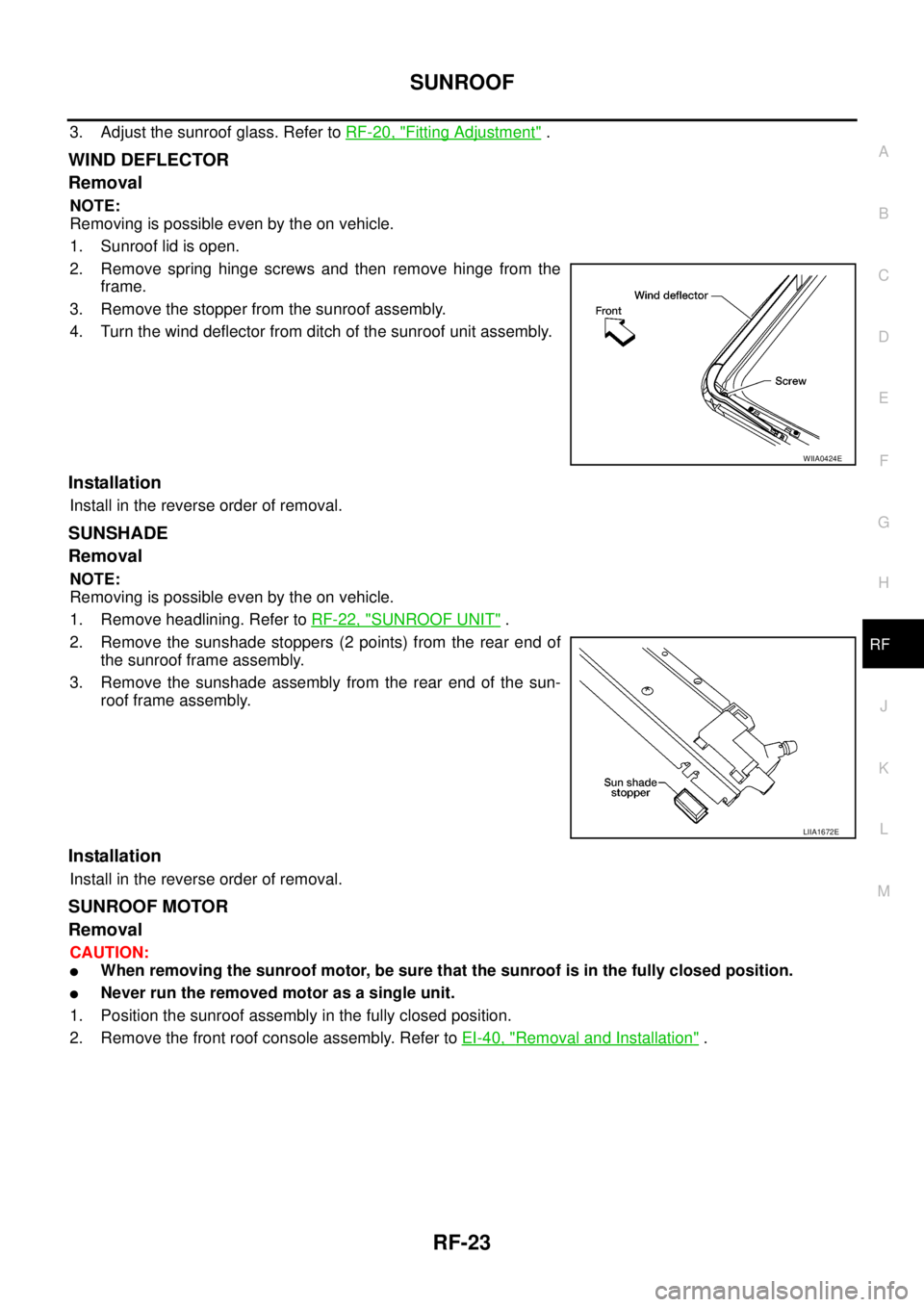
2. Remove the sunshade stoppers (2 points) from the rear end of
the sunroof frame assembly.
3. Remove the sunshade assembly from the rear end of the sun-
roof frame assembly.
Installation
Install in the reverse order of removal.
SUNROOF MOTOR
Removal
CAUTION:
lWhen removing the sunroof motor, be sure that the sunroof is in the fully closed position.
lNever run the removed motor as a single unit.
1. Position the sunroof assembly in the fully closed position.
2. Remove the front roof console assembly. Refer toEI-40, "
Removal and Installation".
WIIA0424E
LIIA1672E
Page 2701 of 3171
RF-24
SUNROOF
3. Disconnect the harness connector from the sunroof motor
assembly.
4. Remove the mounting screws and the sunroof motor assembly.
Installation
1. Move the sunroof motor assembly laterally little by little so that
the gear is completely engaged into the wire on the sunroof unit
and the mounting surface becomes parallel. Then secure the
motor with bolts.
2. Connect the wire harness connector to the sunroof motor
assembly.
3. Install the roof console assembly. Refer toEI-40, "
Removal and Installation".
CAUTION:
lBefore installing the sunroof motor assembly, be sure to place the link and wire assembly in the
symmetrical and fully closed position.
lInitialization of the sunroof motor after installing the sunroof motor.
LIIA1673E
LIIA1674E
Page 2702 of 3171
SUNROOF
RF-25
C
D
E
F
G
H
J
K
L
MA
B
RF
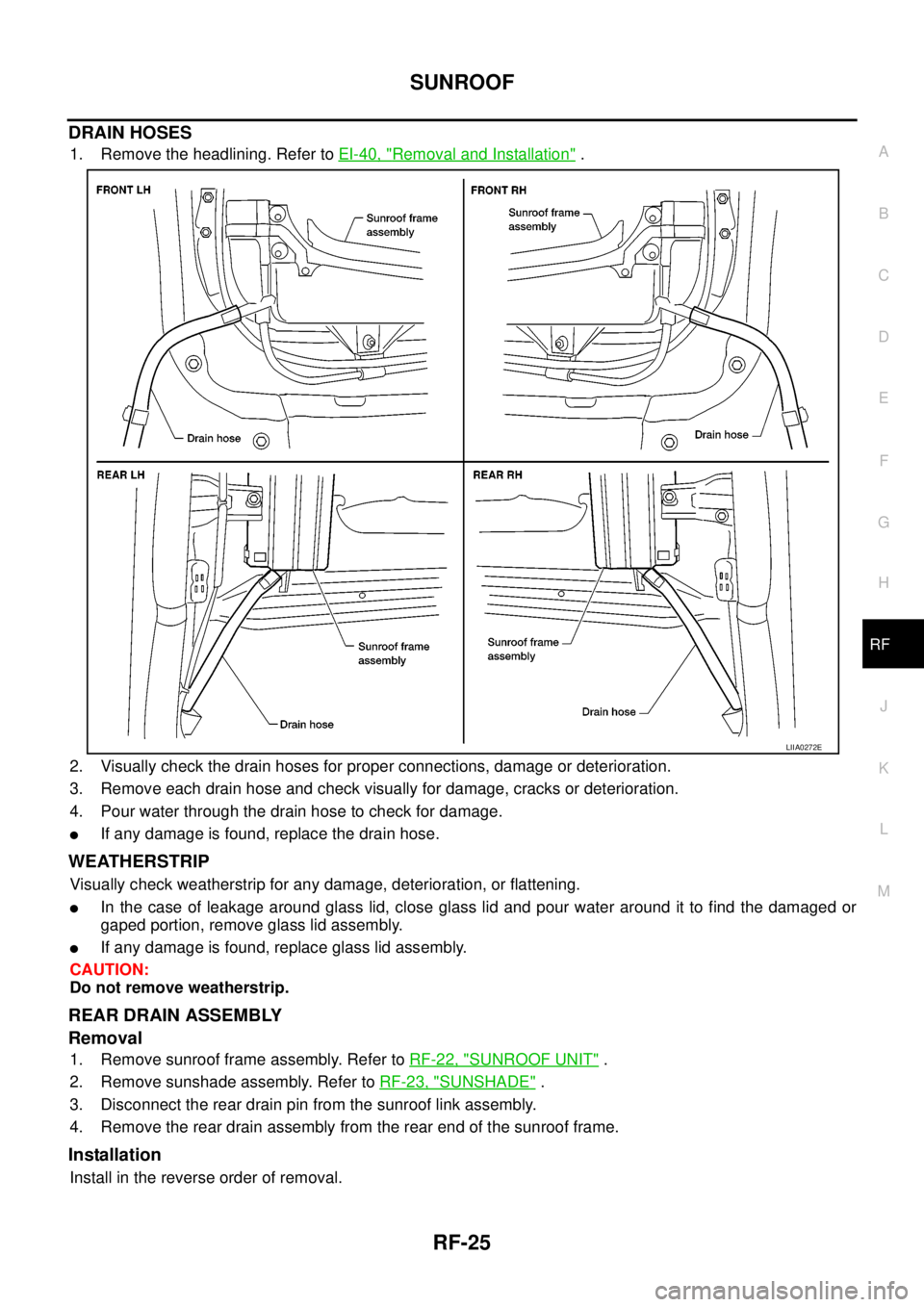
DRAIN HOSES
1. Remove the headlining. Refer toEI-40, "Removal and Installation".
2. Visually check the drain hoses for proper connections, damage or deterioration.
3. Remove each drain hose and check visually for damage, cracks or deterioration.
4. Pour water through the drain hose to check for damage.
lIf any damage is found, replace the drain hose.
WEATHERSTRIP
Visually check weatherstrip for any damage, deterioration, or flattening.
lIn the case of leakage around glass lid, close glass lid and pour water around it to find the damaged or
gaped portion, remove glass lid assembly.
lIf any damage is found, replace glass lid assembly.
CAUTION:
Do not remove weatherstrip.
REAR DRAIN ASSEMBLY
Removal
1. Remove sunroof frame assembly. Refer toRF-22, "SUNROOF UNIT".
2. Remove sunshade assembly. Refer toRF-23, "
SUNSHADE".
3. Disconnect the rear drain pin from the sunroof link assembly.
4. Remove the rear drain assembly from the rear end of the sunroof frame.
Installation
Install in the reverse order of removal.
LIIA0272E
Page 2703 of 3171
RF-26
SUNROOF
LINK AND WIRE ASSEMBLY
NOTE:
Before replacing any suspect part, carefully ensure it is the source of the noise being experienced.
1. Visually check to determine if a sufficient amount of petroleum jelly has been applied to the wire or rail
groove. If not, add petroleum jelly as required.
2. Check wire for any damage or deterioration. If any damage is found, remove rear guide, then replace
wire.
Page 2872 of 3171
SE-1
SEAT
IBODY
CONTENTS
C
D
E
F
G
H
J
K
L
M
SECTIONSE
A
B
SE
SEAT
PRECAUTIONS .......................................................... 2
Precautions for Supplemental Restraint System
(SRS)“AIRBAG”and“SEATBELTPRE-TEN-
SIONER” .................................................................. 2
Precautions for Work ................................................ 2
PREPARATION ........................................................... 3
Commercial Service Tool ......................................... 3
SQUEAK AND RATTLE TROUBLE DIAGNOSES..... 4
Work Flow ................................................................ 4
CUSTOMER INTERVIEW ..................................... 4
DUPLICATE THE NOISE AND TEST DRIVE ....... 5
CHECK RELATED SERVICE BULLETINS ........... 5
LOCATE THE NOISE AND IDENTIFY THE
ROOT CAUSE ...................................................... 5
REPAIR THE CAUSE ........................................... 5
CONFIRM THE REPAIR ....................................... 6
Generic Squeak and Rattle Troubleshooting ........... 6
INSTRUMENT PANEL .......................................... 6
CENTER CONSOLE ............................................. 6
DOORS ................................................................. 6
TRUNK .................................................................. 7
SUNROOF/HEADLINING ..................................... 7
SEATS ................................................................... 7
UNDERHOOD ....................................................... 7
Diagnostic Worksheet .............................................. 8
POWER SEAT .......................................................... 10Wiring Diagram – SEAT – / For LHD Models ......... 10
Wiring Diagram – SEAT – / For RHD Models ......... 11
HEATED SEAT .......................................................... 12
Description .............................................................. 12
Schematic ............................................................... 13
Wiring Diagram – HSEAT – / For LHD Models ....... 14
Wiring Diagram – HSEAT – / For RHD Models ...... 17
FRONT SEAT ............................................................ 20
Components Parts Drawing .................................... 20
DRIVER SEAT ..................................................... 20
PASSENGER SEAT ............................................ 22
Removal and Installation ........................................ 23
REMOVAL ........................................................... 23
INSTALLATION ................................................... 24
Disassembly and Assembly .................................... 24
SEAT CUSHION (POWER SEAT) ....................... 24
SEAT CUSHION (MANUAL SEAT) ..................... 25
SEATBACK (POWER AND MANUAL SEAT) ...... 26
SEATBACK (FRAT FOLD SEAT) ........................ 27
REAR SEAT .............................................................. 29
Removal and Installation ........................................ 29
JUMP SEAT (KING CAB) .................................... 29
BENCH SEAT LH (DOUBLE CAB) ...................... 30
BENCH SEAT RH (DOUBLE CAB) ..................... 30
Disassembly and Assembly .................................... 32
Page 2878 of 3171

SQUEAK AND RATTLE TROUBLE DIAGNOSES
SE-7
C
D
E
F
G
H
J
K
L
MA
B
SE
TRUNK
Trunk noises are often caused by a loose jack or loose items put into the trunk by the owner.
In addition look for:
1. Trunk lid dumpers out of adjustment
2. Trunk lid striker out of adjustment
3. Trunk lid torsion bars knocking together
4. A loose license plate or bracket
Most of these incidents can be repaired by adjusting, securing or insulating the item(s) or component(s) caus-
ing the noise.
SUNROOF/HEADLINING
Noises in the sunroof/headlining area can often be traced to one of the following:
1. Sunroof lid, rail, linkage or seals making a rattle or light knocking noise
2. Sunvisor shaft shaking in the holder
3. Front or rear windshield touching headlining and squeaking
Again, pressing on the components to stop the noise while duplicating the conditions can isolate most of these
incidents. Repairs usually consist of insulating with felt cloth tape.
SEATS
When isolating seat noise it's important to note the position the seat is in and the load placed on the seat when
the noise is present. These conditions should be duplicated when verifying and isolating the cause of the
noise.
Cause of seat noise include:
1. Headrest rods and holder
2. A squeak between the seat pad cushion and frame
3. Rear seatback lock and bracket
These noises can be isolated by moving or pressing on the suspected components while duplicating the con-
ditions under which the noise occurs. Most of these incidents can be repaired by repositioning the component
or applying urethane tape to the contact area.
UNDERHOOD
Some interior noise may be caused by components under the hood or on the engine wall. The noise is then
transmitted into the passenger compartment.
Causes of transmitted underhood noise include:
1. Any component mounted to the engine wall
2. Components that pass through the engine wall
3. Engine wall mounts and connectors
4. Loose radiator mounting pins
5. Hood bumpers out of adjustment
6. Hood striker out of adjustment
These noises can be difficult to isolate since they cannot be reached from the interior of the vehicle. The best
method is to secure, move or insulate one component at a time and test drive the vehicle. Also, engine RPM
or load can be changed to isolate the noise. Repairs can usually be made by moving, adjusting, securing, or
insulating the component causing the noise.