Page 247 of 969
32039-18
32-2
- BRAKEBRAKE SYSTEM
2436 Author�: Date�:
2005 LEXUS ES330 REPAIR MANUAL (RM1124U)
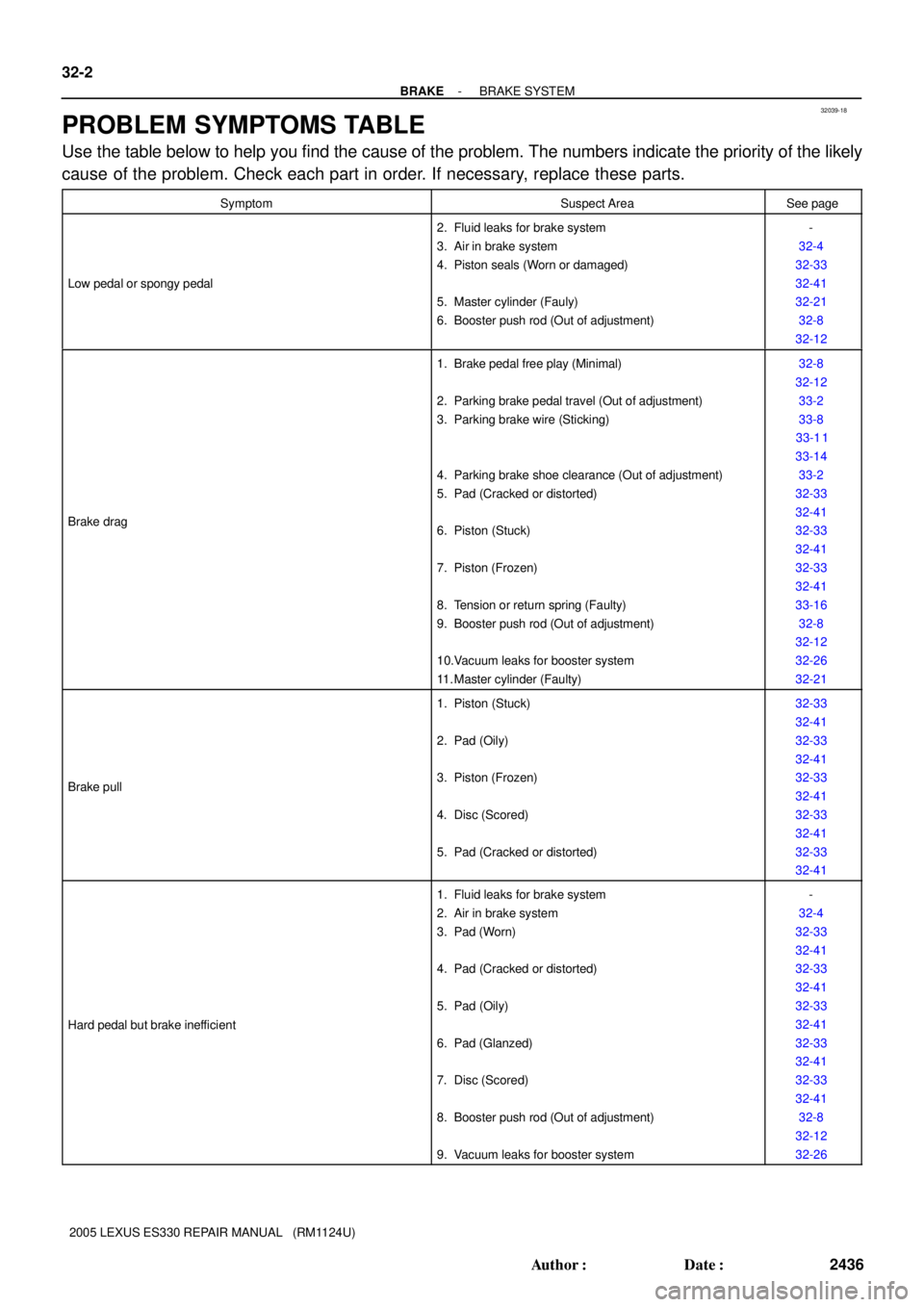
PROBLEM SYMPTOMS TABLE
Use the table below to help you find the cause of the problem. The numbers indicate the priority of the likely
cause of the problem. Check each part in order. If necessary, replace these parts.
SymptomSuspect AreaSee page
Low pedal or spongy pedal
2. Fluid leaks for brake system
3. Air in brake system
4. Piston seals (Worn or damaged)
5. Master cylinder (Fauly)
6. Booster push rod (Out of adjustment)-
32-4
32-33
32-41
32-21
32-8
32-12
Brake drag
1. Brake pedal free play (Minimal)
2. Parking brake pedal travel (Out of adjustment)
3. Parking brake wire (Sticking)
4. Parking brake shoe clearance (Out of adjustment)
5. Pad (Cracked or distorted)
6. Piston (Stuck)
7. Piston (Frozen)
8. Tension or return spring (Faulty)
9. Booster push rod (Out of adjustment)
10.Vacuum leaks for booster system
11. Master cylinder (Faulty)32-8
32-12
33-2
33-8
33-1 1
33-14
33-2
32-33
32-41
32-33
32-41
32-33
32-41
33-16
32-8
32-12
32-26
32-21
Brake pull
1. Piston (Stuck)
2. Pad (Oily)
3. Piston (Frozen)
4. Disc (Scored)
5. Pad (Cracked or distorted) 32-33
32-41
32-33
32-41
32-33
32-41
32-33
32-41
32-33
32-41
Hard pedal but brake inefficient
1. Fluid leaks for brake system
2. Air in brake system
3. Pad (Worn)
4. Pad (Cracked or distorted)
5. Pad (Oily)
6. Pad (Glanzed)
7. Disc (Scored)
8. Booster push rod (Out of adjustment)
9. Vacuum leaks for booster system-
32-4
32-33
32-41
32-33
32-41
32-33
32-41
32-33
32-41
32-33
32-41
32-8
32-12
32-26
Page 254 of 969
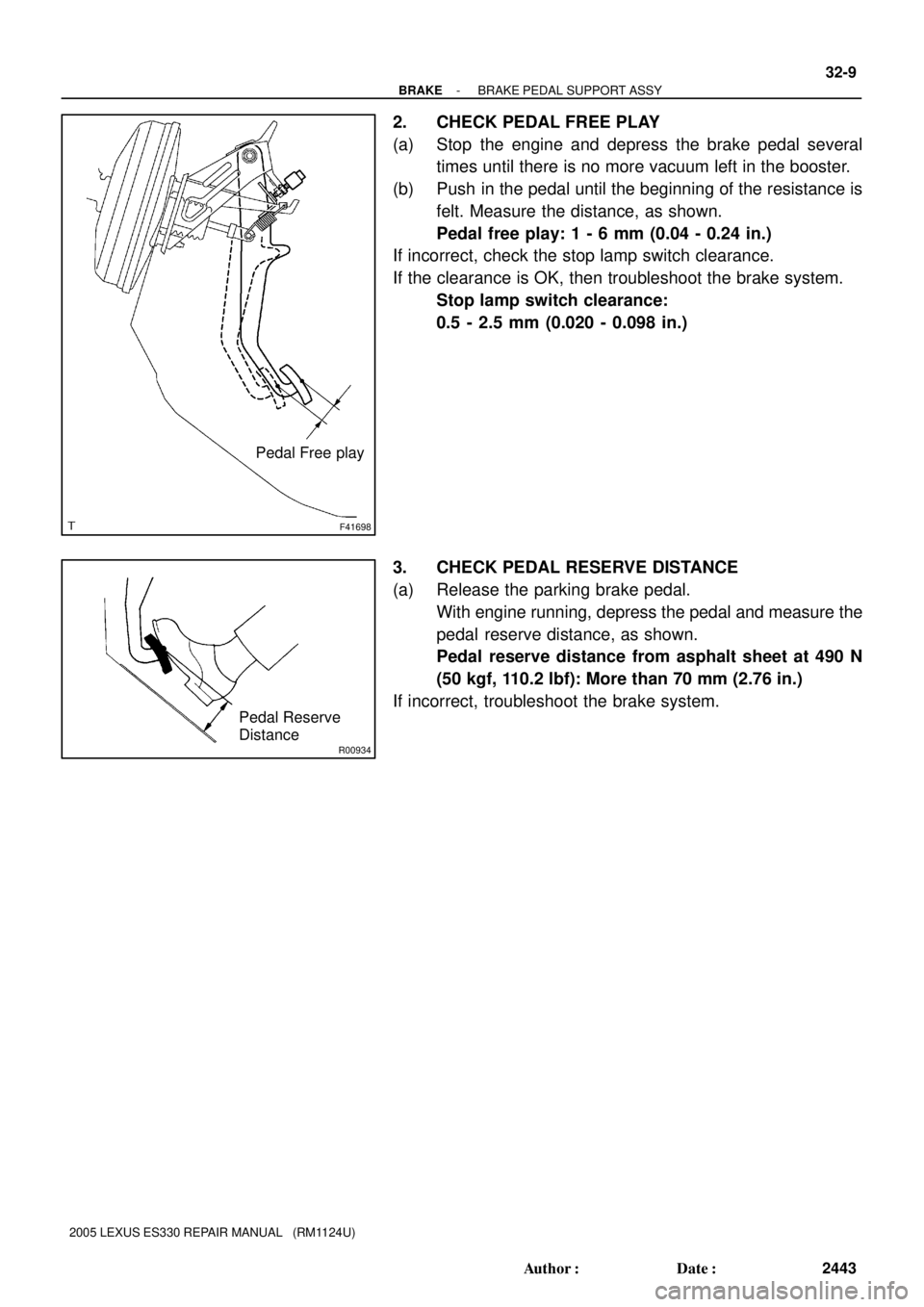
F41698
Pedal Free play
R00934
Pedal Reserve
Distance
- BRAKEBRAKE PEDAL SUPPORT ASSY
32-9
2443 Author�: Date�:
2005 LEXUS ES330 REPAIR MANUAL (RM1124U)
2. CHECK PEDAL FREE PLAY
(a) Stop the engine and depress the brake pedal several
times until there is no more vacuum left in the booster.
(b) Push in the pedal until the beginning of the resistance is
felt. Measure the distance, as shown.
Pedal free play: 1 - 6 mm (0.04 - 0.24 in.)
If incorrect, check the stop lamp switch clearance.
If the clearance is OK, then troubleshoot the brake system.
Stop lamp switch clearance:
0.5 - 2.5 mm (0.020 - 0.098 in.)
3. CHECK PEDAL RESERVE DISTANCE
(a) Release the parking brake pedal.
With engine running, depress the pedal and measure the
pedal reserve distance, as shown.
Pedal reserve distance from asphalt sheet at 490 N
(50 kgf, 110.2 lbf): More than 70 mm (2.76 in.)
If incorrect, troubleshoot the brake system.
Page 258 of 969
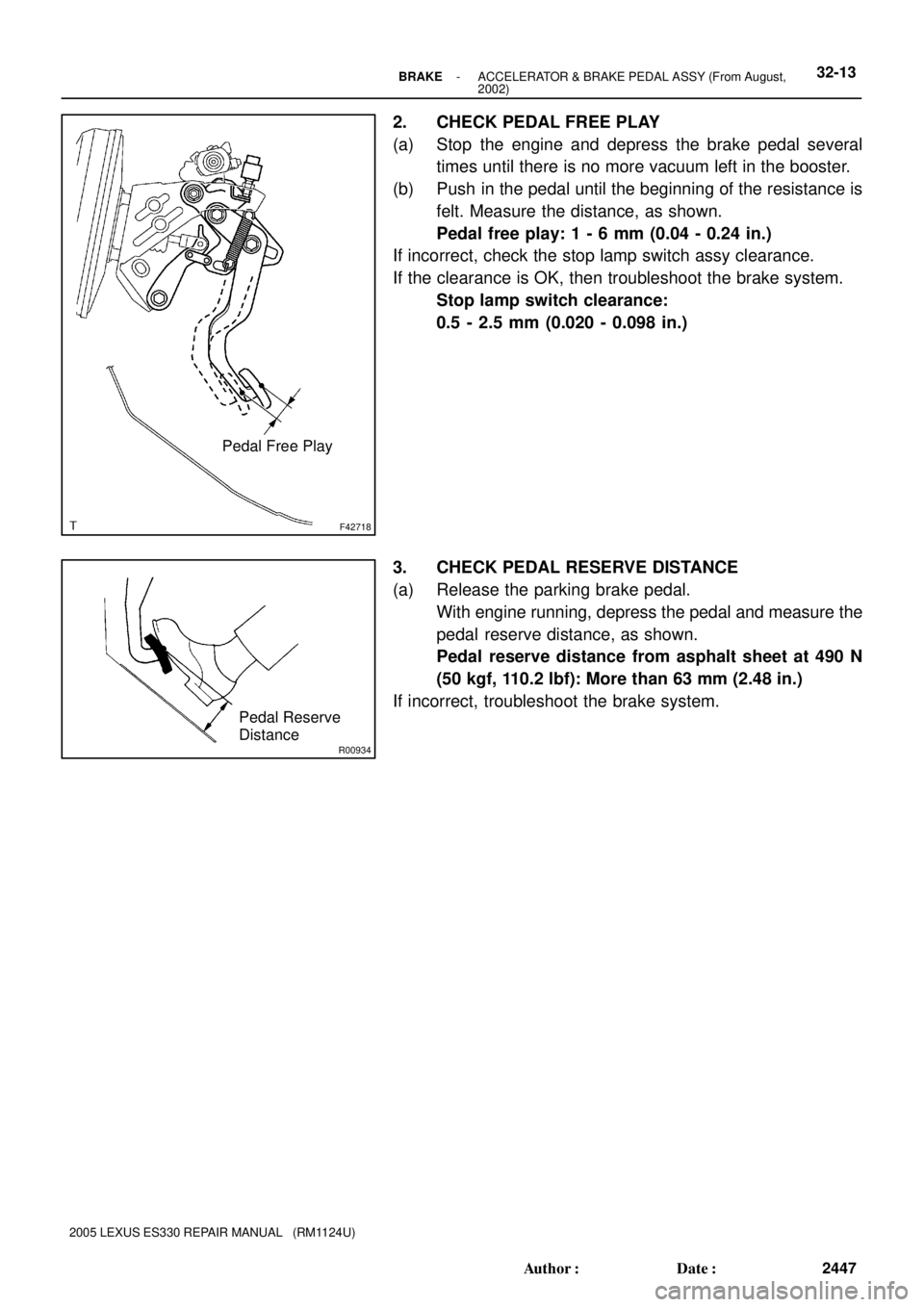
F42718
Pedal Free Play
R00934
Pedal Reserve
Distance
- BRAKEACCELERATOR & BRAKE PEDAL ASSY (From August,
2002)32-13
2447 Author�: Date�:
2005 LEXUS ES330 REPAIR MANUAL (RM1124U)
2. CHECK PEDAL FREE PLAY
(a) Stop the engine and depress the brake pedal several
times until there is no more vacuum left in the booster.
(b) Push in the pedal until the beginning of the resistance is
felt. Measure the distance, as shown.
Pedal free play: 1 - 6 mm (0.04 - 0.24 in.)
If incorrect, check the stop lamp switch assy clearance.
If the clearance is OK, then troubleshoot the brake system.
Stop lamp switch clearance:
0.5 - 2.5 mm (0.020 - 0.098 in.)
3. CHECK PEDAL RESERVE DISTANCE
(a) Release the parking brake pedal.
With engine running, depress the pedal and measure the
pedal reserve distance, as shown.
Pedal reserve distance from asphalt sheet at 490 N
(50 kgf, 110.2 lbf): More than 63 mm (2.48 in.)
If incorrect, troubleshoot the brake system.
Page 271 of 969

3203F-08
BR2238
GOOD NO GOOD
2nd3rd
1st
BR2237
C16481
Ventilation
No Ventilation 32-26
- BRAKEBRAKE BOOSTER ASSY
2460 Author�: Date�:
2005 LEXUS ES330 REPAIR MANUAL (RM1124U)
BRAKE BOOSTER ASSY (From July, 2003)
ON-VEHICLE INSPECTION
1. INSPECT BRAKE BOOSTER
(a) Air tightness check.
(1) Start the engine and stop it after 1 or 2 minutes. De-
press the brake pedal several times slowly.
HINT:
If the pedal goes down farthest the 1st time, but gradually rises
after the 2nd or 3rd time, the booster is air tight.
(2) Depress the brake pedal while the engine is run-
ning, and stop the engine with the pedal depressed.
HINT:
If there is no change in the pedal reserve distance after holding
the pedal for 30 seconds, the booster is air tight.
(b) Operating check.
(1) Depress the brake pedal several times with the igni-
tion switch OFF and check that there is no change
in the pedal reserve distance.
(2) Depress the brake pedal and start the engine.
HINT:
If the pedal goes down slightly, operation is normal.
2. INSPECT VACUUM CHECK VALVE
(a) Check vacuum check valve.
(1) Slide the clip and disconnect the vacuum hose.
(2) Remove the vacuum check valve.
(3) Check that there is ventilation from the booster to
engine, and no ventilation from the engine to the
booster.
(4) If any fault is found, replace the vacuum check
valve.
Page 272 of 969
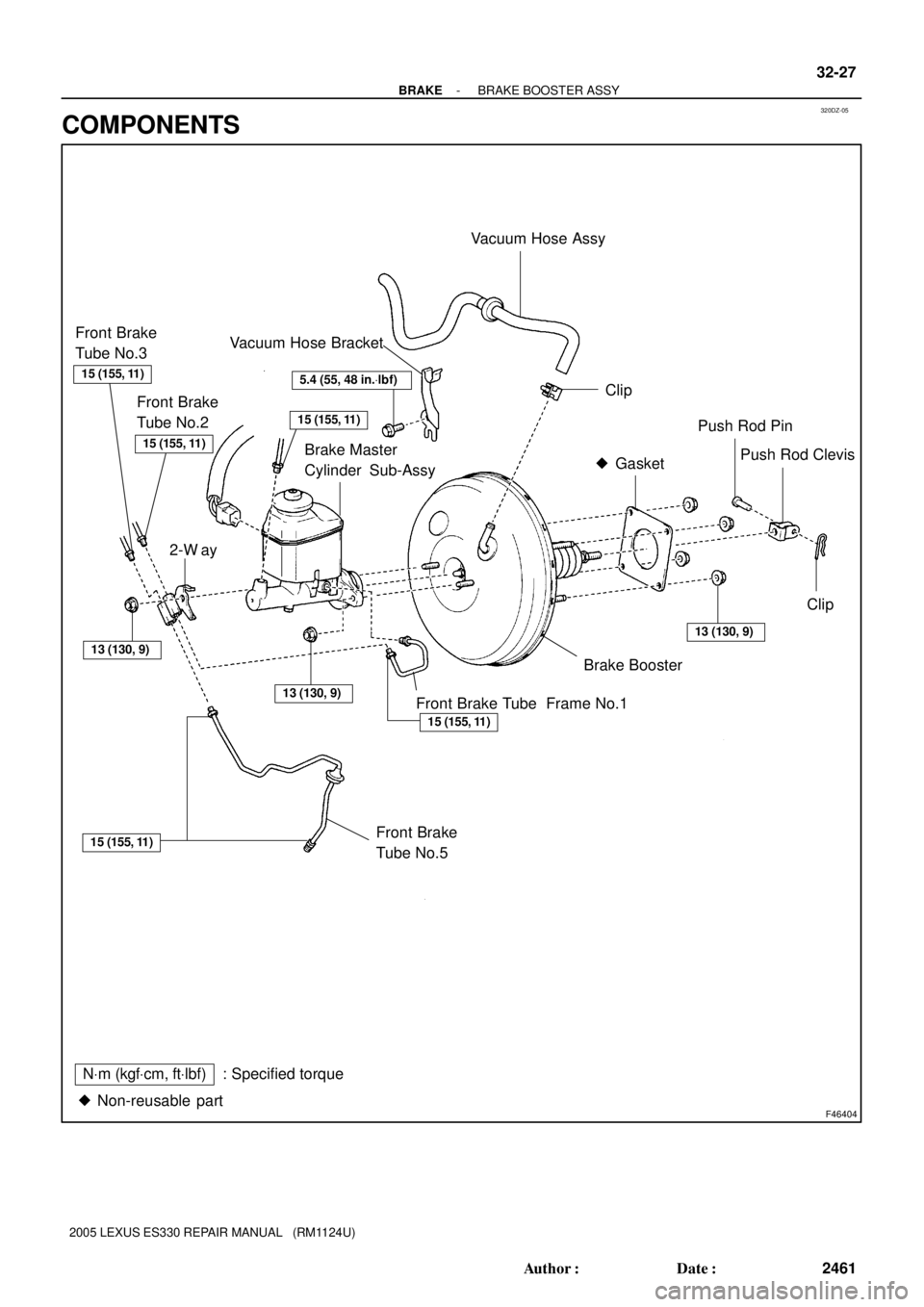
320DZ-05
F46404
Vacuum Hose Assy
Clip
Brake Master
Cylinder Sub-AssyGasket �Push Rod Pin
Push Rod Clevis
Clip
Brake Booster
Front Brake
Tube No.5Front Brake Tube Frame No.1
� Non-reusable part
NVm (kgfVcm, ftVlbf): Specified torque
15 (155, 11)
13 (130, 9)
5.4 (55, 48 in.Vlbf)
13 (130, 9)
15 (155, 11)
13 (130, 9)
Vacuum Hose Bracket
15 (155, 11)
2-W ay
15 (155, 11)
Front Brake
Tube No.2
15 (155, 11)
Front Brake
Tube No.3
- BRAKEBRAKE BOOSTER ASSY
32-27
2461 Author�: Date�:
2005 LEXUS ES330 REPAIR MANUAL (RM1124U)
COMPONENTS
Page 273 of 969
3211X-04
F40995
F40996
BR3753
32-28
- BRAKEBRAKE BOOSTER ASSY
2462 Author�: Date�:
2005 LEXUS ES330 REPAIR MANUAL (RM1124U)
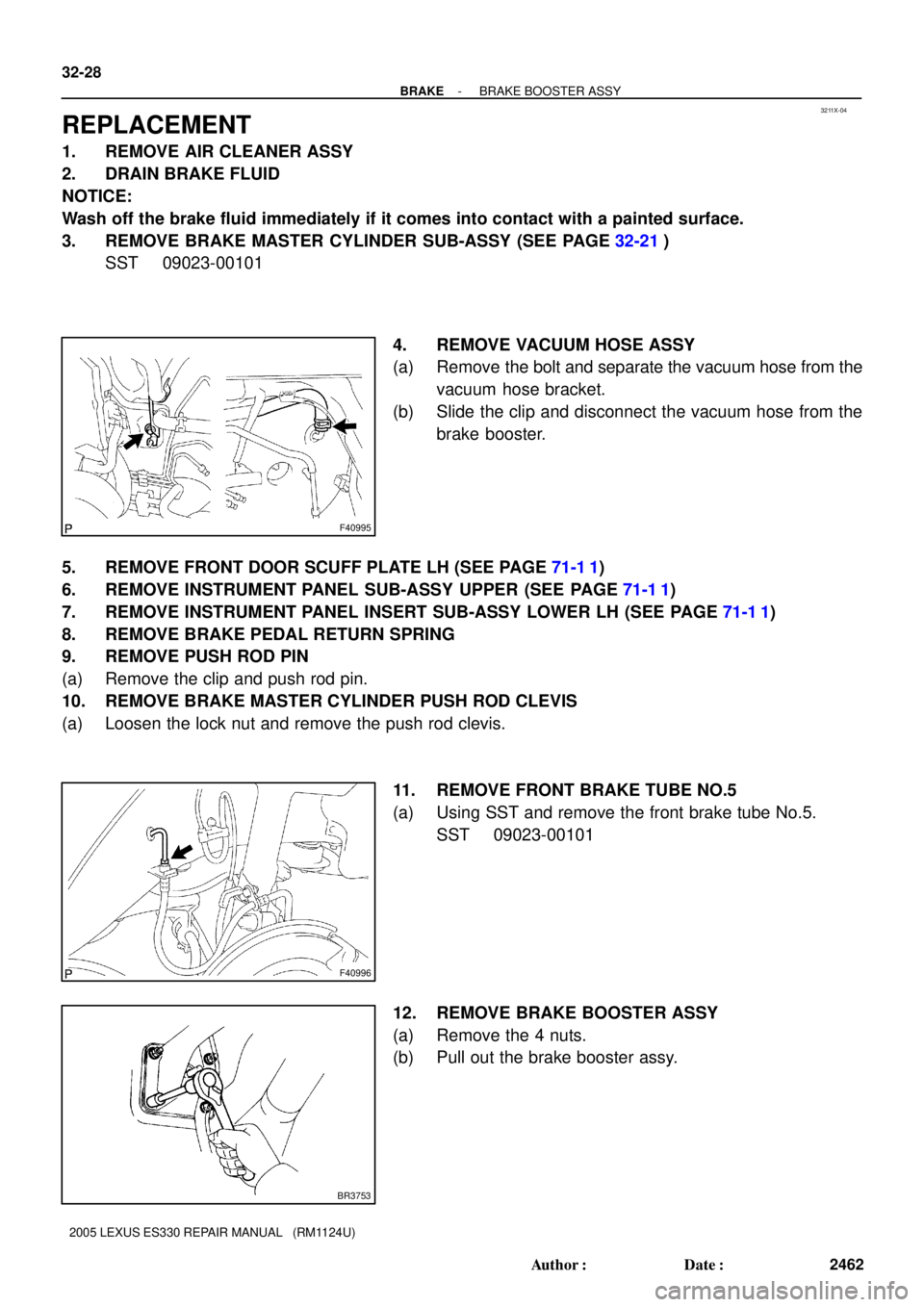
REPLACEMENT
1. REMOVE AIR CLEANER ASSY
2. DRAIN BRAKE FLUID
NOTICE:
Wash off the brake fluid immediately if it comes into contact with a painted surface.
3. REMOVE BRAKE MASTER CYLINDER SUB-ASSY (SEE PAGE 32-21)
SST 09023-00101
4. REMOVE VACUUM HOSE ASSY
(a) Remove the bolt and separate the vacuum hose from the
vacuum hose bracket.
(b) Slide the clip and disconnect the vacuum hose from the
brake booster.
5. REMOVE FRONT DOOR SCUFF PLATE LH (SEE PAGE 71-1 1)
6. REMOVE INSTRUMENT PANEL SUB-ASSY UPPER (SEE PAGE 71-1 1)
7. REMOVE INSTRUMENT PANEL INSERT SUB-ASSY LOWER LH (SEE PAGE 71-1 1)
8. REMOVE BRAKE PEDAL RETURN SPRING
9. REMOVE PUSH ROD PIN
(a) Remove the clip and push rod pin.
10. REMOVE BRAKE MASTER CYLINDER PUSH ROD CLEVIS
(a) Loosen the lock nut and remove the push rod clevis.
11. REMOVE FRONT BRAKE TUBE NO.5
(a) Using SST and remove the front brake tube No.5.
SST 09023-00101
12. REMOVE BRAKE BOOSTER ASSY
(a) Remove the 4 nuts.
(b) Pull out the brake booster assy.
Page 274 of 969
BR3753
F40996
F40995
- BRAKEBRAKE BOOSTER ASSY
32-29
2463 Author�: Date�:
2005 LEXUS ES330 REPAIR MANUAL (RM1124U)
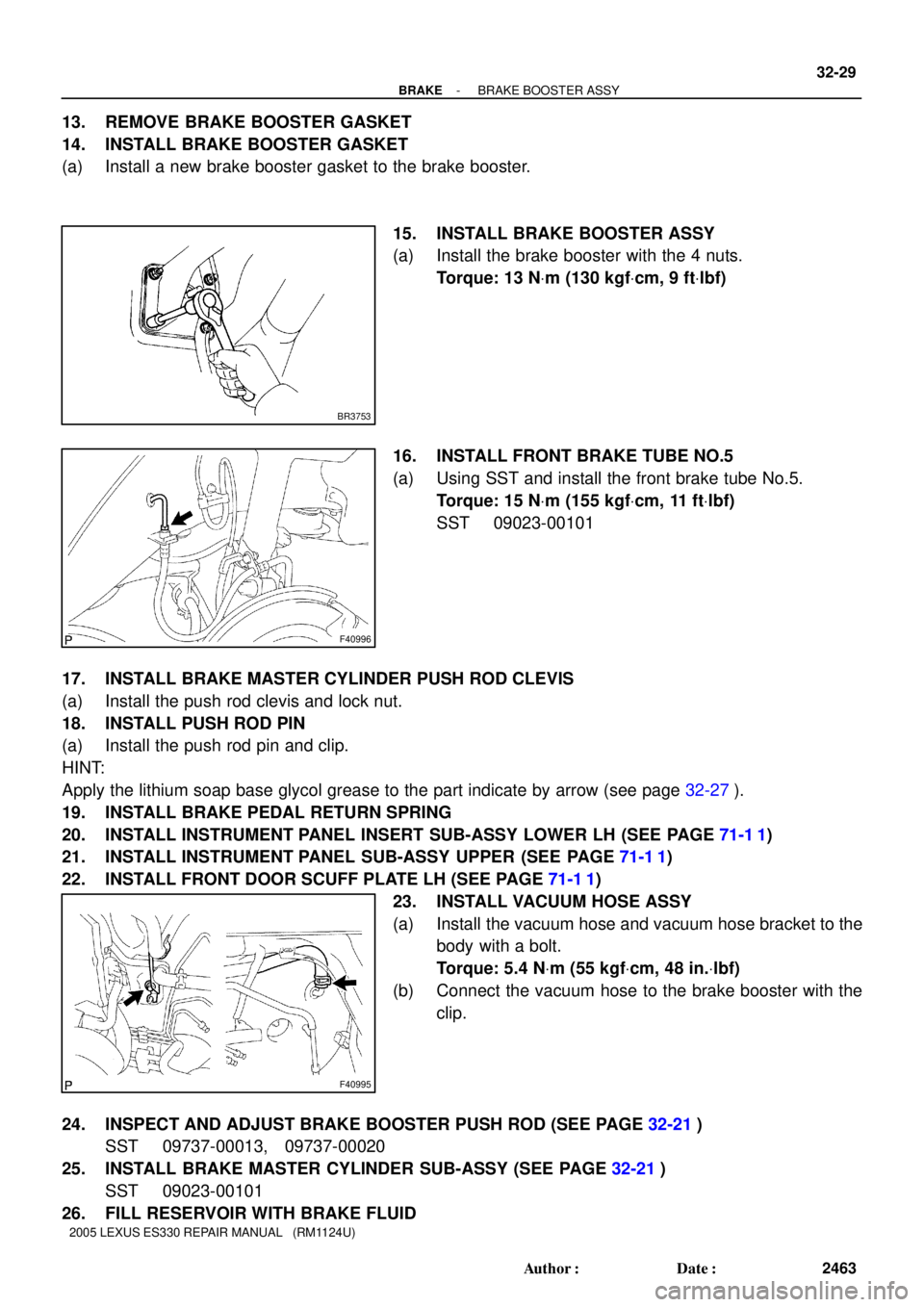
13. REMOVE BRAKE BOOSTER GASKET
14. INSTALL BRAKE BOOSTER GASKET
(a) Install a new brake booster gasket to the brake booster.
15. INSTALL BRAKE BOOSTER ASSY
(a) Install the brake booster with the 4 nuts.
Torque: 13 NVm (130 kgfVcm, 9 ftVlbf)
16. INSTALL FRONT BRAKE TUBE NO.5
(a) Using SST and install the front brake tube No.5.
Torque: 15 NVm (155 kgfVcm, 11 ftVlbf)
SST 09023-00101
17. INSTALL BRAKE MASTER CYLINDER PUSH ROD CLEVIS
(a) Install the push rod clevis and lock nut.
18. INSTALL PUSH ROD PIN
(a) Install the push rod pin and clip.
HINT:
Apply the lithium soap base glycol grease to the part indicate by arrow (see page 32-27).
19. INSTALL BRAKE PEDAL RETURN SPRING
20. INSTALL INSTRUMENT PANEL INSERT SUB-ASSY LOWER LH (SEE PAGE 71-1 1)
21. INSTALL INSTRUMENT PANEL SUB-ASSY UPPER (SEE PAGE 71-1 1)
22. INSTALL FRONT DOOR SCUFF PLATE LH (SEE PAGE 71-1 1)
23. INSTALL VACUUM HOSE ASSY
(a) Install the vacuum hose and vacuum hose bracket to the
body with a bolt.
Torque: 5.4 NVm (55 kgfVcm, 48 in.Vlbf)
(b) Connect the vacuum hose to the brake booster with the
clip.
24. INSPECT AND ADJUST BRAKE BOOSTER PUSH ROD (SEE PAGE 32-21)
SST 09737-00013, 09737-00020
25. INSTALL BRAKE MASTER CYLINDER SUB-ASSY (SEE PAGE 32-21)
SST 09023-00101
26. FILL RESERVOIR WITH BRAKE FLUID
Page 380 of 969
14-4
- ENGINE MECHANICALENGINE (3MZ-FE)
2096 Author�: Date�:
2005 LEXUS ES330 REPAIR MANUAL (RM1124U)
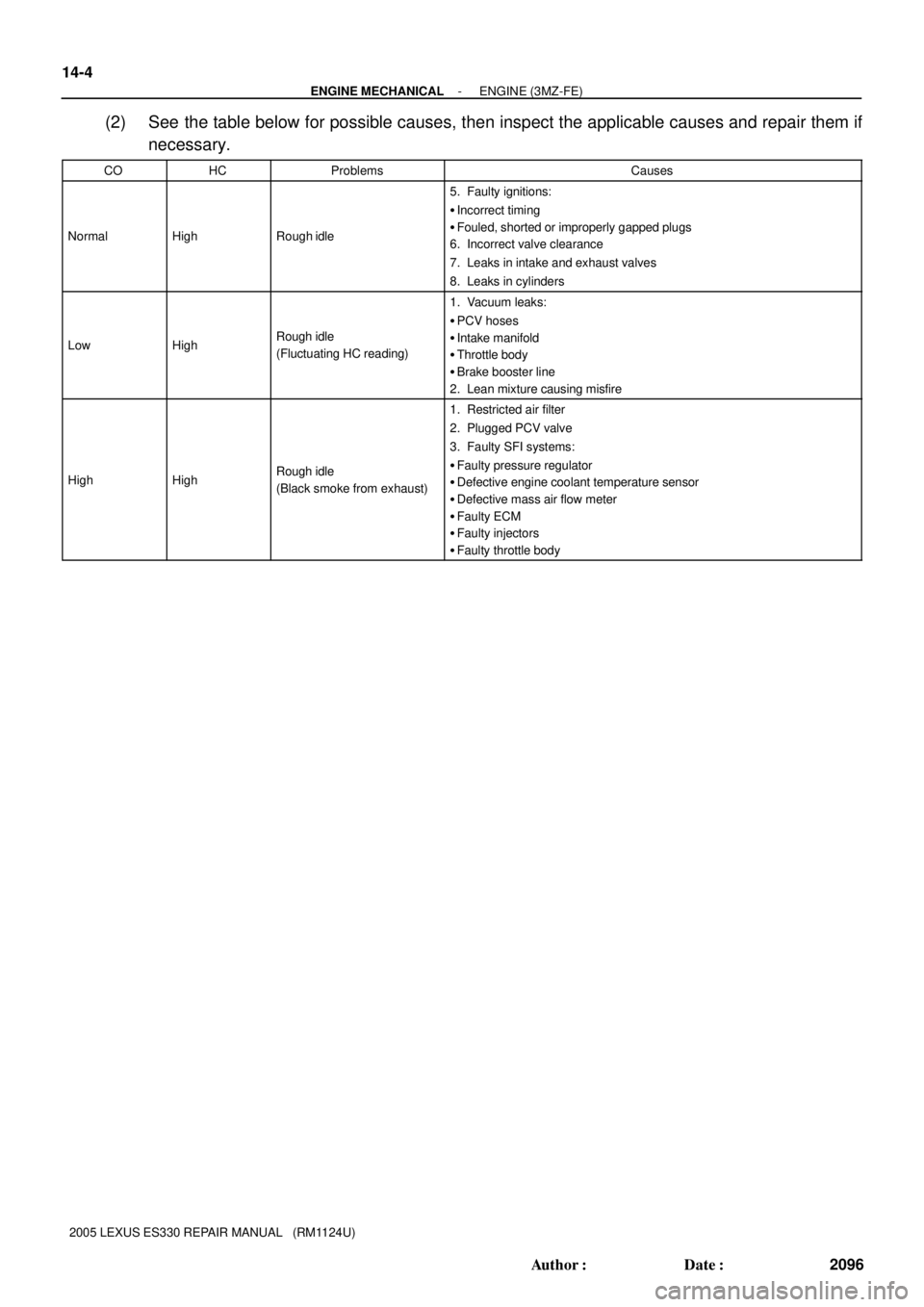
(2) See the table below for possible causes, then inspect the applicable causes and repair them if
necessary.
COHCProblemsCauses
NormalHighRough idle
5. Faulty ignitions:
�Incorrect timing
�Fouled, shorted or improperly gapped plugs
6. Incorrect valve clearance
7. Leaks in intake and exhaust valves
8. Leaks in cylinders
LowHighRough idle
(Fluctuating HC reading)
1. Vacuum leaks:
�PCV hoses
�Intake manifold
�Throttle body
�Brake booster line
2. Lean mixture causing misfire
HighHighRough idle
(Black smoke from exhaust)
1. Restricted air filter
2. Plugged PCV valve
3. Faulty SFI systems:
�Faulty pressure regulator
�Defective engine coolant temperature sensor
�Defective mass air flow meter
�Faulty ECM
�Faulty injectors
�Faulty throttle body