Page 256 of 424
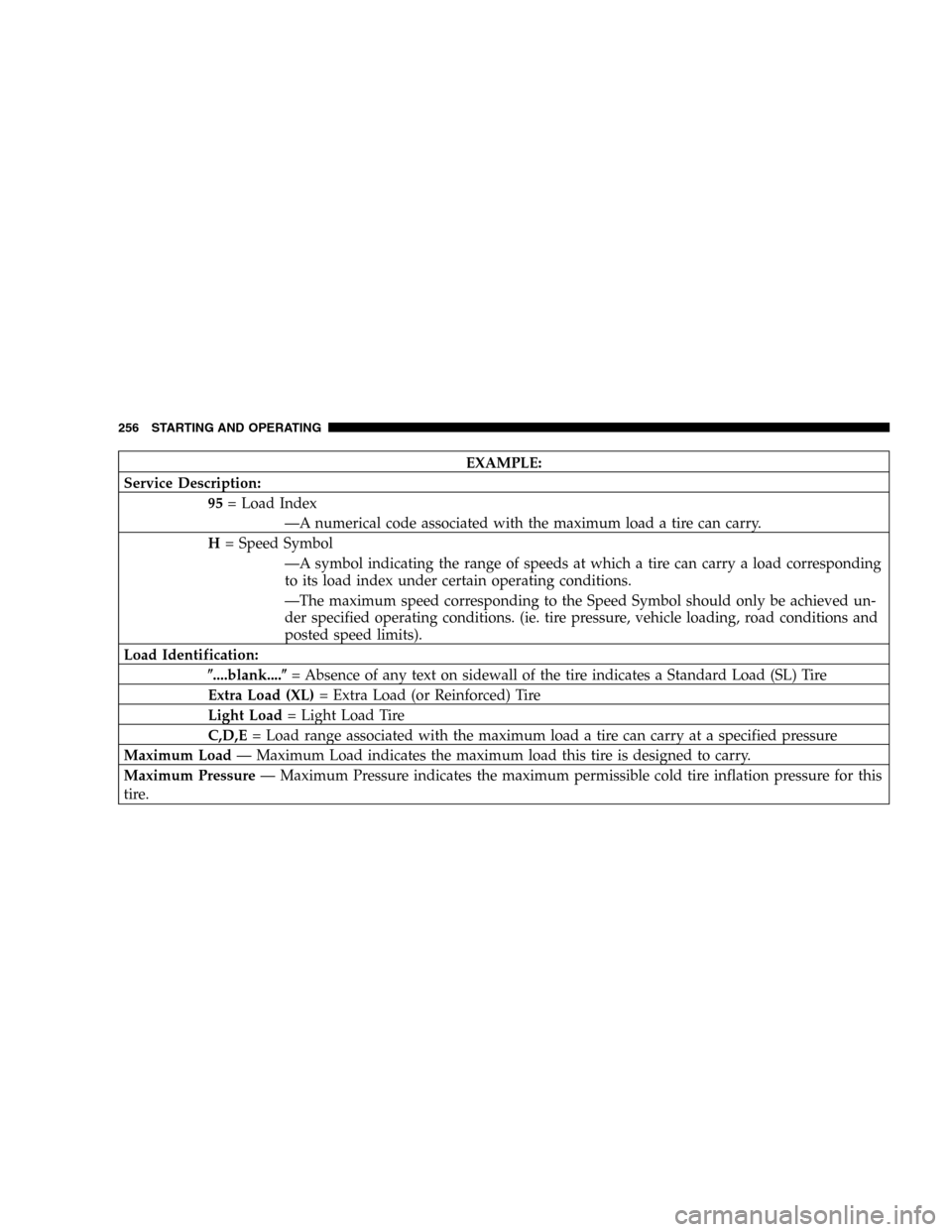
EXAMPLE:
Service Description:
95= Load Index
—A numerical code associated with the maximum load a tire can carry.
H= Speed Symbol
—A symbol indicating the range of speeds at which a tire can carry a load corresponding
to its load index under certain operating conditions.
—The maximum speed corresponding to the Speed Symbol should only be achieved un-
der specified operating conditions. (ie. tire pressure, vehicle loading, road conditions and
posted speed limits).
Load Identification:
�....blank....�= Absence of any text on sidewall of the tire indicates a Standard Load (SL) Tire
Extra Load (XL)= Extra Load (or Reinforced) Tire
Light Load= Light Load Tire
C,D,E= Load range associated with the maximum load a tire can carry at a specified pressure
Maximum Load— Maximum Load indicates the maximum load this tire is designed to carry.
Maximum Pressure— Maximum Pressure indicates the maximum permissible cold tire inflation pressure for this
tire.
256 STARTING AND OPERATING
Page 277 of 424
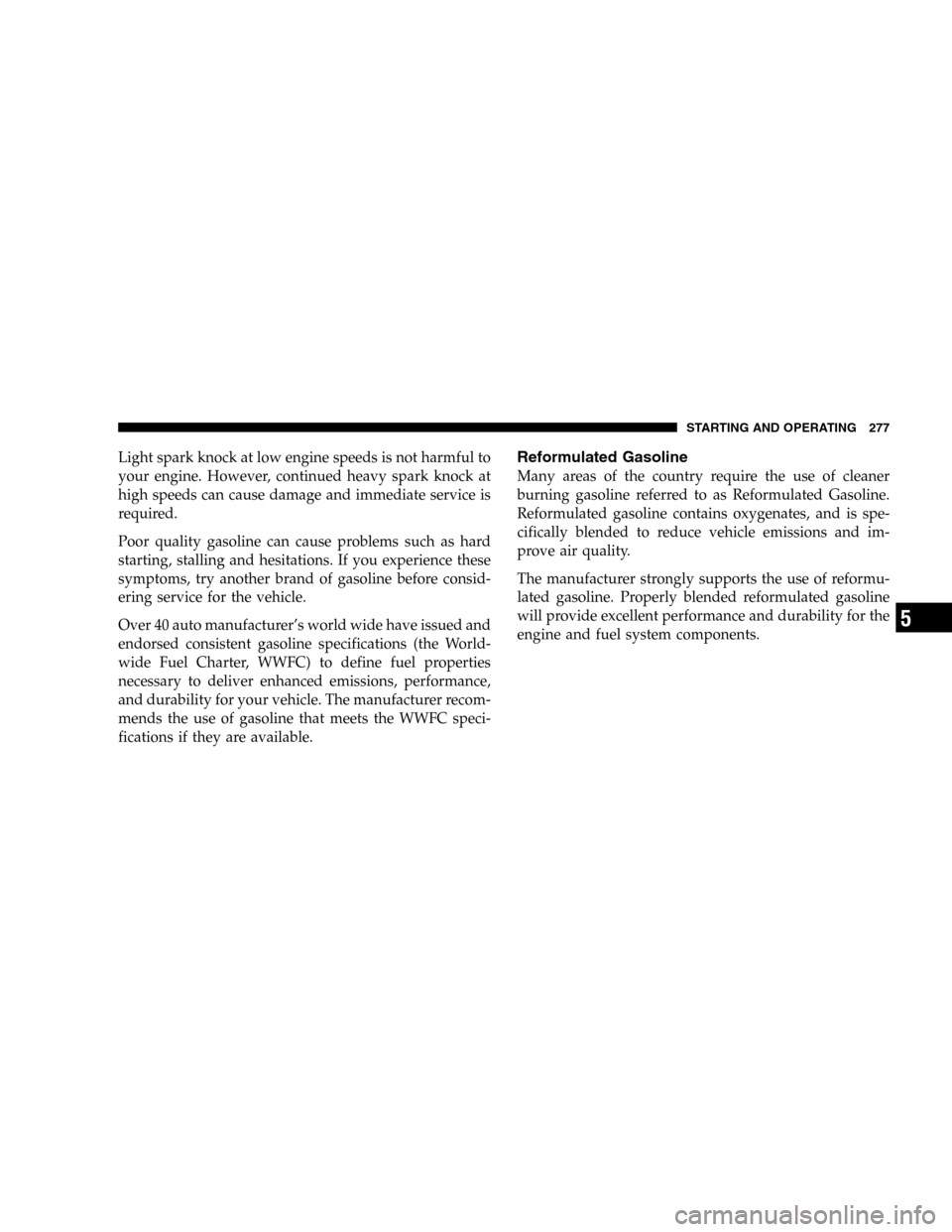
Light spark knock at low engine speeds is not harmful to
your engine. However, continued heavy spark knock at
high speeds can cause damage and immediate service is
required.
Poor quality gasoline can cause problems such as hard
starting, stalling and hesitations. If you experience these
symptoms, try another brand of gasoline before consid-
ering service for the vehicle.
Over 40 auto manufacturer’s world wide have issued and
endorsed consistent gasoline specifications (the World-
wide Fuel Charter, WWFC) to define fuel properties
necessary to deliver enhanced emissions, performance,
and durability for your vehicle. The manufacturer recom-
mends the use of gasoline that meets the WWFC speci-
fications if they are available.Reformulated Gasoline
Many areas of the country require the use of cleaner
burning gasoline referred to as Reformulated Gasoline.
Reformulated gasoline contains oxygenates, and is spe-
cifically blended to reduce vehicle emissions and im-
prove air quality.
The manufacturer strongly supports the use of reformu-
lated gasoline. Properly blended reformulated gasoline
will provide excellent performance and durability for the
engine and fuel system components.
STARTING AND OPERATING 277
5
Page 279 of 424
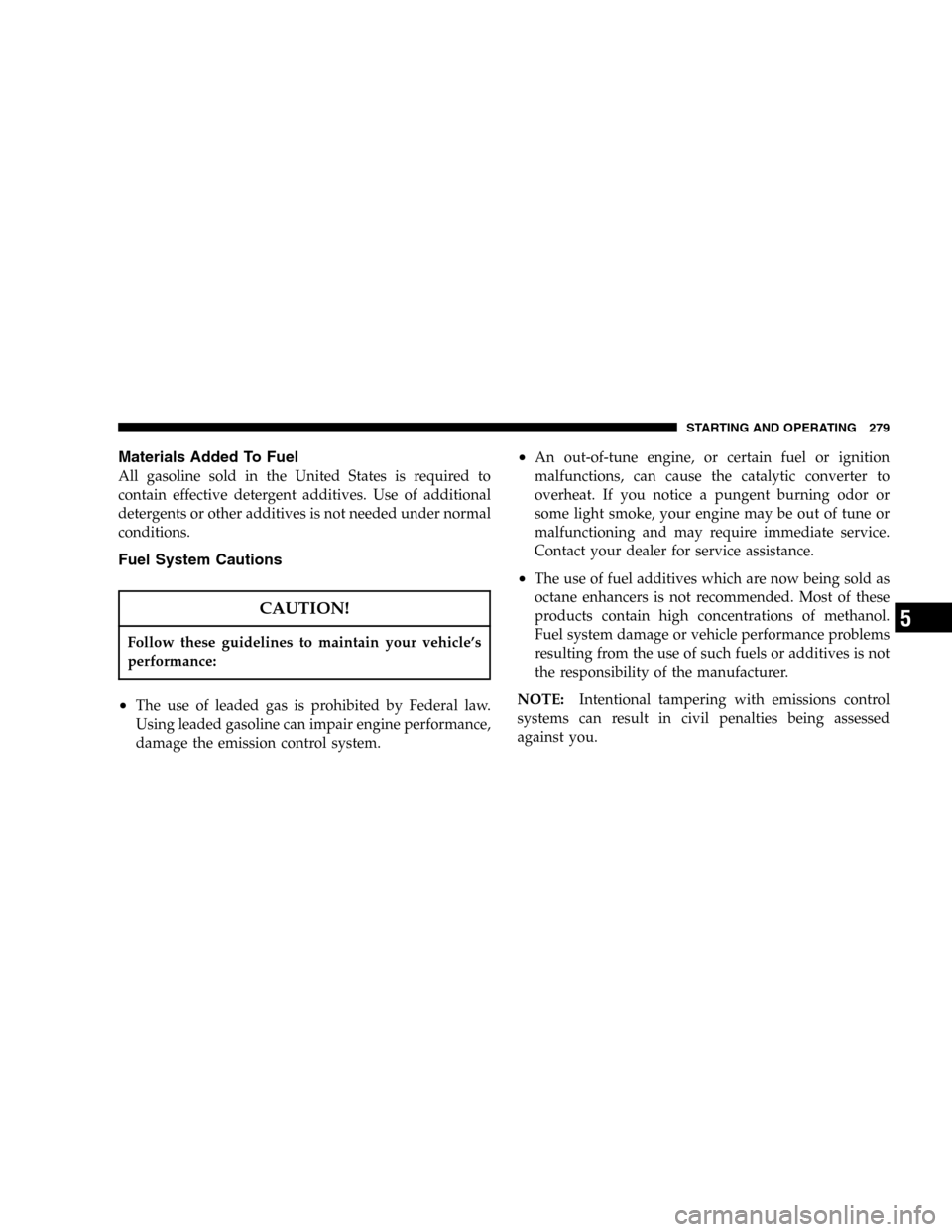
Materials Added To Fuel
All gasoline sold in the United States is required to
contain effective detergent additives. Use of additional
detergents or other additives is not needed under normal
conditions.
Fuel System Cautions
CAUTION!
Follow these guidelines to maintain your vehicle’s
performance:
•The use of leaded gas is prohibited by Federal law.
Using leaded gasoline can impair engine performance,
damage the emission control system.
•An out-of-tune engine, or certain fuel or ignition
malfunctions, can cause the catalytic converter to
overheat. If you notice a pungent burning odor or
some light smoke, your engine may be out of tune or
malfunctioning and may require immediate service.
Contact your dealer for service assistance.
•The use of fuel additives which are now being sold as
octane enhancers is not recommended. Most of these
products contain high concentrations of methanol.
Fuel system damage or vehicle performance problems
resulting from the use of such fuels or additives is not
the responsibility of the manufacturer.
NOTE:Intentional tampering with emissions control
systems can result in civil penalties being assessed
against you.
STARTING AND OPERATING 279
5
Page 280 of 424
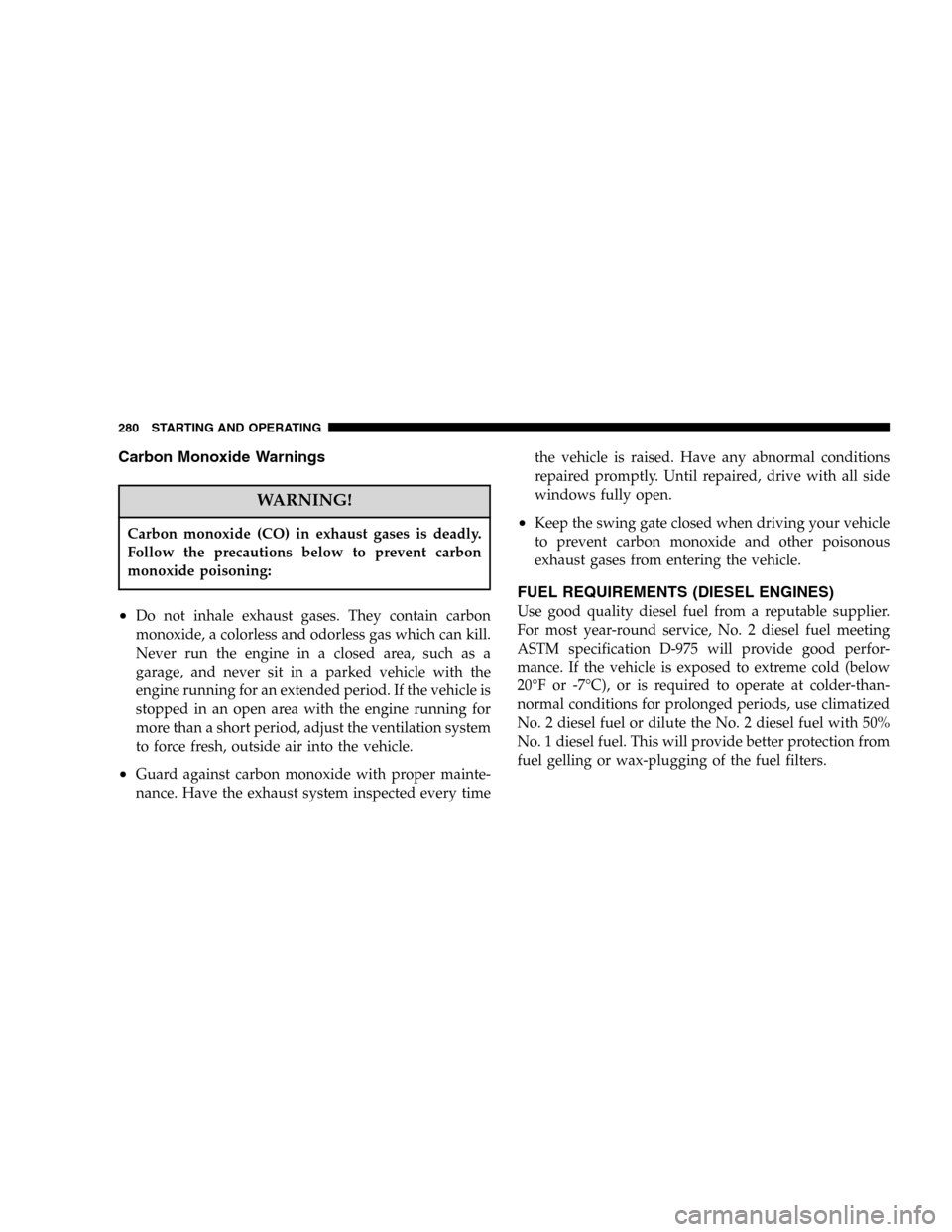
Carbon Monoxide Warnings
WARNING!
Carbon monoxide (CO) in exhaust gases is deadly.
Follow the precautions below to prevent carbon
monoxide poisoning:
•Do not inhale exhaust gases. They contain carbon
monoxide, a colorless and odorless gas which can kill.
Never run the engine in a closed area, such as a
garage, and never sit in a parked vehicle with the
engine running for an extended period. If the vehicle is
stopped in an open area with the engine running for
more than a short period, adjust the ventilation system
to force fresh, outside air into the vehicle.
•Guard against carbon monoxide with proper mainte-
nance. Have the exhaust system inspected every timethe vehicle is raised. Have any abnormal conditions
repaired promptly. Until repaired, drive with all side
windows fully open.
•Keep the swing gate closed when driving your vehicle
to prevent carbon monoxide and other poisonous
exhaust gases from entering the vehicle.
FUEL REQUIREMENTS (DIESEL ENGINES)
Use good quality diesel fuel from a reputable supplier.
For most year-round service, No. 2 diesel fuel meeting
ASTM specification D-975 will provide good perfor-
mance. If the vehicle is exposed to extreme cold (below
20°F or -7°C), or is required to operate at colder-than-
normal conditions for prolonged periods, use climatized
No. 2 diesel fuel or dilute the No. 2 diesel fuel with 50%
No. 1 diesel fuel. This will provide better protection from
fuel gelling or wax-plugging of the fuel filters.
280 STARTING AND OPERATING
Page 284 of 424
Perform maintenance services as prescribed in the
“Maintenance Schedules” section. When your vehicle is
used for trailer towing, never exceed the gross axle
weight rating (GAWR) by the addition of:
•The tongue weight of the trailer.
•The weight of any other type of cargo or equipment
put in or on your vehicle.
Remember that everything put in or on the trailer adds to
the load on your vehicle.
Warranty Requirements
The manufacturer’s warranty will apply to vehicles used
to tow trailers for noncommercial use, however the
following conditions must be met:
•The “D” Overdrive range can be selected when tow-
ing. However, if frequent shifting occurs select the
“O/D Off” function or move the shift lever to the next
lower position to eliminate excessive automatic trans-
mission shifting. This action will also reduce the
possibility of transmission overheating and provide
better engine braking. Refer to “Transmission Shift-
ing” in this section for additional information.
•A load equalizing hitch is recommended for loaded
trailer weights above 1,000 lbs (454 kg).
284 STARTING AND OPERATING
Page 293 of 424
IF YOUR ENGINE OVERHEATS
In any of the following situations, you can reduce the
potential for overheating by taking the appropriate ac-
tion.
•On the highways — Slow down.
•In city traffic — While stopped, put transmission in N
(Neutral), but do not increase engine idle speed.
NOTE:There are steps that you can take to slow down
an impending overheat condition. If your air conditioner
is on, turn it off. The air conditioning system adds heat to
the engine cooling system and turning off the A/C
removes this heat. You can also turn the Temperature
Control to maximum heat, the Mode Control to floor, and
the Fan Control to High. This allows the heater core to act
as a supplement to the radiator and aids in removing heat
from the engine cooling system.If the pointer rises to the “H” (hot mark) on a vehicle
equipped with agasoline engine, pull over and stop the
vehicle. Do not turn the engine off. Idle the vehicle with
the air conditioning turned off, until the pointer drops
back into the normal range.CAUTION!
Driving with a hot cooling system could damage
your vehicle. If the temperature gauge reads “H”,
pull over and stop the vehicle. Idle the vehicle with
the air conditioner turned off until the pointer drops
back into the normal range. If the pointer remains on
the “H”, and you hear continuous chimes, turn the
engine off immediately, and call for service.
WHAT TO DO IN EMERGENCIES 293
6
Page 294 of 424
If the coolant temperature of a vehicle equipped with a
diesel engineapproaches the “H” (hot mark) a warning
chime will sound to alert the driver. The air conditioning
system will turn off automatically and power loss will
occur until the engine temperature returns to the normal
range.
If the overheating condition persists a continuous chime
will sound to alert the driver. Reduce the vehicle speed
and or stop the vehicle while allowing the engine to idle
and cool the engine.JACKING AND TIRE CHANGING
WARNING!
•Getting under a jacked-up vehicle is dangerous.
The vehicle could slip off the jack and fall on you.
You could be crushed. Never get any part of your
body under a vehicle that is on a jack. If you need
to get under a raised vehicle, take it to a service
center where it can be raised on a lift.
•The jack is designed to use as a tool for changing
tires only. The jack should not be used to lift the
vehicle for service purposes. The vehicle should
be jacked on a firm level surface only. Avoid ice or
slippery areas.
294 WHAT TO DO IN EMERGENCIES
Page 298 of 424
WARNING!
Raising the vehicle higher than necessary can make
the vehicle less stable and cause an accident. It could
slip off the jack and hurt someone near it. Raise the
vehicle only enough to remove the tire.
6. Remove the lug nuts and wheel.
7. Position the spare wheel/tire on the vehicle and install
lug nuts with cone-shaped end toward wheel. Lightly
tighten the nuts. To avoid the risk of forcing the vehicle
off the jack, do not tighten the nuts fully until the vehicle
has been lowered.
8. Lower the vehicle by turning the jack screw to the left,
and remove the jack and wheel blocks.
9. Finish tightening the lug nuts. Push down on the
wrench while tightening for increased leverage. Alternatenuts until each nut has been tightened twice. Correct
wheel nut tightness is 130 N·m (95 ft. lbs). If in doubt
about the correct tightness, have them checked with a
torque wrench by your authorized dealer or at a service
station.
10. Lower the jack to it’s fully closed position.WARNING!
A loose tire or jack, thrown forward in a collision or
hard stop could endanger the occupants of the ve-
hicle. Always stow the jack parts and the spare tire in
the places provided.
11. Secure the tire, jack, and tools in their proper loca-
tions.
298 WHAT TO DO IN EMERGENCIES