Page 161 of 424
UNDERSTANDING YOUR INSTRUMENT PANEL
CONTENTS
�Instrument Panel And Interior Controls.......165
�Instrument Cluster......................166
▫2.4L/3.7L Engines.....................166
▫2.8L Diesel Engines....................167
�Instrument Cluster Description.............168
�Electronic Digital Clock..................176
▫Clock Setting Procedure.................176
�Radio General Information................177
▫Radio Broadcast Signals.................177▫Two Types Of Signals..................177
▫Electrical Disturbances..................177
▫AM Reception.......................177
▫FM Reception........................177
�Sales Code RAZ—AM/ FM Stereo Radio With
Cassette Tape Player, CD Player And CD Changer
Controls.............................178
▫Operating Instructions — Radio...........178
▫Power Switch, Volume Control............178
▫Seek Button (Radio Mode)...............1784
Page 167 of 424
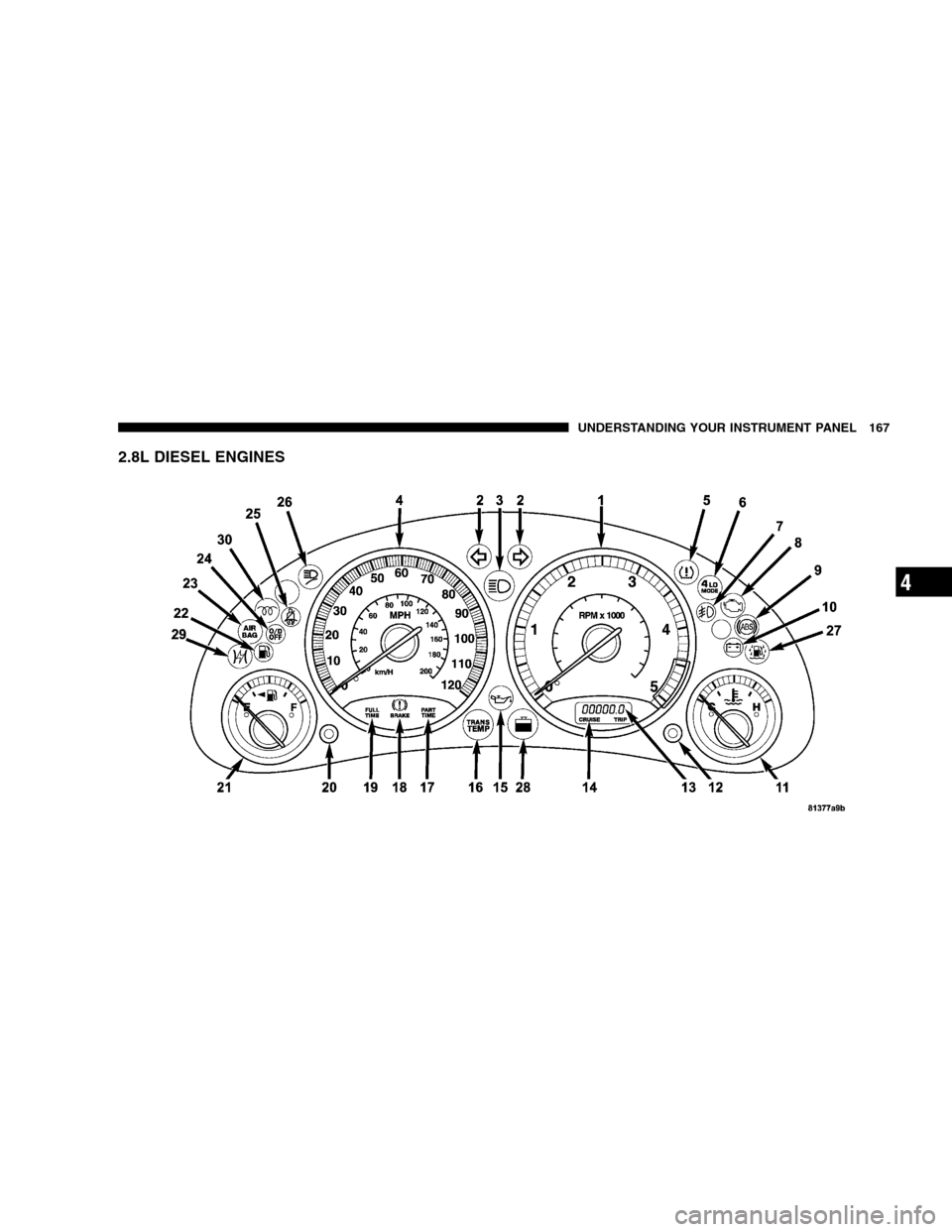
2.8L DIESEL ENGINES
UNDERSTANDING YOUR INSTRUMENT PANEL 167
4
Page 217 of 424
STARTING AND OPERATING
CONTENTS
�Starting Procedures.....................220
▫Manual Transmission..................220
▫Automatic Transmission................220
▫Normal Starting — Gasoline Engines.......221
▫Normal Starting — Diesel Engines.........223
▫Diesel Fuel-Water Separator..............225
▫Re-Priming The Diesel Fuel System........225
�Engine Block Heater — If Equipped.........226
�Transmission Shifting....................227▫6-Speed Manual Transmission............227
▫Automatic Transmission................230
▫Rocking The Vehicle...................236
�Four-Wheel Drive Operation...............236
▫Command-Trac�Operating
Information/Precautions................236
▫Shift Positions........................238
▫Shifting Procedure....................239
▫Selec-Trac�Operating Information/Precautions —
If Equipped.........................240
5
Page 219 of 424
▫Tire Pressure Monitoring — Base System.....268
▫Tire Pressure Monitoring — Premium System . 270
▫General Information...................273
�Tire Chains...........................274
�Tire Rotation Recommendations............275
�Fuel Requirements (Gasoline Engines)........276
▫Reformulated Gasoline.................277
▫Gasoline/Oxygenate Blends..............278
▫MMT In Gasoline.....................278
▫Materials Added To Fuel................279
▫Fuel System Cautions..................279▫Carbon Monoxide Warnings..............280
�Fuel Requirements (Diesel Engines)..........280
�Fuel Tank Filler Cap (Gas Cap).............281
▫Loose Fuel Filler Cap Message............283
�Trailer Towing.........................283
▫Warranty Requirements.................284
�Recreational Towing (Behind Motorhome, Etc.) . . 287
▫Towing – 2WD Models.................287
▫Towing — 4WD Models................287
�Snow Plow...........................289
STARTING AND OPERATING 219
5
Page 223 of 424
If the engine shows no sign of starting after two 15
second periods of cranking with the accelerator pedal
held to the floor, the “Normal Starting” procedure should
be repeated.
After Starting
The idle speed is automatically controlled and will de-
crease as the engine warms up.
Normal Starting — Diesel Engines
1. Turn the ignition key to the ON/RUN position.
2. Watch the “Glow Plug Indicator Light.” It will stay on
for a maximum of 2 seconds, depending on engine
temperature. When the “Glow Plug Indicator Light” goes
out, the engine is ready to start.
3.Do notpress the accelerator. Turn the ignition key to
START and hold it in this position until the engine starts.
Starting and Operating Cautions — Diesel Engines
•
Under normal conditions,do notoperate the starter
for longer than 20 seconds at one time. At tempera-
tures below 5°F (�15°C), you may operate the starter
for up to 25 seconds at one time. Longer periods of
operation may result in starter or battery damage. If
the engine does not start at once, repeat Steps 1
through 4.
•Cold engine speeds higher than necessary for driving
or higher than specified for idling may damage engine
components.
•Before turning off your Diesel engine, always allow
the engine to return to normal idle speed and then run
for several seconds. This assures proper lubrication of
the turbocharger. This is particularly necessary after
periods of high speed driving.
STARTING AND OPERATING 223
5
Page 225 of 424
Diesel Fuel-Water Separator
A diesel fuel-water separator separates the water nor-
mally found in diesel fuel. A manual hand prime pump is
located on the filter head for re-priming the fuel system.
The fuel-water separator is located on the driver side
cowl in the engine compartment. Refer to “2.8L Turbo
Diesel Engine Compartment” in Section 7 for location.
NOTE:If the “Water-In-Fuel Warning Light” (located in
the instrument cluster) comes on, this indicates that
water has collected in the fuel filter and should be
drained immediately. See your authorized dealer for
service.Should your vehicle run out of fuel, the fuel system must
be re-primed in order to start the engine. Factors such as
temperature, which affects the viscosity of the fuel, how
long the vehicle has been sitting and other factors will
influence how quickly the engine starts.
Re-Priming the Diesel Fuel System
The following procedure must be followed after com-
pletely running out of fuel.
1. Add a minimum of 2 gallons (7.57L) of diesel fuel to
the fuel tank.
2. Open the hood.
STARTING AND OPERATING 225
5
Page 275 of 424
TIRE ROTATION RECOMMENDATIONS
Tires on the front and rear axles of vehicles operate at
different loads and perform different steering, handling,
and braking functions. For these reasons, they wear at
unequal rates, and develop irregular wear patterns.
These effects can be reduced by timely rotation of tires.
The benefits of rotation are especially worthwhile with
aggressive tread designs such as those on On/Off Road
type tires. Rotation will increase tread life, help to main-
tain mud, snow, and wet traction levels, and contribute to
a smooth, quiet ride.2.4L/3.7L EnginesFollow the recommended tire rotation frequency for your
type of driving found in the “Maintenance Schedules”
Section of this manual. More frequent rotation is permis-
sible if desired. The reasons for any rapid or unusual wear
should be corrected prior to rotation being performed.
2.8L Turbo Diesel Engines
Rotate the tires every 6,000 miles (10 000 km).
NOTE:The Premium Tire Pressure Monitor System will
automatically locate the pressure values displayed in the
correct vehicle position following a tire rotation.
STARTING AND OPERATING 275
5
Page 280 of 424
Carbon Monoxide Warnings
WARNING!
Carbon monoxide (CO) in exhaust gases is deadly.
Follow the precautions below to prevent carbon
monoxide poisoning:
•Do not inhale exhaust gases. They contain carbon
monoxide, a colorless and odorless gas which can kill.
Never run the engine in a closed area, such as a
garage, and never sit in a parked vehicle with the
engine running for an extended period. If the vehicle is
stopped in an open area with the engine running for
more than a short period, adjust the ventilation system
to force fresh, outside air into the vehicle.
•Guard against carbon monoxide with proper mainte-
nance. Have the exhaust system inspected every timethe vehicle is raised. Have any abnormal conditions
repaired promptly. Until repaired, drive with all side
windows fully open.
•Keep the swing gate closed when driving your vehicle
to prevent carbon monoxide and other poisonous
exhaust gases from entering the vehicle.
FUEL REQUIREMENTS (DIESEL ENGINES)
Use good quality diesel fuel from a reputable supplier.
For most year-round service, No. 2 diesel fuel meeting
ASTM specification D-975 will provide good perfor-
mance. If the vehicle is exposed to extreme cold (below
20°F or -7°C), or is required to operate at colder-than-
normal conditions for prolonged periods, use climatized
No. 2 diesel fuel or dilute the No. 2 diesel fuel with 50%
No. 1 diesel fuel. This will provide better protection from
fuel gelling or wax-plugging of the fuel filters.
280 STARTING AND OPERATING