2005 JEEP LIBERTY child seat
[x] Cancel search: child seatPage 37 of 424
windows down, or the sunroof (if equipped) in certain
open or partially open positions. This is a normal occur-
rence and can be minimized. If the buffeting occurs with
the sunroof open, adjust the sunroof opening to minimize
the buffeting.
OCCUPANT RESTRAINTS
Some of the most important safety features in your
vehicle are the restraint systems. These include the front
and rear seat belts for the driver and all passengers, front
airbags for both the driver and front passenger and, if
equipped, window bags for the driver and passengers
seated next to a window. If you will be carrying children
too small for adult-size belts, your seat belts also can be
used to hold infant and child restraint systems.
NOTE:The front airbags have a multi stage inflator
design. This allows the airbag to have different rates of
inflation that are based on collision severity.Please pay close attention to the information in this
section. It tells you how to use your restraint system
properly to keep you and your passengers as safe as
possible.
WARNING!
In a collision, you and your passengers can suffer
much greater injuries if you are not properly buck-
led up. You can strike the interior of your vehicle or
other passengers, or you can be thrown out of the
vehicle. Always be sure you and others in your
vehicle are buckled up properly.
Buckle up even though you are an excellent driver, even
on short trips. Someone on the road may be a poor driver
and cause a collision which includes you. This can
happen far away from home or on your own street.
THINGS TO KNOW BEFORE STARTING YOUR VEHICLE 37
2
Page 44 of 424
WARNING!
Position the shoulder belt height adjusters so that
the belt rests across the middle of your shoulder.
Failure to adjust the safety belt properly could
reduce the effectiveness of the seat belt and increase
the risk of injury in a collision.
As a guide, if you are shorter than average, you will
prefer a lower position, and if you are taller than average,
you’ll prefer a higher position. When you release the
anchorage, try to move it up or down to make sure that
it is locked in position.
Automatic Locking Mode — If Equipped
In this mode, the shoulder belt is automatically pre-
locked. The belt will still retract to remove any slack in
the shoulder belt.
When To Use The Automatic Locking Mode
Anytime a child safety seat is installed in a passenger
front or outboard rear seating position (if equipped).
Children 12 years old and under should be properly
restrained in the rear seat whenever possible.
How To Use The Automatic Locking Mode
1. Buckle the combination lap and shoulder belt.
2. Grasp the shoulder portion and pull downward until
the entire belt is extracted.
3. Allow the belt to retract. As the belt retracts, you will
hear a clicking sound. This indicates the safety belt is
now in the automatic locking mode.
How to Disengage The Automatic Locking Mode
Disconnect the combination lap/shoulder belt and allow
it to retract completely to disengage the automatic lock-
ing mode and activate the vehicle sensitive (emergency)
locking mode.
44 THINGS TO KNOW BEFORE STARTING YOUR VEHICLE
Page 45 of 424
Energy Management Feature
This vehicle has a safety belt system with an energy
management feature at the driver and front passenger
seating positions to help further reduce the risk of injury
in the event of a head-on collision.
This safety belt system has a retractor assembly that is
designed to pay out webbing in a controlled manner. This
feature is designed to help reduce the belt force acting on
the occupant’s chest.WARNING!
•After a vehicle collision, the driver and front
passenger outboard seat belt system must be
checked by a qualified technician to verify that
the “automatic locking retractor” feature for child
seats is still functioning properly. In addition, all
seat belts should be checked for proper function.
•The belt and retractor assembly must be replaced
if the seat belt assembly “automatic locking re-
tractor” feature or any other seat belt function is
not working properly when checked according to
the procedures in the Service Manual.
•Failure to replace the belt and retractor assembly
could increase the risk of injury in collisions.
THINGS TO KNOW BEFORE STARTING YOUR VEHICLE 45
2
Page 46 of 424
Seat Belt Pretensioners
The driver and front passenger seat belts are equipped
with a pretensioning device that is designed to remove
any slack from the seat belt systems in the event of a
collision. This device improves the performance of the
seat belt by assuring that the belt is tight around the
occupant early in a collision. Pretensioners work for all
size occupants, including those in child restraints.
NOTE:These devices are not a substitute for proper seat
belt placement by the occupant. The seat belt must still be
worn snugly and positioned properly.
The pretensioners are triggered by the front Airbag
Control Module. Like the front airbags, the pretensioners
are a single use item. After a collision that is severe
enough to deploy the airbags and pretensioners, they
must be replaced.
Enhanced Driver Seat Belt Use Reminder System
(BeltAlert)
If the driver’s seat belt has not been buckled within 60
seconds of starting the vehicle and if the vehicle speed is
greater than 5 mph (8 km/h), the Enhanced Warning
System (BeltAlert) will alert the driver to buckle their seat
belt. The driver should also instruct all other occupants to
buckle their seat belts. Once the warning is triggered, the
Enhanced Warning System (BeltAlert) will continue to
chime and flash the Seat Belt Warning Light for 96
seconds or until the driver’s seat belt is buckled.
The Enhanced Warning System (BeltAlert) will be reacti-
vated if the driver’s seat belt is unbuckled for more than
10 seconds and the vehicle speed is greater than 5 mph (8
km/h).
46 THINGS TO KNOW BEFORE STARTING YOUR VEHICLE
Page 50 of 424
WARNING!
•Do not put anything on or around the front airbag
covers or attempt to manually open them. You may
damage the airbags and you could be injured be-
cause the airbags are not there to protect you. These
protective covers for the airbag cushions are de-
signed to open only when the airbags are inflating.
•If your vehicle is equipped with window bags, do
not stack luggage or other cargo up high enough
to block the location of the window bag. The area
where the window bag is located should remain
free from any obstructions.
•If your vehicle is equipped with window bags, do
not have any accessory items installed which will
alter the roof, including adding a sunroof to your
vehicle. Do not add roof racks that require perma-
nent attachments (bolts or screws) for installation
on the vehicle roof. Do not drill into the roof of
the vehicle for any reason.
Along with the seat belts, front airbags work with the
instrument panel knee bolsters to provide improved
protection for the driver and front passenger. Window
bags also work with seat belts to improve occupant
protection.
The seat belts are designed to protect you in many types
of collisions. The front airbags deploy in moderate to
severe frontal collisions.
NOTE:The passenger front airbag may not deploy even
when the driver front airbag has if the Occupant Classi-
fication System (refer to “Occupant Classification Sys-
tem” in this section) has determined the seat is empty or
is occupied by someone that is classified in the “child”
category. This could be a child, a teenager, or even a small
adult.
If your vehicle is so equipped, the window bag on the
crash side of the vehicle is triggered in moderate to
severe side collisions. But even in collisions where the
50 THINGS TO KNOW BEFORE STARTING YOUR VEHICLE
Page 51 of 424
airbags work, you need the seat belts to keep you in the
right position for the airbags to protect you properly.
Here are some simple steps you can take to minimize the
risk of harm from a deploying airbag.
1. Children 12 years and under should always ride
buckled up in a rear seat in an appropriate child restraint.
Infants in rear-facing child restraints shouldNEVERride
in the front seat of a vehicle with a passenger front airbag.
An airbag deployment can cause severe injury or death to
infants in that position.
If a child from 1 to 12 years old must ride in the front
passenger seat because the vehicle is crowded, move the
seat as far back as possible, and use the proper child
restraint. See “Child Restraint” in this section.You should read the instructions provided with your
child restraint to make sure that you are using it properly.
2. All occupants should use their lap and shoulder belts
properly.
3. The driver and front passenger seats should be moved
back as far as practical to allow the airbag room to inflate.
4. If your vehicle has window bags, do not lean against
the door or window, airbags will inflate forcefully into
the space between you and the door.
5. If the airbag system in this vehicle needs to be
modified to accommodate a disabled person, contact the
Customer Center. Phone numbers are provided under “If
You Need Assistance” in Section 9 of this manual.
THINGS TO KNOW BEFORE STARTING YOUR VEHICLE 51
2
Page 56 of 424
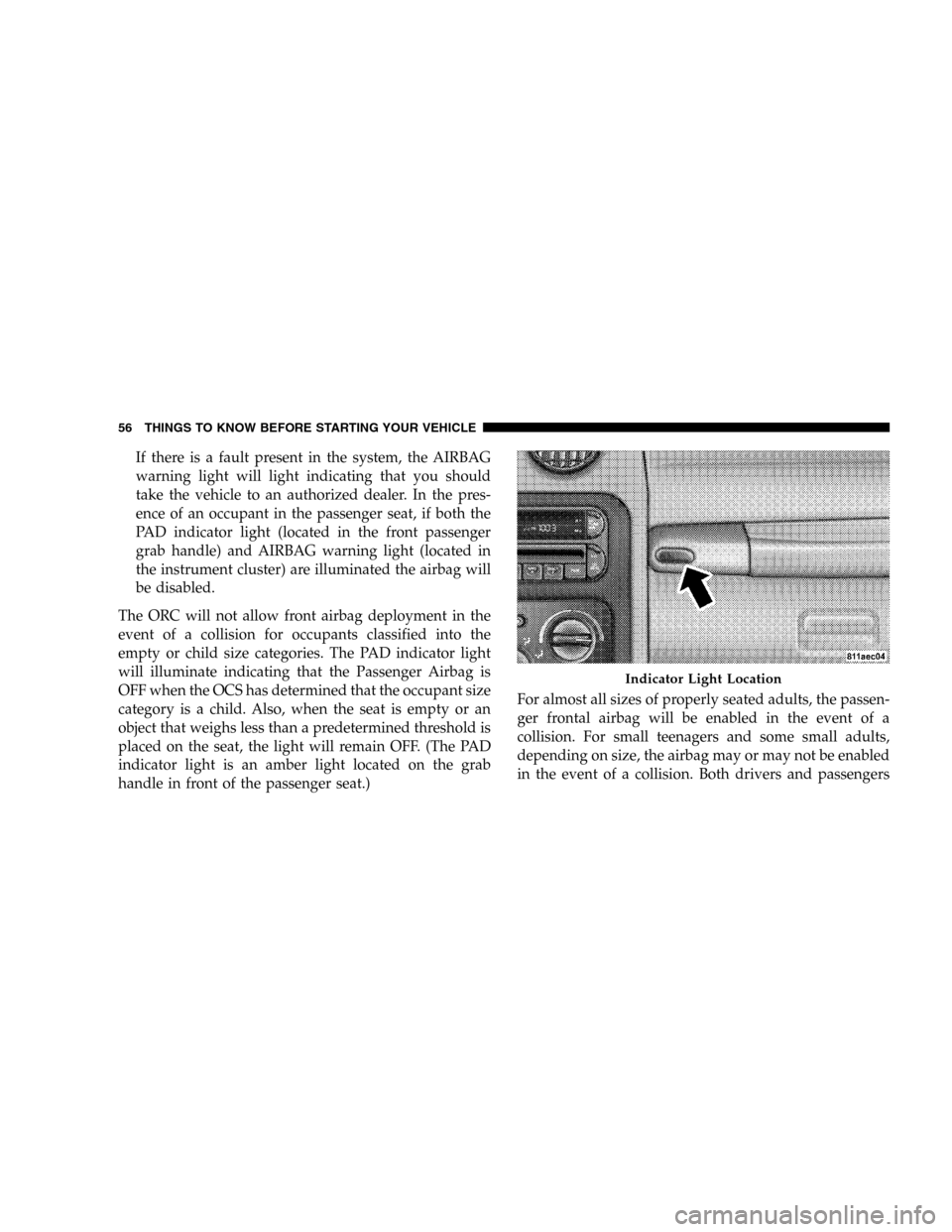
If there is a fault present in the system, the AIRBAG
warning light will light indicating that you should
take the vehicle to an authorized dealer. In the pres-
ence of an occupant in the passenger seat, if both the
PAD indicator light (located in the front passenger
grab handle) and AIRBAG warning light (located in
the instrument cluster) are illuminated the airbag will
be disabled.
The ORC will not allow front airbag deployment in the
event of a collision for occupants classified into the
empty or child size categories. The PAD indicator light
will illuminate indicating that the Passenger Airbag is
OFF when the OCS has determined that the occupant size
category is a child. Also, when the seat is empty or an
object that weighs less than a predetermined threshold is
placed on the seat, the light will remain OFF. (The PAD
indicator light is an amber light located on the grab
handle in front of the passenger seat.)For almost all sizes of properly seated adults, the passen-
ger frontal airbag will be enabled in the event of a
collision. For small teenagers and some small adults,
depending on size, the airbag may or may not be enabled
in the event of a collision. Both drivers and passengers
Indicator Light Location
56 THINGS TO KNOW BEFORE STARTING YOUR VEHICLE
Page 57 of 424
should always use the PAD indicator light as an indica-
tion if the front passenger is properly positioned or not. If
the PAD indicator light comes on when an adult is in the
passenger seat, have the passenger re-position them-
selves in the seat until the light goes out. Remember, if
the PAD indicator light is illuminated the passenger front
airbag will not inflate. For properly installed child re-
straint systems and children properly seated on the front
passenger seat, the airbag will be disabled. If at all
possible, place children 12 years and younger in a back
seat.
•TheOccupant Classification Module (OCM)is lo-
cated beneath the front passenger seat. The OCM
classifies the occupant into one of three size categories
based on the input from the Bladder Assembly and a
Belt Tension Sensor. The size categories include empty,child, and adult. The OCM sends the Occupant Clas-
sification to the ORC to determine if a front passenger
airbag is allowed. If a fault is present, the AIRBAG
warning light is illuminated.
•ThePassenger Airbag Disabled (PAD) Indicator
Lightindicates to the driver and passenger when the
airbag is turned OFF. In the presence of a properly
seated occupant, when the PAD indicator light is
illuminated, the airbag is OFF. Also, when the Occu-
pant Classification System detects either an empty seat
or a weight less than the predetermined threshold, the
ORC will not illuminate the PAD indicator light even
though the airbag is turned OFF.
THINGS TO KNOW BEFORE STARTING YOUR VEHICLE 57
2