Page 332 of 424
WARNING!
Worn brake hoses can burst and cause brake failure.
You could have an accident. If you see any signs of
cracking, scuffing, or worn spots, have the brake
hoses replaced immediately.
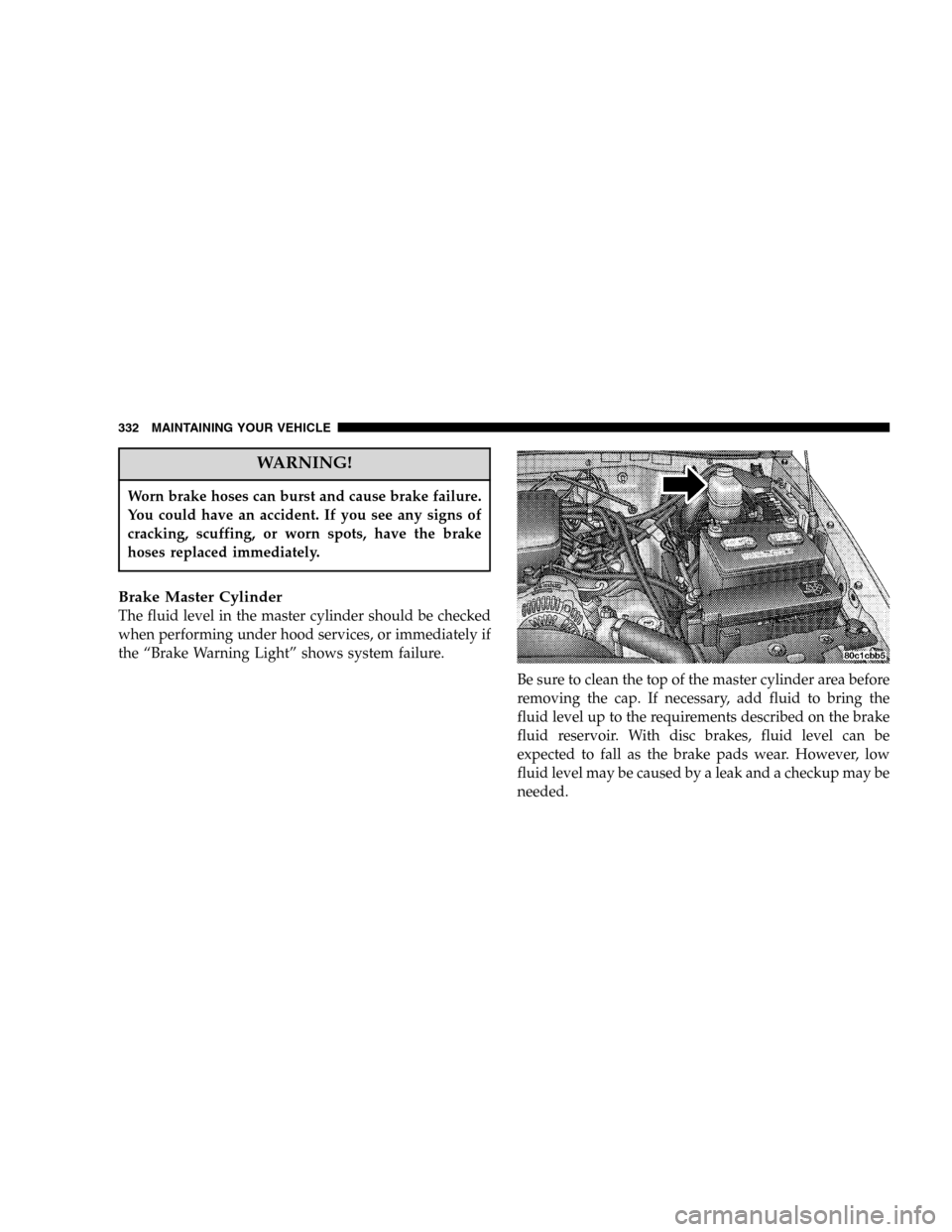
Brake Master Cylinder
The fluid level in the master cylinder should be checked
when performing under hood services, or immediately if
the “Brake Warning Light” shows system failure.
Be sure to clean the top of the master cylinder area before
removing the cap. If necessary, add fluid to bring the
fluid level up to the requirements described on the brake
fluid reservoir. With disc brakes, fluid level can be
expected to fall as the brake pads wear. However, low
fluid level may be caused by a leak and a checkup may be
needed.
332 MAINTAINING YOUR VEHICLE
Page 341 of 424

cleaning inside rear windows equipped with electric
defrosters. Do not use scrapers or other sharp instru-
ments which may scratch the elements.
When cleaning the rear view mirror, spray cleaner on the
towel or rag that you are using. Do not spray cleaner
directly on the mirror.
Carpet
Vacuum your carpet regularly to prevent a soil build-up.
Shampoo soiled carpet with a reliable upholstery cleaner,
using a natural sponge or soft bristle brush. After carpet
dries, vacuum it thoroughly.
Seat Belt Maintenance
Do not bleach, dye or clean the belts with chemical
solvents or abrasive cleaners. This will weaken the fabric.
Sun damage will also weaken the fabric.If the belts need cleaning, use a mild soap solution or
lukewarm water. Do not remove the belts from the
vehicle to wash them.
Replace the belts if they appear frayed or worn or if the
buckles do not work properly.
Maintenance After Off-Pavement Driving
After extended operation in mud, sand or water, or
similar dirty conditions, have your brake drums, brake
linings, and axle joints inspected and cleaned as soon as
possible. This will prevent any abrasive material from
causing excessive wear or unpredictable braking action.
Following off-pavement usage, completely inspect the
underbody of your vehicle. Check tires, body structure,
steering, suspension and exhaust system for damage.
Check threaded fasteners for looseness, particularly on
the chassis, drivetrain components, steering and suspen-
sion. Retighten, if required, to torque values specified in
the Service Manual. Also check for accumulations of
MAINTAINING YOUR VEHICLE 341
7
Page 342 of 424
vegetation or brush that could become a fire hazard, or
conceal damage to fuel lines, brake hoses, axle pinion
seals, and propeller shafts.
CAUTION!
Under frequent heavy-duty driving conditions,
change all lubricants and lubricate body compo-
nents, all driveline joints and steering linkage more
often than in normal service to prevent excessive
wear.
FUSE PANEL
Interior Fuses
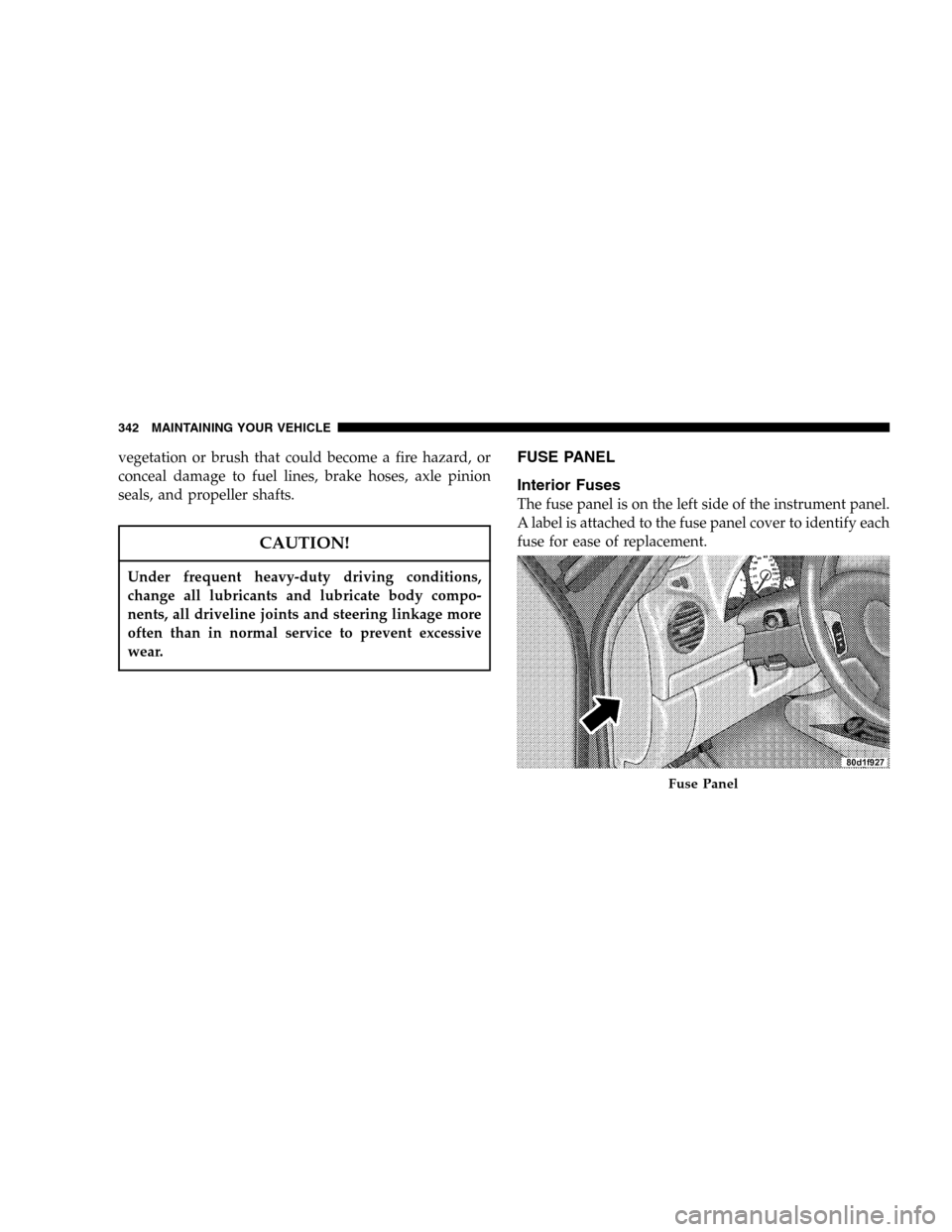
The fuse panel is on the left side of the instrument panel.
A label is attached to the fuse panel cover to identify each
fuse for ease of replacement.
Fuse Panel
342 MAINTAINING YOUR VEHICLE
Page 349 of 424
Cavity Fuse Description
R30 Half ISO Re-
layStarter
R31 Half ISO Re-
layWiper On/Off
R32 Half ISO Re-
layWiper Hi/Lo
R33 Full ISO Re-
layH. Blower
R34 Full ISO Re-
layRad. Fan Hi
R35 Half ISO Re-
layA/C Clutch
R36 Half ISO Re-
layViscous Heat
R37 Open
R38 OpenCavity Fuse Description
R39 Full ISO Re-
layASD
R40 Full ISO Re-
layRad. Fan Lo
VEHICLE STORAGE
If you are leaving your vehicle dormant for more than 21
days you may want to take steps to protect your battery.
You may:
•Remove Cartridge fuse #15 in the Power Distribution
Center labeled Ignition-Off Draw (IOD).
•Store the removed IOD fuse in the Power Distribution
Center location #11 labeled “IOD Storage.”
•Or, disconnect the negative cable from the battery.
•Anytime you store your vehicle, or keep it out of
service (i.e. vacation) for two weeks or more, run the
MAINTAINING YOUR VEHICLE 349
7
Page 350 of 424
air conditioning system at idle for about five minutes
in the fresh air and high blower setting. This will
insure adequate system lubrication to minimize the
possibility of compressor damage when the system is
started again.
REPLACEMENT BULBS
Interior Lights Bulb Type
A/C Heater.................... NotServiceable
Ashtray Receiver Light.................... 161
Climate Control (Manual A/C)................ 74
Front Reading........................... 192
Rear Cargo Light.......................214–2
Lighted Vanity Mirror *.............. P/N6501966
Underpanel Courtesy Lights................. 906
Instrument Cluster (General Illumination)....... 103
Telltale/Hazard Light...................... 74
* Available only from authorized dealers.Exterior Lights Bulb Type
Backup Lights....................3157 P27/7W
Center High-Mounted Stoplight.........921/W16W
Fog Lights (Sport/Limited Only).............9145
Fog Lights (Renegade)..................... H3
Front Park/Turn Lights.............3157 P27/7W
Front Side Marker........................ 168
Headlights..........................9007QL
Rear License Plate Light.................... 168
Rear Stop/Tail Lights...............3157 P27/7W
Rear Turn Signal Lights (2).........3757 APY27/7W
NOTE:Numbers refer to commercial bulb types that
can be purchased from your authorized dealer.
If a bulb needs to be replaced, visit your authorized
dealer.
350 MAINTAINING YOUR VEHICLE
Page 360 of 424
EMISSION CONTROL SYSTEM MAINTENANCE
The “Scheduled” maintenance services, listed inbold
typemust be done at the times or mileages specified to
assure the continued proper functioning of the emission
control system. These, and all other maintenance services
included in this manual, should be done to provide best
vehicle performance and reliability. More frequent main-
tenance may be needed for vehicles in severe operating
conditions such as dusty areas and very short trip
driving.
Inspection and service also should be done any time a
malfunction is suspected.
NOTE:Maintenance, replacement, or repair of the emis-
sion control devices and systems on your vehicle may be
performed by any automotive repair establishment or
individual using any automotive part which has been
certified pursuant to U.S. EPA or, in the State of Califor-
nia, California Air Resources Board regulations.
MAINTENANCE SCHEDULES — GASOLINE
ENGINES
There are two maintenance schedules that show the
requiredservice for your vehicle.
First is Schedule�B�. It is for vehicles that are operated
under the conditions that are listed below and at the
beginning of the schedule.
•Day or night temperatures are below 32°F (0°C).
•Stop and go driving.
•Extensive engine idling.
•Driving in dusty conditions.
•Short trips of less than 10 miles (16.2 km).
•More than 50% of your driving is at sustained high
speeds during hot weather, above 90°F (32°C).
•Trailer towing.
360 MAINTENANCE SCHEDULES
8
M
A
I
N
T
E
N
A
N
C
E
S
C
H
E
D
U
L
E
S
Page 361 of 424
•Taxi, police, or delivery service (commercial service).
•Off-road or desert driving.
•If equipped for and operated with E-85 (ethanol) fuel.
NOTE:IfANYof these apply to you then change your
engine oil every 3,000 miles (5 000 km) or 3 months,
whichever comes first and follow “Schedule B” of the
“Maintenance Schedules” section of this manual.
NOTE:IfANYof these apply to you then flush and
replace your engine coolant/anti-freeze every 102,000
miles (163 000 km) or 60 months, whichever comes first,
and follow “Schedule B” of the “Maintenance Schedules”
section of this manual.
NOTE:Most vehicles are operated under the conditions
listed for Schedule “B.”Second is Schedule“A”. It is for vehicles that are not
operated under any of the conditions listed under Sched-
ule “B.”
Use the schedule that best describes your driving condi-
tions. Where time and mileage are listed, follow the
interval that occurs first.
CAUTION!
Failure to perform the required maintenance items
may result in damage to the vehicle.
MAINTENANCE SCHEDULES 361
8
M
A
I
N
T
E
N
A
N
C
E
S
C
H
E
D
U
L
E
S
Page 363 of 424
Schedule “B” — Gasoline Engines
Follow schedule “B” if you usually operate your vehicle
under one or more of the following conditions.
•Day or night temperatures are below 32°F (0°C).
•Stop and go driving.
•Extensive engine idling.
•Driving in dusty conditions.
•Short trips of less than 10 miles (16.2 km).
•More than 50% of your driving is at sustained high
speeds during hot weather, above 90°F (32°C).
•Trailer towing.
•Taxi, police, or delivery service (commercial service).
•Off-road or desert driving.
•If equipped for and operated with E-85 (ethanol) fuel.
NOTE:IfANYof these apply to you then change your
engine oil every 3,000 miles (5 000 km) or 3 months,
whichever comes first and follow “Schedule B” of the
“Maintenance Schedules” section of this manual.
NOTE:IfANYof these apply to you then flush and
replace your engine coolant/anti-freeze every 102,000
miles (163 000 km) or 60 months, whichever comes first,
and follow “Schedule B” of the “Maintenance Schedules”
section of this manual.
SCHEDULE “B” — GASOLINE ENGINES 363
8
M
A
I
N
T
E
N
A
N
C
E
S
C
H
E
D
U
L
E
S