Page 175 of 424

24. O/D (Overdrive) Off Indicator Light
This light will illuminate when the O/D OFF
button has been selected. The O/D OFF button is
located on the gear shift lever.
25. Seat Belt Indicator Light
When the ignition switch is first turned ON, this
light will turn on for 5 to 8 seconds as a bulb check.
During the bulb check, if the driver’s seat belt is
unbuckled, a chime will sound. After the bulb check or
when driving, if the driver seat belt remains unbuckled,
the Seat Belt Warning Light will flash or remain on
continuously. Refer to�Enhanced Driver Seat Belt Re-
minder System (BeltAlert)�in the Occupant Restraints
section for more information.
26. Light Bar Indicator Light — If Equipped
This light indicates when the light bar lamps
are on.27. Water In Fuel Warning Light — If Equipped
This light indicates water has collected in the
fuel filter and should be drained immediately.
See your authorized dealer for service. (See
page 220 for more information.)
28. Low Coolant Warning Light — If Equipped
This light comes on if the coolant level is low.
This light will come on for 3 seconds as a bulb
check when the ignition switch is first turned
to the ON position.
29. Electronic Throttle Control (ETC) Warning Light —
If Equipped
This light informs you of a problem with the
Electronic Throttle Control system. If a problem
is detected the light will come on while the
engine is running. Cycle the ignition key when
the vehicle has completely stopped and the gear selector
is placed in the P (Park) position. The light should turn
UNDERSTANDING YOUR INSTRUMENT PANEL 175
4
Page 221 of 424
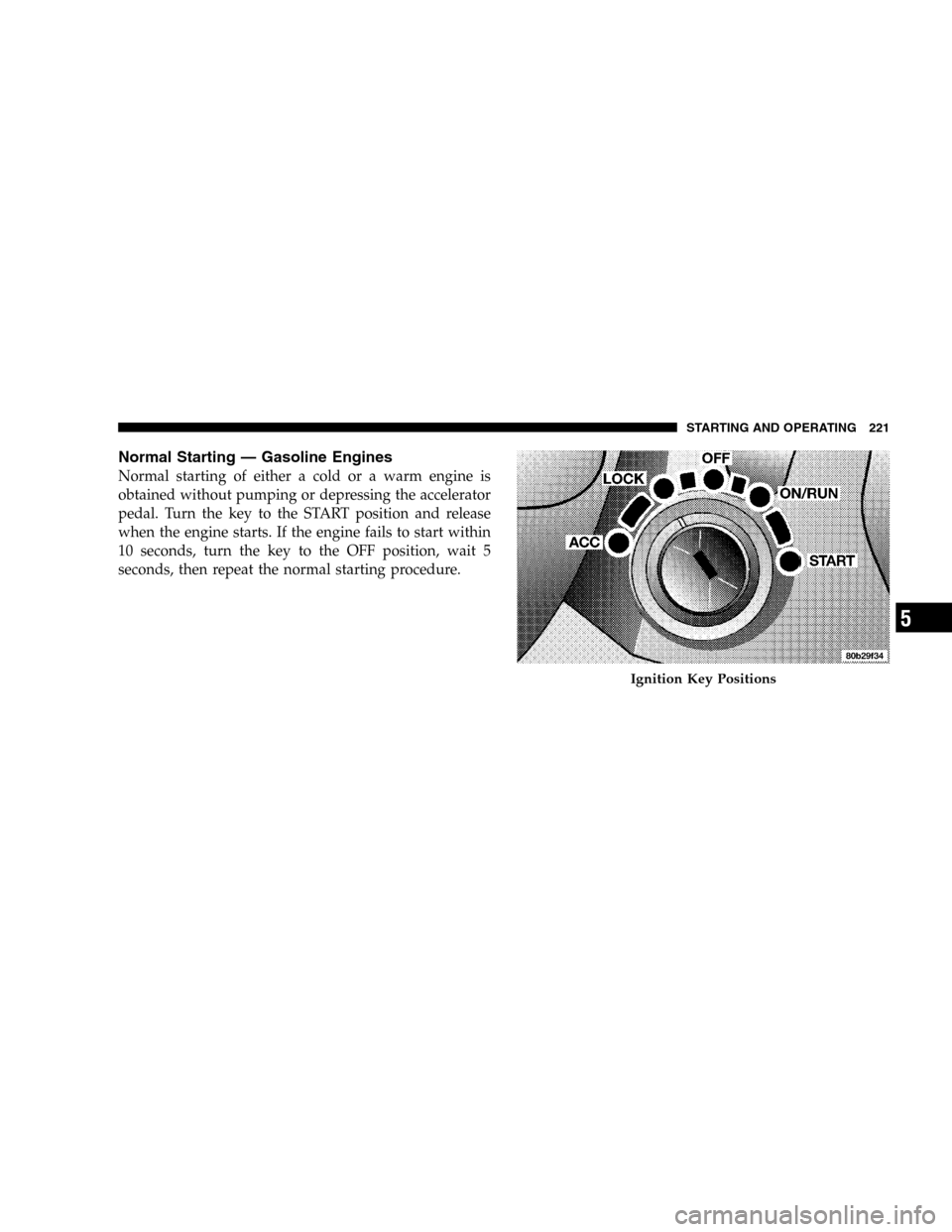
Normal Starting — Gasoline Engines
Normal starting of either a cold or a warm engine is
obtained without pumping or depressing the accelerator
pedal. Turn the key to the START position and release
when the engine starts. If the engine fails to start within
10 seconds, turn the key to the OFF position, wait 5
seconds, then repeat the normal starting procedure.
Ignition Key Positions
STARTING AND OPERATING 221
5
Page 222 of 424
WARNING!
Never pour fuel or other flammable liquids into the
throttle body air inlet opening in an attempt to start
the vehicle. This could result in a flash fire causing
serious personal injury.
If Engine Fails to Start
If the engine fails to start after you have followed the
“Normal Starting” procedure, it may be flooded. Push
the accelerator pedal all the way to the floor and hold it
there while cranking the engine. This should clear any
excess fuel in case the engine is flooded.
CAUTION!
To prevent damage to the starter, do not crank the
engine for more than 15 seconds at a time. Wait 10 to
15 seconds before trying again.
If the engine has been flooded, it may start to run, but not
have enough power to continue running when the key is
released. If this occurs, continue cranking with the accel-
erator pedal pushed all the way to the floor. Release the
accelerator pedal and the key once the engine is running
smoothly.
222 STARTING AND OPERATING
Page 223 of 424
If the engine shows no sign of starting after two 15
second periods of cranking with the accelerator pedal
held to the floor, the “Normal Starting” procedure should
be repeated.
After Starting
The idle speed is automatically controlled and will de-
crease as the engine warms up.
Normal Starting — Diesel Engines
1. Turn the ignition key to the ON/RUN position.
2. Watch the “Glow Plug Indicator Light.” It will stay on
for a maximum of 2 seconds, depending on engine
temperature. When the “Glow Plug Indicator Light” goes
out, the engine is ready to start.
3.Do notpress the accelerator. Turn the ignition key to
START and hold it in this position until the engine starts.
Starting and Operating Cautions — Diesel Engines
•
Under normal conditions,do notoperate the starter
for longer than 20 seconds at one time. At tempera-
tures below 5°F (�15°C), you may operate the starter
for up to 25 seconds at one time. Longer periods of
operation may result in starter or battery damage. If
the engine does not start at once, repeat Steps 1
through 4.
•Cold engine speeds higher than necessary for driving
or higher than specified for idling may damage engine
components.
•Before turning off your Diesel engine, always allow
the engine to return to normal idle speed and then run
for several seconds. This assures proper lubrication of
the turbocharger. This is particularly necessary after
periods of high speed driving.
STARTING AND OPERATING 223
5
Page 231 of 424
Gear Ranges
P (Park)
Supplements the parking brake by locking the transmis-
sion. The engine can be started in this range. Never use P
(Park) while the vehicle is in motion. Apply the parking
brake when leaving the vehicle in this range. Always
place the gear selector in the P (Park) position first, and
then apply the parking brake.
WARNING!
Unintended movement of a vehicle could injure
those in and near the vehicle. As with all vehicles,
you should never exit a vehicle while the engine is
running. Before exiting a vehicle, you should always
shift the vehicle into P (Park), remove the key from
the ignition, and apply the parking brake. Once the
key is removed from the ignition, the transmission
shift lever is locked in the P (Park) position, securing
the vehicle against unwanted movement. Further-
more, you should never leave children unattended
inside a vehicle.
STARTING AND OPERATING 231
5
Page 246 of 424
To release the parking brake, pull up slightly, press the
center button, then lower the lever completely.
Before leaving the vehicle parked on a hill, you must
make sure the parking brake is fully applied and place
the gear selector in the P (Park) position. Make certain the
transfer case is in gear. Failure to do so may cause the
vehicle to roll and cause damage or injury.
When parking on a hill, it is important to set the parking
brake before placing the gear selector in P (Park), other-
wise the load on the transmission locking mechanism
may make it difficult to move the selector out of P (Park).WARNING!
•Leaving children unattended in a vehicle is dan-
gerous for a number of reasons. A child or others
could be injured. Children should be warned not
to touch the parking brake or the gear selector
lever. Don’t leave the keys in the ignition. A child
could operate power windows, other controls, or
move the vehicle.
•Do not leave children or animals inside parked
vehicles in hot weather. Interior heat build up
may cause serious injury or death.
Be sure the parking brake is fully disengaged before
driving. Failure to do so can lead to brake failure.
NOTE:Parking brake adjustment and maintenance
should be performed by your authorized dealer.
246 STARTING AND OPERATING
Page 288 of 424
5. Shift automatic transmission into D (Drive) or manual
transmission into any forward gear.
6. Release brake pedal and ensure that there is no vehicle
movement.
7. Shut the engine OFF and place the ignition key into
the unlocked OFF position.
8. Shift automatic transmission into P (Park) or ensure
manual transmission is in any forward gear.
9. Apply parking brake.
10. Attach vehicle to the tow vehicle with tow bar.
11. Release parking brake.CAUTION!
Transmission damage may occur if the automatic
transmission is shifted into P (Park) with the transfer
case in N (Neutral) and the engine running. With the
transfer case in N (Neutral) ensure that the engine is
OFF prior to shifting the transmission into P (Park)
(refer to steps7 – 8 above).
Shifting Out Of Neutral (N)
Use the following procedure to prepare your vehicle for
normal usage.
1. Shift transmission into N (Neutral).
2. Turn engine off.
3. Shift transfer case lever to desired position.
4. Shift automatic transmission into P (Park).
288 STARTING AND OPERATING
Page 300 of 424
NOTE:To start the vehicle following connection of a
booster battery, the Security Alarm System must first be
disabled by cycling a front door key cylinder or by using
the keyless entry transmitter.
WARNING!
Jump starting can be dangerous. To avoid personal
injury or damage to electrical components in vehicle,
observe the following warnings:
•Battery fluid is a corrosive acid solution and can burn
or even blind you. Don’t allow battery fluid to contact
your eyes, skin, or clothing. Don’t lean over a battery
when attaching clamps. If acid splashes in eyes or on
skin, flush the area immediately with large amounts of
water.
•Do not use a booster battery or any other booster
source that has a greater than 12–volt system, i.e., do
not use a 24–volt power source.
•Never attempt to jump start a discharged battery that
is frozen, because it could rupture or explode during
jump starting.
•Be sure your vehicle is not touching the jump start
vehicle.
•Observe all Battery Warnings in Section 7 of this
manual, while jump starting your vehicle.
300 WHAT TO DO IN EMERGENCIES