Page 256 of 424
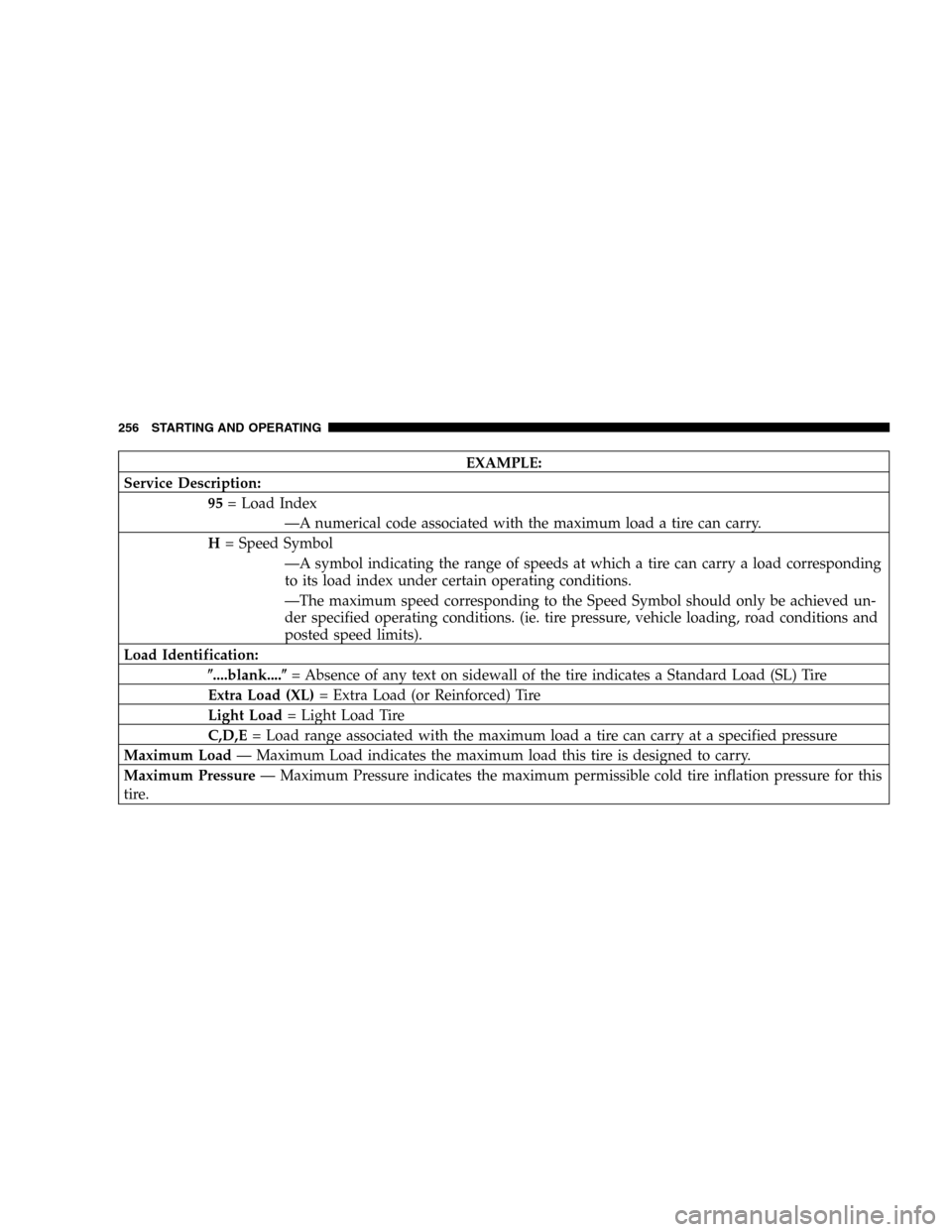
EXAMPLE:
Service Description:
95= Load Index
—A numerical code associated with the maximum load a tire can carry.
H= Speed Symbol
—A symbol indicating the range of speeds at which a tire can carry a load corresponding
to its load index under certain operating conditions.
—The maximum speed corresponding to the Speed Symbol should only be achieved un-
der specified operating conditions. (ie. tire pressure, vehicle loading, road conditions and
posted speed limits).
Load Identification:
�....blank....�= Absence of any text on sidewall of the tire indicates a Standard Load (SL) Tire
Extra Load (XL)= Extra Load (or Reinforced) Tire
Light Load= Light Load Tire
C,D,E= Load range associated with the maximum load a tire can carry at a specified pressure
Maximum Load— Maximum Load indicates the maximum load this tire is designed to carry.
Maximum Pressure— Maximum Pressure indicates the maximum permissible cold tire inflation pressure for this
tire.
256 STARTING AND OPERATING
Page 263 of 424
2. Economy—
Improper inflation pressures can cause uneven wear
patterns to develop across the tire tread. These abnormal
wear patterns will reduce tread life resulting in a need for
earlier tire replacement. Under inflation also increases
tire rolling resistance and results in higher fuel consump-
tion.
3. Ride Comfort and Vehicle Stability—
Proper tire inflation contributes to a comfortable ride.
Over inflation produces a jarring and uncomfortable ride.
Both under inflation and over inflation affect the stability
of the vehicle and can produce a feeling of sluggish
response or over responsiveness in the steering.
Unequal tire pressures can cause erratic and unpredict-
able steering response.
Unequal tire pressure from side to side may cause the
vehicle to drift left or right.Tire Inflation Pressures
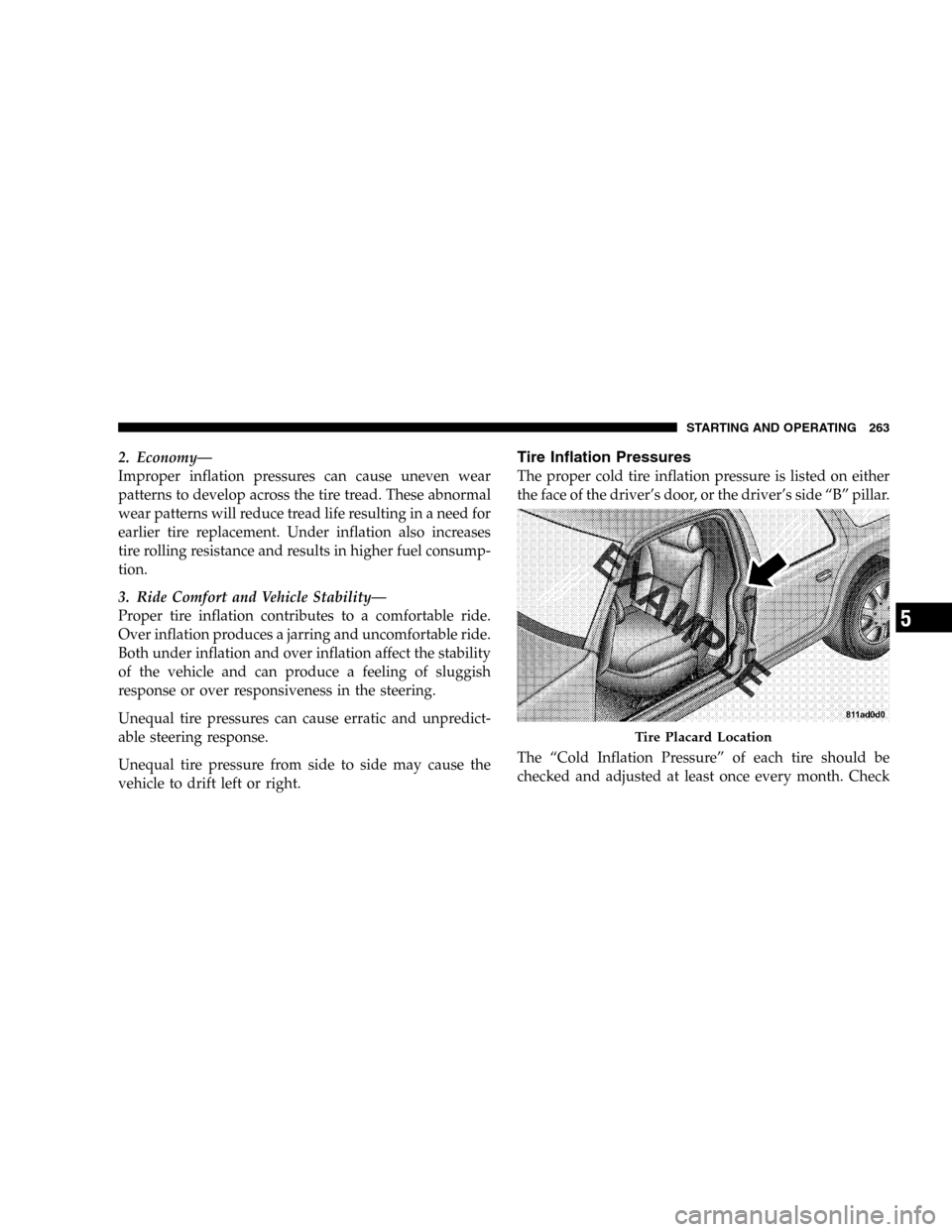
The proper cold tire inflation pressure is listed on either
the face of the driver’s door, or the driver’s side “B” pillar.
The “Cold Inflation Pressure” of each tire should be
checked and adjusted at least once every month. Check
Tire Placard Location
STARTING AND OPERATING 263
5
Page 274 of 424
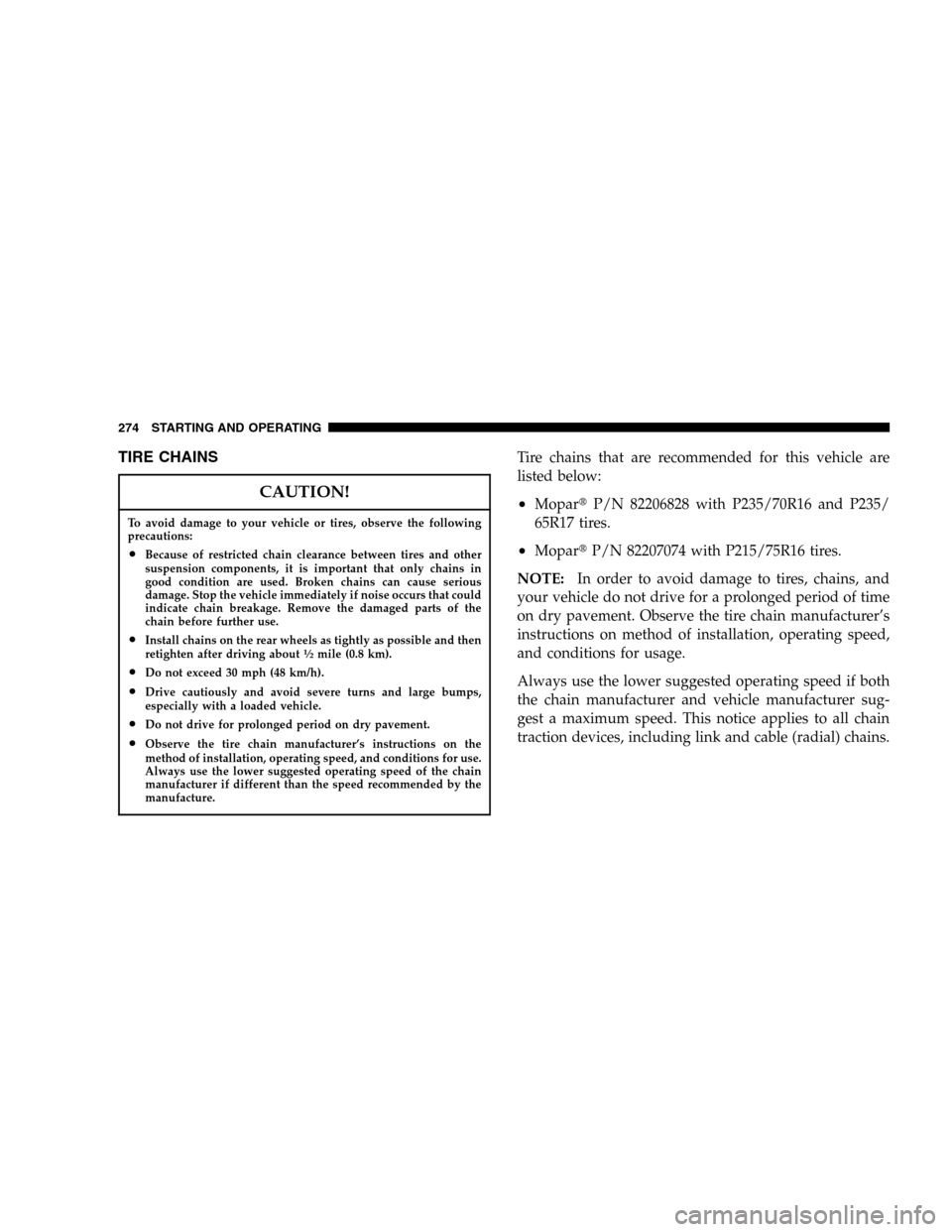
TIRE CHAINS
CAUTION!
To avoid damage to your vehicle or tires, observe the following
precautions:
•Because of restricted chain clearance between tires and other
suspension components, it is important that only chains in
good condition are used. Broken chains can cause serious
damage. Stop the vehicle immediately if noise occurs that could
indicate chain breakage. Remove the damaged parts of the
chain before further use.
•Install chains on the rear wheels as tightly as possible and then
retighten after driving about12mile (0.8 km).
•Do not exceed 30 mph (48 km/h).
•Drive cautiously and avoid severe turns and large bumps,
especially with a loaded vehicle.
•Do not drive for prolonged period on dry pavement.
•Observe the tire chain manufacturer’s instructions on the
method of installation, operating speed, and conditions for use.
Always use the lower suggested operating speed of the chain
manufacturer if different than the speed recommended by the
manufacture.
Tire chains that are recommended for this vehicle are
listed below:
•Mopar�P/N 82206828 with P235/70R16 and P235/
65R17 tires.
•Mopar�P/N 82207074 with P215/75R16 tires.
NOTE:In order to avoid damage to tires, chains, and
your vehicle do not drive for a prolonged period of time
on dry pavement. Observe the tire chain manufacturer’s
instructions on method of installation, operating speed,
and conditions for usage.
Always use the lower suggested operating speed if both
the chain manufacturer and vehicle manufacturer sug-
gest a maximum speed. This notice applies to all chain
traction devices, including link and cable (radial) chains.
274 STARTING AND OPERATING
Page 275 of 424
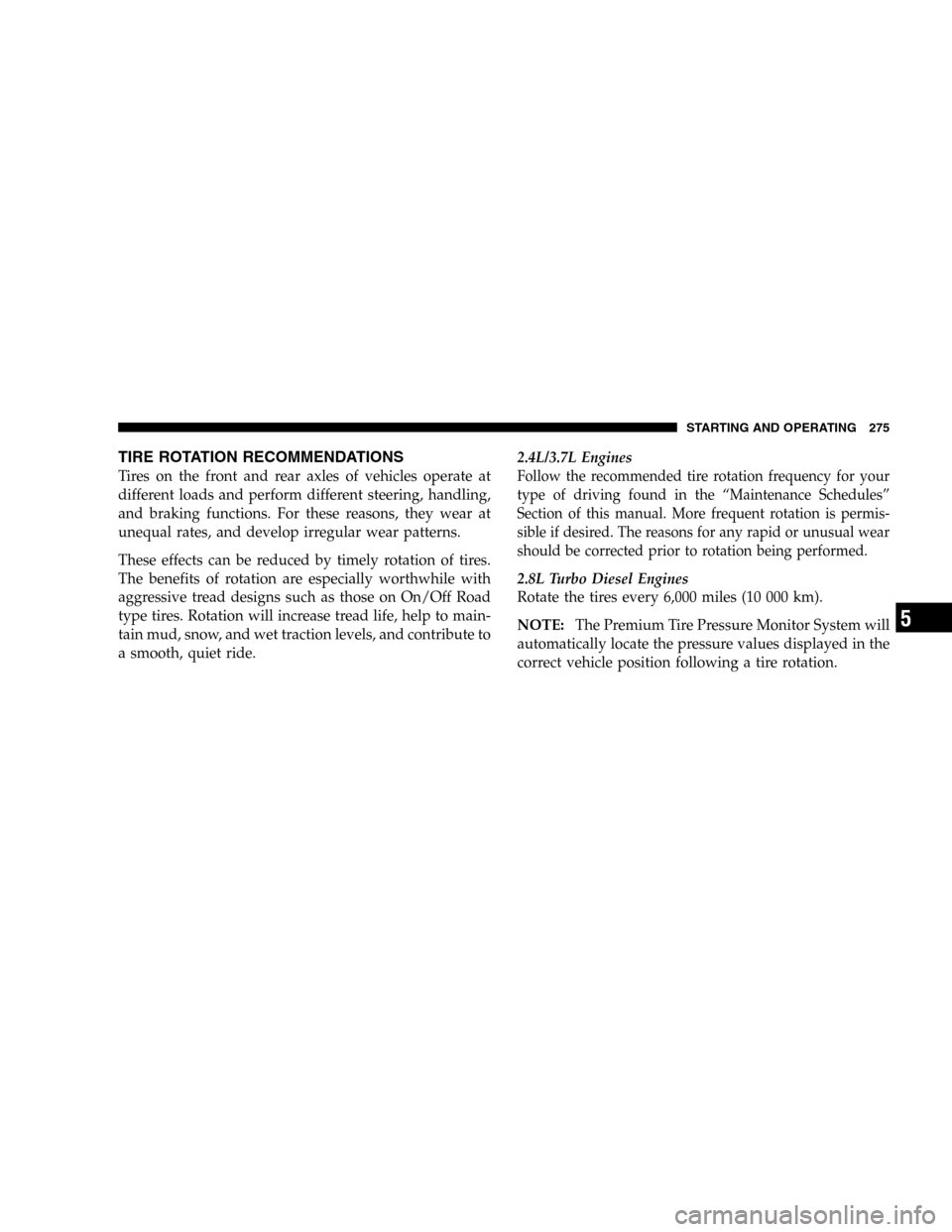
TIRE ROTATION RECOMMENDATIONS
Tires on the front and rear axles of vehicles operate at
different loads and perform different steering, handling,
and braking functions. For these reasons, they wear at
unequal rates, and develop irregular wear patterns.
These effects can be reduced by timely rotation of tires.
The benefits of rotation are especially worthwhile with
aggressive tread designs such as those on On/Off Road
type tires. Rotation will increase tread life, help to main-
tain mud, snow, and wet traction levels, and contribute to
a smooth, quiet ride.2.4L/3.7L EnginesFollow the recommended tire rotation frequency for your
type of driving found in the “Maintenance Schedules”
Section of this manual. More frequent rotation is permis-
sible if desired. The reasons for any rapid or unusual wear
should be corrected prior to rotation being performed.
2.8L Turbo Diesel Engines
Rotate the tires every 6,000 miles (10 000 km).
NOTE:The Premium Tire Pressure Monitor System will
automatically locate the pressure values displayed in the
correct vehicle position following a tire rotation.
STARTING AND OPERATING 275
5
Page 279 of 424
Materials Added To Fuel
All gasoline sold in the United States is required to
contain effective detergent additives. Use of additional
detergents or other additives is not needed under normal
conditions.
Fuel System Cautions
CAUTION!
Follow these guidelines to maintain your vehicle’s
performance:
•The use of leaded gas is prohibited by Federal law.
Using leaded gasoline can impair engine performance,
damage the emission control system.
•An out-of-tune engine, or certain fuel or ignition
malfunctions, can cause the catalytic converter to
overheat. If you notice a pungent burning odor or
some light smoke, your engine may be out of tune or
malfunctioning and may require immediate service.
Contact your dealer for service assistance.
•The use of fuel additives which are now being sold as
octane enhancers is not recommended. Most of these
products contain high concentrations of methanol.
Fuel system damage or vehicle performance problems
resulting from the use of such fuels or additives is not
the responsibility of the manufacturer.
NOTE:Intentional tampering with emissions control
systems can result in civil penalties being assessed
against you.
STARTING AND OPERATING 279
5
Page 327 of 424
Adding Engine Coolant
Your vehicle has been built with an improved antifreeze/
coolant that allows extended maintenance intervals. This
antifreeze/coolant can be used up to 5 Years or 100,000
miles before replacement. To prevent reducing this ex-
tended maintenance period, it is important that you use
the same antifreeze/coolant throughout the life of your
vehicle. Please review these recommendations for using
Hybrid Organic Additive Technology (HOAT) coolant.
When adding antifreeze/coolant, a minimum solution of
50% recommended Mopar�Antifreeze/Coolant 5 Year/
100,000 Mile Formula HOAT (Hybrid Organic Additive
Technology), or equivalent, in water should be used. Use
higher concentrations (not to exceed 70%) if temperatures
below -34°F (-37°C) are anticipated.Use only high purity water such as distilled or deionized
water when mixing the water/antifreeze (coolant) solu-
tion. The use of lower quality water will reduce the
amount of corrosion protection in the engine cooling
system.
Please note that it is the owner’s responsibility to main-
tain the proper level of protection against freezing ac-
cording to the temperatures occurring in the area where
the vehicle is operated.
NOTE:Mixing antifreeze/coolant types will decrease
the life of the antifreeze/coolant and will require more
frequent antifreeze/coolant changes.
Cooling System Pressure Cap
The cap must be fully tightened to prevent loss of
antifreeze/coolant, and to insure that antifreeze/coolant
will return to the radiator from the coolant recovery
bottle.
MAINTAINING YOUR VEHICLE 327
7
Page 339 of 424
CAUTION!
Do not use abrasive or strong cleaning materials
such as steel wool or scouring powder, which will
scratch metal and painted surfaces.
Special Care
•
If you drive on salted or dusty roads or if you drive
near the ocean, hose off the undercarriage at least once
a month.
•It is important that the drain holes in the lower edges
of the doors, rocker panels and tailgate must be kept
clear and open.
•If you detect any stone chips or scratches in the paint,
touch them up immediately. The cost of such repairs is
considered the responsibility of the owner.
•If your vehicle is damaged due to an accident or
similar cause which destroys the paint and protective
coating have your vehicle repaired as soon as possible.
The cost of such repairs is considered the responsibil-
ity of the owner.
•All wheels and wheel trim, especially aluminum and
chrome plated wheels should be cleaned regularly
with mild soap and water to prevent corrosion. To
remove heavy soil, select a non-abrasive, non-acidic
cleaner. Do not use scouring pads, steel wool, a bristle
brush, or metal polishes. Only Mopar�Cleaners are
recommended. Do not use oven cleaner. Avoid auto-
matic car washes that use acidic solutions or harsh
brushes that may damage the wheel’s protective fin-
ish.
•If you carry special cargo such as chemicals, fertilizers,
de-icer salt, etc., be sure that such materials are well
packaged and sealed.
MAINTAINING YOUR VEHICLE 339
7
Page 340 of 424
•If a lot of driving is done on gravel roads, consider
mud or stone shields behind each wheel.
•Use Mopar�Touch Up Paint on scratches or chips as
soon as possible. Your authorized dealer has touch up
paint to match the color of your vehicle.
Interior Care
Use Mopar�Fabric Cleaner to clean fabric upholstery
and carpeting.
Use Mopar�Vinyl Cleaner to clean vinyl or leather
upholstery.
Mopar�Vinyl Cleaner is specifically recommended for
interior vinyl trim.
Leather Seat Care & Cleaning
Leather is best preserved by regular cleaning with a
damp soft cloth. Small particles of dirt can act as an
abrasive and damage the leather surface and should be
removed promptly with a damp cloth. Stubborn soils canbe removed easily with a soft cloth and Mopar�Total
Clean. Care should be taken to avoid soaking the leather
with any liquid. Please do not use polishes, oils, cleaning
fluids, solvents, detergents, or ammonia based cleaners
to clean the leather. Application of a leather conditioner is
not required to maintain the original condition.
WARNING!
Do not use volatile solvents for cleaning purposes.
Many are potentially flammable, and if used in
closed areas they may cause respiratory harm.
Glass Surfaces
All glass surfaces should be cleaned on a regular basis
with any commercial household-type glass cleaner.
Never use an abrasive type cleaner. Use caution when
340 MAINTAINING YOUR VEHICLE