2005 JEEP LIBERTY ESP
[x] Cancel search: ESPPage 199 of 424
show the disc number, the track number, and index time
in minutes and seconds. Play will begin at the start of
track 1.
LOAD/ EJT — Load
Press the LOAD/ EJT button and the button with the
corresponding number where the CD is being loaded.
After the radio displays “load” insert the CD into the
player.
Radio display will show “loading” when it is being
loaded.
LOAD / EJT — Eject
Press the LOAD/ EJT button and the button with the
corresponding number where the CD was loaded and the
disc will unload and move to the entrance for easy
removal.
Radio display will show “ejecting” when it is being
ejected.If you have ejected a disc and have not removed it within
15 seconds, it will be reloaded. If the CD is not removed,
the radio will continue to play the non-removed CD. If
the CD is removed and there are other CD’s in the radio,
the radio will play the next CD. If the CD is removed and
there are no other CD’s in the radio, the radio will return
to the last selected AM or FM mode.
The disc can be ejected with the radio and ignition OFF.
Seek
Press the top of the SEEK button for the next selection on
the CD. Press the bottom of the button to return to the
beginning of the current selection, or return to the
beginning of the previous selection if the CD is within the
first second of the current selection.
Scan
Press the Scan button to scan through each track on the
CD currently playing.
UNDERSTANDING YOUR INSTRUMENT PANEL 199
4
Page 201 of 424
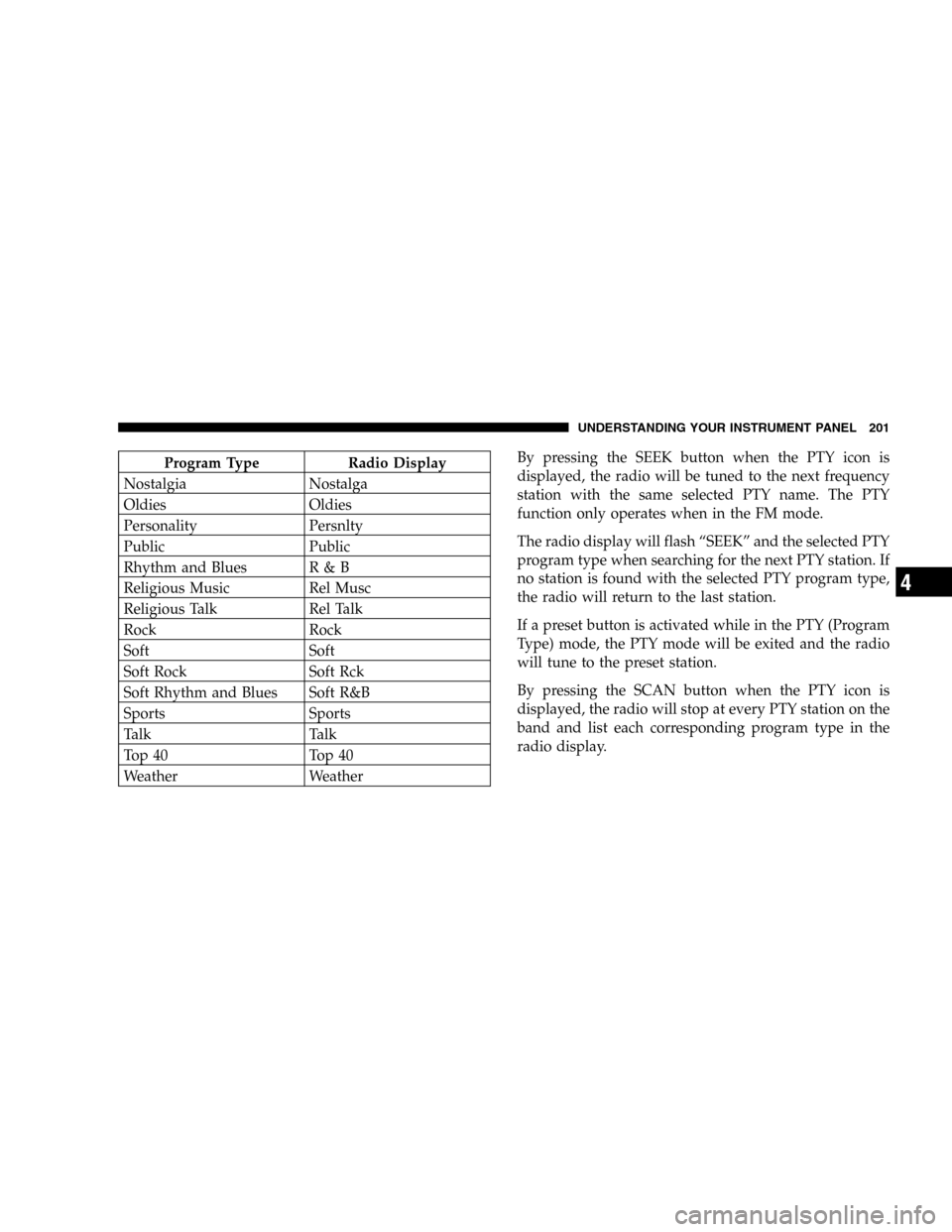
Program Type Radio Display
Nostalgia Nostalga
Oldies Oldies
Personality Persnlty
Public Public
Rhythm and Blues R & B
Religious Music Rel Musc
Religious Talk Rel Talk
Rock Rock
Soft Soft
Soft Rock Soft Rck
Soft Rhythm and Blues Soft R&B
Sports Sports
Talk Talk
Top 40 Top 40
Weather WeatherBy pressing the SEEK button when the PTY icon is
displayed, the radio will be tuned to the next frequency
station with the same selected PTY name. The PTY
function only operates when in the FM mode.
The radio display will flash “SEEK” and the selected PTY
program type when searching for the next PTY station. If
no station is found with the selected PTY program type,
the radio will return to the last station.
If a preset button is activated while in the PTY (Program
Type) mode, the PTY mode will be exited and the radio
will tune to the preset station.
By pressing the SCAN button when the PTY icon is
displayed, the radio will stop at every PTY station on the
band and list each corresponding program type in the
radio display.
UNDERSTANDING YOUR INSTRUMENT PANEL 201
4
Page 213 of 424
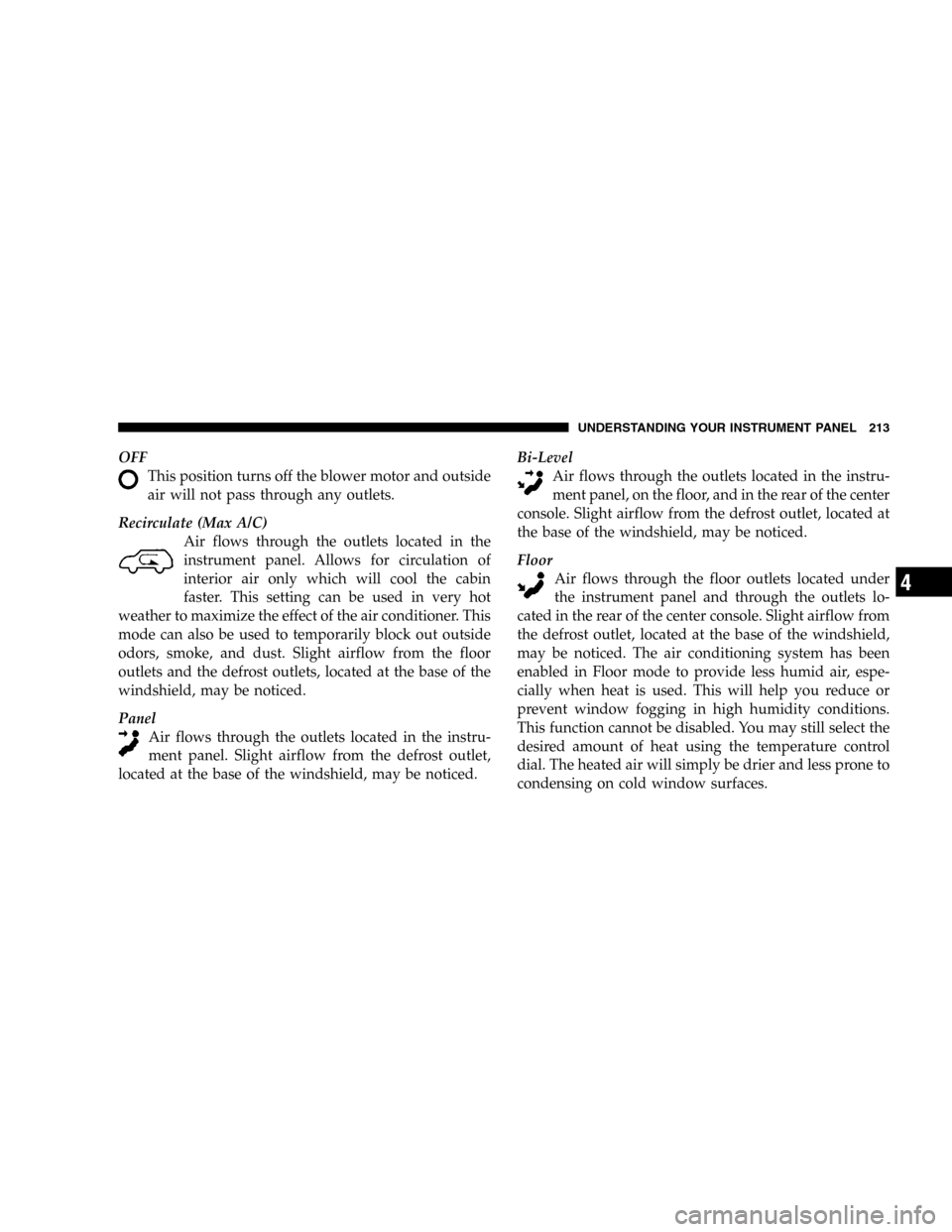
OFF
This position turns off the blower motor and outside
air will not pass through any outlets.
Recirculate (Max A/C)
Air flows through the outlets located in the
instrument panel. Allows for circulation of
interior air only which will cool the cabin
faster. This setting can be used in very hot
weather to maximize the effect of the air conditioner. This
mode can also be used to temporarily block out outside
odors, smoke, and dust. Slight airflow from the floor
outlets and the defrost outlets, located at the base of the
windshield, may be noticed.
Panel
Air flows through the outlets located in the instru-
ment panel. Slight airflow from the defrost outlet,
located at the base of the windshield, may be noticed.Bi-Level
Air flows through the outlets located in the instru-
ment panel, on the floor, and in the rear of the center
console. Slight airflow from the defrost outlet, located at
the base of the windshield, may be noticed.
Floor
Air flows through the floor outlets located under
the instrument panel and through the outlets lo-
cated in the rear of the center console. Slight airflow from
the defrost outlet, located at the base of the windshield,
may be noticed. The air conditioning system has been
enabled in Floor mode to provide less humid air, espe-
cially when heat is used. This will help you reduce or
prevent window fogging in high humidity conditions.
This function cannot be disabled. You may still select the
desired amount of heat using the temperature control
dial. The heated air will simply be drier and less prone to
condensing on cold window surfaces.
UNDERSTANDING YOUR INSTRUMENT PANEL 213
4
Page 229 of 424
•When “rocking” a stuck vehicle by shifting between a
forward gear and reverse, do not spin wheels faster than
15 mph (24 km/h), or drivetrain damage may result.
Recommended Manual Transmission Shifting
Speeds
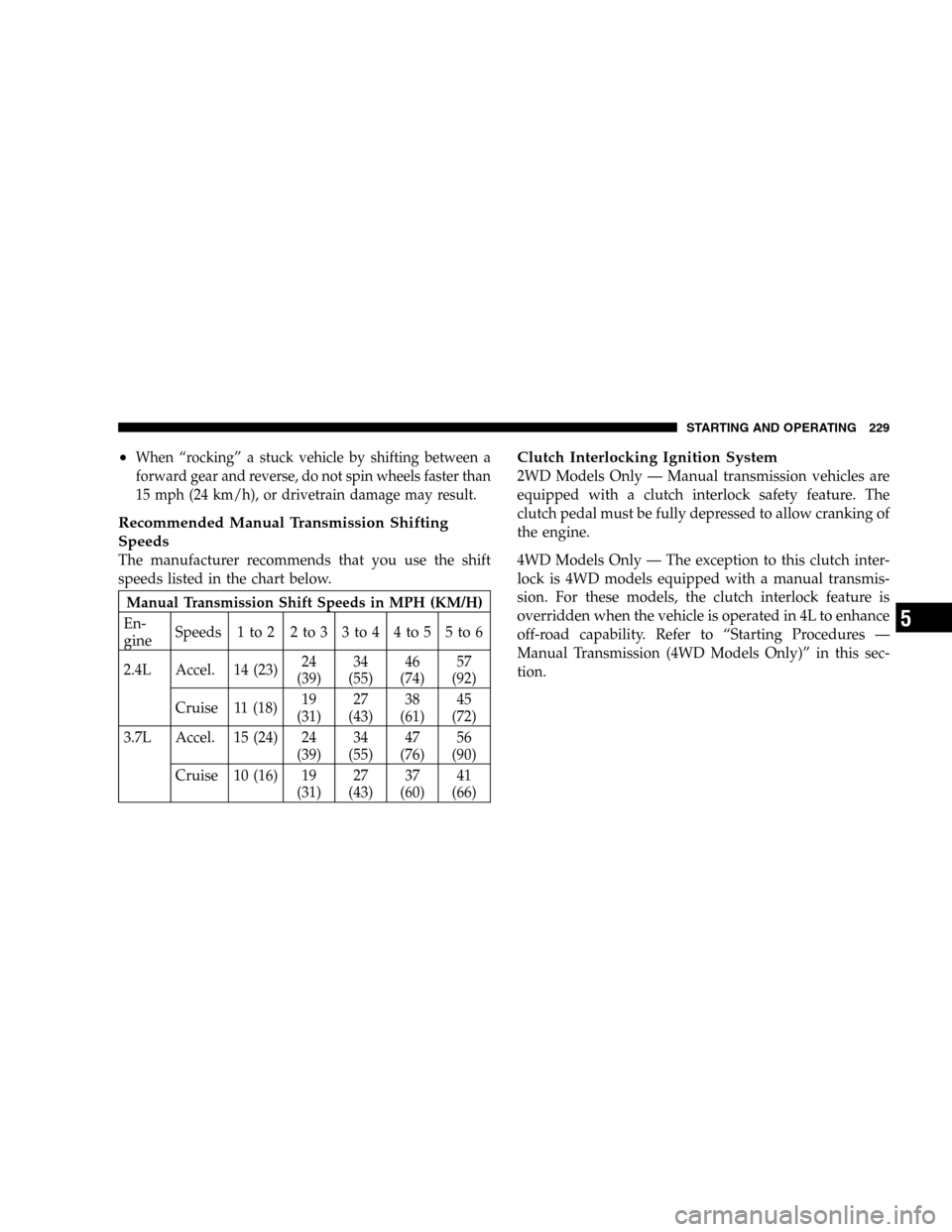
The manufacturer recommends that you use the shift
speeds listed in the chart below.
Manual Transmission Shift Speeds in MPH (KM/H)
En-
gineSpeeds 1 to 2 2 to 3 3 to 4 4 to 5 5 to 6
2.4L Accel. 14 (23)24
(39)34
(55)46
(74)57
(92)
Cruise 11 (18)19
(31)27
(43)38
(61)45
(72)
3.7L Accel. 15 (24) 24
(39)34
(55)47
(76)56
(90)
Cruise 10 (16) 19
(31)27
(43)37
(60)41
(66)
Clutch Interlocking Ignition System
2WD Models Only — Manual transmission vehicles are
equipped with a clutch interlock safety feature. The
clutch pedal must be fully depressed to allow cranking of
the engine.
4WD Models Only — The exception to this clutch inter-
lock is 4WD models equipped with a manual transmis-
sion. For these models, the clutch interlock feature is
overridden when the vehicle is operated in 4L to enhance
off-road capability. Refer to “Starting Procedures —
Manual Transmission (4WD Models Only)” in this sec-
tion.
STARTING AND OPERATING 229
5
Page 232 of 424
The following indicators should be used to ensure that
you have engaged the transmission shift lever into the P
(Park) position:
•When shifting into P (Park), depress the button on the
shift lever and firmly move the lever all the way
forward until it stops.
•Look at the shift indicator window on the console to
ensure it is in the P (Park) position.
•When engaged in P (Park), you will not be able to
move the shifter rearward without depressing the shift
lever button.
CAUTION!
Before moving the shift lever out of P (Park), you must
turn the ignition from LOCK to ON so the steering
wheel and shift lever are released. Otherwise, damage
to the steering column or shifter could result.
R (Reverse)
For moving the vehicle rearward. Always stop before
moving the lever to R (Reverse), except when rocking the
vehicle.
N (Neutral)
Engine may be started in this position.
NOTE:Towing the vehicle, coasting, or otherwise driv-
ing with the transmission in N (Neutral) can cause severe
damage to the transmission.
WARNING!
Do not coast in N (Neutral) and never turn off the
ignition to coast down a hill. These are unsafe
practices that limit your response to changing traffic
or road conditions. You might lose control of the
vehicle.
232 STARTING AND OPERATING
Page 235 of 424

Over Temperature Mode
The transmission electronics constantly monitor the
transmission oil temperature. If the transmission gets too
hot, the transmission will change the way it shifts to help
control the condition. This may result in a slightly
different feeling or response during normal operation in
D (Drive) position. If the transmission becomes hot
enough the TRANS TEMP warning light in the instru-
ment cluster will come on. After the transmission cools
down, it will return to normal operation.
Torque Converter Clutch
A feature designed to improve fuel economy has been
added to the automatic transmission of this vehicle. A
clutch within the torque converter engages automatically
at calibrated speeds. This may result in a slightly differ-
ent feeling or response during normal operation in high
gear. When the vehicle speed drops or during accelera-
tion, the clutch automatically and smoothly disengages.NOTE:
•The torque converter clutch (TCC) will not engage
until the transmission fluid and engine coolant are
warm (usually after 1–3 miles (1.6–4.8 km) of driving)
and the vehicle speed is above approximately 30 mph
(48 km/h). To understand the difference in operation,
drive the vehicle so that TCC engagement conditions
are correct, and then press and release the “O/D OFF”
button once to disengage the TCC. Wait a few seconds,
and then press and release the “O/D OFF” button
again to engage the TCC. You will notice that the
engine runs at a higher RPM when driving at vehicle
speeds above approximately 30 mph (48 km/h) with
the TCC not engaged. This is a normal condition.
•If the vehicle has not been driven for several days, the
first few seconds of operation after shifting the trans-
mission into gear may seem sluggish. This is due to the
transmission fluid partially draining from the torque
converter into the transmission. This is considered a
STARTING AND OPERATING 235
5
Page 238 of 424
Proper operation of 4-wheel drive vehicles depends on
tires of equal size, type and circumference on each wheel.
Any difference will adversely affect shifting and can
cause damage to the transfer case.
WARNING!
•Because 4-wheel drive provides improved trac-
tion, there is a tendency to exceed safe turning and
stopping speeds. Do not go faster than road con-
ditions permit.
•You or others could be injured if you leave the
vehicle unattended with the transfer case in the
Neutral (N) position without first fully engaging
the parking brake. The transfer case Neutral (N)
position disengages both the front and rear drive-
shafts from the powertrain and will allow the
vehicle to move despite the transmission position.
The parking brake should always be applied
when the driver is not in the vehicle.
Shift Positions
For additional information on the appropriate use of each
transfer case mode position see the information below:
2H
Rear Wheel Drive High Range - Normal street and
highway driving. Dry hard surfaced roads.
4H
4-Wheel-Drive High Range - Locks the front and rear
driveshafts together. Forces the front and rear wheels to
rotate at the same speed. Additional traction for loose,
slippery road surfaces only.
N
Neutral - Disengages both the front and rear driveshafts
from the powertrain. To be used for flat towing behind
another vehicle. Refer to “Recreational Towing” in Sec-
tion 5 for more information.
238 STARTING AND OPERATING
Page 245 of 424
TRAC-LOK™ REAR AXLE — IF EQUIPPED
The optional Trac-Lok™ rear axle provides a constant
driving force to both rear wheels and reduces wheel spin
caused by the loss of traction at one driving wheel. If
traction differs between the two rear wheels, the differ-
ential automatically proportions the usable torque by
providing more torque to the wheel that has traction.
Trac-Lok™ is especially helpful during slippery driving
conditions. With both rear wheels on a slippery surface, a
slight application of the accelerator will supply maxi-
mum traction. When starting with only one rear wheel on
an excessively slippery surface, slight application of the
parking brake may be necessary to gain maximum trac-
tion.WARNING!
On vehicles equipped with a limited-slip differen-
tial, never run the engine with one rear wheel off the
ground. The vehicle may drive through the rear
wheel remaining on the ground and cause you to
lose control of your vehicle.
PARKING BRAKE
To set the parking brake, pull the lever up as firmly as
possible. When the parking brake is applied with the
ignition ON, the “Brake Warning Light” in the instru-
ment cluster will light.
NOTE:The instrument cluster “Brake Warning Light”
indicates only that the parking brake is applied. You must
be sure the parking brake is fully applied before leaving
the vehicle.
STARTING AND OPERATING 245
5