Page 187 of 273

If you get stuck, engage the VTM-4
Lock (see page ). Caref ully try to
go in the direction (f orward or
reverse) that you think will get you
unstuck. Do not spin the tires at high
speeds. It will not help you get out
and may cause damage to the
transmission or VTM-4 system.
If you are unable to f ree yourself ,
your vehicle is equipped with f ront
and rear tow hooks designed f or this
purpose.
Use a nylon strap to attach the Pilot
to the recovery vehicle and caref ully
take out the slack in the strap. Once
the strap is tight, the recovery
vehicle should apply f orce.
Remember that the recovery vehicle
needs good traction to avoid
becoming stuck, too.
Bef ore driving through water, stop
and make sure that:
The water is not deep enough to
cover your wheel hubs, axles or
exhaust pipe. You could stall and
not be able to restart your engine.
The water can also damage
important vehicle components.
The banks are sloped so you can
drive out.
The water is not f lowing too f ast.
Deep rushing water can sweep you
downstream. Even very shallow
rushingwatercanwashthe
ground f rom under your tires and
cause you to lose traction and
possibly roll over.
The banks and surf ace under the
water provide good traction. The
water may hide hazards such as
rocks, holes, or mud. If you decide it is saf e to drive
through water, choose a suitable
speed and engage the VTM-4 Lock.
Proceed without shif ting or changing
speeds, and do not stop the vehicle
or shut of f the engine.
After driving through water, test
your brakes. If they got wet, gently
pump them while driving slowly until
they operate normally.
If the water is deeper than the wheel
hubs, some additional service may
be required. This service is not
covered by your warranties.
164
CONT INUED
If You Get Stuck
Crossing a Stream
Of f -Highway Driving Guidelines
Driving
185
Page 195 of 273
![HONDA PILOT 2005 1.G Owners Manual �µ
�Ì�Ì
�Î�Î
�Ì�Î
Follow the Severe Maintenance
Schedule if you drive your vehicle
MAINLY under one or more of the
f ollowing conditions:
Driving in extremely hot [over 90°F
(32°C)] condition](/manual-img/13/6000/w960_6000-194.png "HONDA PILOT 2005 1.G Owners Manual �µ
�Ì�Ì
�Î�Î
�Ì�Î
Follow the Severe Maintenance
Schedule if you drive your vehicle
MAINLY under one or more of the
f ollowing conditions:
Driving in extremely hot [over 90°F
(32°C)] condition")
�µ
�Ì�Ì
�Î�Î
�Ì�Î
Follow the Severe Maintenance
Schedule if you drive your vehicle
MAINLY under one or more of the
f ollowing conditions:
Driving in extremely hot [over 90°F
(32°C)] conditions.
Extensive idling or long periods of
stop and go driving, such as a taxi or
a commercial delivery vehicle.
T railer towing, driving with a roof
rack, or driving in mountainous
conditions. Follow the
Maintenance Schedule f or Severe
Conditions. Driving on muddy, dusty, or de-iced
roads.
Drivinglessthan5miles(8km)per
trip or, in f reezing temperatures,
driving less than 10 miles (16 km) per
trip.
Canadian Owners
193
Check oil and coolant at each fuel stop
Check inflation and condition once a month
Every 3,750 miles (6,000 km) or every 6 months, whichever comes first
Every 7,500 miles (12,000 km)
Every 7,500 miles (12,000 km) or every 6 months, whichever comes first
( (O
O r
re
ev
ve
er
ry
y 1
1y
ye
ea
ar
r,
, w
w h
hi
ic
ch h e
ev
ve
er
r c
coo m
m e
es
s f
fi
ir
r s
st t)
)
(
( O
O r
re
ev
ve
er
ry
y 2
2y
ye
ea
ar
rs
s, , w
w h
hi
ic
ch h e
ev
ve
er
r c
coo m
m e
es
s f
fi
ir
r s
st t)
)
Every 15,000 miles (24,000 km) (Use normal schedule
except in dusty conditions)
(
(O
O t
th
h e
er
rw
w i
is
se e a
ad
d j
ju
u s
stt o
o n
nl
ly
y i
if
f n
n o
oi
is
sy y )
)
(
( O
O r
re
ev
ve
er
ry
y 7
7y
ye
ea
ar
rs
s, , w
w h
hi
ic
ch h e
ev
ve
er
r c
coo m
m e
es
s f
fi
ir
r s
st t)
)
miles x 1,000
km x 1,000
( (O
O r
re
ev
ve
er
ry
y 2
2y
ye
ea
ar
rs
s, , w
w h
hi
ic
ch h e
ev
ve
er
r c
coo m
m e
es
s f
fi
ir
r s
st t)
)
15
24 30
4845
72 75
120 90
144 105
168120
192 150
240
Service the items listed at the indicated distance (or time, if given).
Every 3 years (independent of mileage)
120,000 miles (192,000 km) or 10 years, then every
60,000 miles (96,000 km) or 5 years 60
96
135
216
7.5
12
Check engine oil and coolant
Check tires
Replace engine oil filter
Rotate tires (follow pattern on page 190)
Check front and rear brake wear
Inspect the following items: Tie-rod ends, steering gearbox, and boots
Suspension components
Driveshaft boots
Check parking brake adjustment
Lubricate all hinges, locks and latches
Inspect the following items: Brake hoses and lines (including ABS)
All fluid levels and condition of fluids
Lights and controls/vehicle underbody
Inspect drive belts
Replace dust and pollen filter
Replace air cleaner element
Replace spark plugs
Inspect valve clearance
Replace automatic transmission fluid
Replace VTM-4 rear differential fluid
Inspect idle speed
Replace timing belt and inspect water
pump
Replace engine coolant
Replace brake fluid
Exhaust system , Fuel lines and connections
1, 2
,3
Maintenance Schedule for Severe Conditions
Page 205 of 273

When the radiator and engine are
cool, relieve any pressure in the
cooling system by turning the
radiator cap counterclockwise,
without pressing down.
Remove the radiator cap by
pushing down and turning
counterclockwise.The coolant level should be up to
the base of the f iller neck. Add
coolant if it is low.
Check the f luid level in the
windshield washer reservoir at least
monthly during normal use.
The low washer
level indicator will come on when the
level is low.
Pourthecoolantslowlyand
caref ully so you do not spill. Clean
up any spill immediately; it could
damage components in the engine
compartment.
Put the radiator cap back on and
tighten it.
Pour coolant into the reserve tank.
Fill it to half way between the MAX
and MIN marks. Put the cap back
on the reserve tank.
Do not add any rust inhibitors or
other additives to your vehicle’s
cooling system. They may not be
compatible with the coolant or
engine components. Fill the reservoir with a good-quality
windshield washer f luid. This
increases the cleaning capability and
prevents f reezing in cold weather.
When you ref ill the reservoir, clean
the edges of the windshield wiper
blades with windshield washer f luid
on a clean cloth. This will help to
condition them.
2. 3.
4.
5.
1.
On Canadian models:
Windshield Washers
Engine Coolant, Windshield Washers
Maint enance
203
RADIATOR CAP
Do not use engine antif reeze or a
vinegar/water solution in the
windshield washer reservoir. Antif reeze
can damage your vehicle’s paint, while
a vinegar/water solution can damage
the windshield washer pump. Use only
commercially-available windshield
washer f luid.
Page 209 of 273
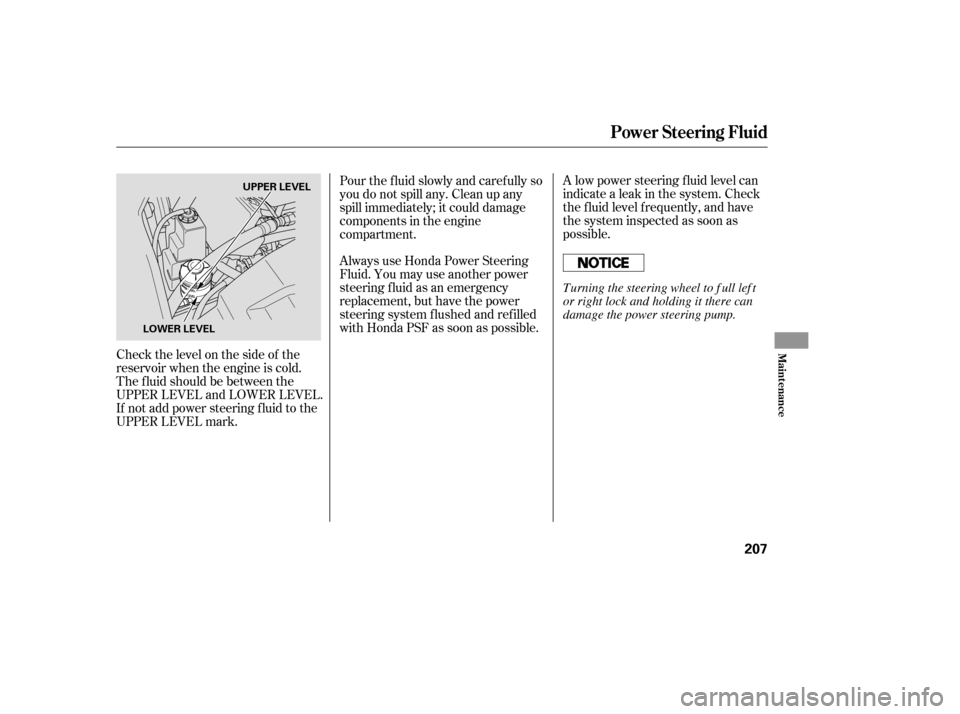
Check the level on the side of the
reservoir when the engine is cold.
The f luid should be between the
UPPER LEVEL and LOWER LEVEL.
If not add power steering f luid to the
UPPER LEVEL mark.A low power steering f luid level can
indicate a leak in the system. Check
the f luid level f requently, and have
the system inspected as soon as
possible.
Always use Honda Power Steering
Fluid. You may use another power
steering f luid as an emergency
replacement, but have the power
steering system f lushed and ref illed
with Honda PSF as soon as possible. Pour the f luid slowly and caref ully so
you do not spill any. Clean up any
spill immediately; it could damage
components in the engine
compartment.
Power Steering Fluid
Maint enance
207
UPPER LEVEL
LOWER LEVEL
T urning the steering wheel to f ull lef t
or right lock and holding it there can
damage the power steering pump.
Page 211 of 273
Remove the socket from the
headlight assembly by turning it
one-quarter turn counterclockwise.
To remove the f ront turn signal
bulb, push it in slightly and turn it
counterclockwise.
Install the new bulb into the
socket and reinstall it.Insert the socket back into the
headlight assembly. Turn it
clockwise to lock it in place.
Turn on the lights to make sure
the new bulb is working.
1. 4.
5.
3. 2.
Lights
Replacing a Front T urn Signal/
Parking L ight Bulb
Maint enance
209
Page 212 of 273
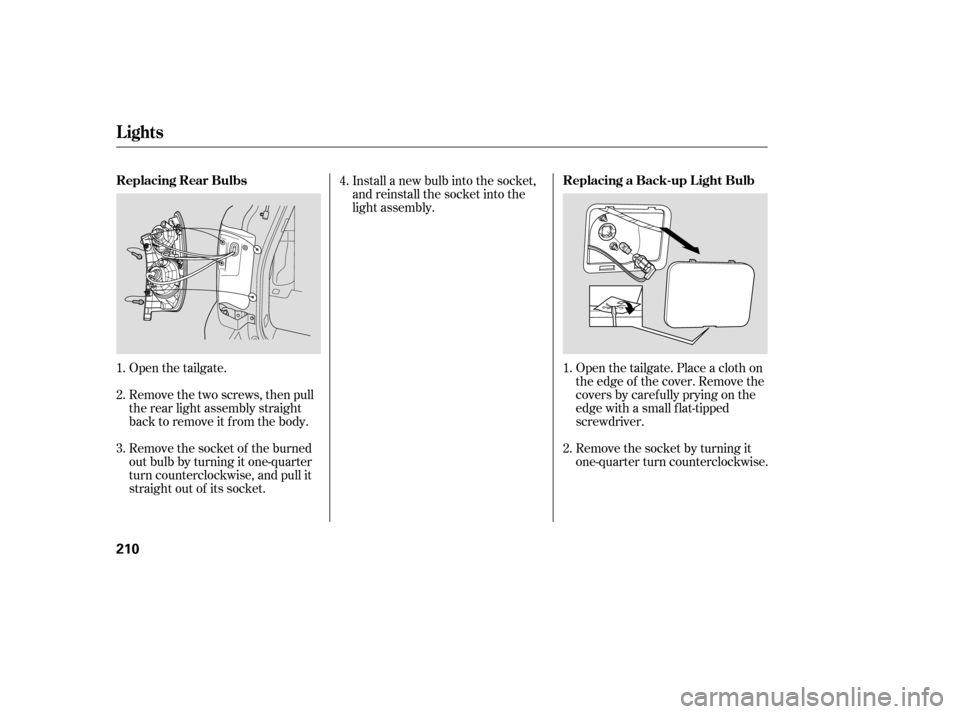
Open the tailgate.
Remove the two screws, then pull
the rear light assembly straight
back to remove it from the body.
Remove the socket of the burned
out bulb by turning it one-quarter
turn counterclockwise, and pull it
straight out of its socket.Install a new bulb into the socket,
and reinstall the socket into the
light assembly.
Open the tailgate. Place a cloth on
the edge of the cover. Remove the
covers by caref ully prying on the
edge with a small f lat-tipped
screwdriver.
Remove the socket by turning it
one-quarter turn counterclockwise.
1.
1.
2.
3. 2.
4.
Lights
Replacing Rear Bulbs
Replacing a Back-up L ight Bulb
210
Page 213 of 273
CONT INUED
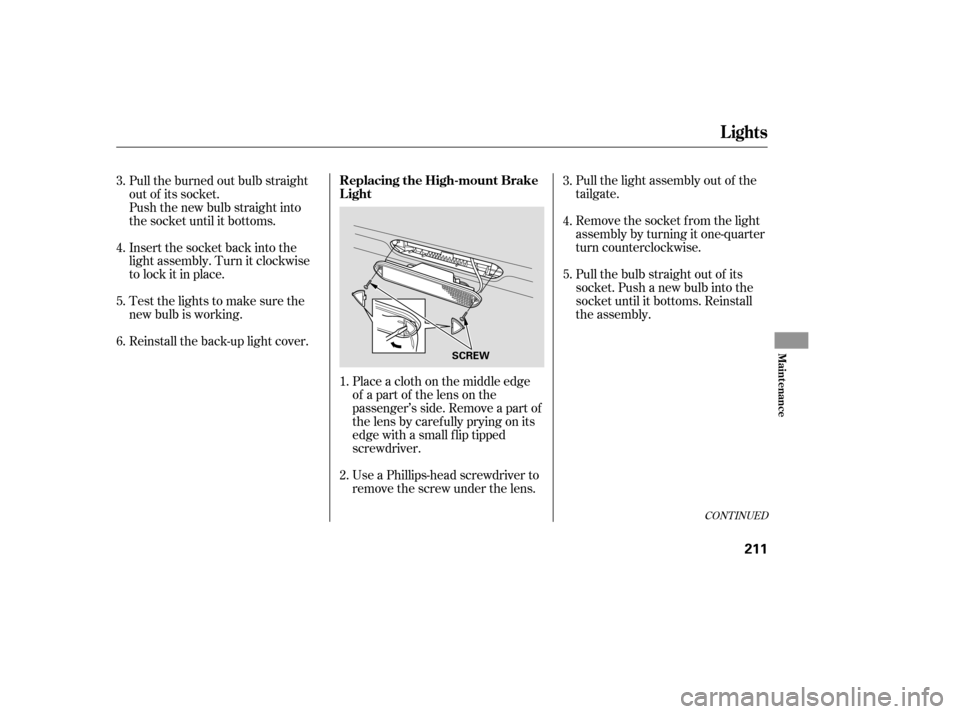
Pull the light assembly out of the
tailgate.
Remove the socket f rom the light
assembly by turning it one-quarter
turn counterclockwise.
Pull the bulb straight out of its
socket. Push a new bulb into the
socket until it bottoms. Reinstall
the assembly.
Use a Phillips-head screwdriver to
remove the screw under the lens. Place a cloth on the middle edge
of a part of the lens on the
passenger’s side. Remove a part of
the lens by caref ully prying on its
edge with a small f lip tipped
screwdriver.
Reinstall the back-up light cover. Testthelightstomakesurethe
new bulb is working. Pull the burned out bulb straight
out of its socket.
Push the new bulb straight into
the socket until it bottoms.
Insert the socket back into the
light assembly. Turn it clockwise
to lock it in place.
1. 4.
5. 3.
2.
4.
5.
6. 3.
Lights
Replacing the High-mount Brake
Light
Maint enance
211
SCREW
Page 214 of 273
Pull the burned out bulb straight
out of its socket.
Push the new bulb straight into
the socket until it bottoms.
Insert the socket back into the
headlight assembly. Turn it
clockwise to lock it in place.
Turn on the lights to make sure
the new bulb is working.
Put the inner f ender in place.
Install the f ive holding clips. Lock
each clip in place by pushing on
the center.
Pull the inner f ender cover away
f rom the f ender and bumper.
Remove the socket from the
headlight assembly by turning it
one-quarter turn counterclockwise.
If you are changing the bulb on
the driver’s side, start the engine,
turn the steering wheel all the way
to the right, and turn off the
engine. If you are changing the
bulb on the passenger’s side, turn
the steering wheel to the left.
Use a f lat-tipped screwdriver to
remove the f ive holding clips f rom
the inner f ender. 3.
4. 5.
6.
7.
8.
1.
2.
Lights
Replacing a Front Side Marker
Light Bulb
212
HOLDING CLIP