Page 335 of 414
Pour the f luid slowly and caref ully
so you do not spill any. Clean up
any spills immediately; it could
damage components in the engine
compartment.
Always use Honda ATF-Z1
(Automatic Transmission Fluid). If
it’s not available, you may use a
DEXRON
III automatic
transmission f luid as a temporary
replacement. However, continued
use can af f ect the shif t quality.
Have the transmission flushed and
ref illed with Honda ATF-Z1 as
soon as it is convenient.
Check the f luid level with the engine
at normal operating temperature.
Park the vehicle on level ground.
Shut of f the engine.
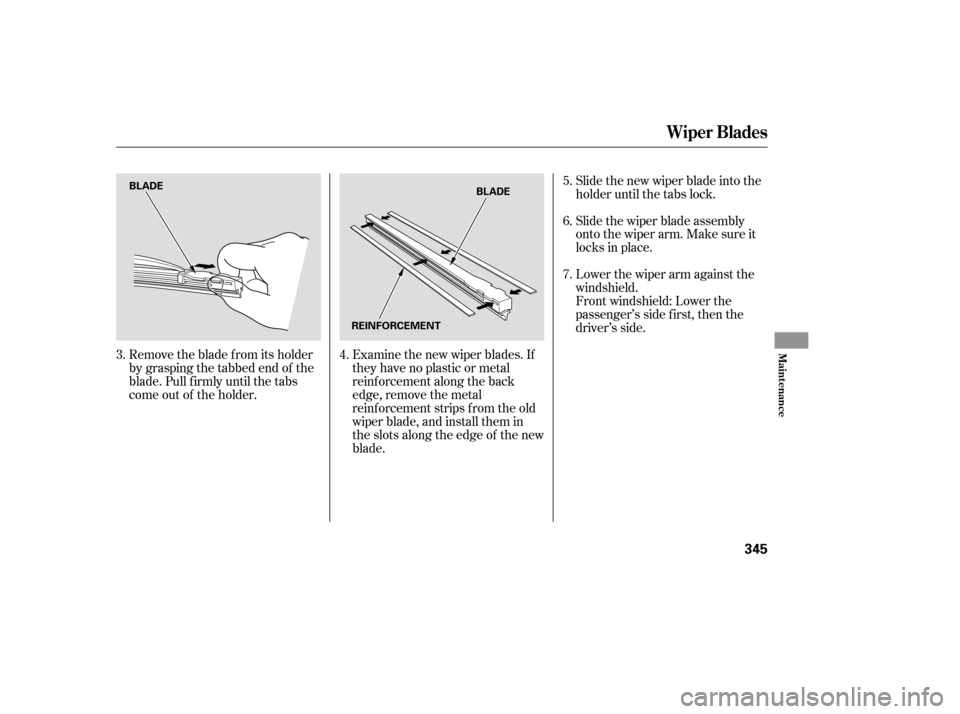
Remove the dipstick (yellow loop)
f rom the transmission, and wipe it
with a clean cloth. Insert the dipstick, all the way into
the transmission as shown.If the level is below the lower
mark, remove the f ill plug, and add
f luid to bring it to the upper mark.
Remove the dipstick, and check
the f luid level. It should be
between the upper and lower
marks. 5.
3.
4.
1.
2.
Automatic Transmission Fluid
334
DIPSTICK
UPPER MARKLOWER MARK
DIPSTICK
Page 339 of 414
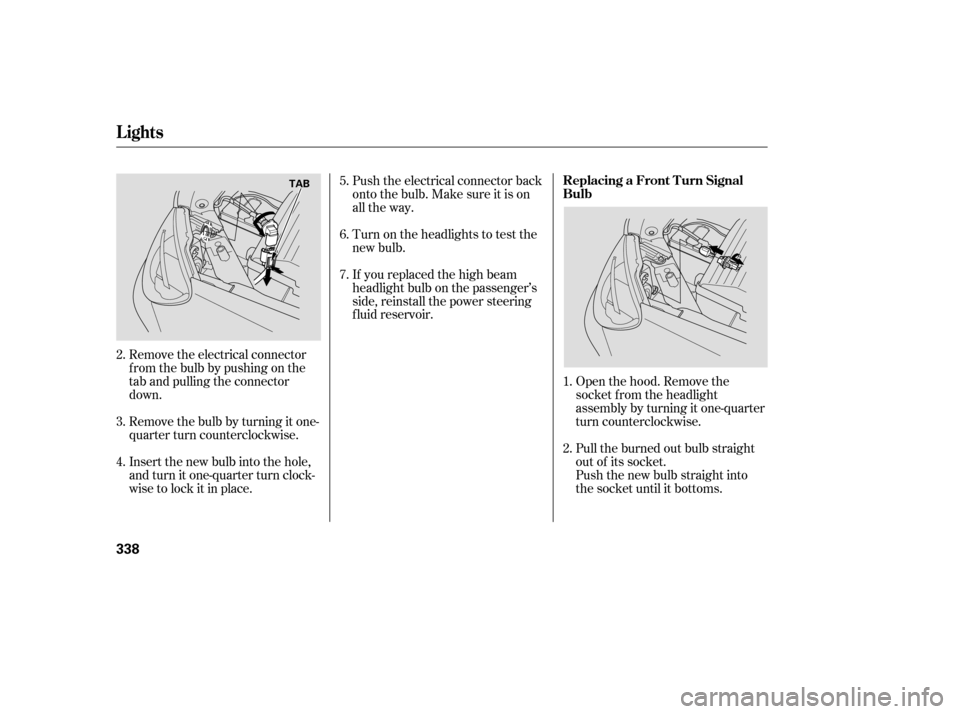
Remove the electrical connector
f rom the bulb by pushing on the
tab and pulling the connector
down.
Remove the bulb by turning it one-
quarter turn counterclockwise.Open the hood. Remove the
socket f rom the headlight
assembly by turning it one-quarter
turn counterclockwise.
Pull the burned out bulb straight
out of its socket.
Push the new bulb straight into
the socket until it bottoms.
Push the electrical connector back
onto the bulb. Make sure it is on
all the way.
Turn on the headlights to test the
new bulb.
If you replaced the high beam
headlight bulb on the passenger’s
side, reinstall the power steering
f luid reservoir.
Insert the new bulb into the hole,
and turn it one-quarter turn clock-
wise to lock it in place. 5.
6.
7.
2.
3.
4. 2. 1.
Lights
Replacing a Front T urn Signal
Bulb
338
TAB
Page 340 of 414
Insert the socket back into the
headlight assembly. Turn it
clockwise to lock it in place.
Turn on the lights to make sure
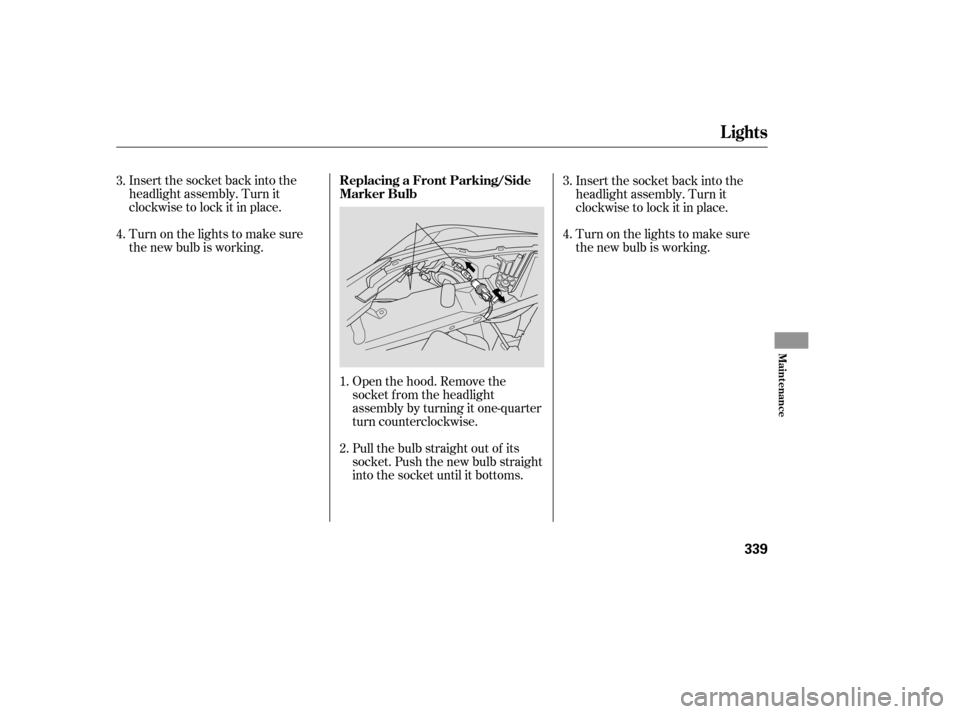
the new bulb is working.Open the hood. Remove the
socket f rom the headlight
assembly by turning it one-quarter
turn counterclockwise.
Pull the bulb straight out of its
socket. Push the new bulb straight
into the socket until it bottoms.Insert the socket back into the
headlight assembly. Turn it
clockwise to lock it in place.
Turn on the lights to make sure
the new bulb is working.
3.
4.
1.
2.
3.
4.
Lights
Replacing a Front Parking/Side
Marker Bulb
Maint enance
339
Page 341 of 414
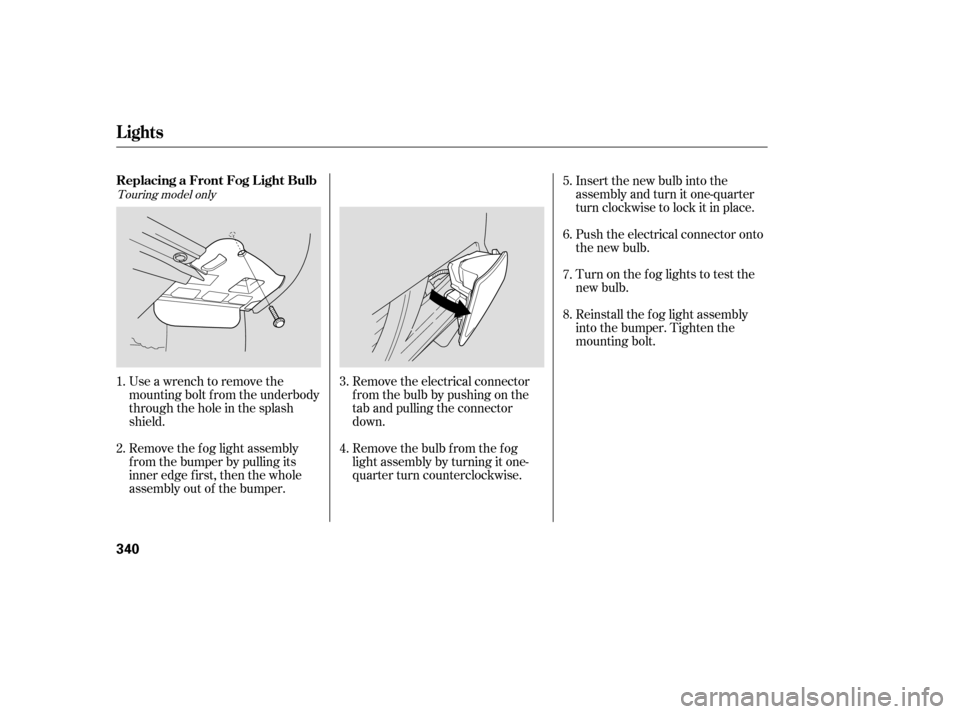
Use a wrench to remove the
mounting bolt f rom the underbody
through the hole in the splash
shield.
Remove the f og light assembly
f rom the bumper by pulling its
inner edge f irst, then the whole
assembly out of the bumper.Remove the electrical connector
f rom the bulb by pushing on the
tab and pulling the connector
down.
Remove the bulb f rom the f og
light assembly by turning it one-
quarter turn counterclockwise.Push the electrical connector onto
the new bulb.
Turn on the f og lights to test the
new bulb.
Reinstall the f og light assembly
into the bumper. Tighten the
mounting bolt. Insert the new bulb into the
assembly and turn it one-quarter
turn clockwise to lock it in place.
1.
2. 3.
4.5.
6.
7.
8.
Touring model only
Lights
Replacing a Front Fog L ight Bulb
340
Page 345 of 414
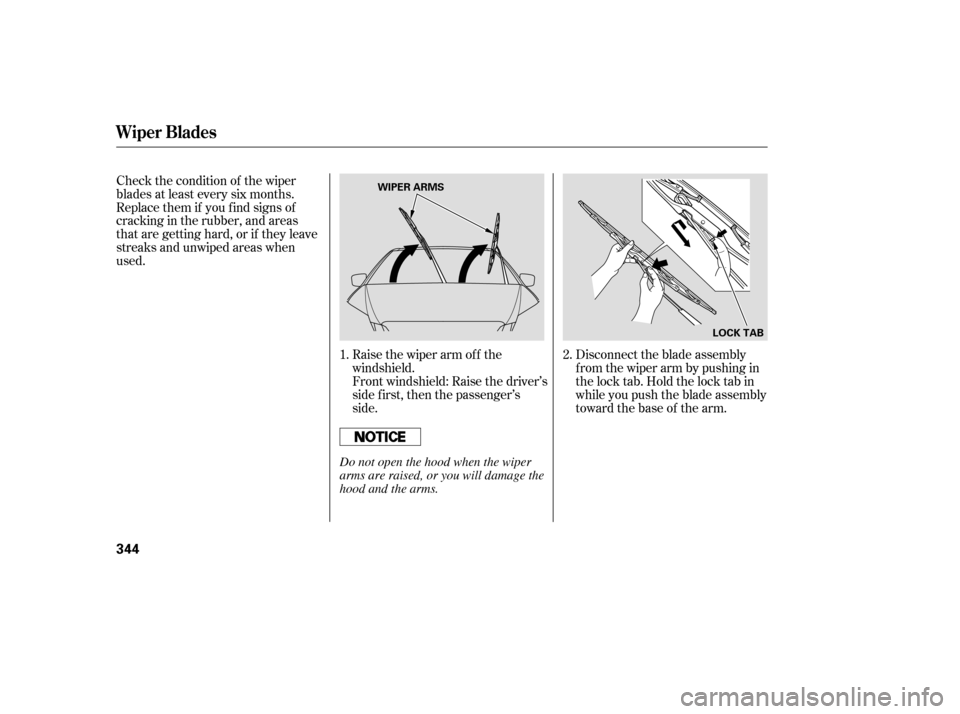
Disconnect the blade assembly
fromthewiperarmbypushingin
the lock tab. Hold the lock tab in
while you push the blade assembly
toward the base of the arm.
Check the condition of the wiper
blades at least every six months.
Replace them if you f ind signs of
cracking in the rubber, and areas
that are getting hard, or if they leave
streaks and unwiped areas when
used.
Raise the wiper arm of f the
windshield.
Front windshield: Raise the driver’s
side first, then the passenger’s
side.2.
1.
Wiper Blades
344
WIPER ARMS
LOCK TAB
Do not open the hood when the wiper
arms are raised, or you will damage the
hood and the arms.
Page 346 of 414
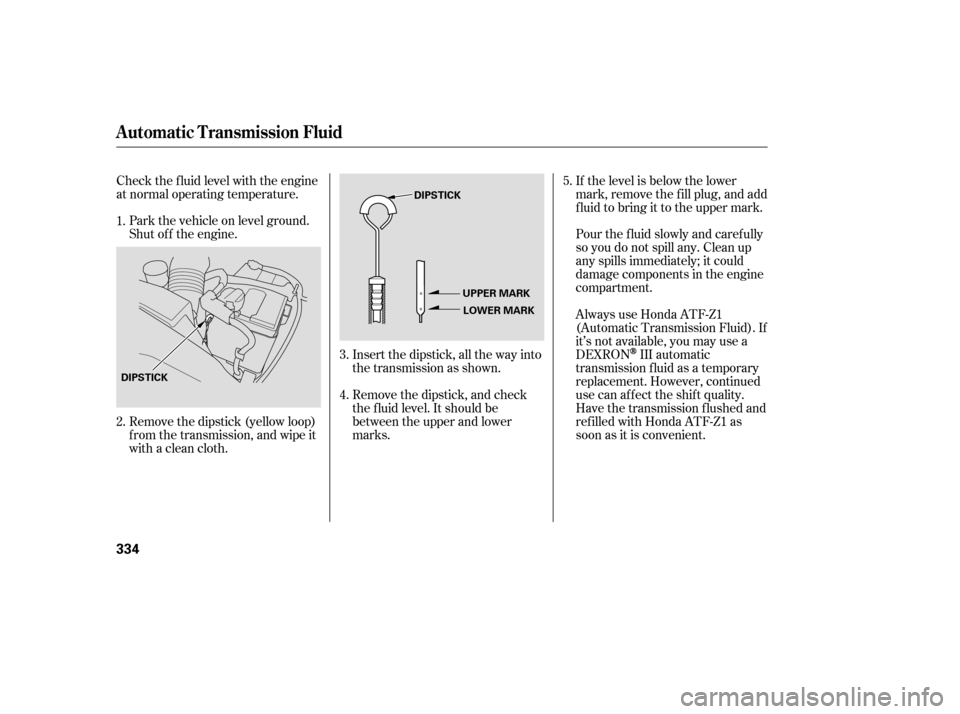
Remove the blade f rom its holder
by grasping the tabbed end of the
blade. Pull f irmly until the tabs
come out of the holder.Examine the new wiper blades. If
they have no plastic or metal
reinf orcement along the back
edge, remove the metal
reinf orcement strips f rom the old
wiper blade, and install them in
the slots along the edge of the new
blade.Slide the new wiper blade into the
holder until the tabs lock.
Slide the wiper blade assembly
onto the wiper arm. Make sure it
locks in place.
Front windshield: Lower the
passenger’s side f irst, then the
driver’s side. Lower the wiper arm against the
windshield.
6.
7.
4. 5.
3.
Wiper Blades
Maint enance
345
BLADE BLADE
REINFORCEMENT
Page 347 of 414
To saf ely operate your vehicle, your
tires must be the proper type and
size, in good condition with adequate
tread, and correctly inf lated.
The f ollowing pages give more
detailed inf ormation on how to take
care of your tires and what to do
when they need to be replaced.Keeping the tires properly inf lated
provides the best combination of
handling, tread lif e, and riding
comf ort.
Underinf lated tires wear unevenly,
adversely affect handling and fuel
economy, and are more likely to
fail from being overheated.
Overinf lated tires can make your
vehicleridemoreharshly,are
more prone to damage f rom road
hazards, and wear unevenly.
The tire pressure monitoring system
(TPMS) warns you when a tire
pressure is low. See page f or
more inf ormation.
We recommend that you visually
check your tires every day. If you
think a tire might be low, check it
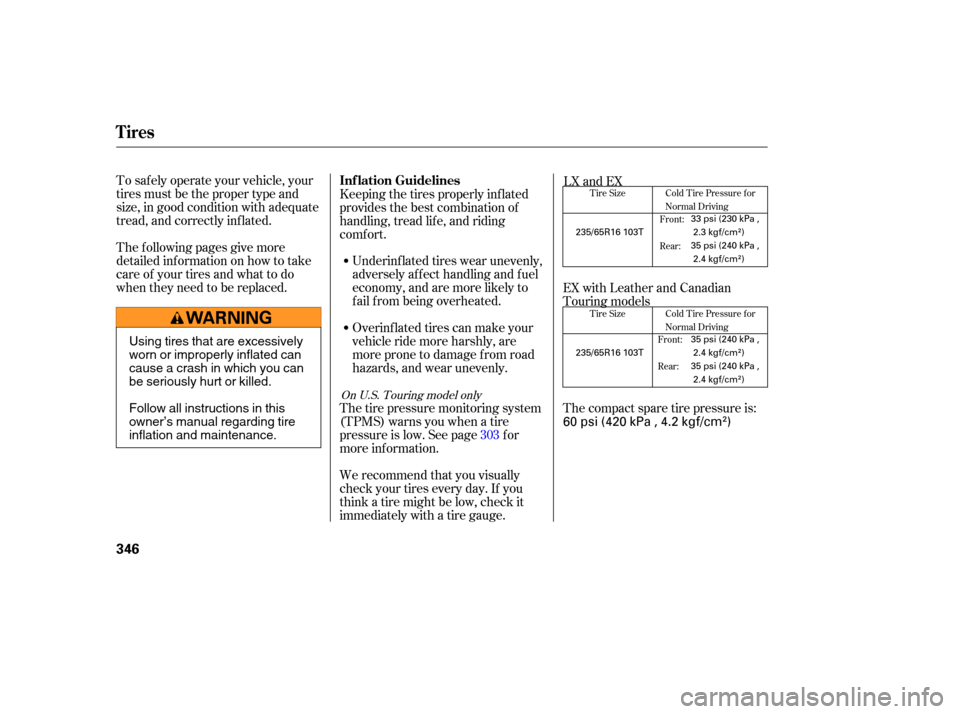
immediately with a tire gauge. Thecompactsparetirepressureis:
303 LX and EX
EX with Leather and Canadian
Touring modelsTire Size
Tire Size Cold Tire Pressure for
Normal Driving
Front:
Rear:
Cold Tire Pressure for
Normal Driving
Front:
Rear:
On U.S. Touring model only
Tires
Inf lation Guidelines
346
235/65R16 103T 33 psi (230 kPa ,
2.3 kgf/cm)
35 psi (240 kPa , 2.4 kgf/cm
)
235/65R16 103T 35 psi (240 kPa ,
2.4 kgf/cm
)
35 psi (240 kPa , 2.4 kgf/cm
)
60 psi (420 kPa , 4.2 kgf/cm)
Using tires that are excessively
worn or improperly inflated can
cause a crash in which you can
be seriously hurt or killed.
Follow all instructions in this
owner’s manual regarding tire
inflation and maintenance.
Page 348 of 414

CONT INUED
Excessive tread wear. Cuts, splits, or cracks in the side
of the tire. Replace the tire if you
can see f abric or cord.
Youshouldgetyourowntire
pressure gauge and use it whenever
you check your tire pressures. This
will make it easier f or you to tell if a
pressure loss is due to a tire problem
and not due to a variation between
gauges.
Bumps or bulges in the tread or
side of the tire. Replace the tire if
youfindeitherof theseconditions.
Every time you check inf lation, you
should also examine the tires for
damage, f oreign objects, and wear.
Youshouldlookfor:
If you check the pressure when the
tires are hot [driven f or several miles
(kilometers)], you will see readings 4
to6psi(30to40kPa,0.3to
0.4 kgf /cm ) higher than the cold
reading. This is normal; do not
release air to match the cold
pressure. The tires will be
underinf lated.
Tubeless tires have some ability to
self -seal if they are punctured. You
should look closely f or punctures if a
tire starts losing pressure.
For convenience, the recommended
tire sizes and cold air pressures are
on a label on the driver’s doorjamb.
Tire pressure f or high speed driving
is the same as f or normal driving.
For additional technical inf ormation,
see page .
Use a gauge to measure the air
pressure at least once a month. Even
tires that are in good condition may
lose one to two psi (10 to 20 kPa, 0.1
to 0.2 kgf /cm ) per month.
Remember to check the spare tire at
thesametime. Check the air pressures when the
tires are cold. This means the
vehicle has been parked f or at least
three hours, or driven less than 1
mile (1.6 km). Add or release air, if
needed, to match the recommended
cold tire pressures.
390
U.S. Touring model
Tire Size Cold Tire Pressure for
Normal Driving
Front:
Rear:
Tires
Tire Inspection
Maint enance
347
235-710R460A
104T 33 psi (230 kPa ,
2.3 kgf/cm)
35 psi (240 kPa , 2.4 kgf/cm
)