Page 5 of 414
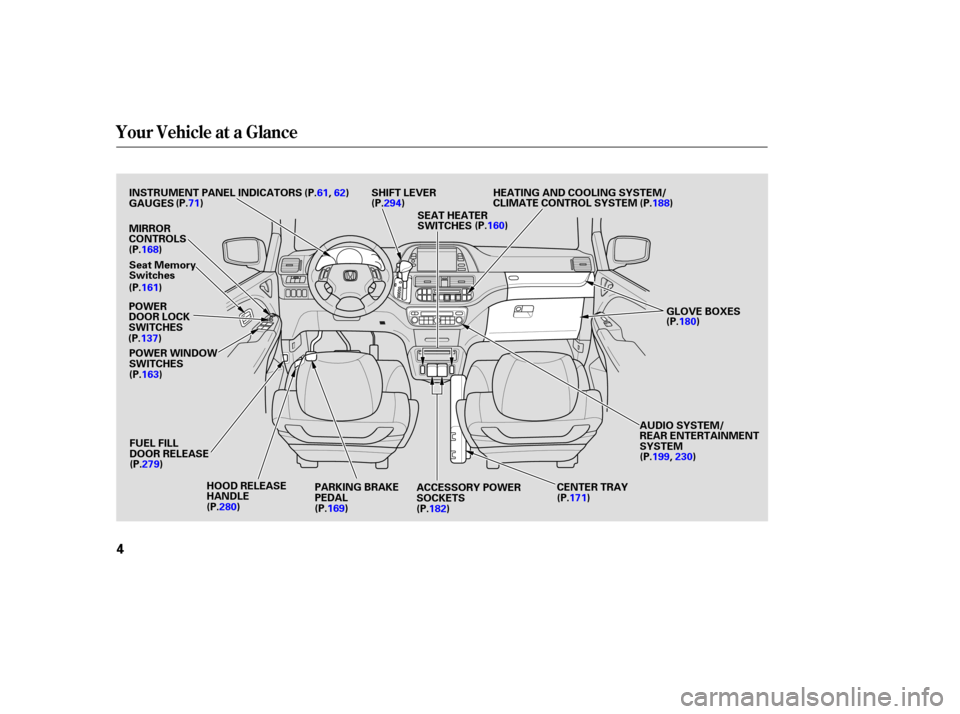
Your Vehicle at a Glance
4
AUDIO SYSTEM/
REAR ENTERTAINMENT
SYSTEM
PARKING BRAKE
PEDAL
FUEL FILL
DOOR RELEASE
HOOD RELEASE
HANDLE
POWER WINDOW
SWITCHES
POWER
DOOR LOCK
SWITCHES INSTRUMENT PANEL INDICATORS
GAUGES SHIFT LEVER
CLIMATE CONTROL SYSTEM
MIRROR
CONTROLS
ACCESSORY POWER
SOCKETS
(P.61,
62)
(P.71)
(P.137)
(P.182)(P.171)(P.180)
HEATING AND COOLING SYSTEM/
(P.188)
(P.279) (P.280) (P.199,
230)
(P.294)
CENTER TRAY
(P.168)
(P.163)
(P.169)SEAT HEATER
SWITCHES
(P.160)
Seat Memory
Switches
(P.161)
GLOVE BOXES
Page 57 of 414

Your vehicle’s exhaust contains
carbon monoxide gas. You should
have no problem with carbon
monoxide entering the vehicle in
normal driving if you maintain your
vehicle properly.High levels of carbon monoxide can
collect rapidly in enclosed areas,
such as a garage. Do not run the
engine with the garage door closed.
Even with the door open, run the
engine only long enough to move the
vehicle out of the garage.With the tailgate open, air flow can
pull exhaust gas into your vehicle’s
interior and create a hazardous
condition. If you must drive with the
tailgate open, open all the windows
and set the heating and cooling
system/climate control system as
shown below.
Have the exhaust system inspected
f or leaks whenever:
If you must sit in your parked vehicle,
even in an unconfined area, adjust
the heating and cooling system/
climate control system as f ollows:
Select the f resh air mode.
Select the mode.
Turn the f an on high speed.
Set the temperature control to a
comfortable setting.
The vehicle is raised f or an oil
change.
You notice a change in the sound
of the exhaust.
The vehicle was in an accident
that may have damaged the
underside.
1.
2.
3.
4.
Carbon Monoxide Hazard
56
Carbon monoxide gas is toxic.
Breathing it can cause
unconsciousness and even kill
you.
Avoid any enclosed areas or
activities that expose you to
carbon monoxide.
Page 61 of 414
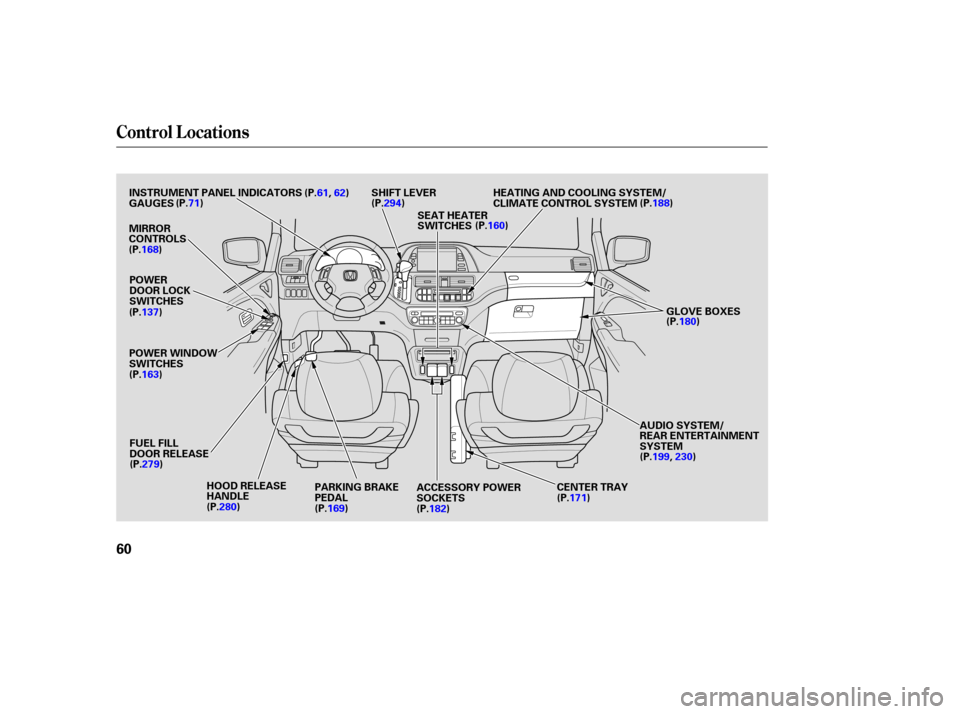
Control L ocations
60
AUDIO SYSTEM/
REAR ENTERTAINMENT
SYSTEM
PARKING BRAKE
PEDAL
FUEL FILL
DOOR RELEASE
HOOD RELEASE
HANDLE
POWER WINDOW
SWITCHES
POWER
DOOR LOCK
SWITCHES
INSTRUMENT PANEL INDICATORS
SHIFT LEVER
MIRROR
CONTROLS
ACCESSORY POWER
SOCKETS
(P.61,
62)
GAUGES (P.71)
(P.137)
(P.279) (P.280) (P.182)(P.171)(P.199,
230)
(P.180)
(P.188)
HEATING AND COOLING SYSTEM/
CLIMATE CONTROL SYSTEM
(P.294)
CENTER TRAY
(P.168)
(P.163)
(P.169)SEAT HEATER
SWITCHES
(P.160)
GLOVE BOXES
Page 72 of 414

This shows how much f uel you have.
It may show slightly more or less
than the actual amount. The needle
returns to the bottom after you turn
of f the ignition. This shows the temperature of the
engine’s coolant. During normal
operation, the pointer should rise to
about the middle of the gauge. In
severe driving conditions, the pointer
may rise to the upper zone. If it
reaches the red (hot) mark, pull
safely to the side of the road. For
instructions and precautions on
checking the engine’s cooling
system, see page .369
Temperature Gauge
Fuel Gauge
Gauges
Inst rument s and Cont rols
71
SPEEDOMETER
FUEL GAUGE
SPEEDOMETER
ODOMETER/OUTSIDE
TEMPERATURE TEMPERATURE
GAUGE
FUEL GAUGE
MULTI-INFORMATION
DISPLAY TEMPERATURE
GAUGE
TACHOMETER
TACHOMETER TRIP METER
LX and EX models
Touring model TRIP METER
SELECT/RESET
KNOB
TRIP METER SELECT/
RESET KNOB
Avoid driving with an extremely low
f uel level. Running out of f uel could
cause the engine to misf ire, damaging
the catalytic converter.
Page 182 of 414
Open the center pocket by pulling
thehandle.Closeitwithafirmpush.On vehicles without navigation
system, there is another pocket
under the heating and cooling
system control panel. Pull the handle
to open it. Close it with a f irm push.
Center Pocket
Interior Convenience Items
Inst rument s and Cont rols
181
Vehicles without RES
Vehicles with RES
Page 190 of 414

�Û
�Ý
�Û�Ý
Turn the dial clockwise to increase
the fan speed and airflow. Turn the
dial counterclockwise to decrease it.
Press the button to increase
the fan speed and airflow. Press the button to decrease it.
Turning this dial clockwise increases
the temperature of the airflow.
The driver’s side temperature and
the passenger’s side temperature can
be set separately. On the Touring
model, the rear passenger
compartment temperature can also
be set separately. Press the top ( )
of the appropriate temperature
control button to increase the
temperature of airflow. Press the bottom ( ) of the button to
decrease it. Each set temperature is
shown in the display. When you turn
the A/C off, the system cannot
regulate the inside temperature if
you set the temperature control
below the outside temperature.
When you set the temperature to its
lower limit or its upper limit, it will be
displayed as ‘‘Lo’’ or ‘‘Hi’’.
When you press this button, the
indicator in the button comes on, and
the passenger’s side temperature
(and the temperature of the rear
passenger compartment on the
Touring model) is synchronized to
the driver’s side set temperature.
Changing the passenger’s side
temperature (or the temperature of
the rear passenger compartment on
the Touring model) makes the
indicator to go of f , and takes thesystem out of SYNC mode.
This button turns the air
conditioning on and of f . On the LX
model, the indicator in the button is
on when the A/C is on. On the EX
and Touring models, you will see
A/C ON or A/C OFF in the display.
The outside air intakes f or the
heating and cooling system are at
the base of the windshield. Keep this
area clear of leaves and other debris. When the indicator in the button is
on, air f rom the vehicle’s interior is
sent throughout the system again.
When the indicator is off, air is
brought in f rom the outside of the
vehicle (fresh air mode).
CONT INUED
LX model
LX modelEX and Touring models
EX and Touring models
On EX and Touring models
Vents, Heating, and A/C
Fan Control
T emperature Control Air Conditioning (A/C) Button
Recirculation Button
SYNC Button
Features
189
Page 194 of 414

If you set the temperature to its
lower or its upper limit, the system
runs at f ull cooling or heating only. It
does not regulate the interior
temperature.
Press the Auto button. The
indicator in the button comes on.
Set the desired temperature with
the temperature control button.
You will see AUTO in the system’s
display. You can set the driver’s
side temperature and passenger’s
side temperature (and the
temperature of the rear passenger
compartment on the Touring
model) separately. The system
automatically selects the proper
mix of conditioned and/or heated
air that will, as quickly as possible,
raise or lower the interior
temperature to your pref erence.
The automatic climate control
system adjusts the f an speed and
airflow levels to maintain the interior
temperature you select.
When you press a f an control button,
the fan is taken out of AUTO mode.
You can manually select various
f unctions of the climate control
system when it is in f ully automatic
mode. All other f eatures remain
automatically controlled. Making any
manual selection causes the word
AUTO in the display to go out.Turn the f an speed and temperature
control dials all the way to the lef t,
and turn the rear controller dial to
OFF position.
To keep stale air and mustiness
f rom collecting, you should have
the f an running at all times. Keep the system completely of f
f or short periods only.
Press the OFF button and REAR
button (indicator is of f ).
1.
2.
LX model
EX and Touring models
EX, and Touring models
Vents, Heating, and A/C
Using A utomatic Climate Control
T o T urn Everything Of f
Semi-automatic Operation
Features
193
Page 312 of 414

When preparing to tow, and bef ore
driving away, be sure to check the
f ollowing:The vehicle has been properly
serviced, and the tires, brakes,
suspension, cooling system, and
lights are in good operating
condition.
The trailer has been properly
serviced and is in good condition.
All weights and loads are within
limits.
Thehitch,safetychains,andany
other attachments are secure. All items in or on the trailer are
properly secured and cannot shif t
while you drive.
Your vehicle tires and spare are
properly inf lated, and the trailer
tires and spare are inf lated as
recommended by the trailer
maker.
The added weight, length, and
height of a trailer will af f ect your
vehicle’s handling and perf ormance,
so driving with a trailer requires
some special driving skills and
techniques.
Foryoursafetyandthesafetyof
others,taketimetopracticedriving
maneuvers bef ore heading f or the
open road, and f ollow the guidelines
below.
Drive slower than normal in all
driving situations, and obey posted
speed limits f or vehicles with trailers.
Use the D position when towing a
trailer on level roads. Do not exceed
55 mph (88 km/h). At higher speeds,
the trailer may sway or affect vehicle
handling.
Towing a Trailer
Pre-T ow Checklist
Driving Saf ely With a T railer
T owing Speeds and Gears
Driving
311