Page 1 of 226
Your Vehicle at a Glance
Your Vehicle at a Glance
3
POWER WINDOW
SWITCHESHOOD RELEASE
HANDLE HEATING/COOLING CONTROLS
A/T model is shown. AUTOMATIC TRANSMISSION
MANUAL TRANSMISSION
GAUGES
POWER
DOOR LOCK
MASTER
SWITCH INSTRUMENT PANEL INDICATORS (P. 51)
(P. 58) (P.9,22)FRONT AIRBAGS
(P. 69)
(P. 78)
FUEL FILL DOOR RELEASE
HANDLE
(P. 123)
TRUNK RELEASE HANDLE
(P. 70) (P. 124)(P. 138)
(P. 136) (P. 88)
�����—�����—�����y�
���������
���y���
�(���%�������y���������y
Page 2 of 226
Your Vehicle at a Glance
4
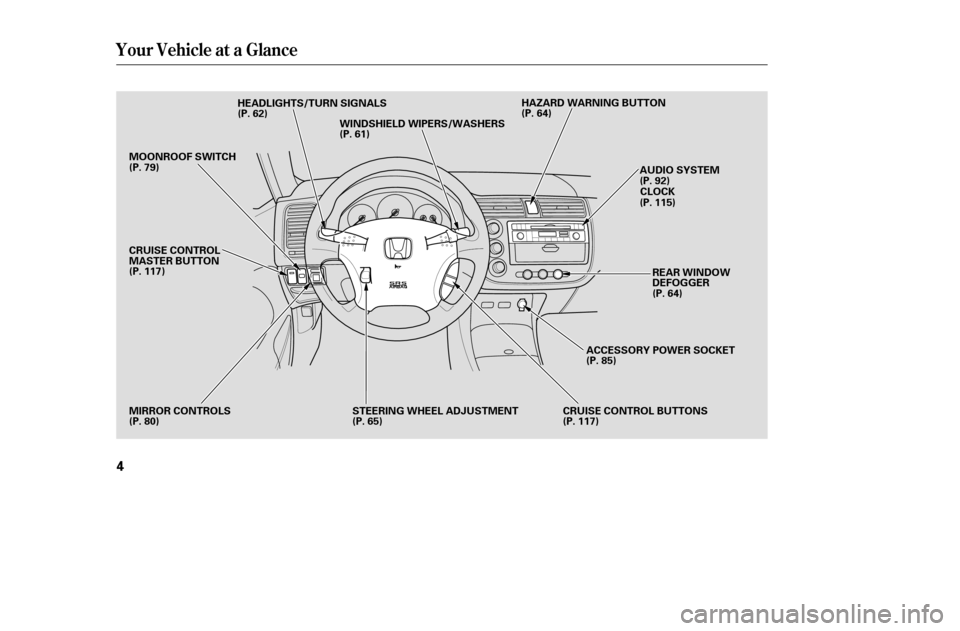
HEADLIGHTS/TURN SIGNALS
MIRROR CONTROLS CRUISE CONTROL BUTTONSREAR WINDOW
DEFOGGER
WINDSHIELD WIPERS/WASHERS
AUDIO SYSTEM
STEERING WHEEL ADJUSTMENT HAZARD WARNING BUTTON
MOONROOF SWITCH
(P. 79)
CRUISE CONTROL
MASTER BUTTON
(P. 117)
(P. 80) (P. 62)
(P. 61) (P. 64)
(P. 92)CLOCK
(P. 115)
(P. 64)
ACCESSORY POWER SOCKET
(P. 85)
(P. 117)
(P. 65)
�����—�����—�����y�
�������������y���
�(���%�������y���������y
Page 4 of 226
Your vehicle is equipped with many
features that work together to
protect you and your passengers
during a crash.
Some f eatures do not require any
action on your part. These include a
strong steel f ramework that f orms a
saf ety cage around the passenger
compartment; front and rear crush
zones; a collapsible steering column;
and tensioners that tighten the f ront
seat belts in a crash.
However, you and your passengers
can’t take f ull advantage of these
f eatures unless you remain sitting in
a proper position and. In fact, some safety
f eatures can contribute to injuries if
they are not used properly.
The f ollowing pages explain how you
cantakeanactiveroleinprotecting
yourself and your passengers.
Your Vehicle’s Saf ety Features
always wear
your seat belt s
Driver and Passenger Saf ety
7
(7) (11)(9) (2)
(8)
(6)
(4)
(3)
(1)
(7)
(5)
(2)
(10)
(8)
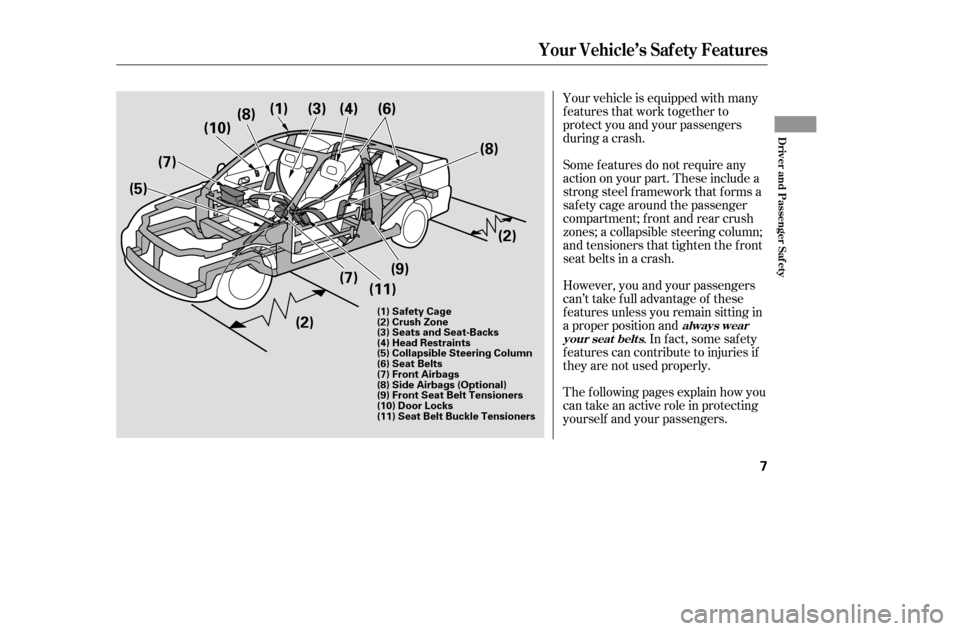
(1) Safety Cage
(2) Crush Zone
(3) Seats and Seat-Backs
(4) Head Restraints
(5) Collapsible Steering Column
(6) Seat Belts
(7) Front Airbags
(8) Side Airbags (Optional)
(9) Front Seat Belt Tensioners
(10) Door Locks
(11) Seat Belt Buckle Tensioners
�����—�����—�����y�
�������������y���
�(���%�������y�����
���y
Page 8 of 226
�µAf ter everyone has entered the
vehicle, be sure the doors are closed
and locked.
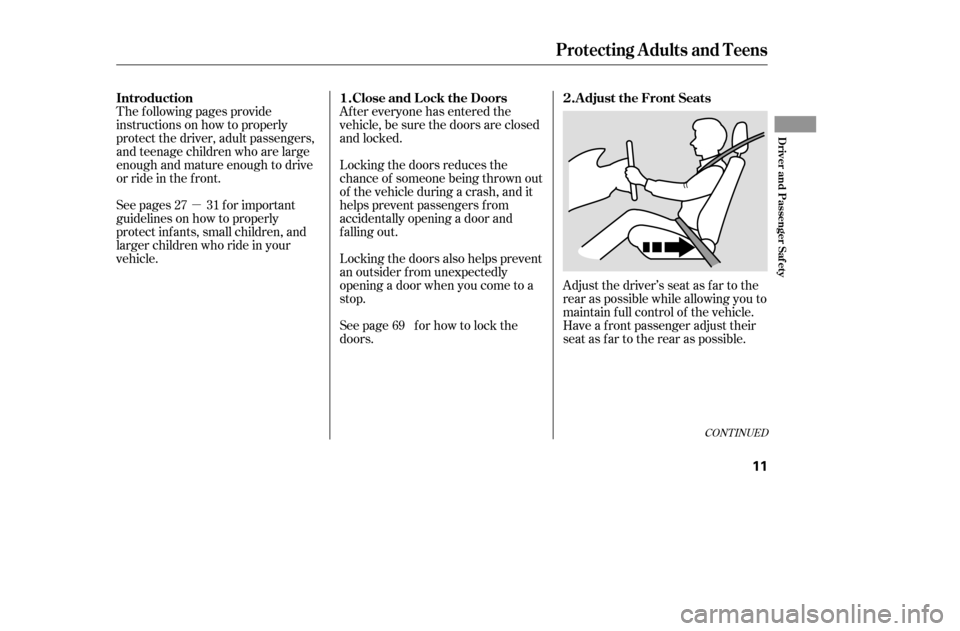
Adjust the driver’s seat as far to the
rear as possible while allowing you to
maintain f ull control of the vehicle.
Have a front passenger adjust their
seat as far to the rear as possible.
The f ollowing pages provide
instructions on how to properly
protect the driver, adult passengers,
and teenage children who are large
enough and mature enough to drive
or ride in the f ront.
See pages f or important
guidelines on how to properly
protect inf ants, small children, and
larger children who ride in your
vehicle.
Locking the doors reduces the
chance of someone being thrown out
of the vehicle during a crash, and it
helps prevent passengers f rom
accidentally opening a door and
f alling out.
Locking the doors also helps prevent
an outsider f rom unexpectedly
opening a door when you come to a
stop.
See page f or how to lock the
doors.
69
27 31
CONT INUED
Protecting A dults and Teens
Adjust the Front Seats
Close and L ock the Doors
Introduction 1. 2.
Driver and Passenger Saf ety
11
�����—�����—�����y�
�������������y���
�(���%�������y�����
���y
Page 9 of 226
If you sit too close to the steering
wheel or dashboard, you can be
seriously injured by an inf lating f ront
airbag, or by striking the steering
wheel or dashboard.
The National Highway Traffic Safety
Administration and Transport
Canada recommend that drivers
allow at least 10 inches (25 cm)
between the center of the steering
wheel and the chest.
If you cannot get f ar enough away
f rom the steering wheel and still
reach the controls, we recommend
that you investigate whether some
type of adaptive equipment may help.Once your seat is adjusted correctly,
rock it back and f orth to make sure
the seat is locked in position.
See page f or how to adjust the
f ront seats.
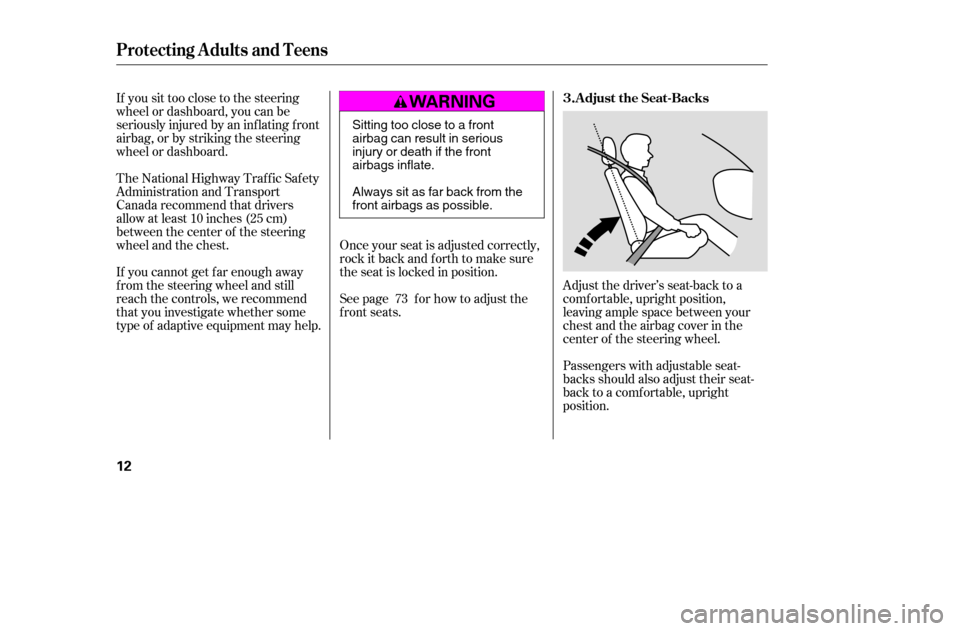
Adjust the driver’s seat-back to a
comf ortable, upright position,
leaving ample space between your
chest and the airbag cover in the
center of the steering wheel.
Passengers with adjustable seat-
backs should also adjust their seat-
back to a comf ortable, upright
position.
73
Protecting A dults and Teens
Adjust the Seat-Backs
3.
12
Sitting too close to a front
airbag can result in serious
injury or death if the front
airbags inflate.
Always sit as far back from the
front airbags as possible.
�����—�����—�����y�
�������������y���
�(���%�������y�����
���y
Page 15 of 226

Your seat belt system includes lap/
shoulder belts in all f ive seating
positions. The f ront seat belts are
also equipped with automatic seat
belt tensioners.The lap and shoulder belt goes over
your shoulder, across your chest,
and across your hips.
To fasten the belt, insert the latch
plate into the buckle, then tug on the
belt to make sure the buckle is
latched (see page f or how to
properly position the belt).
To unlock the belt, push the red
PRESSbuttononthebuckle.Guide
the belt across your body so that it
retracts completely. Af ter exiting the
vehicle, be sure the belt is out of the
way and will not get closed in the
door.All seat belts have an emergency
locking retractor. In normal driving,
the retractor lets you move f reely in
your seat while it keeps some
tension on the belt. During a collision
or sudden stop, the retractor
automatically locks the belt to help
restrain your body.
If the shoulder part of the belt is
pulled all the way out, the locking
mechanism will activate. The belt
will retract, but it will not allow the
passenger to move f reely.
The seat belts in all positions except
the driver’s have an additional
locking mechanism that must be
activated to secure a child seat (see
page ).
The seat belt system
includes an indicator on the
instrument panel and a beeper to
remind you to f asten your seat belt.
If you turn the ignition switch to ON
(II) bef ore f astening your seat belt,
the beeper will sound, and the
indicator will f lash. If you do not
f asten your seat belt bef ore the
beeper stops, the indicator will stop
f lashing but remain on.
If you continue driving without
f astening your seat belt, the beeper
will sound and the indicator will f lash
again at regular intervals. To deactivate the locking
mechanism, unlatch the buckle and
let the seat belt f ully retract. To
ref asten the seat belt, pull it out only
as f ar as needed.
14
38
Seat Belt System Components L ap/Shoulder Belt
Additional Inf ormation About Your Seat Belts
18
�����—�����—�����y�
�����������
�y���
�(���%�������y�������
�y
Page 28 of 226

�µ
Leaving children without
adult supervision is illegal in most
states and Canadian provinces,
and can be very hazardous.
For example, infants and small
childrenleftinavehicleonahot
day can die f rom heatstroke. A
child lef t alone with the key in the
ignition switch can accidentally set
the vehicle in motion, possibly
injuring themselves or others.
Children who play in vehicles can
accidentally get trapped inside.
Teach your children not to play in
or around vehicles. Know how to
operate the emergency trunk
opener and decide if your children
should be shown how to use this
feature(seepage ). Even very young
children learn how to unlock
vehicle doors, turn on the ignition
switch, and open the trunk, which
can lead to accidental injury or
death.
70
Protecting Children General Guidelines
Do not leave children alone in a vehicle.
Lock both doors and the trunkwhen your vehicle is not in use. K eep vehicle keys and remot e
transmitters out of the reach ofchildren.
Driver and Passenger Saf ety
31
�����—�����—�����y�
�������������y���
�(���%�������y���������y
Page 29 of 226
When properly installed, a rear-
f acing child seat may prevent the
driver or a f ront passenger f rom
moving the seat as far back as
recommended, or f rom locking the
seat-back in the desired position.
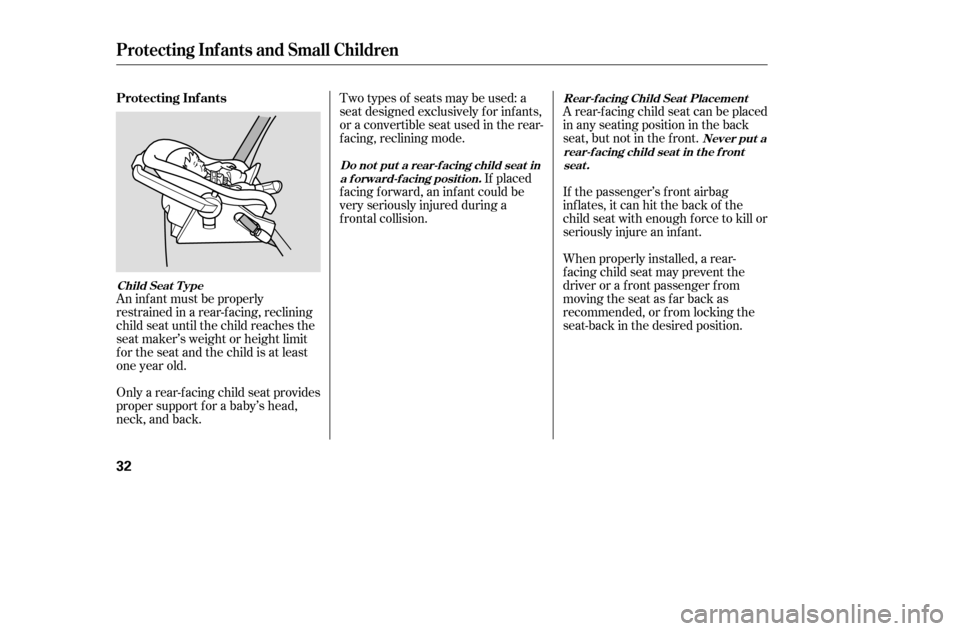
An inf ant must be properly
restrained in a rear-f acing, reclining
child seat until the child reaches the
seat maker’s weight or height limit
for the seat and the child is at least
one year old.
Only a rear-f acing child seat provides
proper support f or a baby’s head,
neck, and back. Two types of seats may be used: a
seat designed exclusively f or inf ants,
or a convertible seat used in the rear-
f acing, reclining mode.
If placed
f acing f orward, an inf ant could be
very seriously injured during a
f rontal collision. A rear-f acing child seat can be placed
in any seating position in the back
seat, but not in the f ront.
If the passenger’s f ront airbag
inflates, it can hit the back of the
child seat with enough f orce to kill or
seriously injure an inf ant.
Protecting Inf ants
Protecting Inf ants and Small Children
Child Seat T ype
Do not put a rear-f acing child seat in
a f orward-f acing position. Rear-f acing Child Seat Placement
Never put a
rear-f acing child seat in t he f ront seat .
32
�����—�����—�����y�
�������������y���
�(���%�������y���������y