2005 FORD TAURUS brakes
[x] Cancel search: brakesPage 145 of 248
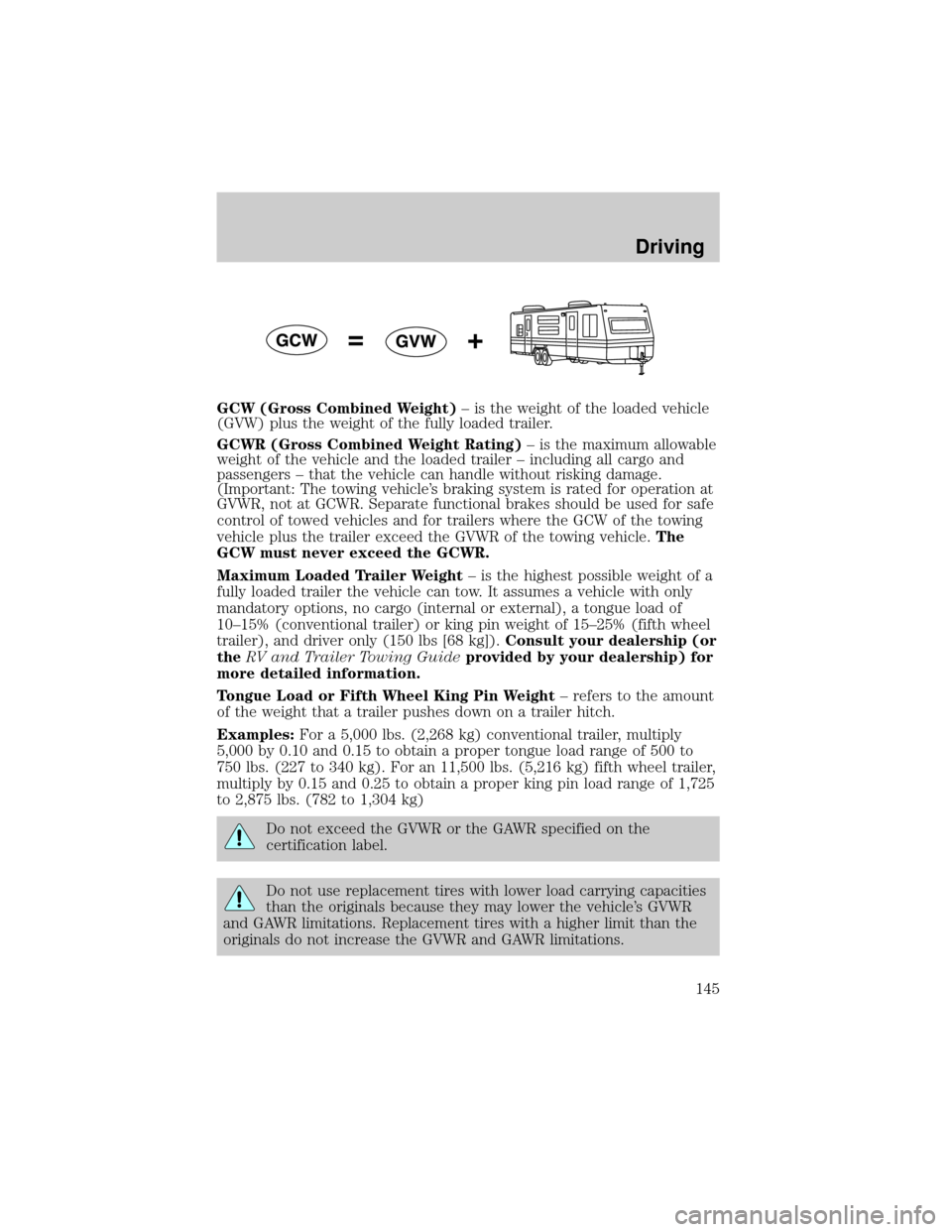
GCW (Gross Combined Weight)± is the weight of the loaded vehicle
(GVW) plus the weight of the fully loaded trailer.
GCWR (Gross Combined Weight Rating)± is the maximum allowable
weight of the vehicle and the loaded trailer ± including all cargo and
passengers ± that the vehicle can handle without risking damage.
(Important: The towing vehicle's braking system is rated for operation at
GVWR, not at GCWR. Separate functional brakes should be used for safe
control of towed vehicles and for trailers where the GCW of the towing
vehicle plus the trailer exceed the GVWR of the towing vehicle.The
GCW must never exceed the GCWR.
Maximum Loaded Trailer Weight± is the highest possible weight of a
fully loaded trailer the vehicle can tow. It assumes a vehicle with only
mandatory options, no cargo (internal or external), a tongue load of
10±15% (conventional trailer) or king pin weight of 15±25% (fifth wheel
trailer), and driver only (150 lbs [68 kg]).Consult your dealership (or
theRV and Trailer Towing Guideprovided by your dealership) for
more detailed information.
Tongue Load or Fifth Wheel King Pin Weight± refers to the amount
of the weight that a trailer pushes down on a trailer hitch.
Examples:For a 5,000 lbs. (2,268 kg) conventional trailer, multiply
5,000 by 0.10 and 0.15 to obtain a proper tongue load range of 500 to
750 lbs. (227 to 340 kg). For an 11,500 lbs. (5,216 kg) fifth wheel trailer,
multiply by 0.15 and 0.25 to obtain a proper king pin load range of 1,725
to 2,875 lbs. (782 to 1,304 kg)
Do not exceed the GVWR or the GAWR specified on the
certification label.
Do not use replacement tires with lower load carrying capacities
than the originals because they may lower the vehicle's GVWR
and GAWR limitations. Replacement tires with a higher limit than the
originals do not increase the GVWR and GAWR limitations.
Driving
145
Page 146 of 248
Exceeding any vehicle weight rating limitation could result in
serious damage to the vehicle and/or personal injury.
TRAILER TOWING
Your vehicle is classified as a light duty towing vehicle. The amount of
weight you can safely tow depends on the type of engine you have in
your vehicle. Your vehicle does not come from the factory fully equipped
to tow. No towing packages are available through Ford or
Mercury/Lincoln dealers. Do not tow a trailer until your vehicle has been
driven at least 800 km (500 miles). If towing with a station wagon, inflate
the rear tires to 35 psi.
Towing a trailer places an additional load on your vehicle's engine,
transaxle, brakes, tires and suspension. Inspect these components
carefully after towing.
In order to identify your vehicle's engine, refer toIdentifying
components in the engine compartmentin theMaintenance and
specificationschapter.
The amount of weight that you can tow depends on the type of engine in
your vehicle. See the following charts:
3.0L Engine
Model Passenger
Load - #/Lbs.
(kg)Luggage Load -
lbs. (kg)Max Trailer
Wt.- lbs. (kg)
Sedan 5/750 (340) 0 800 (365)
4/600 (270) 150 (70) 800 (365)
2/300 (135) 150 (70) 1100 (500)
2/300 (135) 0 1250 (565)
Wagon 4/600 (270) 0 800 (365)
2/300 (135) 150 (70) 950 (430)
2/300 (135) 0 1100 (500)
The above chart is based on the specified vehicle at a maximum GCW
(Vehicle weight + Trailer weight) equal to 4,950 lbs. (2,245 kg).
Do not exceed the GVWR or the GAWR specified on the
certification label.
Driving
146
Page 147 of 248
Towing trailers beyond the maximum recommended gross trailer
weight exceeds the limit of the vehicle and could result in
engine damage, transaxle damage, structural damage, loss of control,
and personal injury.
Preparing to tow
Use the proper equipment for towing a trailer and make sure it is
properly attached to your vehicle. See your dealer or a reliable trailer
dealer if you require assistance.
Hitches
Do not use hitches that clamp onto the vehicle bumper. Use a load
carrying hitch. You must distribute the load in your trailer so that
10±15% of the total weight of the trailer is on the tongue.
Safety chains
Always connect the trailer's safety chains to the frame or hook retainers
of the vehicle hitch. To connect the trailer's safety chains, cross the
chains under the trailer tongue and allow slack for turning corners.
If you use a rental trailer, follow the instructions that the rental agency
gives to you.
Do not attach safety chains to the bumper.
Trailer brakes
Electric brakes and manual, automatic or surge-type trailer brakes are
safe if installed properly and adjusted to the manufacturer's
specifications. The trailer brakes must meet local and Federal
regulations.
Do not connect a trailer's hydraulic brake system directly to your
vehicle's brake system. Your vehicle may not have enough
braking power and your chances of having a collision greatly increase.
The braking system of the tow vehicle is rated for operation at the
GVWR not GCWR.
Trailer lamps
Trailer lamps are required on most towed vehicles. Make sure all running
lights, brake lights, turn signals and hazard lights are working. See your
dealer or trailer rental agency for proper instructions and equipment for
hooking up trailer lamps.
Driving
147
Page 148 of 248

Driving while you tow
When towing a trailer:
²Turn off the speed control. The speed control may shut off
automatically when you are towing on long, steep grades.
²Consult your local motor vehicle speed regulations for towing a trailer.
²To eliminate excessive shifting, use a lower gear. This will also assist
in transaxle cooling.
²Anticipate stops and brake gradually.
Servicing after towing
If you tow a trailer for long distances, your vehicle will require more
frequent service intervals. Refer to yourScheduled Maintenance Guide
for more information.
Trailer towing tips
²Practice turning, stopping and backing up before starting on a trip to
get the feel of the vehicle trailer combination. When turning, make
wider turns so the trailer wheels will clear curbs and other obstacles.
²Allow more distance for stopping with a trailer attached.
²If you are driving down a long or steep hill, shift to a lower gear. Do
not apply the brakes continuously, as they may overheat and become
less effective.
²The trailer tongue weight should be 10±15% of the loaded trailer
weight.
²After you have traveled 50 miles (80 km), thoroughly check your
hitch, electrical connections and trailer wheel lug nuts.
²To aid in engine/transmission cooling and A/C efficiency during hot
weather while stopped in traffic, place the gearshift lever in P (Park).
²Vehicles with trailers should not be parked on a grade. If you must
park on a grade, place wheel chocks under the trailer's wheels.
RECREATIONAL TOWING
Follow these guidelines for your specific powertrain combination to tow
your vehicle with all four wheels on the ground (such as behind a
recreational vehicle).
These guidelines are designed to ensure that your transmission is not
damaged due to insufficient lubrication.
Driving
148
Page 216 of 248

BRAKE FLUID RESERVOIR
The fluid level will drop slowly as
the brakes wear, and will rise when
the brake components are replaced.
Fluid levels between the ªMINº and
ªMAXº lines are within the normal
operating range; there is no need to
add fluid. If the fluid levels are
outside of the normal operating
range the performance of your
brake system could be
compromised; seek service from
your dealer immediately.
TRANSMISSION FLUID
Checking automatic transmission fluid
Refer to yourScheduled Maintenance Guidefor scheduled intervals for
fluid checks and changes. Your transaxle does not consume fluid.
However, the fluid level should be checked if the transaxle is not working
properly, i.e., if the transaxle slips or shifts slowly or if you notice some
sign of fluid leakage.
Automatic transmission fluid expands when warmed. To obtain an
accurate fluid check, drive the vehicle until it is warmed up
(approximately 30 km [20 miles]). If your vehicle has been
operated for an extended period at high speeds, in city traffic
during hot weather or pulling a trailer, the vehicle should be
turned off for about 30 minutes to allow fluid to cool before
checking.
1. Drive the vehicle 30 km (20 miles) or until it reaches normal operating
temperature.
2. Park the vehicle on a level surface and engage the parking brake.
3. With the parking brake engaged and your foot on the brake pedal,
start the engine and move the gearshift lever through all of the gear
ranges. Allow sufficient time for each gear to engage.
4. Latch the gearshift lever in P (Park) and leave the engine running.
5. Remove the dipstick, wiping it clean with a clean, dry lint free rag. If
necessary, refer toIdentifying components in the engine compartment
in this chapter for the location of the dipstick.
6. Install the dipstick making sure it is fully seated in the filler tube.
Maintenance and Specifications
216
Page 243 of 248

A
Accessory delay ..........................49
Air bag supplemental restraint
system ........................108±109, 115
and child safety seats ............111
description ......................109, 115
disposal ....................................117
driver air bag ..........109, 111, 116
indicator light .........................115
operation .................109, 111, 116
passenger air bag ...109, 111, 116
side air bag ..............................115
Air cleaner filter .......................231
Air conditioning ..........................26
Antifreeze
(see Engine coolant) ................198
Anti-lock brake system
(see Brakes) ..............................135
Anti-theft system ........................86
arming the system ....................86
disarming a triggered system ..86
Audio system
(see Radio) ......................15±16, 19
Automatic transaxle
fluid, adding ............................216
fluid, checking ........................216
fluid, refill capacities ..............232
fluid, specification ..................235
Automatic transmission
driving an automatic
overdrive .................................140
Auxiliary power point .................48
Axle
lubricant specifications ..........234
B
Battery .......................................196acid, treating emergencies .....196
jumping a disabled battery ....165
maintenance-free ....................196
replacement, specifications ...231
servicing ..................................196
BeltMinder .................................103
Brakes ........................................134
anti-lock ...................................135
anti-lock brake system
(ABS) warning light ...............135
fluid, checking and adding ....216
fluid, refill capacities ..............232
fluid, specifications .........234±235
lubricant specifications ..234±235
parking ....................................136
shift interlock ..........................138
Bulbs ............................................35
C
Capacities for refilling fluids ....232
Cargo area shade ........................71
Cargo cover .................................70
Cargo net .....................................70
CD changer .................................21
CD-single premium .........15±16, 19
Cell phone use ............................68
Certification Label ....................238
Changing a tire .........................159
Child safety restraints ..............118
child safety belts ....................118
Child safety seats ......................120
attaching with tether straps ..125
in front seat ............................122
in rear seat ......................122, 124
Cleaning your vehicle
engine compartment ..............182
Index
Index
243
Page 246 of 248

K
Keyless entry system .................81
Keys
positions of the ignition .........130
L
Lamps
autolamp system .......................30
bulb replacement
specifications chart ..................35
daytime running light ...............30
headlamps .................................30
headlamps, flash to pass ..........31
instrument panel, dimming .....31
interior lamps .....................33±36
replacing bulbs .35, 37, 39±42, 44
Lane change indicator
(see Turn signal) ........................33
Liftgate ........................................69
Lights, warning and indicator ....10
anti-lock brakes (ABS) ..........135
Load limits .................................142
Locks
childproof ..................................74
doors ..........................................73
Lubricant specifications ...234±235
Lug nuts ....................................164
Luggage rack ...............................72
Lumbar support, seats ...............89
M
Message center .....................58±59
english/metric button ...............64
system check button ................64
warning messages .....................64
Mirrors ...................................48, 50automatic dimming rearview
mirror ........................................50
heated ........................................51
side view mirrors (power) .......50
Moon roof ....................................54
Motorcraft parts ................208, 231
O
Octane rating ............................207
Oil (see Engine oil) ..................192
Overdrive ...................................139
P
Parking brake ............................136
Parts (see Motorcraft parts) ....231
Passenger Occupant
Classification Sensor ...................93
Pedals (see Power adjustable
foot pedals) .................................51
Power adjustable foot pedals .....51
Power distribution box
(see Fuses) ...............................157
Power door locks ........................73
Power point .................................48
Power steering ..........................137
fluid, checking and adding ....214
fluid, refill capacity ................232
fluid, specifications .........234±235
Power Windows ...........................48
R
Radio ................................15±16, 19
Rear window defroster ...............28
Relays ........................................159
Index
246