2005 FORD TAURUS cooling
[x] Cancel search: coolingPage 24 of 248
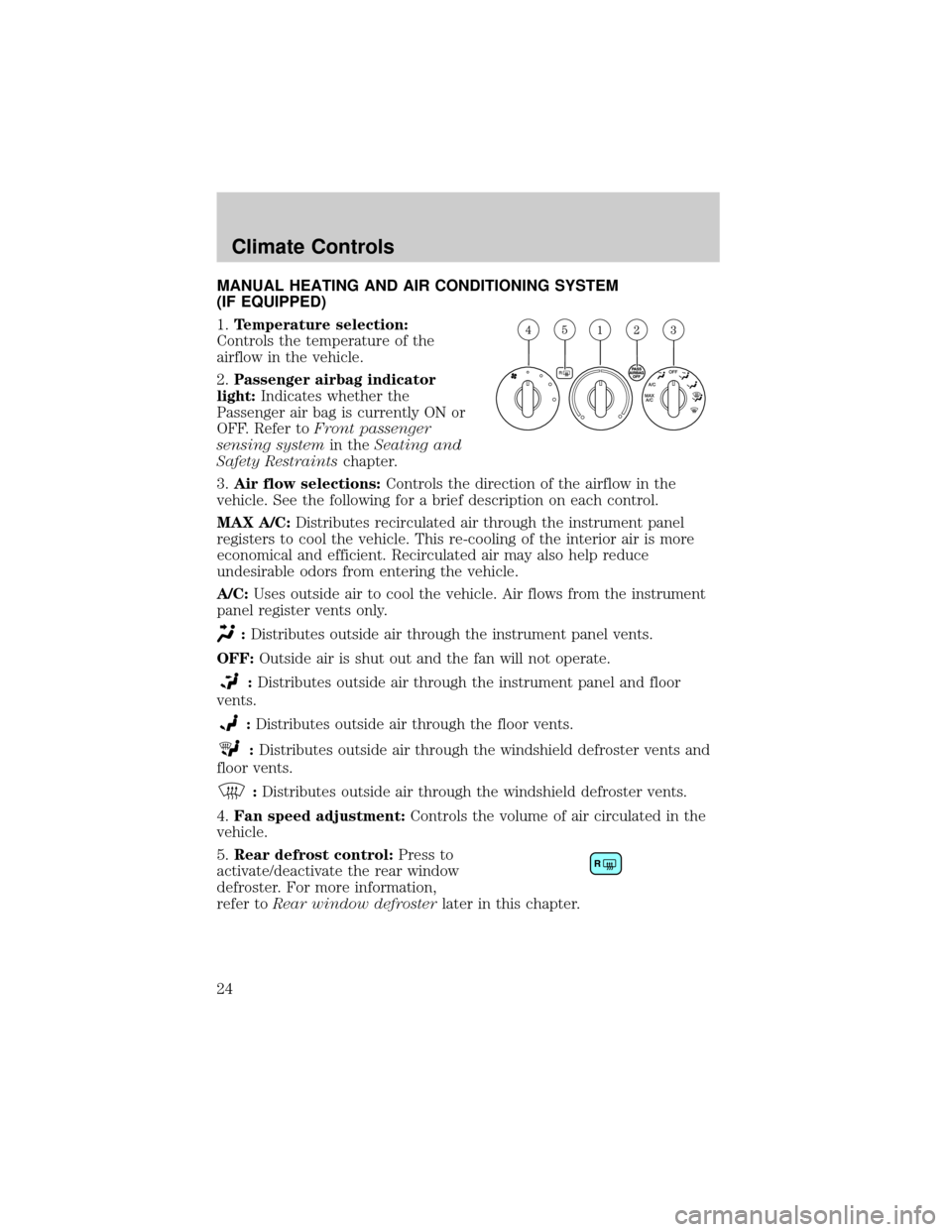
MANUAL HEATING AND AIR CONDITIONING SYSTEM
(IF EQUIPPED)
1.Temperature selection:
Controls the temperature of the
airflow in the vehicle.
2.Passenger airbag indicator
light:Indicates whether the
Passenger air bag is currently ON or
OFF. Refer toFront passenger
sensing systemin theSeating and
Safety Restraintschapter.
3.Air flow selections:Controls the direction of the airflow in the
vehicle. See the following for a brief description on each control.
MAX A/C:Distributes recirculated air through the instrument panel
registers to cool the vehicle. This re-cooling of the interior air is more
economical and efficient. Recirculated air may also help reduce
undesirable odors from entering the vehicle.
A/C:Uses outside air to cool the vehicle. Air flows from the instrument
panel register vents only.
:Distributes outside air through the instrument panel vents.
OFF:Outside air is shut out and the fan will not operate.
:Distributes outside air through the instrument panel and floor
vents.
:Distributes outside air through the floor vents.
:Distributes outside air through the windshield defroster vents and
floor vents.
:Distributes outside air through the windshield defroster vents.
4.Fan speed adjustment:Controls the volume of air circulated in the
vehicle.
5.Rear defrost control:Press to
activate/deactivate the rear window
defroster. For more information,
refer toRear window defrosterlater in this chapter.
Climate Controls
Climate Controls
24
Page 25 of 248

OPERATING TIPS
²To reduce fog build up on the windshield during humid weather, place
the air flow selector in the
position.
²To reduce humidity buildup within the cabin, do not drive with the
selector in the OFF or MAX A/C position.
²To improve A/C cool down, drive with the windows slightly open for
the first 2±3 minutes after starting the vehicle or until the vehicle has
ªaired out.º
²Do not put objects under the front seats that will interfere with the
airflow to the back seats.
²Remove any snow, ice or leaves from the air intake area at the base of
the windshield.
²For best cooling results when using the MAX A/C mode, move the
temperature control to full cold and initially set the fan to highest
speed, then adjust the temperature and fan to maintain comfort.
To aid in side window defogging/demisting in cold weather:
1. Select
.
2. Adjust the temperature control to maintain comfort.
3. Set the fan speed to the highest setting.
4. Direct the outer instrument panel vents towards the side windows.
To increase airflow to the outer instrument panel vents, close the vents
located in the middle of the instrument panel.
Do not place objects on top of the instrument panel as these
objects may become projectiles in a collision or sudden stop.
Climate Controls
25
Page 26 of 248
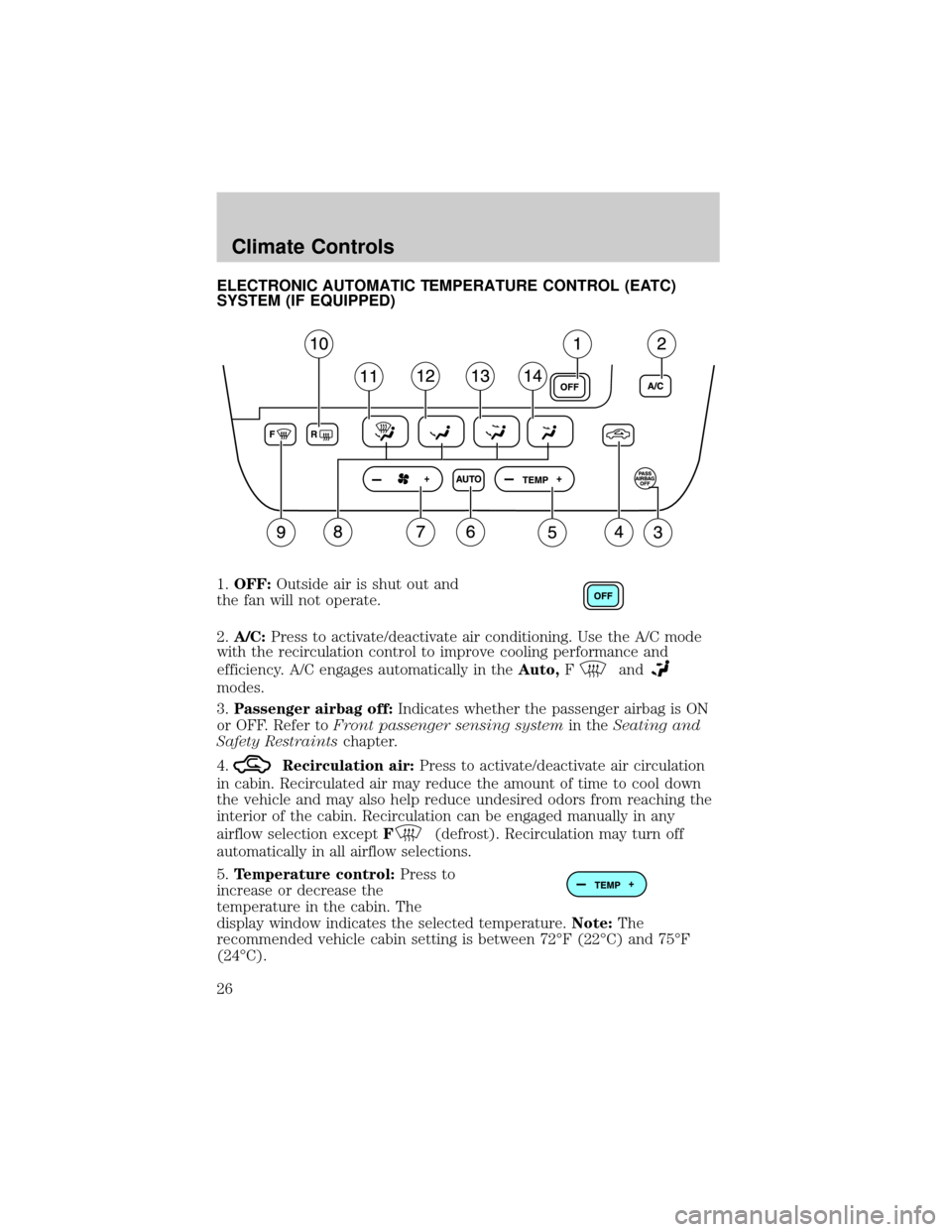
ELECTRONIC AUTOMATIC TEMPERATURE CONTROL (EATC)
SYSTEM (IF EQUIPPED)
1.OFF:Outside air is shut out and
the fan will not operate.
2.A/C:Press to activate/deactivate air conditioning. Use the A/C mode
with the recirculation control to improve cooling performance and
efficiency. A/C engages automatically in theAuto,F
and
modes.
3.Passenger airbag off:Indicates whether the passenger airbag is ON
or OFF. Refer toFront passenger sensing systemin theSeating and
Safety Restraintschapter.
4.
Recirculation air:Press to activate/deactivate air circulation
in cabin. Recirculated air may reduce the amount of time to cool down
the vehicle and may also help reduce undesired odors from reaching the
interior of the cabin. Recirculation can be engaged manually in any
airflow selection exceptF
(defrost). Recirculation may turn off
automatically in all airflow selections.
5.Temperature control:Press to
increase or decrease the
temperature in the cabin. The
display window indicates the selected temperature.Note:The
recommended vehicle cabin setting is between 72ÉF (22ÉC) and 75ÉF
(24ÉC).
Climate Controls
26
Page 28 of 248

²Do not put objects under the front seats that will interfere with the
airflow to the back seats.
²Remove any snow, ice or leaves from the air intake area at the base of
the windshield.
²For maximum cooling performance (MAX A/C), select AUTO and set
to desired temperature. In the manual override mode, press
, A/C
and
, then set the temperature to 60ÉF (16ÉC) and the fan to
the highest setting. To improve the A/C cool down of the vehicle
cabin, drive with the windows slightly open for the first 2±3 minutes
after starting the vehicle or until the vehicle has ªaired out.º
To aid in side window defogging/demisting in cold weather:
1. Select
.
2. Select A/C.
3. Adjust the temperature control to maintain comfort.
4. Set the fan speed to the highest setting.
5. Direct the outer instrument panel vents towards the side windows.
To increase airflow to the outer instrument panel vents, close the vents
located in the middle of the instrument panel.
Do not place objects on top of the instrument panel as these
objects may become projectiles in a collision or sudden stop.
REAR WINDOW DEFROSTER
The rear defroster control is located
on the instrument panel and works
to clear the rear window of thin ice
and fog.
Do not use razor blades or other sharp objects to clean the inside
of the rear window or to remove decals from the inside of the
rear window. This may cause damage to the heated grid lines and
will not be covered by your warranty.
Activating the rear window defroster will also activate the heated mirrors
(if equipped). For more information refer toHeated outside mirrorsin
theDriver controls chapter.
R
Climate Controls
28
Page 148 of 248

Driving while you tow
When towing a trailer:
²Turn off the speed control. The speed control may shut off
automatically when you are towing on long, steep grades.
²Consult your local motor vehicle speed regulations for towing a trailer.
²To eliminate excessive shifting, use a lower gear. This will also assist
in transaxle cooling.
²Anticipate stops and brake gradually.
Servicing after towing
If you tow a trailer for long distances, your vehicle will require more
frequent service intervals. Refer to yourScheduled Maintenance Guide
for more information.
Trailer towing tips
²Practice turning, stopping and backing up before starting on a trip to
get the feel of the vehicle trailer combination. When turning, make
wider turns so the trailer wheels will clear curbs and other obstacles.
²Allow more distance for stopping with a trailer attached.
²If you are driving down a long or steep hill, shift to a lower gear. Do
not apply the brakes continuously, as they may overheat and become
less effective.
²The trailer tongue weight should be 10±15% of the loaded trailer
weight.
²After you have traveled 50 miles (80 km), thoroughly check your
hitch, electrical connections and trailer wheel lug nuts.
²To aid in engine/transmission cooling and A/C efficiency during hot
weather while stopped in traffic, place the gearshift lever in P (Park).
²Vehicles with trailers should not be parked on a grade. If you must
park on a grade, place wheel chocks under the trailer's wheels.
RECREATIONAL TOWING
Follow these guidelines for your specific powertrain combination to tow
your vehicle with all four wheels on the ground (such as behind a
recreational vehicle).
These guidelines are designed to ensure that your transmission is not
damaged due to insufficient lubrication.
Driving
148
Page 158 of 248

Fuse/relay
locationFuse amp rating Power distribution box
description
1 60A** Fuse junction panel
2 30A** Powertrain Control Module (PCM)
3 60A** Fuse junction panel
4 10A CB Low speed cooling fan
5 40A** Cooling fan
6 Ð Not used
7 40A** Starter relay, Ignition switch
8 Ð Not used
9 20A** Cooling fan (passenger side)
10 20A** Cooling fan (driver side)
11 50A** Rear defrost (sedan only)
12 Ð Not used
13 40A** Anti-lock Brake System (ABS)
module pump feed
14 Ð Not used
15 20A* ABS module valve solenoid
16 20A* Fuel pump relay
17 20A* CD
18 10A* (Vulcan engine only)
A/C clutch relay, PCM keep alive power
Ð (Duratec engine only) Not used power
19 Ð Not used
20 Ð Not used
21 Ð Not used
22 5A* (Vulcan engine only) Heated PCV valve
10A*
(Duratec engine only)A/C clutch relay, PCM keep alive power
23 Ð Starter motor relay
24 Ð Fan relay
25 Ð Wiper speed relay
26 10A* Alternator
27 5A* Rear control unit, Antenna
28 15A* HEGO sensor, Transmission shift
solenoid, Canister vent, A/C clutch
relay
Roadside Emergencies
158
Page 165 of 248
JUMP STARTING YOUR VEHICLE
The gases around the battery can explode if exposed to flames,
sparks, or lit cigarettes. An explosion could result in injury or
vehicle damage.
Batteries contain sulfuric acid which can burn skin, eyes and
clothing, if contacted.
Do not attempt to push-start your vehicle. Automatic
transmissions do not have push-start capability; doing so may
damage the catalytic converter.
Preparing your vehicle
When the battery is disconnected or a new battery is installed, the
transmission must relearn its shift strategy. As a result, the transmission
may have firm and/or soft shifts. This operation is considered normal and
will not affect function or durability of the transmission. Over time, the
adaptive learning process will fully update transmission operation.
1.Use only a 12±volt supply to start your vehicle.
2. Do not disconnect the battery of the disabled vehicle as this could
damage the vehicle's electrical system.
3. Park the booster vehicle close to the hood of the disabled vehicle
making sure the two vehiclesdo nottouch. Set the parking brake on
both vehicles and stay clear of the engine cooling fan and other moving
parts.
4. Check all battery terminals and remove any excessive corrosion before
you attach the battery cables. Ensure that vent caps are tight and level.
5. Turn the heater fan on in both vehicles to protect any electrical
surges. Turn all other accessories off.
Roadside Emergencies
165
Page 191 of 248
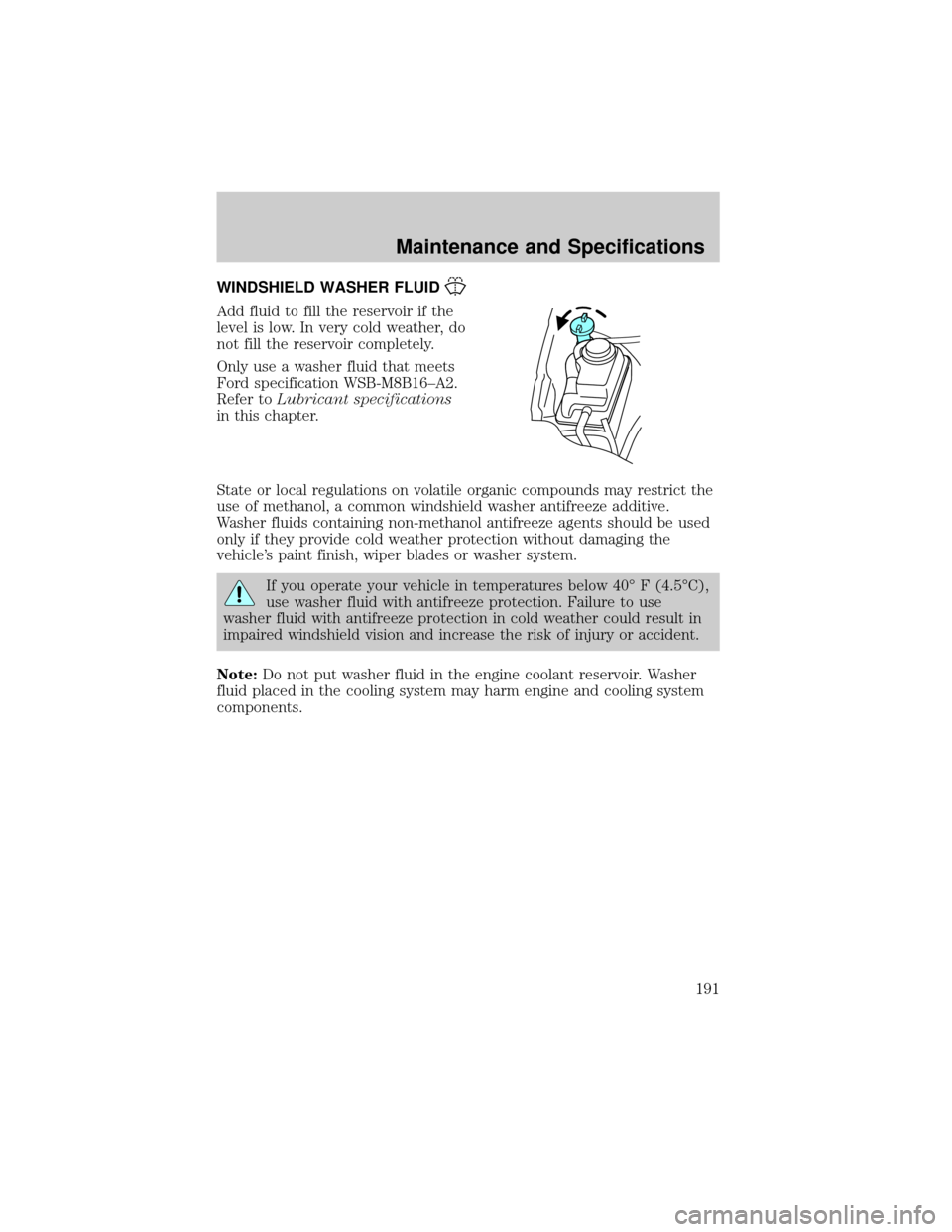
WINDSHIELD WASHER FLUID
Add fluid to fill the reservoir if the
level is low. In very cold weather, do
not fill the reservoir completely.
Only use a washer fluid that meets
Ford specification WSB-M8B16±A2.
Refer toLubricant specifications
in this chapter.
State or local regulations on volatile organic compounds may restrict the
use of methanol, a common windshield washer antifreeze additive.
Washer fluids containing non-methanol antifreeze agents should be used
only if they provide cold weather protection without damaging the
vehicle's paint finish, wiper blades or washer system.
If you operate your vehicle in temperatures below 40É F (4.5ÉC),
use washer fluid with antifreeze protection. Failure to use
washer fluid with antifreeze protection in cold weather could result in
impaired windshield vision and increase the risk of injury or accident.
Note:Do not put washer fluid in the engine coolant reservoir. Washer
fluid placed in the cooling system may harm engine and cooling system
components.
Maintenance and Specifications
191