2005 FORD SUPER DUTY weight
[x] Cancel search: weightPage 15 of 72
TRAILER TOWING
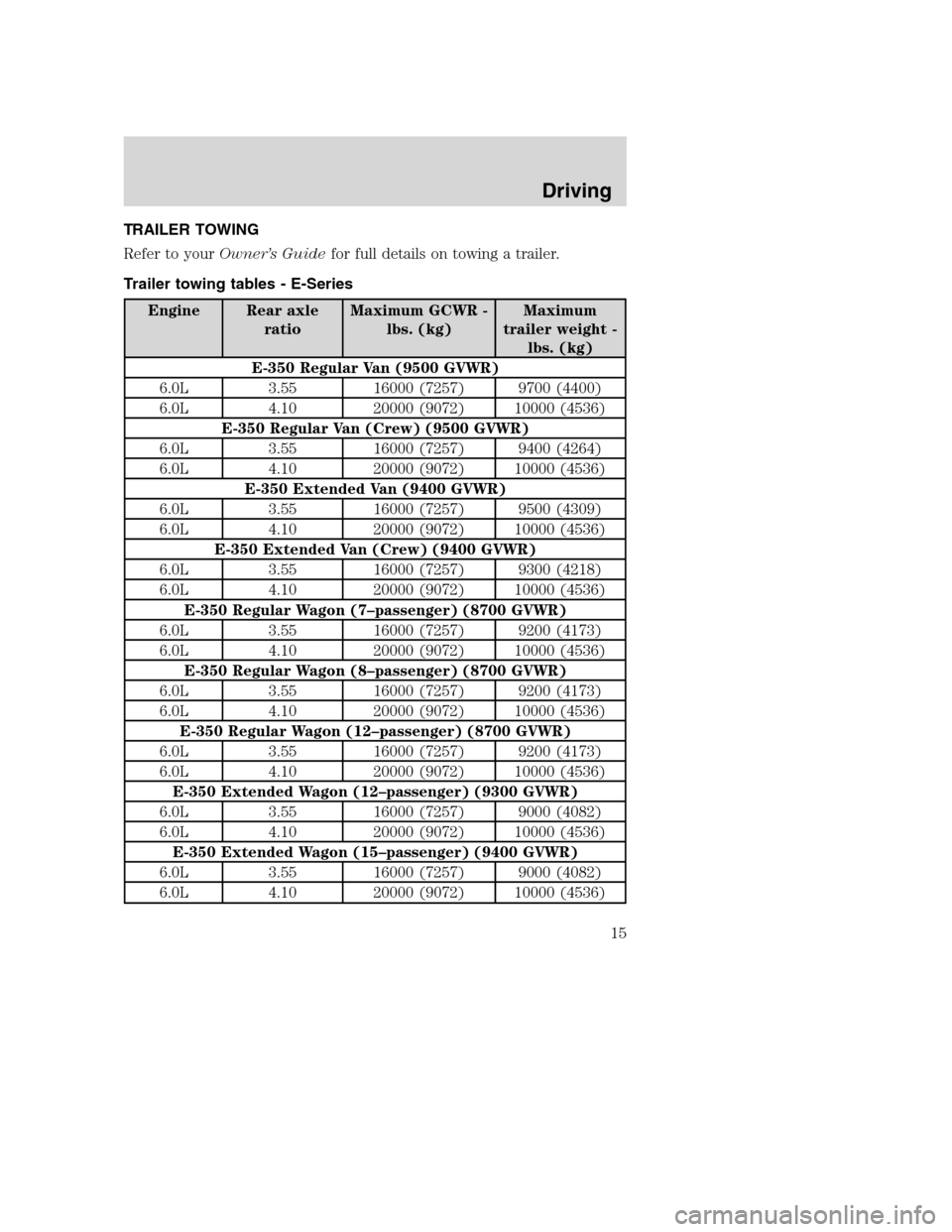
Refer to yourOwner’s Guidefor full details on towing a trailer.
Trailer towing tables - E-Series
Engine Rear axle
ratioMaximum GCWR -
lbs. (kg)Maximum
trailer weight -
lbs. (kg)
E-350 Regular Van (9500 GVWR)
6.0L 3.55 16000 (7257) 9700 (4400)
6.0L 4.10 20000 (9072) 10000 (4536)
E-350 Regular Van (Crew) (9500 GVWR)
6.0L 3.55 16000 (7257) 9400 (4264)
6.0L 4.10 20000 (9072) 10000 (4536)
E-350 Extended Van (9400 GVWR)
6.0L 3.55 16000 (7257) 9500 (4309)
6.0L 4.10 20000 (9072) 10000 (4536)
E-350 Extended Van (Crew) (9400 GVWR)
6.0L 3.55 16000 (7257) 9300 (4218)
6.0L 4.10 20000 (9072) 10000 (4536)
E-350 Regular Wagon (7–passenger) (8700 GVWR)
6.0L 3.55 16000 (7257) 9200 (4173)
6.0L 4.10 20000 (9072) 10000 (4536)
E-350 Regular Wagon (8–passenger) (8700 GVWR)
6.0L 3.55 16000 (7257) 9200 (4173)
6.0L 4.10 20000 (9072) 10000 (4536)
E-350 Regular Wagon (12–passenger) (8700 GVWR)
6.0L 3.55 16000 (7257) 9200 (4173)
6.0L 4.10 20000 (9072) 10000 (4536)
E-350 Extended Wagon (12–passenger) (9300 GVWR)
6.0L 3.55 16000 (7257) 9000 (4082)
6.0L 4.10 20000 (9072) 10000 (4536)
E-350 Extended Wagon (15–passenger) (9400 GVWR)
6.0L 3.55 16000 (7257) 9000 (4082)
6.0L 4.10 20000 (9072) 10000 (4536)
Driving
15
Page 16 of 72
Engine Rear axle
ratioMaximum GCWR -
lbs. (kg)Maximum
trailer weight -
lbs. (kg)
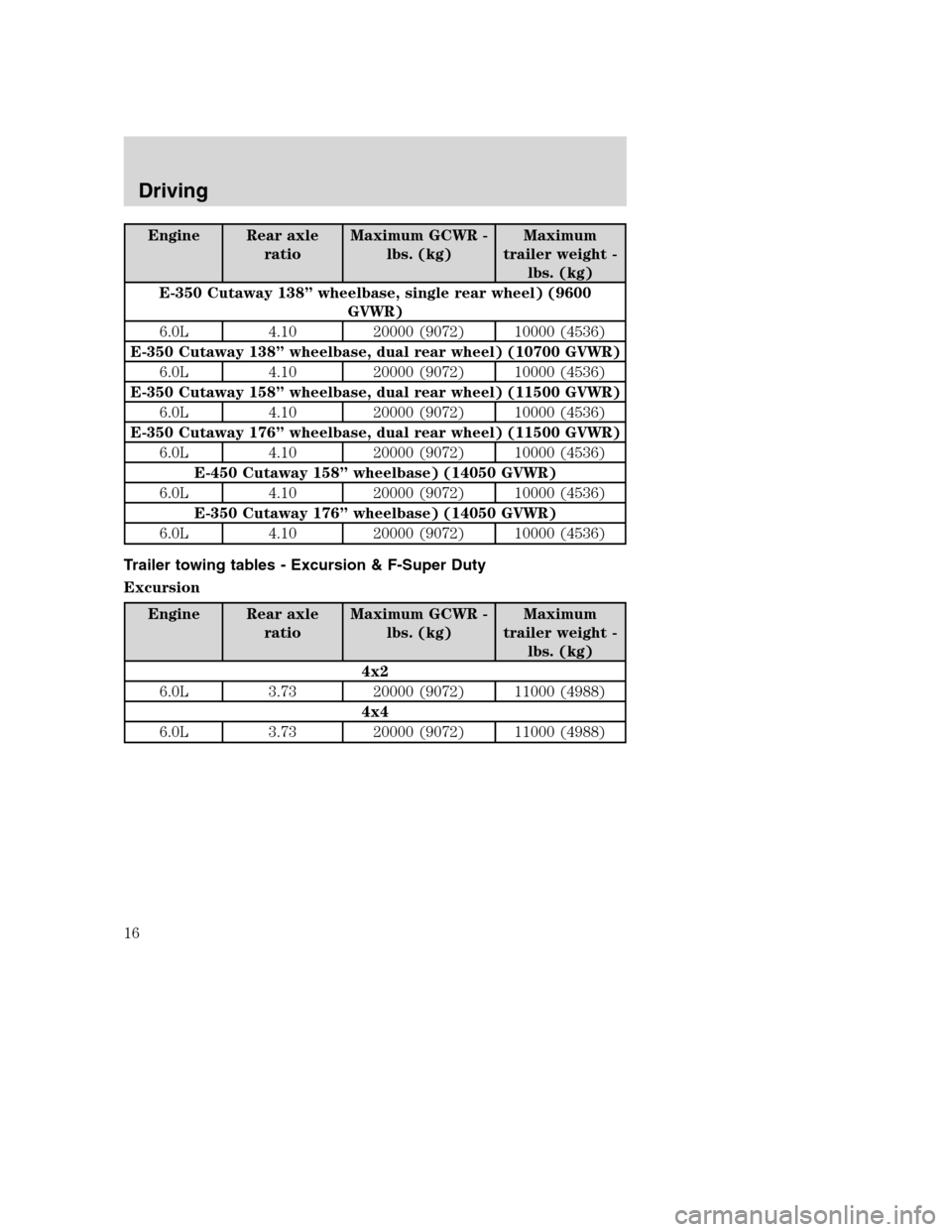
E-350 Cutaway 138”wheelbase, single rear wheel) (9600
GVWR)
6.0L 4.10 20000 (9072) 10000 (4536)
E-350 Cutaway 138”wheelbase, dual rear wheel) (10700 GVWR)
6.0L 4.10 20000 (9072) 10000 (4536)
E-350 Cutaway 158”wheelbase, dual rear wheel) (11500 GVWR)
6.0L 4.10 20000 (9072) 10000 (4536)
E-350 Cutaway 176”wheelbase, dual rear wheel) (11500 GVWR)
6.0L 4.10 20000 (9072) 10000 (4536)
E-450 Cutaway 158”wheelbase) (14050 GVWR)
6.0L 4.10 20000 (9072) 10000 (4536)
E-350 Cutaway 176”wheelbase) (14050 GVWR)
6.0L 4.10 20000 (9072) 10000 (4536)
Trailer towing tables - Excursion & F-Super Duty
Excursion
Engine Rear axle
ratioMaximum GCWR -
lbs. (kg)Maximum
trailer weight -
lbs. (kg)
4x2
6.0L 3.73 20000 (9072) 11000 (4988)
4x4
6.0L 3.73 20000 (9072) 11000 (4988)
Driving
16
Page 17 of 72
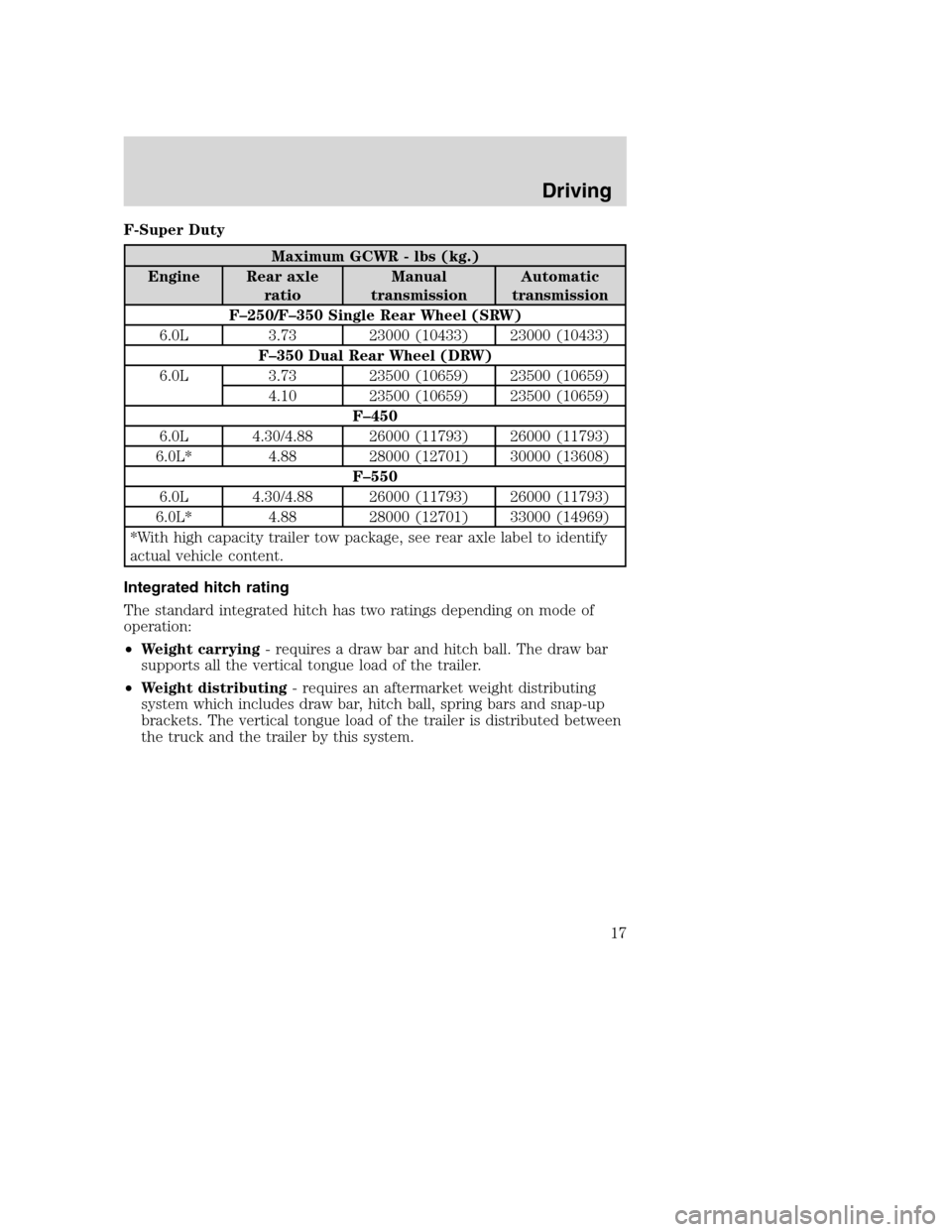
F-Super Duty
Maximum GCWR - lbs (kg.)
Engine Rear axle
ratioManual
transmissionAutomatic
transmission
F–250/F–350 Single Rear Wheel (SRW)
6.0L 3.73 23000 (10433) 23000 (10433)
F–350 Dual Rear Wheel (DRW)
6.0L 3.73 23500 (10659) 23500 (10659)
4.10 23500 (10659) 23500 (10659)
F–450
6.0L 4.30/4.88 26000 (11793) 26000 (11793)
6.0L* 4.88 28000 (12701) 30000 (13608)
F–550
6.0L 4.30/4.88 26000 (11793) 26000 (11793)
6.0L* 4.88 28000 (12701) 33000 (14969)
*With high capacity trailer tow package, see rear axle label to identify
actual vehicle content.
Integrated hitch rating
The standard integrated hitch has two ratings depending on mode of
operation:
•Weight carrying- requires a draw bar and hitch ball. The draw bar
supports all the vertical tongue load of the trailer.
•Weight distributing- requires an aftermarket weight distributing
system which includes draw bar, hitch ball, spring bars and snap-up
brackets. The vertical tongue load of the trailer is distributed between
the truck and the trailer by this system.
Driving
17
Page 18 of 72
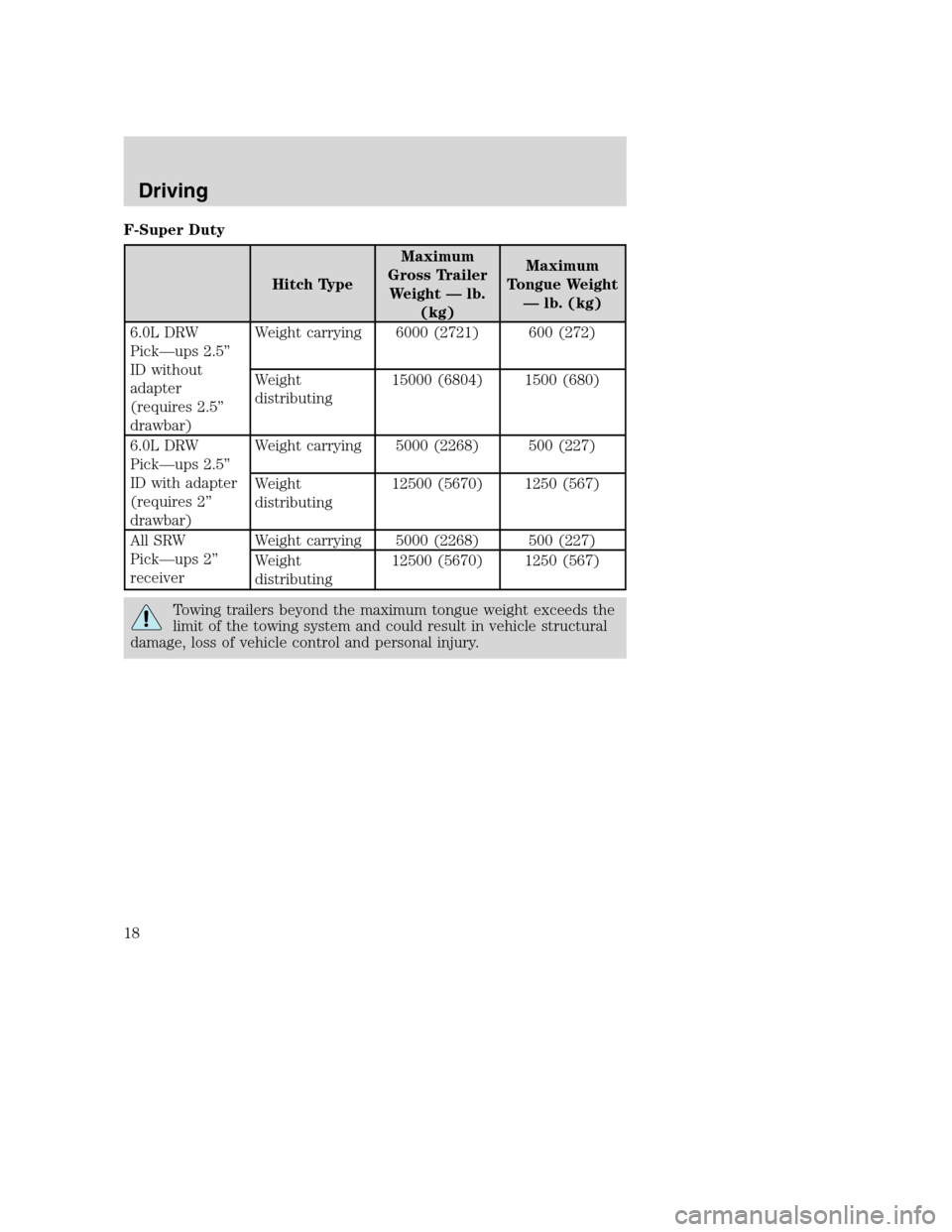
F-Super Duty
Hitch TypeMaximum
Gross Trailer
Weight—lb.
(kg)Maximum
Tongue Weight
—lb. (kg)
6.0L DRW
Pick—ups 2.5”
ID without
adapter
(requires 2.5”
drawbar)Weight carrying 6000 (2721) 600 (272)
Weight
distributing15000 (6804) 1500 (680)
6.0L DRW
Pick—ups 2.5”
ID with adapter
(requires 2”
drawbar)Weight carrying 5000 (2268) 500 (227)
Weight
distributing12500 (5670) 1250 (567)
All SRW
Pick—ups 2”
receiverWeight carrying 5000 (2268) 500 (227)
Weight
distributing12500 (5670) 1250 (567)
Towing trailers beyond the maximum tongue weight exceeds the
limit of the towing system and could result in vehicle structural
damage, loss of vehicle control and personal injury.
Driving
18
Page 38 of 72
![FORD SUPER DUTY 2005 1.G Diesel Supplement Manual •sustained, high speed driving at Gross Vehicle Weight Rating
(maximum loaded weight for vehicle operation during hot
weather-above 32°C [90°F]).
•frequent or extended idling (over 10 minutes pe](/manual-img/11/5263/w960_5263-37.png "FORD SUPER DUTY 2005 1.G Diesel Supplement Manual •sustained, high speed driving at Gross Vehicle Weight Rating
(maximum loaded weight for vehicle operation during hot
weather-above 32°C [90°F]).
•frequent or extended idling (over 10 minutes pe")
•sustained, high speed driving at Gross Vehicle Weight Rating
(maximum loaded weight for vehicle operation during hot
weather-above 32°C [90°F]).
•frequent or extended idling (over 10 minutes per hour of normal
driving).
•operating in severe dust conditions.
•frequent, short trips of 16 km (10 miles) or less during freezing
weather
If you are operating your vehicle under any of these conditions, observe
the following service procedures:
•Change engine oil and filter every 8,000 km (5,000 miles).
•Use Motorcraft oil or an equivalent oil conforming to Ford
Specification WSS-M2C171–D or API categories CI-4, CI–4/SL or
DHD-1. If CI-4 oil is not available, CH-4 is acceptable.
For more information refer theGeneral Owner’s Informationsection of
this supplement.
REPLACING THE AIR FILTER ELEMENT
When replacing the air filter element, use the Motorcraft air filter element
listed. Refer to theMotorcraft part numberschart in this section.
Note: Do not start your engine with the air cleaner removed and do not
remove it while the engine is running.
Failure to use the correct air filter element may result in severe
engine damage.
•E-series air filter element:
1. Disconnect the hoses from the air cleaner outlet tube.
2. Loosen the clamp and disconnect
the air cleaner outlet tube.
Maintenance and Specifications
38
Page 44 of 72
EMISSION CONTROL SYSTEM(S) LAWS
Federal law prohibits vehicle manufacturers, dealers and other persons
engaged in the business of repairing, servicing, selling, leasing or trading
motor vehicles as well as fleet operations from unknowingly removing or
rendering emission control system(s) inoperative. Further, modifications
of the emission control system(s) could create liability on the part of the
individual owners under the laws of some states. In Canada,
modifications of the emission control system(s) could create liability
under applicable Federal or Provincial laws.
Do not remove or alter the original equipment floor covering or
insulation between it and the metal floor of the vehicle. The floor
covering and insulation protect occupants of the vehicle from the engine
and exhaust system heat and noise. On vehicles with no original
equipment floor covering insulation, do not carry passengers in a manner
that permits prolonged skin contact with the metal floor. Provide
adequate insulation.
NOISE EMISSIONS WARRANTY, PROHIBITED TAMPERING ACTS
AND MAINTENANCE
On January 1, 1978, Federal regulation became effective governing the
noise emission on trucks over 4,536 kg (10,000 lbs.) GVWR (Gross
Vehicle Weight Rating). The following statements concerning prohibited
tampering acts and maintenance, and the noise warranty found in the
Warranty Facts Booklet, are applicable to complete chassis cabs over
4,536 (10,000 lbs.) GVWR.
Tampering with noise control system prohibited
Federal law prohibits the following acts or the causing thereof: (1) The
removal or rendering inoperative by any person other than for purposes
of maintenance, repair or replacement of any device or element of design
incorporated into any new vehicle for the purpose of noise control prior
to its sale or delivery to the ultimate purchaser or while it is in use, or
(2) the use of the vehicle after such device or element of design has
been removed or rendered inoperative by any person.
Among those acts which the U.S. Environmental Protection Agency may
presume to constitute tampering are the acts listed below:
•Removal of hood blanket, fender apron absorbers, fender apron
barriers, underbody noise shields or acoustically absorptive material.
•Tampering or rendering inoperative the engine speed governor, so as
to allow engine speed to exceed manufacturer’s specifications.
Maintenance and Specifications
44
Page 65 of 72
and F-550 trucks operated at or near maximum Gross Vehicle Weights,
the rear axle lubricant should be replaced every 50,000 miles. In
addition, this 50,000 mile schedule should be observed when the vehicles
are operated under the Special Operating Conditions, where noted.
SPECIAL OPERATING CONDITIONS
Towing a trailer or using a camper or car-top carrier
Every 5,000 miles or 6 months:Change engine oil and replace filter
Every 5,000 miles:Check air filter restriction gauge (replace air filter
as required or when air filter restriction gauge indicates)
Every 30,000 miles:Lubricate 4x4 front hub needle bearings
(Excursion only)
Every 60,000 miles:Change transfer case fluid
As required:Change manual transmission fluid
Date:
Odometer reading:
R.O.#Dealer’s Stamp:
See corresponding mileage in maintenance schedule for services performed.
Extensive idling and/or low-speed driving for long distances as in
heavy commercial use such as delivery, taxi, patrol or livery
Every 5,000 miles, 6 months or 200 hours of engine operation
(whichever comes first):Change engine oil and replace filter
Every 5,000 miles:Check air filter restriction gauge (replace air filter
as required or when air filter restriction gauge indicates)
Every 5,000 miles:Inspect brake system. Inspect and lubricate 4x2 ball
joints and steering idler arms
30,000 miles and 90,000 miles:Lubricate 4x2 wheel bearings. Replace
wheel bearing grease seal.
Every 60,000 miles:Change transfer case fluid
General Owner’s Information
65