2005 CHEVROLET EQUINOX ECO mode
[x] Cancel search: ECO modePage 72 of 364
Remote Keyless Entry System
Operation
With this feature, you can lock and unlock the doors
from about 26 feet (8 m) away using the remote keyless
entry transmitter supplied with your vehicle.
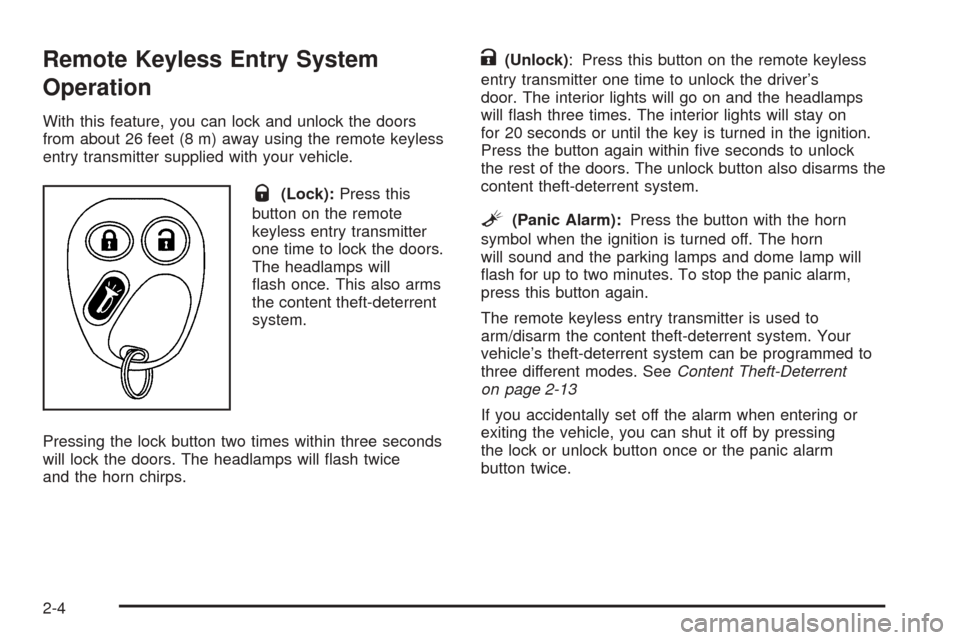
Q(Lock):Press this
button on the remote
keyless entry transmitter
one time to lock the doors.
The headlamps will
ash once. This also arms
the content theft-deterrent
system.
Pressing the lock button two times within three seconds
will lock the doors. The headlamps will ash twice
and the horn chirps.
K(Unlock): Press this button on the remote keyless
entry transmitter one time to unlock the driver’s
door. The interior lights will go on and the headlamps
will ash three times. The interior lights will stay on
for 20 seconds or until the key is turned in the ignition.
Press the button again within ve seconds to unlock
the rest of the doors. The unlock button also disarms the
content theft-deterrent system.
L(Panic Alarm):Press the button with the horn
symbol when the ignition is turned off. The horn
will sound and the parking lamps and dome lamp will
ash for up to two minutes. To stop the panic alarm,
press this button again.
The remote keyless entry transmitter is used to
arm/disarm the content theft-deterrent system. Your
vehicle’s theft-deterrent system can be programmed to
three different modes. SeeContent Theft-Deterrent
on page 2-13
If you accidentally set off the alarm when entering or
exiting the vehicle, you can shut it off by pressing
the lock or unlock button once or the panic alarm
button twice.
2-4
Page 81 of 364
Visor Vanity Mirrors
Your vehicle has covered visor vanity mirrors on both
the driver’s and passenger’s side.
Theft-Deterrent Systems
Vehicle theft is big business, especially in some cities.
Although your vehicle has a number of theft-deterrent
features, we know that nothing we put on it can make it
impossible to steal.
Content Theft-Deterrent
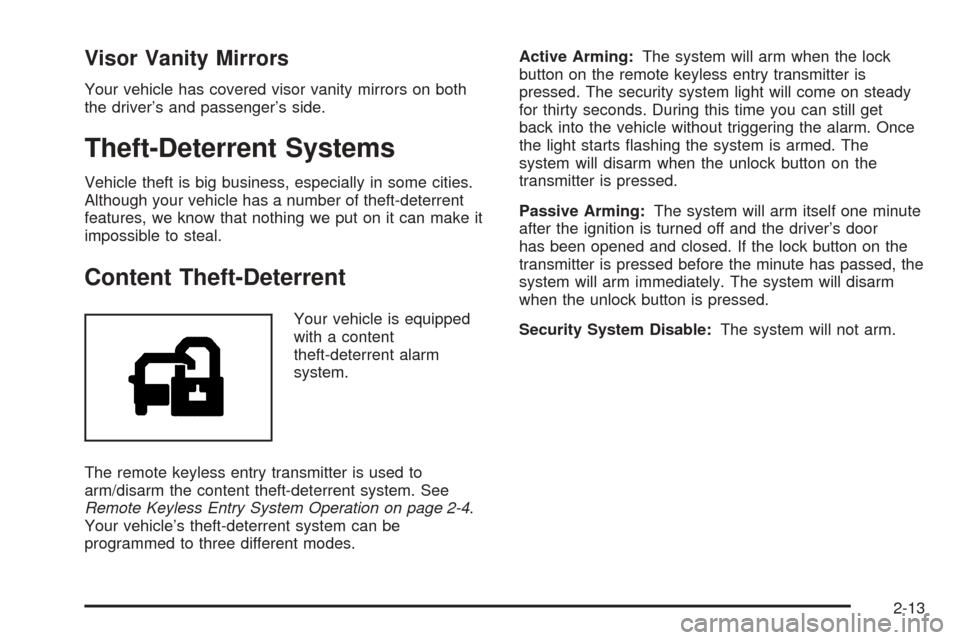
Your vehicle is equipped
with a content
theft-deterrent alarm
system.
The remote keyless entry transmitter is used to
arm/disarm the content theft-deterrent system. See
Remote Keyless Entry System Operation on page 2-4.
Your vehicle’s theft-deterrent system can be
programmed to three different modes.Active Arming:The system will arm when the lock
button on the remote keyless entry transmitter is
pressed. The security system light will come on steady
for thirty seconds. During this time you can still get
back into the vehicle without triggering the alarm. Once
the light starts ashing the system is armed. The
system will disarm when the unlock button on the
transmitter is pressed.
Passive Arming:The system will arm itself one minute
after the ignition is turned off and the driver’s door
has been opened and closed. If the lock button on the
transmitter is pressed before the minute has passed, the
system will arm immediately. The system will disarm
when the unlock button is pressed.
Security System Disable:The system will not arm.
2-13
Page 82 of 364
Content Theft-Deterrent Personalization
To change the mode that your vehicle is programmed to,
do the following:
1. Turn the ignition to RUN or ACC.
2. Press the panic alarm button on the transmitter
slowly four times within ve seconds.
3. You must complete one of the following within
three seconds to change the mode.
To select the active arming mode, press the
lock button on the transmitter once within
three seconds. A chime will sound two times
to acknowledge that the active arming mode has
been selected.
To select the passive arming mode, press the
lock button on the transmitter twice within
three seconds. A chime will sound three times to
acknowledge that the passive arming mode
has been selected.
To select the security system disable mode,
press the unlock button on the transmitter
once within three seconds. A chime will sound
one time to acknowledge that the security system
disabled mode has been selected.If you accidentally set off the alarm when entering or
exiting the vehicle, you can shut it off by pressing either
the lock or unlock button once on the remote keyless
entry transmitter. The panic alarm button needs to
be pressed twice to turn off the alarm. There is
a ten second pre-alarm grace period indicated by a
rapid beeping. By pressing the transmitter buttons as
indicated above, you can disarm the system before
the horn begins to sound and the exterior lights begin
to ash.
If you hear three horn chirps when you press the unlock
button on the transmitter, that means the vehicle’s
alarm was triggered while you were away.
2-14
Page 89 of 364
LOW TWO (L2):This position gives you more power
but lower fuel economy. You can use LOW TWO (L2) on
hills. It can help control your speed as you go down
steep mountain roads, but then you would also want to
use your brakes off and on.
Notice:Do not drive in LOW TWO (L2) for more
than 25 miles (40 km), or at speeds over 55 mph
(90 km/h), or you can damage your transaxle.
Use AUTOMATIC OVERDRIVE (D) or LOW FOUR (L4)
as much as possible. Do not shift into LOW
TWO (L2) unless you are going slower than 65 mph
(105 km/h) or you can damage your engine.
Notice:Spinning the tires or holding the vehicle in
one place on a hill using only the accelerator
pedal may damage the transaxle. If you are stuck,
do not spin the tires. When stopping on a hill,
use the brakes to hold the vehicle in place.Transaxle Overheating
If the transaxle uid temperature rises above 284°F
(140°C) or rises rapidly, the Engine Coolant
Temperature Warning Light will ash. SeeEngine
Coolant Temperature Warning Light on page 3-31for
more information. When the transaxle overheats it
will go into a protection mode and will default shift into
fth gear if in the AUTOMATIC OVERDRIVE (D)
position, or second gear if in the LOW TWO (L2)
position. Continue driving the vehicle in either position
depending on the required vehicle speed and load. Once
the uid temperature lowers to the normal temperature
range, the transaxle will return to the normal shift
patterns. Towing or driving on long hills can cause the
transaxle uid temperature to be higher than normal.
If the transaxle uid temperature will not cool, you may
need to pull over and check the transaxle uid level.
You should also check the engine coolant temperature.
If it is hot, seeEngine Overheating on page 5-24.
2-21
Page 96 of 364
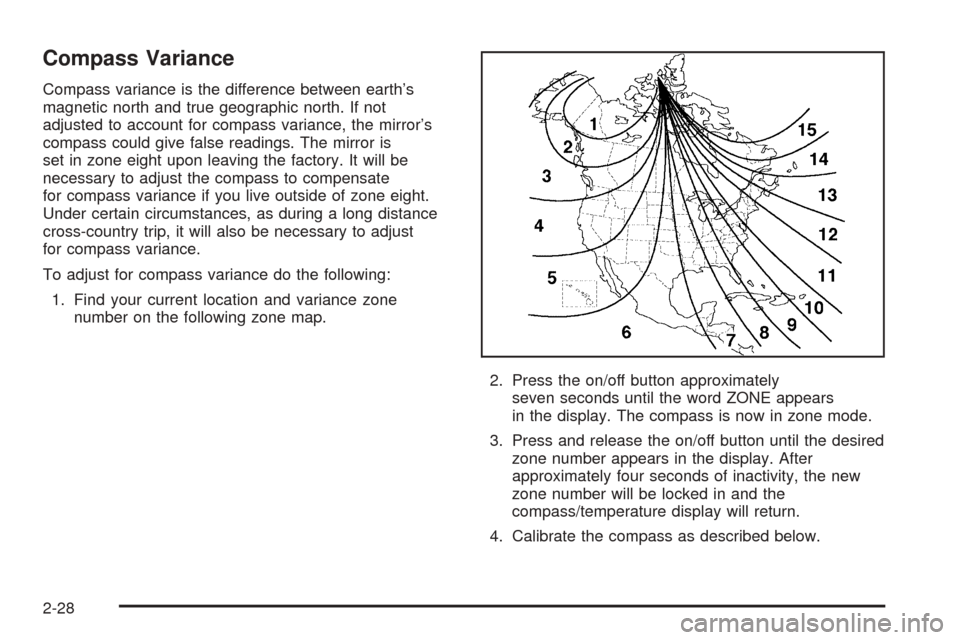
Compass Variance
Compass variance is the difference between earth’s
magnetic north and true geographic north. If not
adjusted to account for compass variance, the mirror’s
compass could give false readings. The mirror is
set in zone eight upon leaving the factory. It will be
necessary to adjust the compass to compensate
for compass variance if you live outside of zone eight.
Under certain circumstances, as during a long distance
cross-country trip, it will also be necessary to adjust
for compass variance.
To adjust for compass variance do the following:
1. Find your current location and variance zone
number on the following zone map.
2. Press the on/off button approximately
seven seconds until the word ZONE appears
in the display. The compass is now in zone mode.
3. Press and release the on/off button until the desired
zone number appears in the display. After
approximately four seconds of inactivity, the new
zone number will be locked in and the
compass/temperature display will return.
4. Calibrate the compass as described below.
2-28
Page 98 of 364
Temperature and Compass Display
Press the on/off button, located in the center, to cycle
between °F, °C and off. If the display reads CAL,
the compass needs to be calibrated. For more
information, see “Compass Calibration” later in this
section.
If an abnormal temperature reading is displayed for an
extended period of time, please consult your dealer.
Under certain circumstances, a delay in updating
the temperature is normal.
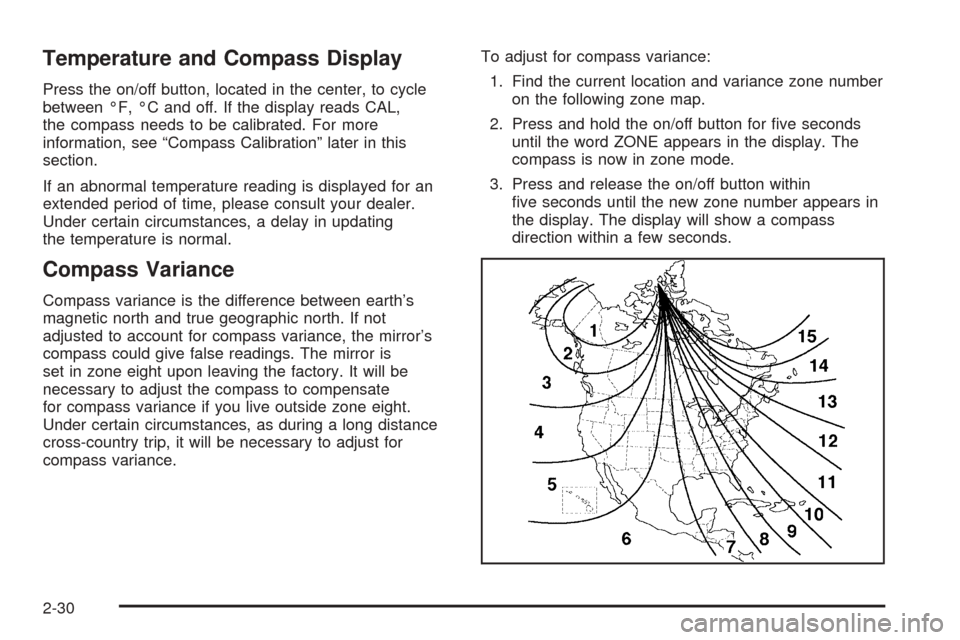
Compass Variance
Compass variance is the difference between earth’s
magnetic north and true geographic north. If not
adjusted to account for compass variance, the mirror’s
compass could give false readings. The mirror is
set in zone eight upon leaving the factory. It will be
necessary to adjust the compass to compensate
for compass variance if you live outside zone eight.
Under certain circumstances, as during a long distance
cross-country trip, it will be necessary to adjust for
compass variance.To adjust for compass variance:
1. Find the current location and variance zone number
on the following zone map.
2. Press and hold the on/off button for ve seconds
until the word ZONE appears in the display. The
compass is now in zone mode.
3. Press and release the on/off button within
ve seconds until the new zone number appears in
the display. The display will show a compass
direction within a few seconds.
2-30
Page 123 of 364
Ending Cruise Control
To end a cruise control session, step lightly on the
brake pedal.
Stepping on the brake will end the current cruise control
session only. Press the cruise on/off button to turn off
the system completely.
If the driver takes over the acceleration pedal for more
than 60 seconds, cruise control will shut off.
Erasing Speed Memory
When you turn off the cruise control or the ignition, your
cruise control set speed memory is erased.
Headlamps
The exterior lamp control is located on the turn
signal/multifunction lever.
O(Exterior Lamp Control):Turn the control with
this symbol on it to operate the exterior lamps.The exterior lamp control has the following positions:
AUTO (Off/Automatic Headlamps):Turn the control to
this position to put the headlamps in automatic mode.
Automatic mode will turn the exterior lamps on and
off depending upon how much light is available outside
of the vehicle.
;(Parking Lamps):Turn the control to this position
to turn on the parking lamps together with the
following:
Sidemarker Lamps
Taillamps
License Plate Lamps
Instrument Panel Lights
53(Headlamps):Turning the control to this
position turns on the headlamps, together with the
previously listed lamps and lights.
Headlamps on Reminder
If you open the driver’s door with the ignition off and the
lamps on, you will hear a warning chime.
3-13
Page 135 of 364
Speedometer and Odometer
Your speedometer lets you see your speed in both
miles per hour (mph) and kilometers per hour (km/h).
Your odometer shows how far your vehicle has
been driven, in either miles (used in the United States)
or kilometers (used in Canada).
Your vehicle has a tamper resistant odometer. The
digital odometer will read 999,999 if someone tries to
turn it back.
The ERROR message is displayed on the odometer
indicating that the speedometer reading is approximately
10 percent above the actual speed. The SERVICE
VEHICLE SOON light will also come on. Press the trip
odometer button to return to the odometer/trip mode.
This message will appear every 10 minutes. If this
occurs, see your dealer for service.
You may wonder what happens if your vehicle needs a
new odometer installed. If the new one can be set to
the mileage total of the old odometer, then it must
be. But if it can’t, then it’s set at zero and a label must
be put on the driver’s door to show the old mileage
reading when the new odometer was installed.
Trip Odometer
Your trip odometer is located on the instrument panel
and shows how far your vehicle has been driven
since the trip odometer was last reset. To reset the trip
odometer to zero, press and hold the trip/reset button
on the speedometer for about two seconds.
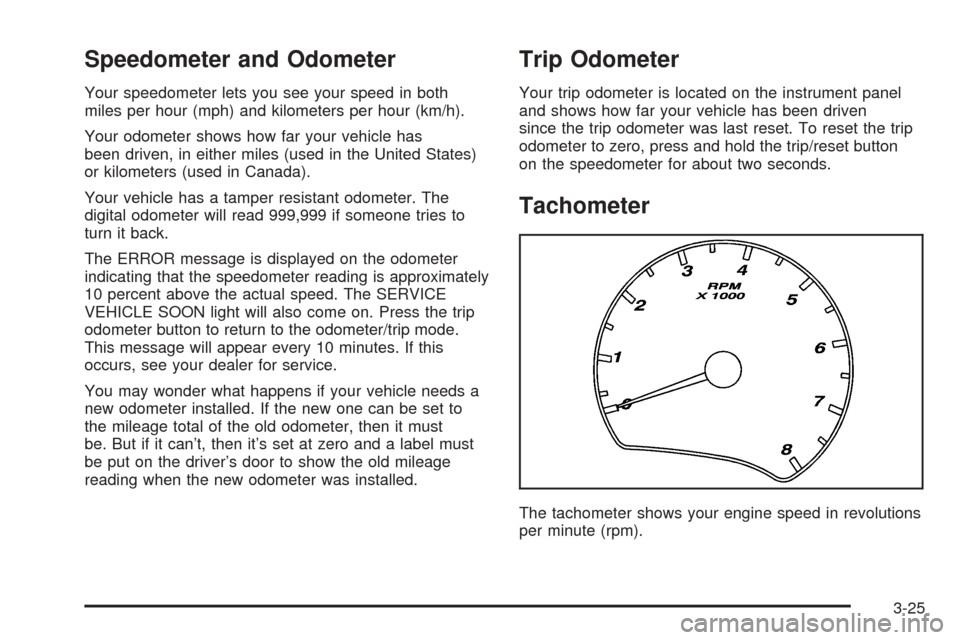
Tachometer
The tachometer shows your engine speed in revolutions
per minute (rpm).
3-25