2005 BUICK CENTURY light
[x] Cancel search: lightPage 102 of 348

Malfunction Indicator Lamp.............................3-36
Oil Pressure Light.........................................3-40
Change Engine Oil Light................................3-40
Security Light...............................................3-41
Cruise Control Light......................................3-41
Low Washer Fluid Warning Light.....................3-41
Door/Trunk Ajar Warning Light........................3-42
Service Vehicle Soon Light............................3-42
Fuel Gage...................................................3-42
Low Fuel Warning Light.................................3-43Audio System(s).............................................3-44
Setting the Time...........................................3-44
Radio with CD..............................................3-45
Radio with Cassette and CD..........................3-53
Theft-Deterrent Feature..................................3-63
Audio Steering Wheel Controls.......................3-63
Radio Reception...........................................3-64
Care of Your Cassette Tape Player.................3-65
Care of Your CDs.........................................3-66
Care of Your CD Player................................3-66
Fixed Mast Antenna......................................3-66
Chime Level Adjustment................................3-66
Section 3 Instrument Panel
3-2
Page 105 of 348
The main components of the instrument panel are the following:
A. Exterior Lamps Control. SeeExterior Lamps on
page 3-13.
B. Turn Signal/Multifunction Lever. SeeTurn
Signal/Multifunction Lever on page 3-7.
C. Instrument Panel Cluster. SeeInstrument Panel
Cluster on page 3-29.
D. Hazard Warning Flasher Button. SeeHazard
Warning Flashers on page 3-6.
E. Audio Steering Wheel Controls. SeeAudio Steering
Wheel Controls on page 3-63.
F. Gear Shift Lever. SeeAutomatic Transaxle
Operation on page 2-21.
G. Air Outlets. SeeOutlet Adjustment on page 3-26.H. Side Window Defogger Outlet.
I. Hood Release. SeeHood Release on page 5-11.
J. Tilt Wheel Lever. SeeTilt Wheel on page 3-6.
K. Horn. SeeHorn on page 3-6.
L. Audio System. SeeAudio System(s) on page 3-44.
M. Ashtray. SeeAshtrays and Cigarette Lighter on
page 3-18.
N. Climate Control. SeeDual Climate Control System
on page 3-18.
O. Glove Box. SeeGlove Box on page 2-33.
P. Instrument Panel Fuse Block. SeeFuses and Circuit
Breakers on page 5-91.
3-5
Page 108 of 348

Headlamp High/Low-Beam Changer
To change the headlamps from low beams to high
beams, or high to low, pull the multifunction lever until
a click is heard, then release it.
This indicator light on the
instrument panel cluster
will come on while the
high-beam lamps are on.
Flash-to-Pass
This feature lets you use your high-beam headlamps to
signal the driver in front of you that you want to pass.
It works even if the headlamps are off. Pull the turn
signal lever toward you a little, but not so much that you
hear a click.
If the headlamps are off or on low-beam, the high-beam
headlamps will turn on. They will stay on as long as
you hold the lever toward you. The high-beam indicator
on the instrument panel cluster will come on. Release
the lever to return it to the normal operation.
Windshield Wipers
To operate the windshield wipers turn the band located
on the multifunction lever upward or downward.
WIPER:Turn this band to control the windshield wipers.
OFF:Turn the band to OFF to turn off the
windshield wipers.
LO (Low Speed):Turn the band away from you
to LO and past the delay settings for steady wiping at
low speed.
HI (High Speed):Turn the band away from you, to HI,
and past the delay settings for steady wiping at a
high speed.
(Delayed Wiping):Turn the band away from you,
just past OFF, to one of the ve delayed settings,
to choose the length of intervals between each wiping
cycle. The further the band is turned upward, toward LO,
the shorter the delay will be. Select one of these
settings for light rain or snow.
3-8
Page 109 of 348

MIST:Turn the band to MIST for a single wiping cycle.
Hold it until the windshield wipers start. Then let it
go. The windshield wipers will stop after one wipe.
If more wipes are needed, hold the band on
MIST longer.
Be sure to clear ice and snow from the windshield wiper
blades before using them. If they are frozen to the
windshield, carefully loosen or thaw them. If the blades
do become worn or damaged, get new blades or
blade inserts. SeeWindshield Wiper Blade Replacement
on page 5-52.
Heavy snow or ice can overload the wipers. A circuit
breaker will stop them until the motor cools. Clear away
snow or ice to prevent an overload.Windshield Washer
J(Windshield Washer):A paddle with the word
PUSH on it is located at the top of the multifunction
lever. Push on the paddle to spray washer uid on the
windshield. The wipers will run for several sweeps
and then either stop or return to the preset speed.
SeeWindshield Washer Fluid on page 5-35.
{CAUTION:
In freezing weather, do not use your washer
until the windshield is warmed. Otherwise the
washer uid can form ice on the windshield,
blocking your vision.
The LOW WASH light on
the instrument panel
cluster will come on when
the uid level is low.
3-9
Page 111 of 348
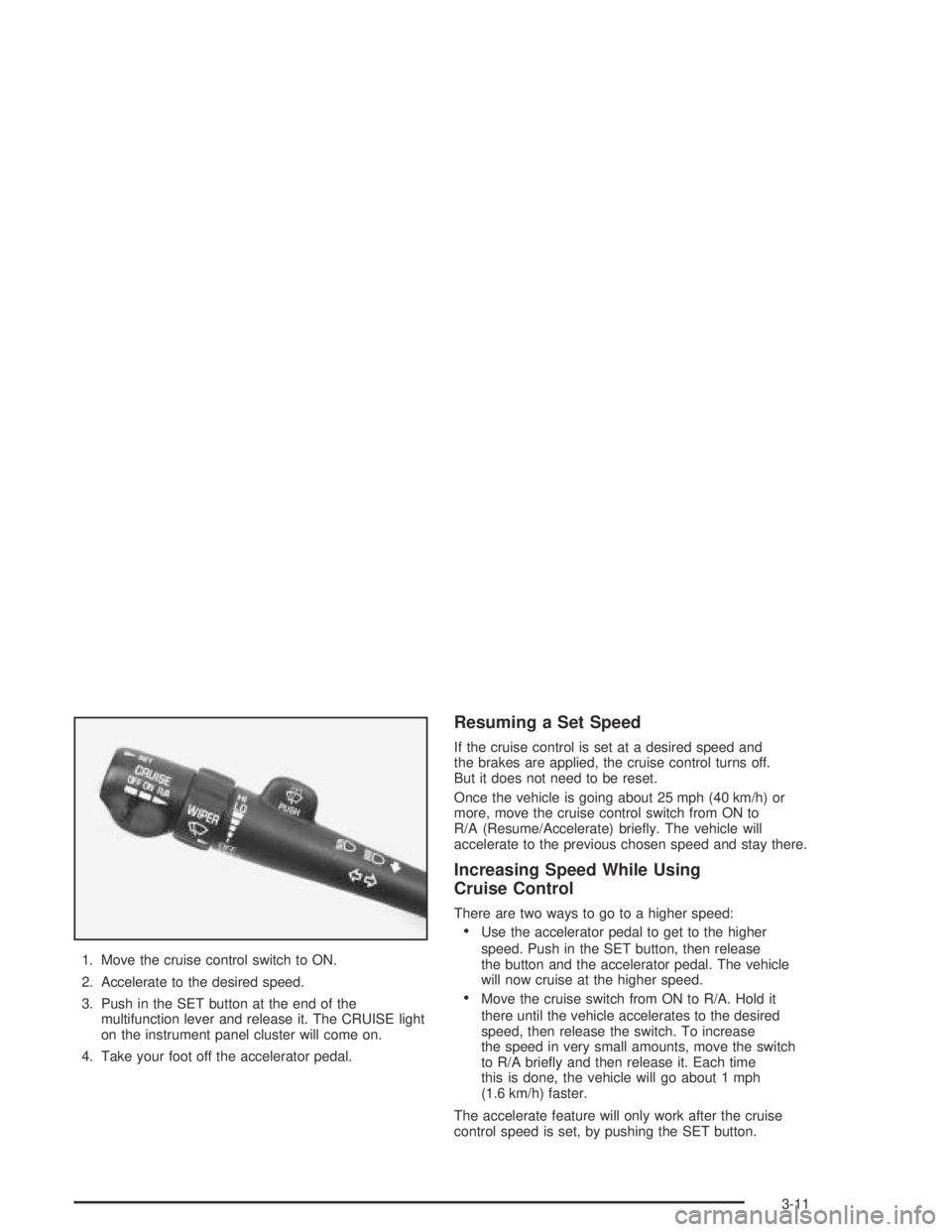
1. Move the cruise control switch to ON.
2. Accelerate to the desired speed.
3. Push in the SET button at the end of the
multifunction lever and release it. The CRUISE light
on the instrument panel cluster will come on.
4. Take your foot off the accelerator pedal.
Resuming a Set Speed
If the cruise control is set at a desired speed and
the brakes are applied, the cruise control turns off.
But it does not need to be reset.
Once the vehicle is going about 25 mph (40 km/h) or
more, move the cruise control switch from ON to
R/A (Resume/Accelerate) briey. The vehicle will
accelerate to the previous chosen speed and stay there.
Increasing Speed While Using
Cruise Control
There are two ways to go to a higher speed:
Use the accelerator pedal to get to the higher
speed. Push in the SET button, then release
the button and the accelerator pedal. The vehicle
will now cruise at the higher speed.
Move the cruise switch from ON to R/A. Hold it
there until the vehicle accelerates to the desired
speed, then release the switch. To increase
the speed in very small amounts, move the switch
to R/A briey and then release it. Each time
this is done, the vehicle will go about 1 mph
(1.6 km/h) faster.
The accelerate feature will only work after the cruise
control speed is set, by pushing the SET button.
3-11
Page 112 of 348
Reducing Speed While Using
Cruise Control
There are two ways to reduce the vehicle’s speed while
using cruise control:
Push in the SET button until the vehicle slows down
to the desired, then release it.
To slow the vehicle down in very small amounts,
push the SET button briey. Each time this is down,
the vehicle will go about 1 mph (1.6 km/h) slower.
Passing Another Vehicle While Using
Cruise Control
Use the accelerator pedal to increase the vehicle’s
speed. When you take your foot off the pedal, the
vehicle will slow down to the cruise control speed that
was set earlier.
Using Cruise Control on Hills
How well the cruise control will work on hills depends
upon the speed and load of the vehicle, and the
steepness of the hills. When going up steep hills, the
accelerator pedal may have to be pressed to maintain
the vehicle’s speed. When going downhill, the vehicle’s
brakes may have to be used, or a lower gear may
have to be used to keep the vehicle’s speed down.
Of course, applying the brake takes the vehicle out of
cruise control. Many drivers nd this to be too much
trouble and do not use cruise control on steep hills.
Ending Cruise Control
There are two ways to turn off the cruise control:
Step lightly on the brake pedal.
Move the cruise switch to OFF.
Ending Speed Memory
When the cruise control or the ignition is turned off, or
the vehicle is shifted into PARK (P) or NEUTRAL (N),
the cruise control set speed memory is erased.
3-12
Page 113 of 348

Exterior Lamps
The exterior lamps control has three positions:
Off:Push the control all the way to turn off all lamps.
Parking Lamps:Pull the control out, halfway to the rst
position, to turn on the parking lamps together with
the following:
Taillamps
License Plate Lamps
Sidemarker Lamps
Instrument Panel Lights
Headlamps:Pull the control out all the way, to the
second position, to turn on the headlamps together with
the previously listed lamps and lights.
A warning chime will sound if the driver’s door is
opened when the ignition switch is turned to OFF,
LOCK or ACCESSORY and the headlamps are on.
Headlamps on Reminder
A warning chime will sound if the driver’s door is
opened when the ignition is turned to OFF, LOCK or
ACCESSORY and the headlamps are on.
Delayed Headlamps
Delayed headlamp illumination provides a period of
exterior lighting when leaving the vehicle. The feature is
activated when the vehicle’s ignition is turned off and
the headlamps are on due to the automatic headlamp
control feature described previously. The headlamps will
remain on until the exterior lamps control is moved
from OFF to the parking lamp position or until a
90 second lighting period has ended.
If the ignition is turned off while the exterior lamps
control is in the parking lamp or headlamp position,
the delayed headlamp illumination cycle will not occur.
This feature can be turned on or off by doing
the following:
1. Turn the ignition to RUN.
2. Close all the doors.
3. Press and hold LOCK on the power door lock
switch. While holding LOCK on the door lock
switch, cycle the exterior lamps control on and off
two times.
3-13
Page 114 of 348

4. Release the power door LOCK switch. These steps
must be carried out in a time period of less than
10 seconds, followed by a delay period of no more
than 10 seconds.
5. Then, press and hold the unlock position on the
power door switch. While holding the unlock
position, turn the exterior lamps control on and off
two times. Release the unlock position on the power
door switch. These operations must be carried
out in a time period of less than 10 seconds.
After releasing the unlock position on the power door
switch, a single chime will be heard if the delayed
headlamp illumination function has been turned off.
Two chimes will be heard if the feature has been turned
on. Disconnecting the vehicle’s battery for up to a
year will not change the programmed operation for
this feature.Daytime Running Lamps/Automatic
Headlamp System
Daytime Running Lamps (DRL) can make it easier for
others to see the front of the vehicle during the day.
DRL can be helpful in many different driving conditions,
but they can be especially helpful in the short periods
after dawn and before sunset. Daytime running lamps
are required to function at all times on all vehicles
rst sold in Canada.
A light sensor on top of the instrument panel makes the
DRL work, so be sure it is not covered.
The DRL system will make the front turn signal lamps
come on when the following conditions are met:
The ignition is on.
The exterior lamps control is off.
The parking brake is released.
While the DRL are on, only the vehicle’s front turn
signal lamps will also be on. The headlamps,
taillamps, sidemarker and other lamps will not be on.
The instrument panel will not be lit up either.
3-14