Page 143 of 348
Here are four things that some owners ask about.
All these things are normal and do not indicate that
anything is wrong with the fuel gage:
At the gas station, the pump shuts off before the
gage reads full.
It takes more, or less, fuel to ll up than the gage
reads. For example, the gage reads half full, but
it took more, or less, than half of the tank’s capacity
to ll it.
The gage pointer may move while cornering,
braking or accelerating.
The gage may not indicate empty when the ignition
is turned off.
Low Fuel Warning Light
If the vehicle’s fuel is low, a light on the instrument
panel cluster will come on and a chime will sound
periodically until fuel is added to the fuel tank.
It will also come on for a few seconds when the ignition
is turned on as a check to indicate it is working. If it
does not come on then, have it xed.United States
Canada
3-43
Page 163 of 348
Theft-Deterrent Feature
THEFTLOCK®is designed to discourage theft of your
vehicle’s radio. It works by using a secret code to
disable all radio functions whenever battery power is
removed and the radio is placed in a different vehicle.
This feature requires no user input to be activated.
The radio is automatically armed when it is put into the
vehicle for the rst time.
When the ignition is turned off, the blinking red light
indicates that THEFTLOCK
®is armed.
If THEFTLOCK
®is activated, the radio will not operate
if stolen. The radio will display LOCKED and a red
LED indicator light will come on above the key symbol
to indicate a locked condition. If this occurs, the radio will
need to be returned to your GM dealer.
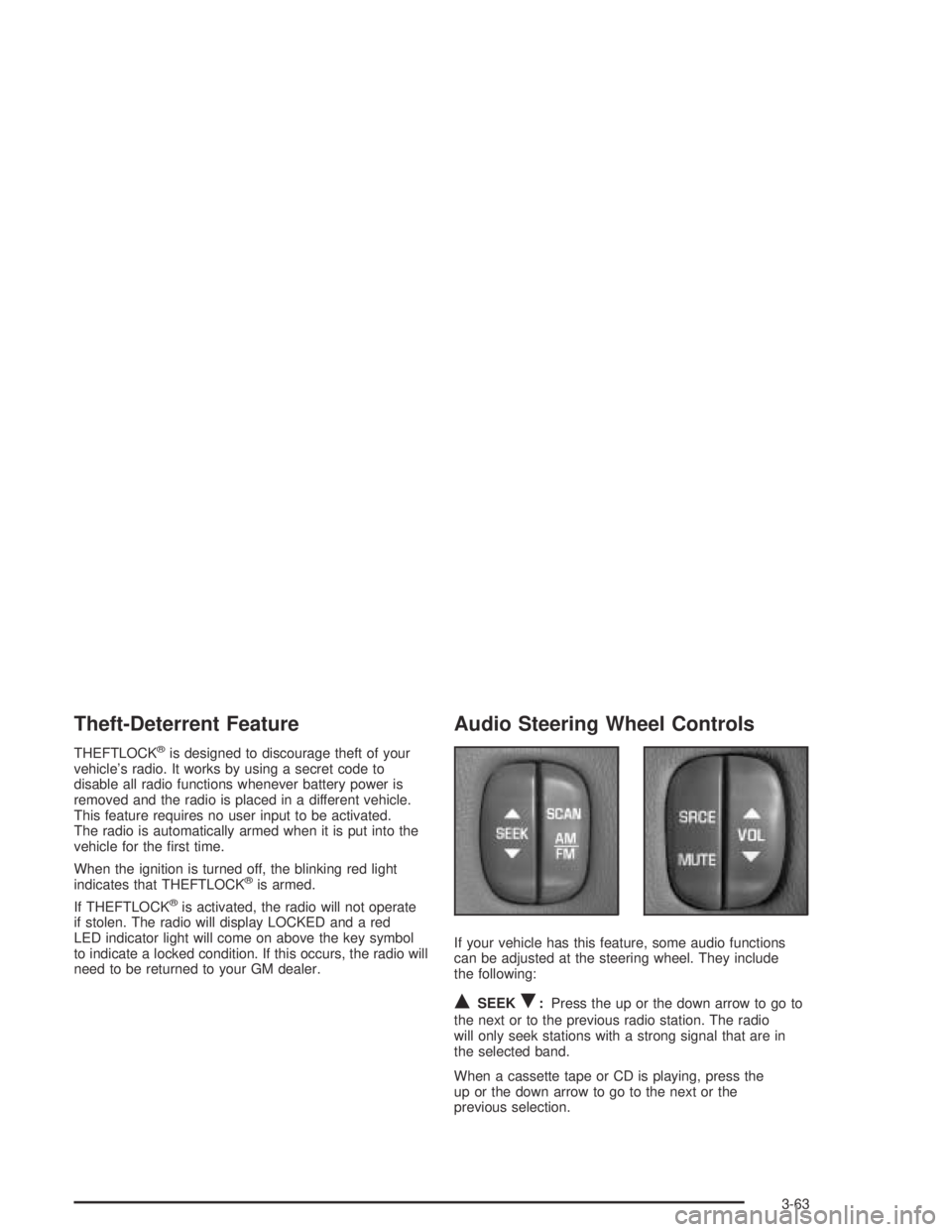
Audio Steering Wheel Controls
If your vehicle has this feature, some audio functions
can be adjusted at the steering wheel. They include
the following:
QSEEKR:Press the up or the down arrow to go to
the next or to the previous radio station. The radio
will only seek stations with a strong signal that are in
the selected band.
When a cassette tape or CD is playing, press the
up or the down arrow to go to the next or the
previous selection.
3-63
Page 165 of 348

Care of Your Cassette Tape Player
A tape player that is not cleaned regularly can cause
reduced sound quality, ruined cassettes, or a damaged
mechanism. Cassette tapes should be stored in their
cases away from contaminants, direct sunlight, and
extreme heat. If they are not, they may not operate
properly or they may cause failure of the tape player.
The tape player should be cleaned regularly after every
50 hours of use. The radio may display CLEAN
PLAYER to indicate that the tape player has been used
for 50 hours without resetting the tape clean timer.
If this message appears on the display, the cassette
tape player needs to be cleaned. It will still play tapes,
but it should be cleaned as soon as possible to
prevent damage to the tapes and player. If there is a
reduction in sound quality, try a known good cassette to
see if the tape or the tape player is at fault. If this
other cassette has no improvement in sound quality,
clean the tape player.
For best results, use a scrubbing action, non-abrasive
cleaning cassette with pads which scrub the tape
head as the hubs of the cleaner cassette turn.
The recommended cleaning cassette is available
through your dealer.The cut tape detection feature of the cassette tape
player may identify the cleaning cassette tape as
a damaged tape, in error. If the cleaning cassette ejects,
insert the cassette at least three times to ensure
thorough cleaning.
A non-scrubbing action, wet-type cleaner which uses a
cassette with a fabric belt to clean the tape head
can be used. This type of cleaning cassette will not
eject on its own. A non-scrubbing action cleaner may not
clean as thoroughly as the scrubbing type cleaner.
The use of a non-scrubbing action, dry-type cleaning
cassette is not recommended.
After the player is cleaned, press and hold the eject
button for ve seconds to reset the CLEAN PLAYER
indicator. The radio will display --- to show the indicator
was reset.
Cassettes are subject to wear and the sound quality
may degrade over time. Always make sure the
cassette tape is in good condition before the tape player
is serviced.
3-65
Page 166 of 348

Care of Your CDs
Handle CDs carefully. Store them in their original
cases or other protective cases and away from direct
sunlight and dust. If the surface of a CD is soiled,
dampen a clean, soft cloth in a mild, neutral detergent
solution and clean it, wiping from the center to the edge.
Be sure never to touch the side without writing when
handling CDs. Pick up CDs by grasping the outer edges
or the edge of the hole and the outer edge.
Care of Your CD Player
The use of CD lens cleaners for CD players is not
advised, due to the risk of contaminating the lens of the
CD optics with lubricants internal to the CD mechanism.
Fixed Mast Antenna
The xed mast antenna can withstand most car washes
without being damaged. If the mast should ever
become slightly bent, straighten it out by hand. If the
mast is badly bent, replace it.
Check occasionally to make sure the mast is still
tightened to the fender. If tightening is required, tighten
by hand, then with a wrench one quarter turn.
Chime Level Adjustment
The radio is the vehicle’s chime producer. To change
the volume level, press and hold pushbutton 6 with
the ignition on and the radio power off. The chime
volume level will change from the normal level to loud,
and Loud Chime Vol will appear on the radio display.
To change back to the default or normal setting, press
and hold pushbutton 6 again. The chime level will
change from the loud level to normal, and Soft Chime
Vol will appear on the radio display. Removing the radio
and not replacing it with a factory radio or chime will
disable vehicle chimes.
3-66
Page 173 of 348
Anti-Lock Brake System (ABS)
Your vehicle may have anti-lock brakes. ABS is an
advanced electronic braking system that will help
prevent a braking skid.
If your vehicle has anti-lock brakes, this warning light on
the instrument panel will come on briey when you
start your vehicle.
When you start your engine, or when you begin to drive
away, your anti-lock brake system will check itself.
You may hear a momentary motor or clicking noise while
this test is going on, and you may even notice that
your brake pedal moves or pulses a little. This is normal.Let us say the road is wet and you are driving safely.
Suddenly, an animal jumps out in front of you. You slam
on the brakes and continue braking. Here is what
happens with ABS:
A computer senses that wheels are slowing down.
If one of the wheels is about to stop rolling, the computer
will separately work the brakes at each wheel. United States
Canada
4-7
Page 174 of 348
The anti-lock system can change the brake pressure
faster than any driver could. The computer is
programmed to make the most of available tire and road
conditions. This can help you steer around the obstacle
while braking hard.
As you brake, your computer keeps receiving updates on
wheel speed and controls braking pressure accordingly.Remember: Anti-lock does not change the time you
need to get your foot up to the brake pedal or always
decrease stopping distance. If you get too close to
the vehicle in front of you, you will not have time to apply
your brakes if that vehicle suddenly slows or stops.
Always leave enough room up ahead to stop, even
though you have anti-lock brakes.
Using Anti-Lock
Do not pump the brakes. Just hold the brake pedal
down rmly and let anti-lock work for you. You may feel
a slight brake pedal pulsation or notice some noise,
but this is normal.
4-8
Page 175 of 348
Braking in Emergencies
At some time, nearly every driver gets into a situation
that requires hard braking.
If you have anti-lock, you can steer and brake at the
same time. However, if you do not have anti-lock, your
rst reaction — to hit the brake pedal hard and hold
it down — may be the wrong thing to do. Your wheels
can stop rolling. Once they do, the vehicle can not
respond to your steering. Momentum will carry it
in whatever direction it was headed when the wheels
stopped rolling. That could be off the road, into the very
thing you were trying to avoid, or into traffic.
If you do not have anti-lock, use a “squeeze” braking
technique. This will give you maximum braking while
maintaining steering control. You can do this by pushing
on the brake pedal with steadily increasing pressure.
In an emergency, you will probably want to squeeze the
brakes hard without locking the wheels. If you hear or
feel the wheels sliding, ease off the brake pedal.
This will help you retain steering control. If youdohave
anti-lock, it is different. SeeAnti-Lock Brake System
(ABS) on page 4-7
In many emergencies, steering can help you more than
even the very best braking.
Enhanced Traction System (ETS)
If the vehicle has an Enhanced Traction System (ETS)
it will limit wheel spin. This is especially useful in
slippery road conditions. The system operates only if
it senses that one or both of the front wheels are
spinning or beginning to lose traction. When this
happens, the system reduces engine power and may
also upshift the transaxle to limit wheel spin.
This light will come on the
instrument panel cluster
while the ETS is limiting
wheel spin. SeeEnhanced
Traction System Warning
Light on page 3-34.
You may feel or hear the system working, but this
is normal.
If the vehicle is in cruise control when the enhanced
traction system begins to limit wheel spin, the cruise
control will automatically disengage. The cruise control
can be used again when road conditions allow safe
use of it. See “Cruise Control” underTurn
Signal/Multifunction Lever on page 3-7.
4-9
Page 176 of 348

The ETS operates in THIRD (3) and AUTOMATIC
OVERDRIVE (
X). If the vehicle is in THIRD (3),
the system can upshift the transaxle to AUTOMATIC
OVERDRIVE (
X). The ETS is turned off in
SECOND (2) or FIRST (1) gear, and when the parking
brake is set. SeeAutomatic Transaxle Operation on
page 2-21.
While the ETS is on, this
warning light will come on
the instrument panel
cluster to show that the
system is not limiting
wheel spin.
SeeEnhanced Traction System Warning Light on
page 3-34. Adjust your driving accordingly.
To limit wheel spin, especially in slippery road
conditions, the ETS should always be left on. But the
system can be turned off. The ETS should be turned off
if the vehicle ever gets stuck in sand, mud or snow
and rocking the vehicle is required. See “Rocking Your
Vehicle To Get It Out” underIf You Are Stuck:
In Sand, Mud, Ice or Snow on page 4-30.To turn the system off, move the gear shift lever to
FIRST (1) or SECOND (2) gear. See “Rocking Your
Vehicle To Get It Out” underIf You Are Stuck: In Sand,
Mud, Ice or Snow on page 4-30. When the system is
turned off, the TRAC OFF warning light will come on
and stay on. If the ETS is limiting wheel spin when
the system is turned off, the TRAC OFF light will
come on – but the ETS will not turn off right away.
It will continue to operate until there is no longer a
need to limit wheel spin.
4-10


