Page 57 of 92
Downloaded from www.Manualslib.com manuals search engine 59
326_120
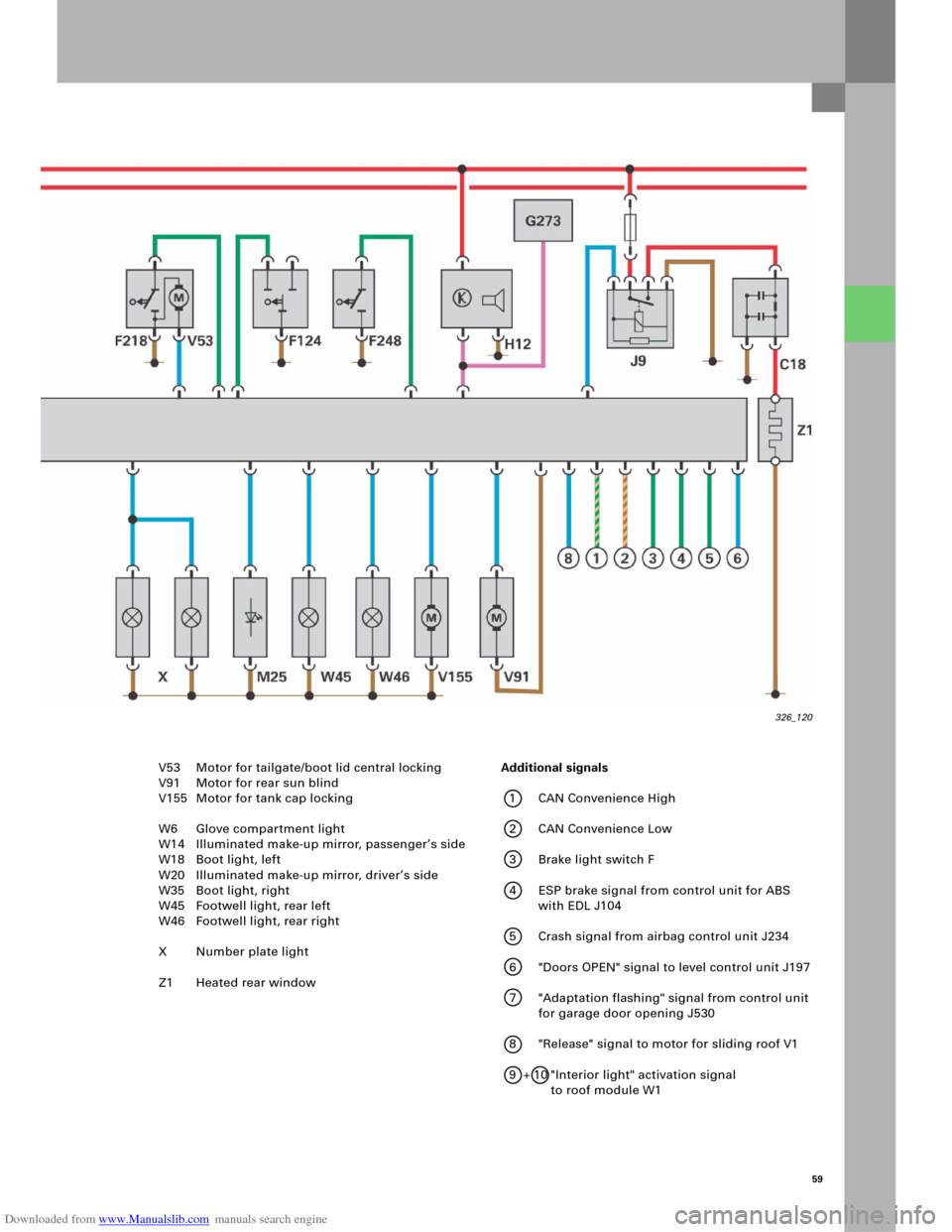
V53 Motor for tailgate/boot lid central locking
V91 Motor for rear sun blind
V155 Motor for tank cap locking
W6 Glove compartment light
W14 Illuminated make-up mirror, passenger’s side
W18 Boot light, left
W20 Illuminated make-up mirror, driver’s side
W35 Boot light, right
W45 Footwell light, rear left
W46 Footwell light, rear right
X Number plate light
Z1 Heated rear window Additional signals
1CAN Convenience High
2CAN Convenience Low
3 Brake light switch F
4 ESP brake signal from control unit for ABS
with EDL J104
5 Crash signal from airbag control unit J234
6 "Doors OPEN" signal to level control unit J197
7 "Adaptation flashing" signal from control unit
for garage door opening J530
8 "Release" signal to motor for sliding roof V1
9 + 10 "Interior light" activation signal
to roof module W1
Page 58 of 92
Downloaded from www.Manualslib.com manuals search engine 60
Diagnosis
The central control unit for convenience
system, J393, has the usual diagnostic functions,
such as read fault memory, read measured value
blocks, adaptation, coding, as well as selective and
sequential actuator test at its disposal.
Actuator test
The selective actuator test initiated by the diagnosis
tester can be used to check the following actuators:
– Indicator light for safe central locking K133
(in door rim)
– Lock central locking signal (once)
– Activate safe locking for doors (once)
– Unlock central locking signal
– Lock filler flap
– Unlock filler flap
– Lamp for left brake light M9
– Lamp for right brake light M10
– Lamp for high-level brake light M25
– Lamps for tail light, left
– Lamp for parking light, left M43
– Lamps for tail light, right
– Lamp for parking light, right M44
– Lamp for reversing light, left M16
– Lamp for reversing light, right M17
– Lamp for direction indicator light, rear left M6
– Lamp for direction indicator light, rear right M8
– Lamp for rear fog light, left L46
– Lamp for rear fog light, right L47
Coding
This diagnostic option can be used to perform
coding, for example, for these functions:
– Anti-theft warning system
– Central locking (normal/selective)
–Tilt sensor
– Passenger compartment sensor
– Convenience function via radio
–Right-hand traffic
–Avant detection
–Rear sun blind
Convenience electrics
Note
In addition to the selective actuator test,
the diagnosis software also includes the option
of a sequential actuator test.
– Number plate light X
– Boot light W3
– Footwell light, rear left W45
– Footwell light, rear right W46
– Activation of rear lid remote unlocking
(rotary latch opens, closing aid moves up)
– Motor for rear sun blind (rear sun blind moves in
both directions)
– Signal for rear window heater activation
–Interior lighting
– Acknowledgement of anti-theft warning system
horn
–RoW/USA
–Light package
– Tank cap lock detection
– Equipment (Basic/High-Line)
–Sliding roof
– Multi-function control unit (taxi/emergency
doctor/fire brigade, installed/not installed)
Page 61 of 92
Downloaded from www.Manualslib.com manuals search engine 63
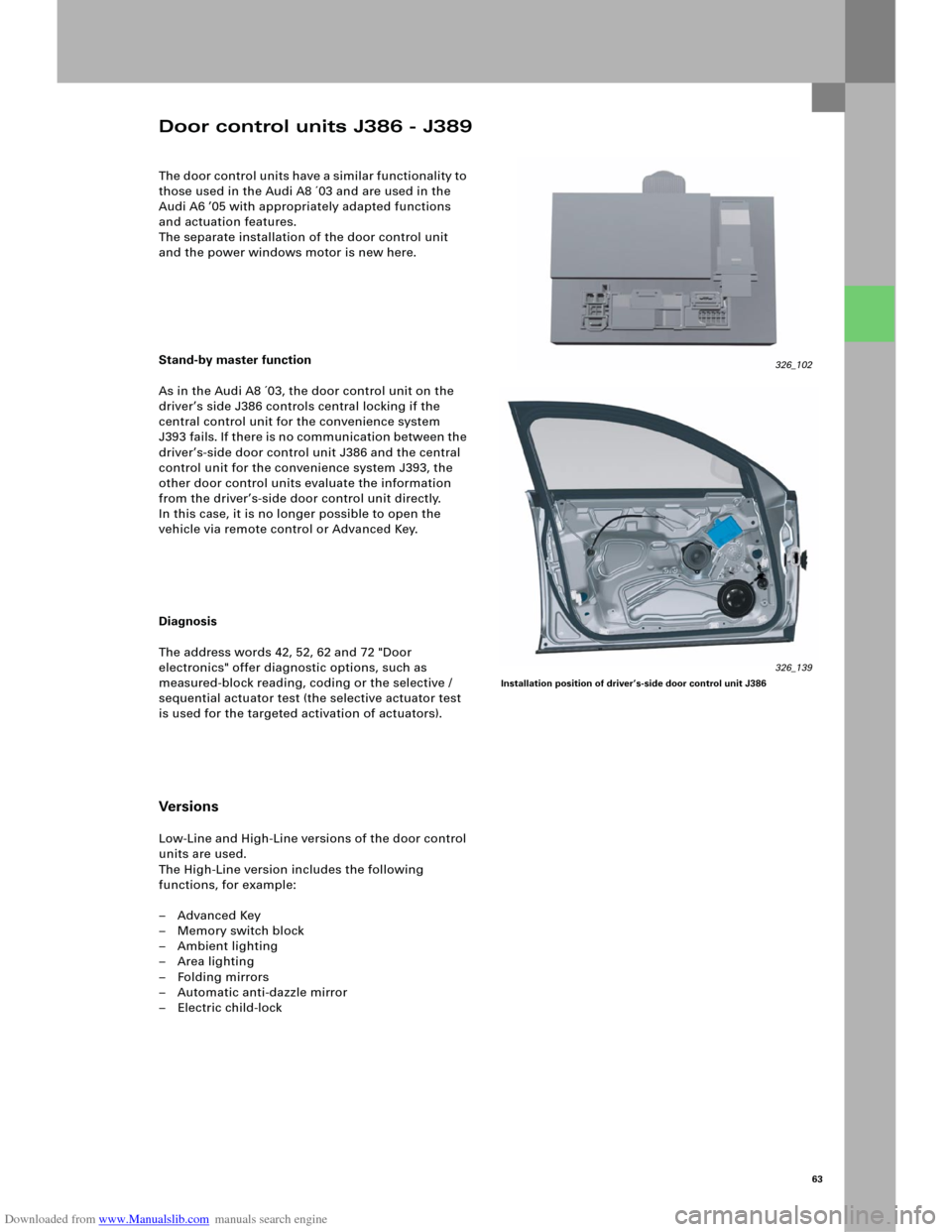
The door control units have a similar functionality to
those used in the Audi A8 ´03 and are used in the
Audi A6 ’05 with appropriately adapted functions
and actuation features.
The separate installation of the door control unit
and the power windows motor is new here.
Stand-by master function
As in the Audi A8 ´03, the door control unit on the
driver’s side J386 controls central locking if the
central control unit for the convenience system
J393 fails. If there is no co mmunic atio n b etw een the
driver’s-side door control unit J386 and the central
control unit for the convenience system J393, the
other door control units evaluate the information
from the driver’s-side door control unit directly.
In this case, it is no longer possible to open the
vehicle via remote control or Advanced Key.
Diagnosis
The address words 42, 52, 62 and 72 "Door
electronics" offer diagnostic options, such as
measured-block reading, coding or the selective /
sequential actuator test (the selective actuator test
is used for the targeted activation of actuators).
Versi on s
Low-Line and High-Line versions of the door control
units are used.
The High-Line version includes the following
functions, for example:
– Advanced Key
– Memory switch block
– Ambient lighting
–Area lighting
–Folding mirrors
– Automatic anti-dazzle mirror
– Electric child-lock
Installation position of driver’s-side door control unit J386326_139
Door control units J386 - J389
326_102
Page 62 of 92
Downloaded from www.Manualslib.com manuals search engine 64
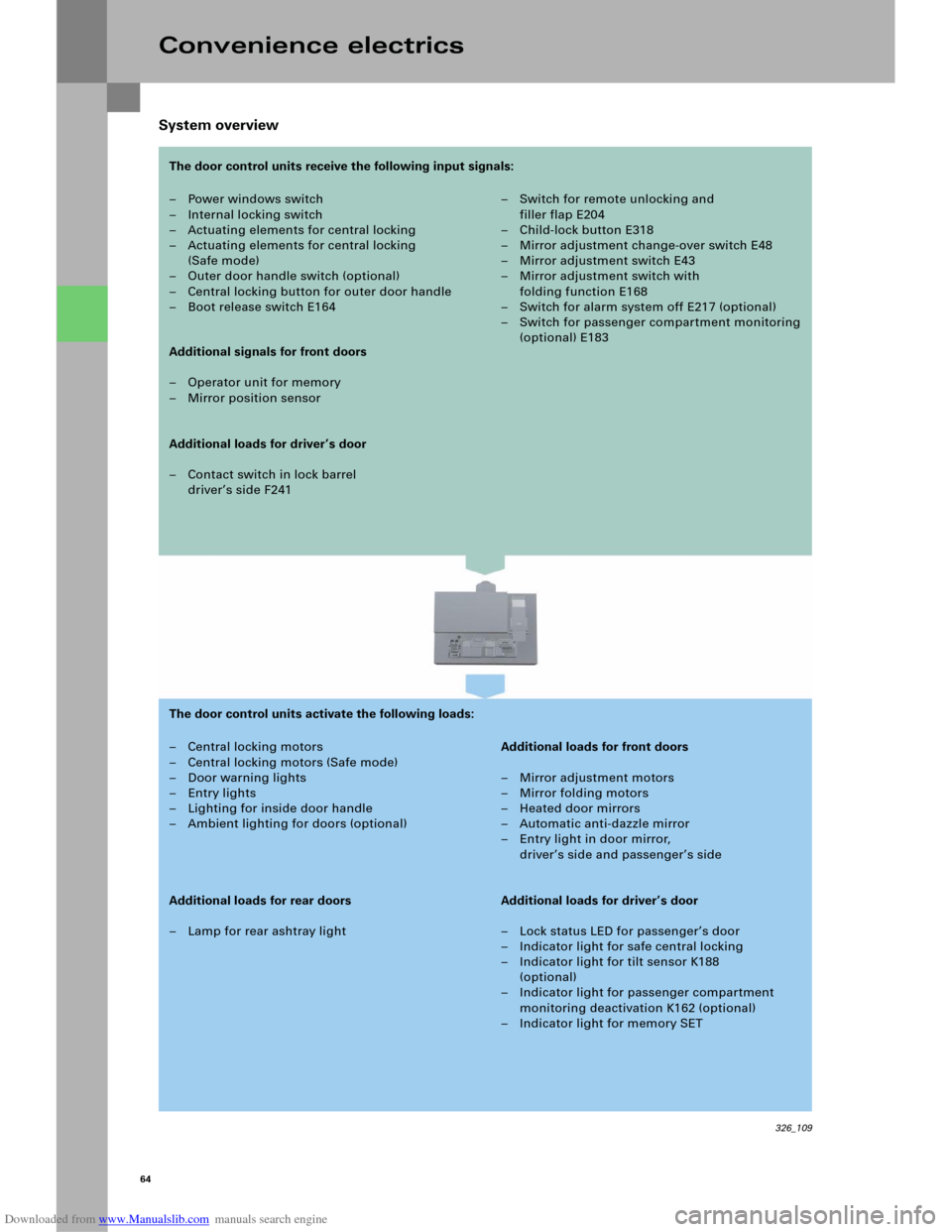
System overview
Convenience electrics
– Power windows switch
– Internal locking switch
– Actuating elements for central locking
– Actuating elements for central locking
(Safe mode)
– Outer door handle switch (optional)
– Central locking button for outer door handle
– Boot release switch E164– Switch for remote unlocking and
filler flap E204
–Child-lock button E318
– Mirror adjustment change-over switch E48
–Mirror adjustment switch E43
– Mirror adjustment switch with
folding function E168
– Switch for alarm system off E217 (optional)
– Switch for passenger compartment monitoring
(optional) E183
Additional signals for front doors
– Operator unit for memory
– Mirror position sensor
Additional loads for driver’s door
– Contact switch in lock barrel
driver’s side F241
– Central locking motors
– Central locking motors (Safe mode)
– Door warning lights
–Entry lights
– Lighting for inside door handle
– Ambient lighting for doors (optional)Additional loads for front doors
– Mirror adjustment motors
– Mirror folding motors
– Heated door mirrors
– Automatic anti-dazzle mirror
– Entry light in door mirror,
driver’s side and passenger’s side
Additional loads for rear doors
–Lamp for rear ashtray lightAdditional loads for driver’s door
– Lock status LED for passenger’s door
– Indicator light for safe central locking
– Indicator light for tilt sensor K188
(optional)
– Indicator light for passenger compartment
monitoring deactivation K162 (optional)
– Indicator light for memory SET
326_109
The door control units receive the following input signals:
The door control units activate the following loads: