Page 287 of 394

Many states and Canadian provinces
require special outside mirrors when
towing a trailer. Even if they don’t,
you should install special mirrors if
you cannot clearly see behind you, or
if the trailer creates a blind spot.
Askyourtrailersalesorrental
agency if any other items are
recommended or required f or your
towing situation.When preparing to tow, and bef ore
driving away, be sure to check the
f ollowing:
The vehicle has been properly
serviced, and the tires, brakes,
suspension, cooling system, and
lights are in good operating
condition.
Thehitch,safetychains,andany
other attachments are secure.
All items in or on the trailer are
properly secured and cannot shif t
while you drive. All weights and loads are within
limits. Your vehicle tires and spare are
properly inf lated, and the trailer
tires and spare are inflated as
recommended by the trailer
maker. The lights and brakes on your
vehicle and the trailer are working
properly.
A dditional T owing Equipment Pre-T ow Checklist
Towing a Trailer
286
Page 288 of 394
�µ�µ
�µ �µ
�µ �µ
The added weight, length, and
height of a trailer will af f ect your
vehicle’s handling and perf ormance,
so driving with a trailer requires
some special driving skills and
techniques.
Foryoursafetyandthesafetyof
others,taketimetopracticedriving
maneuvers bef ore heading f or the
open road, and f ollow the guidelines
below.
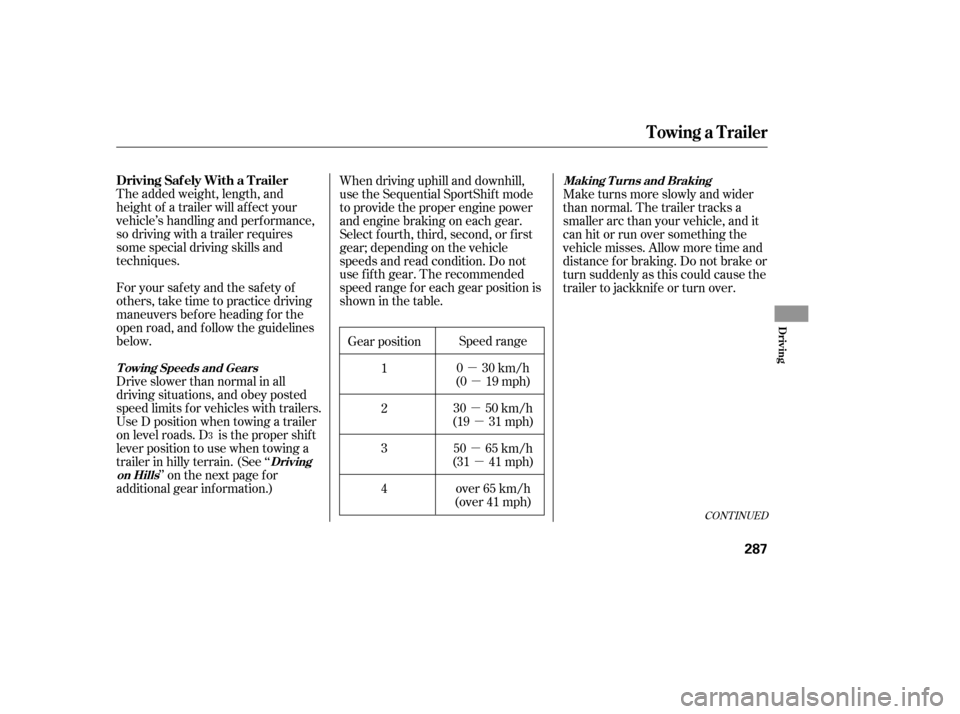
When driving uphill and downhill,
use the Sequential SportShif t mode
to provide the proper engine power
and engine braking on each gear.
Select f ourth, third, second, or f irst
gear; depending on the vehicle
speeds and read condition. Do not
use f if th gear. The recommended
speed range f or each gear position is
showninthetable.
Speed range
030km/h
(0 19 mph)
30 50 km/h
(19 31 mph)
50 65 km/h
(31 41 mph)
over 65 km/h
(over 41 mph) Maketurnsmoreslowlyandwider
than normal. The trailer tracks a
smaller arc than your vehicle, and it
canhitorrunoversomethingthe
vehicle misses. Allow more time and
distance f or braking. Do not brake or
turn suddenly as this could cause the
trailer to jackknif e or turn over.
Drive slower than normal in all
driving situations, and obey posted
speed limits f or vehicles with trailers.
Use D position when towing a trailer
on level roads. D is the proper shif t
lever position to use when towing a
trailer in hilly terrain. (See ‘‘ ’’onthenextpagefor
additional gear information.) Gear position
1
2
3
4
3
CONT INUED
Driving Saf ely With a T railer
T owing Speeds and Gears Making T urns and Braking
Driving
on Hills
Towing a Trailer
Driving
287
Page 289 of 394

Crosswinds and air turbulence
caused by passing trucks can disrupt
your steering and cause trailer to
sway. When being passed by a large
vehicle, keep a constant speed, and
steer straight ahead. Do not try to
make quick steering or braking
corrections.
Follow all normal precautions when
parking, including f irmly setting the
parking brake and putting the
transmission in Park. Also, place
wheel chocks at each of the trailer’s
tires.
When driving down hills, reduce
your speed, and shif t down to second
gear. Do not ‘‘ride’’ the brakes, and
remember, it will take longer to slow
downandstopwhentowingatrailer. If you must stop when f acing uphill,
use the f oot brake or parking brake.
Do not try to hold the vehicle in
placebypressingontheaccelerator,
as this can cause the automatic
transmission to overheat. When climbing hills, closely watch
your temperature gauge. If it nears
the red (hot) mark, turn the air
conditioning of f , reduce speed and, if
necessary, pull to the side of the
road to let the engine cool.
If the automatic transmission shif ts
f requently while going up a hill, shif t
to D .
Always drive slowly and have
someone guide you when backing up.
Grip the of the steering
wheel; turn the wheel to the lef t to
get the trailer to move to the lef t,
andturnthewheelrighttomovethe
trailer to the right.
3
bottom
Backing Up
Handling Crosswinds and Buf f et ing
Parking
Driving on Hills
Towing a Trailer
288
Page 301 of 394

Maintenance Minder
300
Maintenance Sub Items
Rotate tires
Replace air cleaner element If you drive in dusty conditions, replace every 15,000
miles (24,000 km).
Replace dust and pollen filter If you drive primarily in urban areas that have high
concentrations of soot in the air from industry and
from diesel-powered vehicles, replace every 15,000
miles (24,000 km).
Inspect drive belt
Replace transmission fluid and transfer fluid Driving in mountainous areas at very low vehicle
speeds or trailer towing results in higher
transmission and transfer temperatures.
This requires transmission and transfer fluid changes
more frequently than recommended by the
Maintenance Minder. If you regulary drive your
vehicle under these conditions, have the transmission
and transfer fluid changed at 60,000 miles
(100,000 km), then every 30,000 miles (48,000 km).
Replace spark plugs
Replace timing belt and inspect water pump If you drive regularly in very high temperatures (over
110°F, 43°C), or in very low temperatures (under-20°F,
29°C), replace every 60,000 mile (U.S.)/100,000 km
(Canada)
Inspect valve clearance
Replace engine coolant Maintenance Sub Items
Replace rear differential fluid Driving in mountainous areas at very low vehicle
speeds or trailer towing results in higher level of
mechanical (shear) stress to fluid This requires
differential fluid changes more frequently than
recommended by the Maintenance Minder. If you
regulary drive your vehicle under these conditions,
have the differential fluid changed at 7,500 miles
(12,000 km), then every 15,000 miles (24,000 km).
Symbol
1
2
3
4
5 Symbol
6
Maintenance Minder
Page 336 of 394

This section covers the more
common problems that motorists
experience with their vehicles. It
gives you inf ormation about how to
safely evaluate the problem and what
to do to correct it. If the problem has
stranded you on the side of the road,
you may be able to get going again.
If not, you will also f ind instructions
on getting your vehicle towed.......................
Compact Spare Tire .336
....................
Changing a Flat Tire .337
.............
If the Engine Won’t Start . 341
................................
Jump Starting .343
..............
If the Engine Overheats . 345
.........
Low Oil Pressure Indicator . 348
..........
Charging System Indicator . 348
.......
Malf unction Indicator Lamp . 349
...............
Brake System Indicator . 350
Opening the Fuel Fill Door ....................................
Manually .351
..............................................
Fuses .352
..............................
Fuse Locations .357
......................
Emergency Towing .360
..........
If Your Vehicle Gets Stuck . 361
Taking Care of the Unexpected
T aking Care of t he Unexpect ed
335
Page 343 of 394
In this case, the starter motor’s
speed sounds normal, or even f aster
than normal, when you turn the
ignition switch to START (III), but
the engine does not run.Are you using the proper starting
procedure? Ref er to on page . There may be an electrical
problem, such as no power to the
f uel pump. Check all the f uses
(see page ).
If youfindnothingwrong,youwill
need a qualif ied technician to f ind
the problem. See on page .
Are you using a properly coded
built-in key or remote? An
improperly coded built-in key or
remote will cause the immobilizer
system indicator in the instrument
panel to blink rapidly (see page ).
Do you have f uel? Check the f uel
gauge; the low f uel indicator may
not be working. 114 263
352
360
T he Starter Operates Normally
Starting the
Engine Emergency
Towing
If theEngineWon’tStart
342
Page 346 of 394

The pointer of the vehicle’s
temperature gauge should stay in
the midrange. If it climbs to the red
mark, you should determine the
reason (hot day, driving up a steep
hill, etc.).
If your vehicle overheats, you should
take immediate action. The only
indication may be the temperature
gauge climbing to or above the red
mark. Or you may see steam or
spray coming f rom under the hood.If you do not see steam or spray,
leave the engine running, and
watch the temperature gauge. If
the high heat is due to overloading,
the engine should start to cool
down almost immediately. If it
does, wait until the temperature
gauge comes down to the midpoint,
then continue driving.
If the temperature gauge stays at
the red mark, turn off the engine.
Look f or any obvious coolant leaks,
such as a split radiator hose.
Everything is still extremely hot,
so use caution. If you f ind a leak, it
must be repaired bef ore you
continue driving (see
on page ).
If you see steam and/or spray
coming f rom under the hood,
turn of f the engine. Wait until
you see no more signs of steam
or spray, then open the hood. Saf ely pull to the side of the road.
Put the transmission in Park, and
set the parking brake. Turn of f all
accessories, and turn on the
hazard warning indicators.
1.
2. 3.
4.
5.
360
CONT INUED
Emergency
Towing
If theEngineOverheats
T aking Care of t he Unexpect ed
345
Steam and spray from an
overheated engine can
seriously scald you.
Do not open the hood if steam
is coming out.
Driving with the temperature gauge
pointer at the red mark can cause
serious damage to the engine.
Page 347 of 394

If you do not f ind an obvious leak,
check the coolant level in the
radiator reserve tank. Add coolant
if the level is below the MIN mark.
If there was no coolant in the
reserve tank, you may need to add
coolant to the radiator. Let the
engine cool down until the pointer
reaches the middle of the tempera-
ture gauge, or lower, bef ore check-
ing the radiator.Using gloves or a large heavy
cloth, turn the radiator cap
counterclockwise, without pushing
down, to the f irst stop. Af ter the
pressure releases, push down on
the cap, and turn it until it comes
off.
Put the radiator cap back on
tightly. Run the engine, and watch
the temperature gauge. If it goes
back to the red mark, the engine
needs repair (see
on page ).
If the temperature stays normal,
check the coolant level in the
radiator reserve tank. If it has
gone down, add coolant to the
MAX mark. Put the cap back on
tightly.
Start the engine, and set the
interior temperature to maximum
(climate control to FULL AUTO at
‘‘ ’’). Add coolant to the
radiator up to the base of the f iller
neck. If you do not have the
proper coolant mixture available,
you can add plain water.
Remember to have the cooling
system drained and ref illed with
the proper mixture as soon as you
can.
6.
7.
8.
9.10.
11. 360
Emergency
Towing
If theEngineOverheats
346
Removing the radiator cap
while the engine is hot can
cause the coolant to spray out,
seriously scalding you.
Always let the engine and
radiator cool down before
removing the radiator cap.
