2004 YAMAHA YBR125 oil
[x] Cancel search: oilPage 63 of 83
6-23
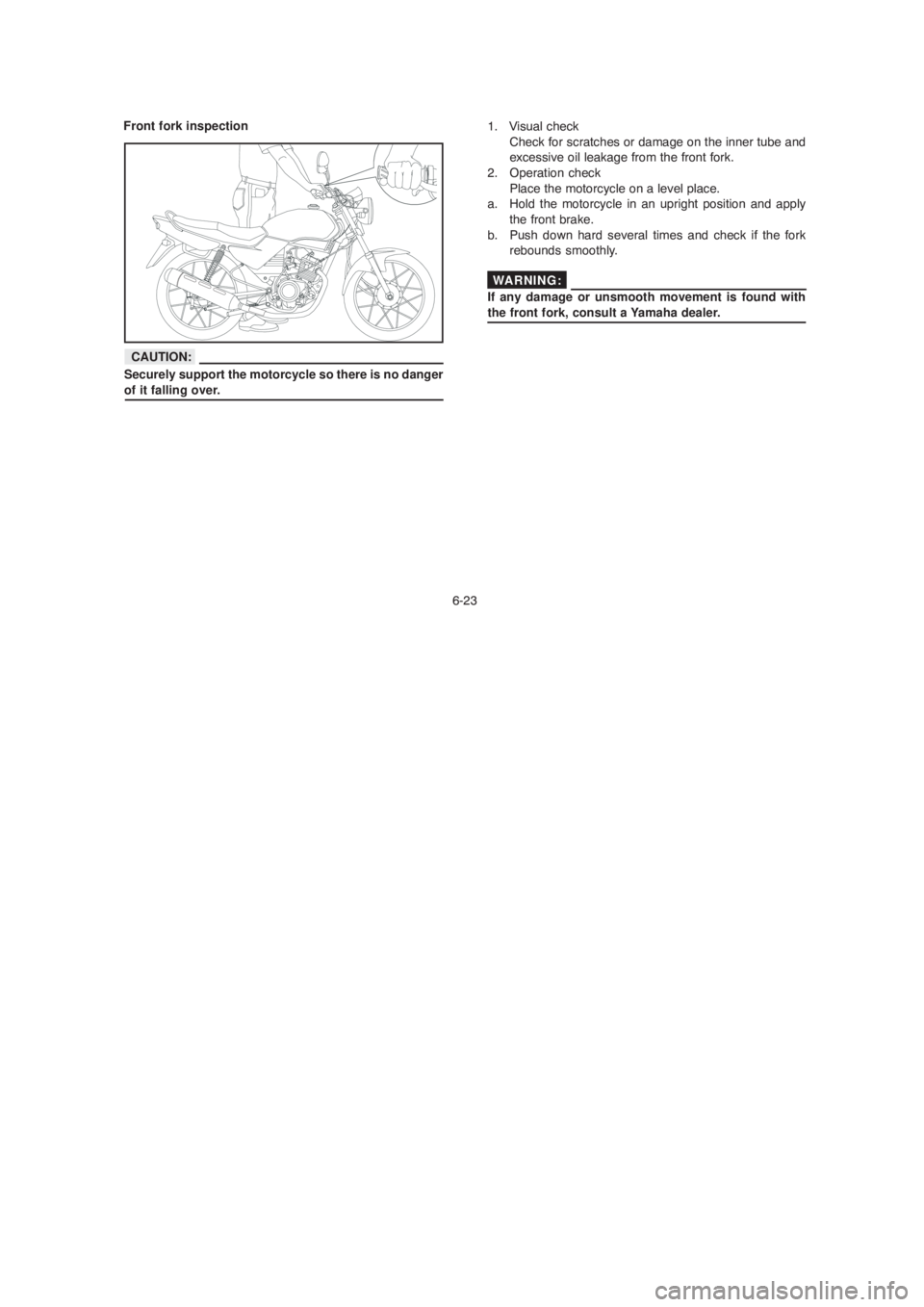
1. Visual check
Check for scratches or damage on the inner tube and
excessive oil leakage from the front fork.
2. Operation check
Place the motorcycle on a level place.
a. Hold the motorcycle in an upright position and apply
the front brake.
b. Push down hard several times and check if the fork
rebounds smoothly.
If any damage or unsmooth movement is found with
the front fork, consult a Yamaha dealer. Front fork inspection
Securely support the motorcycle so there is no danger
of it falling over.
CAUTION:
WARNING:
6-23
1. Visual check
Check for scratches or damage on the inner tube and
excessive oil leakage from the front fork.
2. Operation check
Place the motorcycle on a level place.
a. Hold the motorcycle in an upright position and apply
the front brake.
b. Push down hard several times and check if the fork
rebounds smoothly.
If any damage or unsmooth movement is found with
the front fork, consult a Yamaha dealer. Front fork inspection
Securely support the motorcycle so there is no danger
of it falling over.
CAUTION:
WARNING:
Page 66 of 83
6-26
Battery electrolyte is poisonous and dangerous,
causing severe burns, etc. It contains sulfuric acid.
Avoid contact with skin, eyes or clothing.
Antidote:
EXTERNAL: Flush with water.
INTERNAL: Drink large quantities of water or milk.
Follow with milk of magnesia, beaten egg, or vegetable
oil. Call a physician immediately.
EYES: Flush with water for 15 minutes and get prompt
medical attention.
Batteries produce explosive gases. Keep sparks, flame,
cigarrettes, etc., away. Ventilate when charging or using
it in an enclosed space. Always shield your eyes when
working near batteries.
KEEP OUT OF REACH OF CHILDREN.
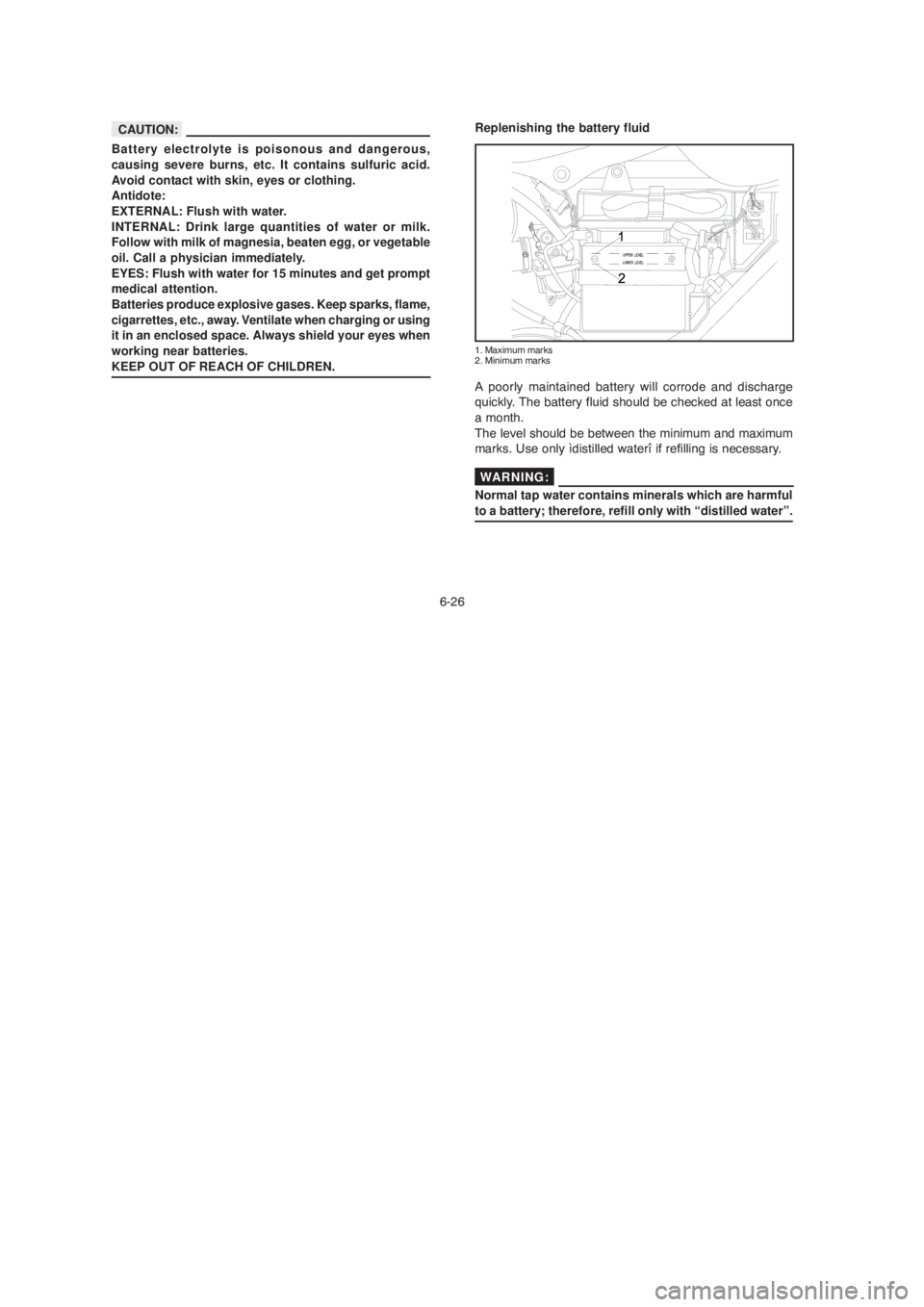
A poorly maintained battery will corrode and discharge
quickly. The battery fluid should be checked at least once
a month.
The level should be between the minimum and maximum
marks. Use only ìdistilled waterî if refilling is necessary.
Normal tap water contains minerals which are harmful
to a battery; therefore, refill only with “distilled water”. Replenishing the battery fluid
1. Maximum marks
2. Minimum marks
CAUTION:
WARNING:
6-26
Battery electrolyte is poisonous and dangerous,
causing severe burns, etc. It contains sulfuric acid.
Avoid contact with skin, eyes or clothing.
Antidote:
EXTERNAL: Flush with water.
INTERNAL: Drink large quantities of water or milk.
Follow with milk of magnesia, beaten egg, or vegetable
oil. Call a physician immediately.
EYES: Flush with water for 15 minutes and get prompt
medical attention.
Batteries produce explosive gases. Keep sparks, flame,
cigarrettes, etc., away. Ventilate when charging or using
it in an enclosed space. Always shield your eyes when
working near batteries.
KEEP OUT OF REACH OF CHILDREN.
A poorly maintained battery will corrode and discharge
quickly. The battery fluid should be checked at least once
a month.
The level should be between the minimum and maximum
marks. Use only ìdistilled waterî if refilling is necessary.
Normal tap water contains minerals which are harmful
to a battery; therefore, refill only with “distilled water”. Replenishing the battery fluid
1. Maximum marks
2. Minimum marks
CAUTION:
WARNING:
Page 69 of 83

6-29
1. Bulb
4. Put a new bulb, install the socket and the bulb rubber
cover.
5. Reconnect the connectors.
6. Reinstall the headlight assy. If it is necessary to adjust
the headlight beam, please consult a Yamaha dealer.
Avoid touching the glass part of the headlight bulb to
keep it free from oil, otherwise the transparency of
the glass, the life of the bulb and the luminous flux
will be adversely affected. If the headlight bulb gets
soiled, thoroughly clean it with a cloth moistened with
alcohol or lacquer thinner.
WARNING:
6-29
1. Bulb
4. Put a new bulb, install the socket and the bulb rubber
cover.
5. Reconnect the connectors.
6. Reinstall the headlight assy. If it is necessary to adjust
the headlight beam, please consult a Yamaha dealer.
Avoid touching the glass part of the headlight bulb to
keep it free from oil, otherwise the transparency of
the glass, the life of the bulb and the luminous flux
will be adversely affected. If the headlight bulb gets
soiled, thoroughly clean it with a cloth moistened with
alcohol or lacquer thinner.
WARNING:
Page 77 of 83
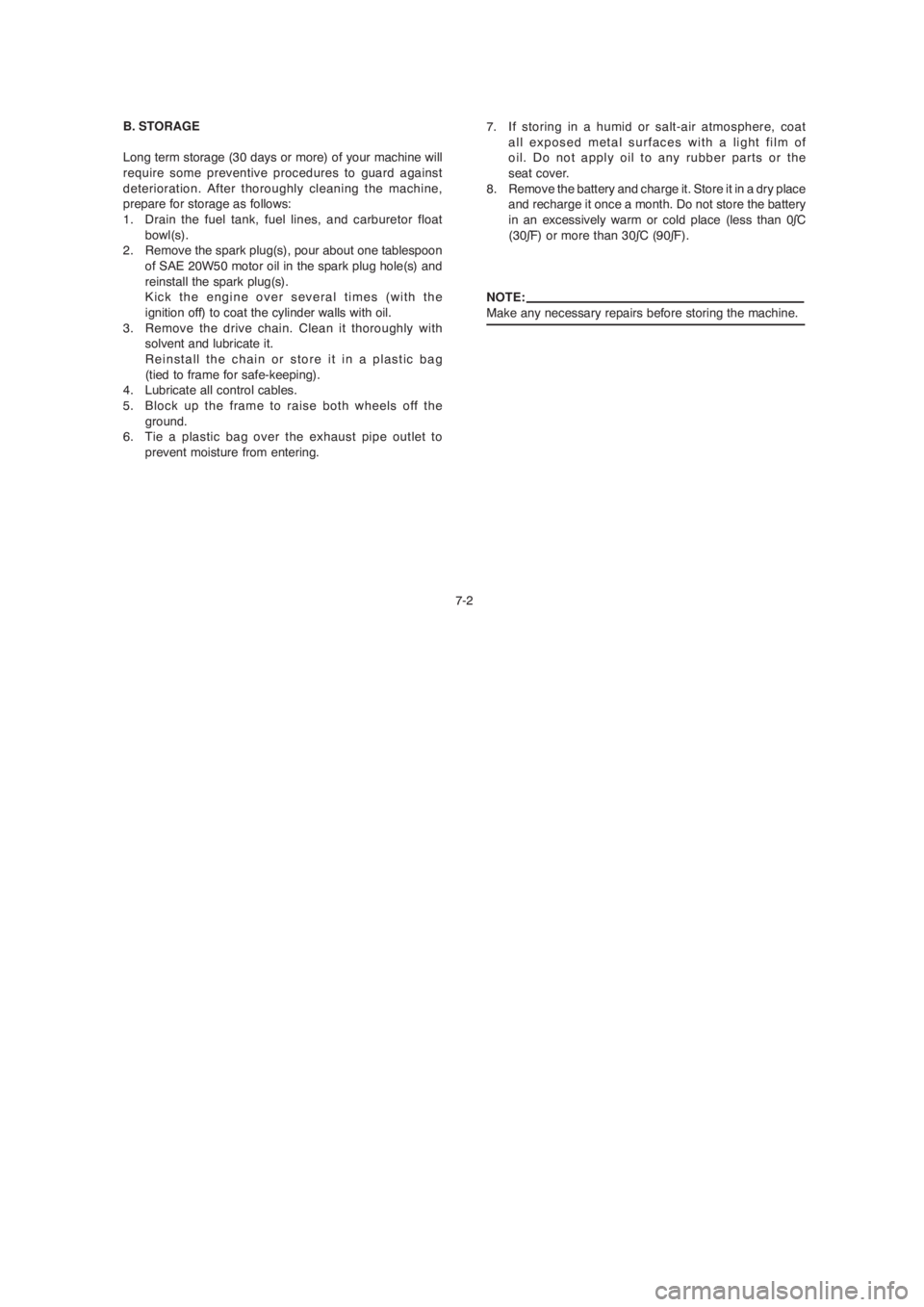
7-2 B. STORAGE
Long term storage (30 days or more) of your machine will
require some preventive procedures to guard against
deterioration. After thoroughly cleaning the machine,
prepare for storage as follows:
1. Drain the fuel tank, fuel lines, and carburetor float
bowl(s).
2. Remove the spark plug(s), pour about one tablespoon
of SAE 20W50 motor oil in the spark plug hole(s) and
reinstall the spark plug(s).
Kick the engine over several times (with the
ignition off) to coat the cylinder walls with oil.
3. Remove the drive chain. Clean it thoroughly with
solvent and lubricate it.
Reinstall the chain or store it in a plastic bag
(tied to frame for safe-keeping).
4. Lubricate all control cables.
5. Block up the frame to raise both wheels off the
ground.
6. Tie a plastic bag over the exhaust pipe outlet to
prevent moisture from entering.7. If storing in a humid or salt-air atmosphere, coat
all exposed metal surfaces with a light film of
oil. Do not apply oil to any rubber parts or the
seat cover.
8. Remove the battery and charge it. Store it in a dry place
and recharge it once a month. Do not store the battery
in an excessively warm or cold place (less than 0∫C
(30∫F) or more than 30∫C (90∫F).
NOTE:
Make any necessary repairs before storing the machine.
7-2 B. STORAGE
Long term storage (30 days or more) of your machine will
require some preventive procedures to guard against
deterioration. After thoroughly cleaning the machine,
prepare for storage as follows:
1. Drain the fuel tank, fuel lines, and carburetor float
bowl(s).
2. Remove the spark plug(s), pour about one tablespoon
of SAE 20W50 motor oil in the spark plug hole(s) and
reinstall the spark plug(s).
Kick the engine over several times (with the
ignition off) to coat the cylinder walls with oil.
3. Remove the drive chain. Clean it thoroughly with
solvent and lubricate it.
Reinstall the chain or store it in a plastic bag
(tied to frame for safe-keeping).
4. Lubricate all control cables.
5. Block up the frame to raise both wheels off the
ground.
6. Tie a plastic bag over the exhaust pipe outlet to
prevent moisture from entering.7. If storing in a humid or salt-air atmosphere, coat
all exposed metal surfaces with a light film of
oil. Do not apply oil to any rubber parts or the
seat cover.
8. Remove the battery and charge it. Store it in a dry place
and recharge it once a month. Do not store the battery
in an excessively warm or cold place (less than 0∫C
(30∫F) or more than 30∫C (90∫F).
NOTE:
Make any necessary repairs before storing the machine.
Page 78 of 83

8-1 SPECIFICATIONS
MODEL YBR 125K
Dimension:
Overall length 1,980 mm ( 78 in)
Overall width 745 mm ( 29 in)
Overall height 1,050 mm ( 41 in)
Seat height 780 mm ( 31 in)
Wheel base 1,290 mm ( 51 in)
Minimum ground clearance 175 mm ( 7 in)
Basic weight: 105 Kg ( 231.5 lb)
With oil and without fuel: 116 Kg ( 255.7 lb)
Minimum turning radius: 1,750 mm ( 70 in)
Engine:
Type Air cooled, 4-stroke gasoline, SOHC
Cylinder arrangement Single cylinder, Forward inclined
Displacement 123.7 cm
3
Bore x Stroke 54 x 54 mm ( 2.13 x 2.13 in)
Compression rate 10.0 : 1
Starting system Kick starter
Lubrication system Wet sump
8-1 SPECIFICATIONS
MODEL YBR 125K
Dimension:
Overall length 1,980 mm ( 78 in)
Overall width 745 mm ( 29 in)
Overall height 1,050 mm ( 41 in)
Seat height 780 mm ( 31 in)
Wheel base 1,290 mm ( 51 in)
Minimum ground clearance 175 mm ( 7 in)
Basic weight: 105 Kg ( 231.5 lb)
With oil and without fuel: 116 Kg ( 255.7 lb)
Minimum turning radius: 1,750 mm ( 70 in)
Engine:
Type Air cooled, 4-stroke gasoline, SOHC
Cylinder arrangement Single cylinder, Forward inclined
Displacement 123.7 cm
3
Bore x Stroke 54 x 54 mm ( 2.13 x 2.13 in)
Compression rate 10.0 : 1
Starting system Kick starter
Lubrication system Wet sump
Page 79 of 83
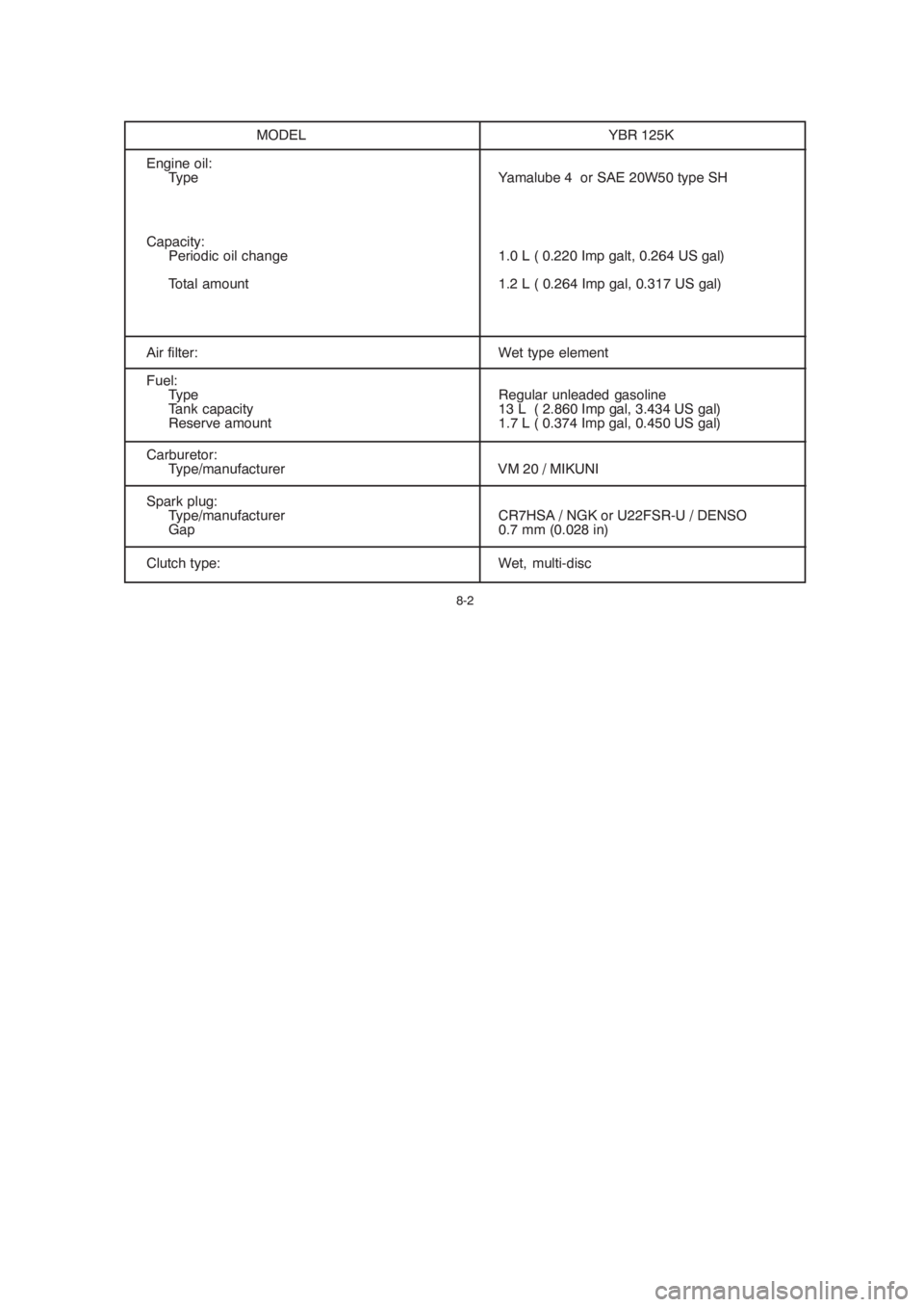
MODEL YBR 125K
Engine oil:
Type Yamalube 4 or SAE 20W50 type SH
Capacity:
Periodic oil change 1.0 L ( 0.220 Imp galt, 0.264 US gal)
Total amount 1.2 L ( 0.264 Imp gal, 0.317 US gal)
Air filter: Wet type element
Fuel:
Type Regular unleaded gasoline
Tank capacity 13 L ( 2.860 Imp gal, 3.434 US gal)
Reserve amount 1.7 L ( 0.374 Imp gal, 0.450 US gal)
Carburetor:
Type/manufacturer VM 20 / MIKUNI
Spark plug:
Type/manufacturer CR7HSA / NGK or U22FSR-U / DENSO
Gap 0.7 mm (0.028 in)
Clutch type: Wet, multi-disc
8-2
MODEL YBR 125K
Engine oil:
Type Yamalube 4 or SAE 20W50 type SH
Capacity:
Periodic oil change 1.0 L ( 0.220 Imp galt, 0.264 US gal)
Total amount 1.2 L ( 0.264 Imp gal, 0.317 US gal)
Air filter: Wet type element
Fuel:
Type Regular unleaded gasoline
Tank capacity 13 L ( 2.860 Imp gal, 3.434 US gal)
Reserve amount 1.7 L ( 0.374 Imp gal, 0.450 US gal)
Carburetor:
Type/manufacturer VM 20 / MIKUNI
Spark plug:
Type/manufacturer CR7HSA / NGK or U22FSR-U / DENSO
Gap 0.7 mm (0.028 in)
Clutch type: Wet, multi-disc
8-2
Page 81 of 83

8-4
MODEL YBR 125K
Brakes:
Front brake type Drum brake
Operation Right hand operation
Rear brake type Drum brake
Operation Right foot operation
Suspension:
Front Telescopic fork
Rear Swingarm (New monocross suspension)
Shock absorber:
Front Coil spring, Oil damper
Rear Gas, Coil spring, Oil damper
Front 120 mm ( 5.0 in)
Rear 105 mm ( 4.0 in)
Electrical:
Ignition system CDI
Generator system AC Magneto generator
Battery type / capacity 12N 5,5-3B / 12V 5,5 Ah
8-4
MODEL YBR 125K
Brakes:
Front brake type Drum brake
Operation Right hand operation
Rear brake type Drum brake
Operation Right foot operation
Suspension:
Front Telescopic fork
Rear Swingarm (New monocross suspension)
Shock absorber:
Front Coil spring, Oil damper
Rear Gas, Coil spring, Oil damper
Front 120 mm ( 5.0 in)
Rear 105 mm ( 4.0 in)
Electrical:
Ignition system CDI
Generator system AC Magneto generator
Battery type / capacity 12N 5,5-3B / 12V 5,5 Ah