2004 VOLKSWAGEN BEETLE air
[x] Cancel search: airPage 106 of 138
Downloaded from www.Manualslib.com manuals search engine Speed lirniter
~~~~n~t~ro~d~t~tc~t~io~r~,-----------------------------------------------
hi , h:.1~t r ntains inf nn3tion on th e fo llo wing
subjt 't ~:
lmd indi 1t r I mp . . . . . . . 222
d
limit er . . . . . . . . . . . . . . . 223
h s~ d limit r hel~ t11e driv er n ot to excee d an
individua l ~t r d ~ d wh en driving forwards at
~ t ds f 3~pr im ate ly 30 km /h (20 m ph) and
~1b -
Addition3l Information and w arnings:
• IKm in g g r page 169
• ruls Co ntro l Syst em (CCS) ==-page 218
• dnptive Cruise Con trol (ACC ) ~page 226
• Ac -s ri s, m odifications , re pairs and re newa l
f parts ~ pRge 320
Display & warning and indicator lamp
®
©
' B~K Oot06
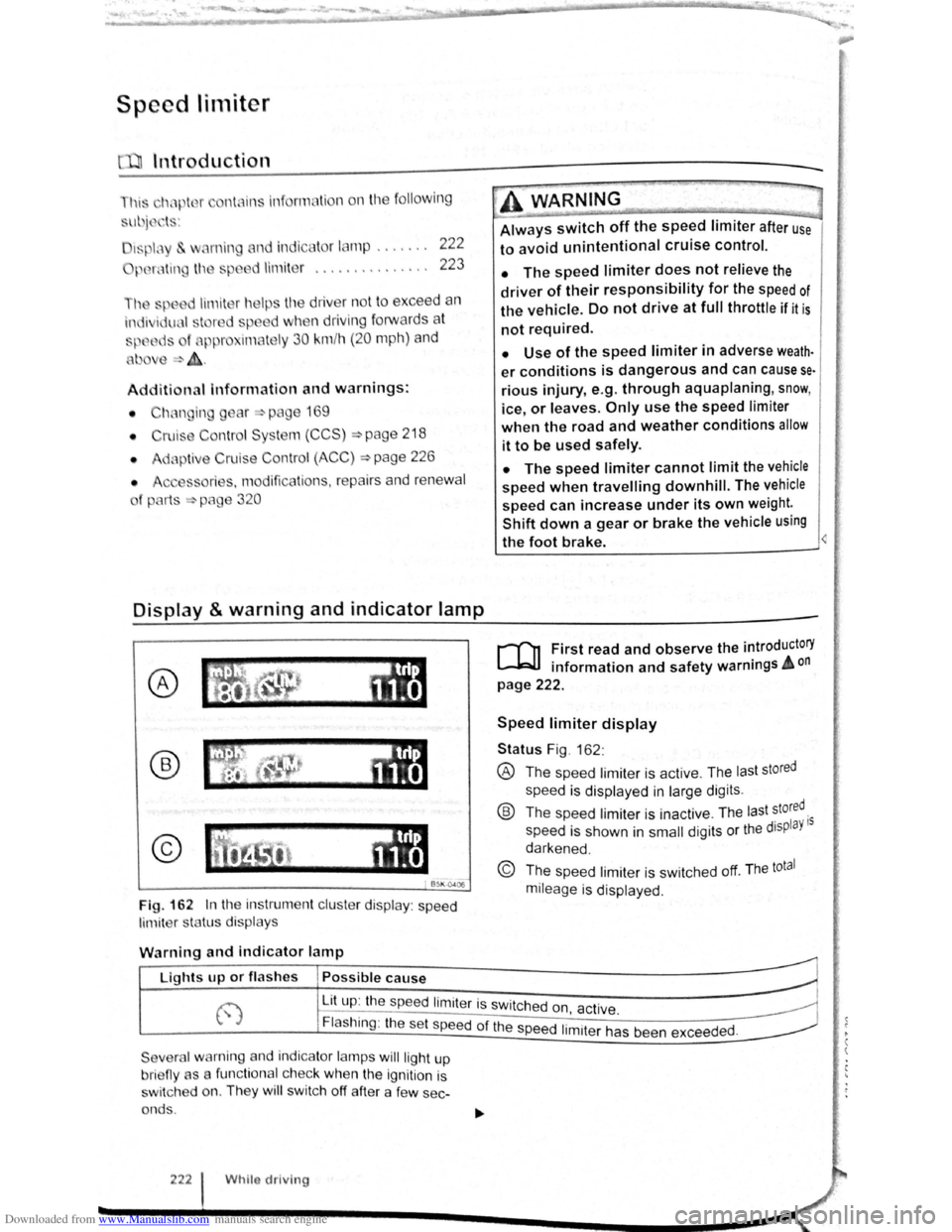
Fig. 162 In th e instrument clu ste r display : speed
limit er sta tus disp lays
·~ ~ ' -
~~~_W_A_R_N_IN_G ________ ~~----~
Always switch off the speed limiter after use
to avoid unintentional cruise control.
• The speed limiter does not relieve the
driver of their responsibility for the speed of
the vehicle. Do not drive at full throttle if it is
not required.
• Use of the speed limiter in adverse weath·
er conditions is dangerous and can cause se
rious injury, e.g. through aquaplaning, snow,
ice, or leaves. Only use the speed limiter
when the road and weather conditions allow
it to be used safely.
• The speed limiter cannot limit the vehicle
speed when travelling downhill. The vehicle
speed can increase under its own weight.
Shift down a gear or brake the vehicle using
the foot brake.
r-f'n First read and observe the introductory
L-JcJ.I information and safety warnings A on
page 222.
Speed limiter display
Status Fig . 162 :
® The spee d limiter is active . The las t stored
speed is displayed in large dig its .
® Th e speed limiter is ina ctive . Th e last stored.
speed is shown in
small digits or the displaY 15
darkened .
© The speed limiter is sw itched off. The total
mileage is displayed .
W
arning and indicator lamp
r~~~fucl,~~~~~---------------------~ Lights up or fl as hes Possible cause
j-~~----~~==~==~~---------------~ ~ L_it;u~p~:~th~e~sp~e:e:d~l:im:i:te:r~is~sw~itc~h~e~d~o~n~~~·~~---------------~ t.,.; :1 , ac 1ve. ~
Flashing : the set speed of the speed 1. .
t h d d
Severa l warning and indicator lamps will ligh t up
bri eny as a func tiona l c h ec k
when the ignition is
s wi tc h ed on. They
wi ll swi tc h off after a few sec
onds .
222 Whilo driving
1m1 er as been excee e .
Page 109 of 138
Downloaded from www.Manualslib.com manuals search engine ... . ·
' '
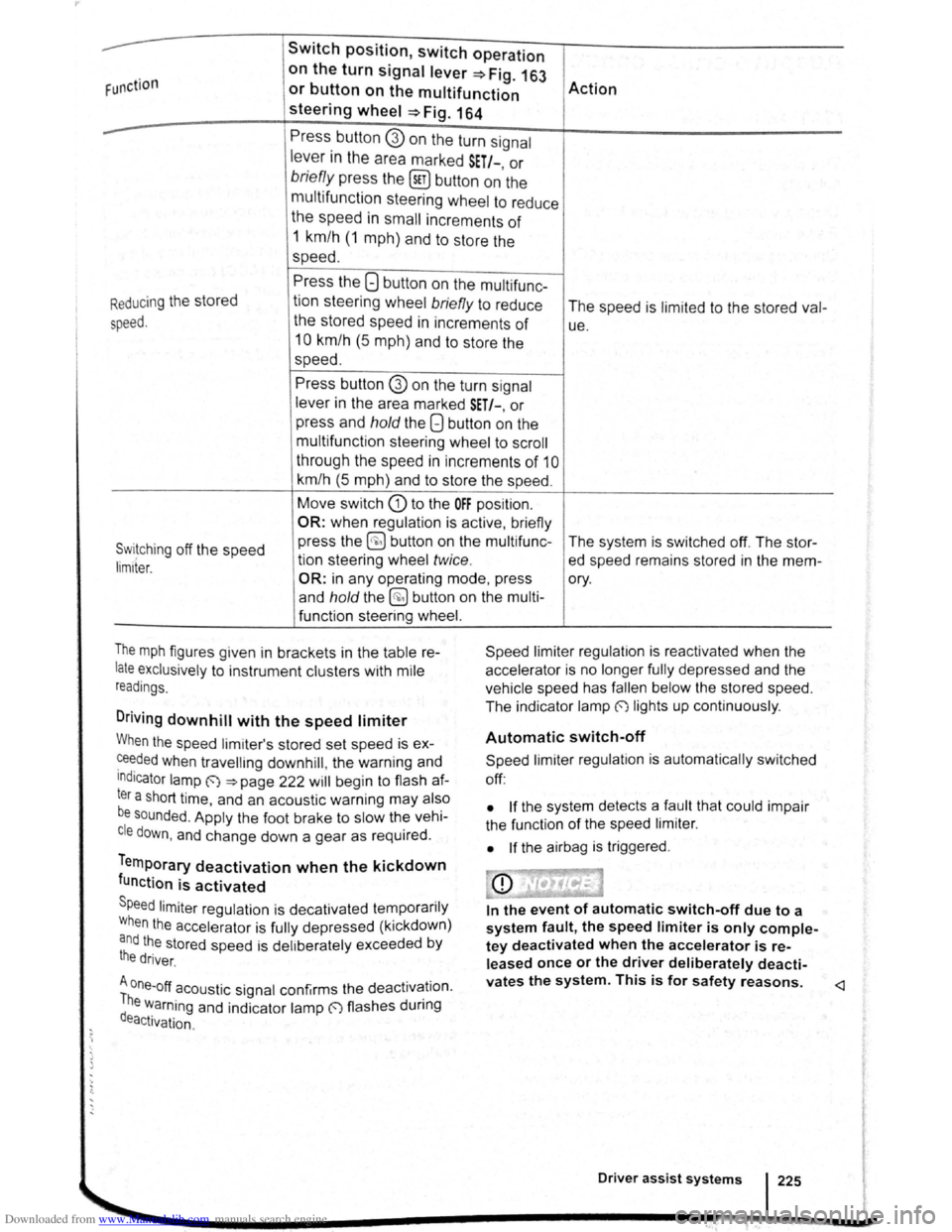
Swit c h posit ion , switch oper ation
F unction
on the turn signal lever=> F ig. 16J
Action or button on the multifunction
steering wheel =>Fig . 164
--Press butto n G) on the turn signal
lever in the area marked S ET/-, or
brie fly pre ss the (sET) button on the
multifu nction
steerin g whe el to reduce
the speed in small increments of
1 km/h ( 1 m ph) a nd to store the
speed.
Press the 8 button on the multi func-
R
educing the stored
tion steering wheel briefly to reduce
The speed is limit e d to the stored val-
speed. the stored speed in increments of ue .
10 km /h (5 m p h) a nd to sto re the
speed.
Press button @ on the turn s ignal
lever i n the a rea marked SET/-, or
p r
ess and hold the Q button on the
m ult ifunctio n stee rin g
wheel t o sc ro ll
t h roug h th e spee d in i ncre m ents
of 1 0
km/h (5 m ph) and to sto re the speed .
Move switc h G) to the OFF position.
OR: when regula tio n is active , briefly
Switching off the speed press
the ~ butto n on th e multifunc -
The system is switched off. The stor-
tion stee rin g wheel twice . ed speed remains stored in the mem -lim1ter.
OR: in any opera tin g m od e, pr es s ory.
a nd
hold th e @ button on the mult i-
f u n ctio n steering wheel.
T
he m ph figures given in bracke ts i n the tab le re
late exclusively to instrument clu sters with mile
r
ead ings.
Driv ing downhill w ith the speed limiter
Speed limi te r regu lat io n is reactivated when the
acce le ra to r is no longe r fully depressed and th e
ve hic le s pee d h as
falle n be low th e s tored speed.
The ind icato r lam p
(') lig hts up continuo usly .
When the speed lim ite r's stored set speed is ex
~e~ded when travellmg downhill, the warn in g a nd
Indicator lamp ~ ~page 22 2 will begi n to flas h af
ter a short tim e, and an aco ustic warnin g may also
be sounded . A pp ly the foot brake to s low the ve hi
cle down, and change down a gear as req uir e d .
Temporary deactivation when the kickdown
function is activated
Speed limite r reg ulatio n is decati va ted te m po rari ly
W he n
the acce le ra to r is fully dep ressed (kickdown)
and the sto red speed is delib erate ly exceede d by
the driver .
A one-off acoustic signal confirms th e deac tivation.
The warning and indicato r lamp (') flashes durin g
deactivation .
. .
Automatic switch-off
Spee d li mi ter regu lat ion is automatically switched
off :
• If the syste m d etects a fa ul t that could im pai r
t he fun ction of th e spee d
limit e r.
•
If t h e airbag is triggered .
In the event of automatic switch-off due to a
system fault, the speed limiter is only comple
tey deactivated when the accelerator is re
leased once or the driver deliberately deacti-
vates the system. This is for safety reasons.
Page 111 of 138

Downloaded from www.Manualslib.com manuals search engine .... ... ' 1)
' ) ....
m The ACC restricts the speed to 160 km/h
W (100 mph). 0
Repair wor k on the radar sensor will require
• ecial knowled ge and tools. Volkswagen rec
~~mends using a Volkswagen dealership for
m If the ACC is active, unfamiliar noises may be
W heard during the automatic braking proce-
this purpose.
dure. Th ese are caused by the braking system.
W this chapte r, do not use the ACC and have
the system checkd by a qualified workshop . V olks
wagen recommends using a Vol kswagen dealer
ship for this purpose .
Display, warning and indicator lamps
Fig. 165 In the instrument cluster disp lay : ACC
~eactivated temporarily ; vehicle detected ahead,
t1me interval set
BSK-05eJ
Fig. 166 In the instrument cluster display : ACC
active : vehicle detected ahead, time interval is b e
ing set
[Q] First read and observe the introductory information and safety warnings~ on page 226.
Display
D
isplay fields ~Fig. 165 or ~Fig. 166:
G) Vehicle ahea d when ACC is inact ive .
0 Selected distance range when ACC is inactive .
@ Vehicle detected ahead. ACC is active.
@) Setting the time int erval to the vehicle in front while travell ing at stored speed.
® Time interval to the vehicle in front while travell ing at stored speed has been set.
Warning and indicator lamps r--
to--lit up Possible cause ~ 6 Solution
(~) The braking funct ion of the ACC to the ve- Brake!
Depress the brake pedal. The system
t---:. hicle ahead is insu fficient. tells the driver to take control.
Sw itch off the engine and restart it while sta-
ACC currently not availab le. a)
tionary . Inspect the radar sensor (for dirt , ice
• etc.) . Proceed to a qualified workshop imme-
• diately and have the system checked if it is
constantly unavailable .
Driver assist systems 227
-
Page 112 of 138

Downloaded from www.Manualslib.com manuals search engine Lit up Possible cause => & Solution
ACC is active . No vehicle has been detec----..
~8 ted ahead . The set speed is kept con-
stant.
When displayed in white: ACC active. Ve---
hicle detected ahead. ACC regulates the
~
speed and the distance from the vehicle
ahead .
-When displayed in grey: ACC not active .
System switched on, does not regulate :
-
(") ACC is active .
a) D isplayed in col our on an ins trum ent clust er w ith colo ur display .
Several warning and indicator lamps will light up
bri efly as a functional check when the ignition is
switched on. They will switch oft after a few sec
onds.
~..,.-"~
A WAR_NING
Failure to observe illuminated warning lamps
and text messages can lead to your vehicle
breaking down in traffic, and can cause acci
dent and serious injury.
Radar sensor
Fig. 167 In the front bumper : radar sensor
r-('n First read and observe the introductory
L-J=JJ information and safety warnings 4 on
page 226.
228 I Whi le driving
•• --;;>
A V'{ARNING (Continued) ~J
• Never ignore any illuminated warning
lamps or text messages.
Failure to observe illuminated indicator lamps
and text messages can lead to your vehicle be·
ing damaged.
r::l When the ACC is switched on, the display in
~ the instrument cluster can be overwritt en by
other functions , incoming telephone calls for exam·~ 1
pie.
to mom · A radar sensor is fitted to the front bump er 1 tor the traffic situation=> Fig. 167 . Vehicl es travc: ·o f
ling ahead can thus be detected up to a dJstan
approximately
120 m .
The adaptive cruise control and cruise
con~rol sys·
tems will not function if the radar sensor is ,m-The
paired , e .g . due to heavy rain, spr ay, or snow.
instrument cluster display shows the me
ssage 50rs
ACC: no sensor view!. Clean the ra d ar s en
as required
=>
· d The as the radar sensor is no longer impa1re ·
message in the instrument cluster display goes
out , and the
ACC can be reactivated .
S ·gnal. e 9 · trong reflected radiation of the radar 5
' 11·c ob-. meta 1 1n mult i-storey car parks or when near used · ' I tes ~ects such as rails in the road or metal P a ACC·
m roadworks . can impair the function of the
sensor
The area in front of and around the radar kers or
mu~t. not be c~vered by objects ~uch. as st'~nction ,
auxJIJary headlights, as this can 1mpa1r the
of the ACC .
Page 113 of 138

Downloaded from www.Manualslib.com manuals search engine . ,~~t ral dification s to the vehicle , e .g .
~ :·.
9 t o e i le or making alteration s to the
~.': d tri , can impair the function of the ACC.
~ ·· ra~ od ifict ton s s hould therefore only be
t y a qualified workshop . Vo lkswage n
e s using a Vo lkswagen dealership for
, ec y erformed repair s to the front end of the
·~"· •e can a lter t h e posit ion of the radar sensor ~I
. e re r e im pair the funct ion of the ACC . R e-
.. ~i , should there fore only be carried out by a
,__a11 ed wo shop . Volk swagen recommends us-
1 sv agen dealersh ip for this purpose .
Switch off the ACC if you suspect that the radar
sensor has been damaged or its position has
been altered. This can help to prevent further
damage. Have the radar sensor realigned.
• The radar sensor could be moved if it is hit,
for example in parking manoeuvres. Readjust
ing the sensor could impair the performance of
the system or cause it to be switched off .
• Repair work on the radar sensor will require
special knowledge and tools. Volkswagen rec
ommends using a Volkswagen dealership for
this purpose.
• Remove snow with a brush, and remove ice
preferably with a solvent-free de-icer spray. <1
Operat ing adaptive cruise control (ACC)
Fig . 168 L eft-hand side of the mu ltifunctlon steer
ing wheel: buttons for operatmg the adaptive cruise
control
[Q] :irst read and observe the i~troductory
tnformation and safety warnrngs 4 on
Page 226.
Funct ion
Button on the multifunc-
tion steering wheel
-=>Fig. 168
Pre ss the
(9 but ton on the
S w i
tching on the ACC . multifunction steering
wheel. s . Press the ~ button on the Wttching between the
Ace and the speed limit-multifunction steering er. wheel.
When the adapt ive cruise control (ACC) is switch
ed on, the green indicator lamp f) in the instrument
c
luste r lights up, and the speed memory and the
status
of the adaptive cruise contro l are shown in
the disp la y ~Fig. 165.
Conditions for starting the adaptive cruise
control
• The selector lever must be in position D or S or
be in the Tiptron ic gate. A forward gear, but not 1st
gear , must be selected
in the manu al gearbox .
• In vehicles with a manual gearbox , the actual
speed should be minimum 30 km /h (18 mph) if no
speed is stored .
Controlling speed
When switched on, the speed can be stored and
set. The stored speed can vary from the speed
ac
tually
being driven if the distance is b ein g act ively
controlled.
Action
The system is switched on. No speed has yet
been stored and the speed is not yet being con-
trolled.
This sw itches between the CCS and the speed
limiter ~page 222 .
Page 116 of 138

Downloaded from www.Manualslib.com manuals search engine Switch off the adaptive cruise control (ACC) temporarily in the following
situations
J""'("'n First read and observe the Introductory
L-.kJ.l ir"'formation and safety warnings & on
page 226.
The adapttve cruise contro l (ACC) should be
s it c hed off in the following situations due t o sys
tem limitations -~:
• When turning off roads. driving around round
abouts, narrow curves. joining motorways, exiting
from motorways or driving through road works, to
prevent th e vehicle from unnecessarily accelerat
ing to the set speed in these situations
• When driving through a tunnel as this situation
could impair the system function.
• On roads with more than one lane, if other vehi
cles are driving more s lowly in the fast la ne . The
slower vehicles in the other lane would be o ve rtak
en from the right side in this case.
• In heavy rain, snow or spray as vehicles tra ve l
ling
ahead cannot be monitored sufficiently or
maybe cannot be monitored a t all.
Special driving situations
A WARNING
Failure to switch off the ACC in the above
mentioned situations can cause acciden ts
and result in serious injuries.
• Switch off the ACC in critical driving situa.
tions.
r:1 Failure to switch off the adaptive cru ise con
~ trol in the above-mentioned situations can
cause a violation of legal requirements. <
Fig. 169 A: vehicle in a bend B: motorbike in front is outside the range of the radar sensor
0
Fig. 170 C: veh icle is changing lanes . D : turn ing vehi cle , stationary vehicle
r-('n First read and observe the introductory
~ information and safety warnings~ on
page 226.
The adaptive cruise control (ACC) has physical
and system-rel ated limits . As such, certain ACC
system reactions may occur, from the driver's per-
232 While driving
spective , unexpectedly or with some delay. You
should therefore always be prepared to take full
control of the vehicle if necessary .
Th . quire e followmg traffic situations for example , re ~
particular vigilance: '
Page 118 of 138

Downloaded from www.Manualslib.com manuals search engine Possible radar sensor function impairments
The adaptive cruise control will switch off tempora
rily if th e radar sensor function is impaired , e .g .
due to heavy rain, spray , snow, ice or mud . A cor
responding message will appear in the instrument
clu ster display .
Clean the radar sensors as re
quired .
The adaptive cruise control will automatically be
available again as soon as the radar sensors are
no longer impaired . The message in the instrument
cluster display goes out, and the adaptive cruise
control can be reactivated .
~trong. reflected radiation of the radar signal , e.g.
1n mult1-storey car parks , can impair the function of
the radar sensor .
Towing a trailer
The adaptive cruise control operates with reduced
dynamics when the
vehicle is towing a trailer .
Overheated brakes
If the brak~s. overheat , e .g . following heavy braking
or when
dnv1ng down steep inclines for long peri
ods , the
ada~tive cruise control may be deactiva
ted
t~mpor~nly. A correspond ing message will ap
p e ar
.m the tns~rument cluster display. lt is then not
poss1ble to act1vate the adaptive cruise control.
As soon as the temperature of the brakes has de
creased sufficiently , the adaptive cruise control can
be activated again. The message in the instrument
cluster
display goes out. If the message ACC not
ava i 1 ab 1 e does not go out for a long time, there
is a fault. Proceed to a qualified workshop. Volks
wagen recommends using a Volkswagen dealer
ship for this purpose.
.,. . ..,,
... -,
If the message ACC ready for start ap·
pears
in the instrument cluster display and
th_e vehicle in front moves off, your vehicle
w1ll move off automatically. In some cases
the radar
sensor may be unable to detect ob·
st~cles that are located in the vehicle's path.
Th1s can result in serious injury and acci·
dents.
l
• Always check the road ahead before the
veh~cle pulls away. If necessary, cancel the
pulling away procedure by depressing the
brake
pedal.
~--~--------------------~~
Page 119 of 138

Downloaded from www.Manualslib.com manuals search engine ' )
)
Area monito ring system (Front Assist)
QJl Introduction
This ch a pter contains information on the following
s
ubjects:
warning lamps and displays . . . . . . . . . . . . . . 236
Radar sensor ....... · · . . . . . . . . . . . . . . . . . . 237
Operating the area monitoring system (Front
Assist) .... . .. · · · · · · · · · · · · · · · · · · . . . . . . . . 237
Temporarily switch off the area monitoring
system (Front Assist) in the following
s it u
ations . . . . . . . . . . . . . . . . . . . . . . . . . . . . . . 238
System limits . . . . . . . . . . . . . . . . . . . . . . . . . . . 238
C i
ty emergency brake function . . . . . . . . . . . . 239
The area monitoring system (Front Assist) helps to
avoid rear-end collisions.
lt uses a radar sensor to monitor traffic situations
up to a distance of approximately 120 metres in
front of the vehicle within a speed range of approx
i
mately 5 km/h (3 mph) to 210 km/h (130 mph) .
The area monitoring system (Front Assist) can
warn the driver about imminent collisions, pre
pare the vehicle for emergency braking in case
of danger, assist with braking, and initiate auto
matic braking.
Additional
information and warnings:
• Exterior views ~page 6
• Volkswagen information system ~ page 26
• lnfotainment system ~page 31
' Cruise Control System (CCS ) ~page 218
'
Speed limiter ~page 222
' Accessories , modifications , repairs and renewal
o f
Parts ~page 320
Distance warning
If the system detects danger from driving too close
to.the vehicle in front , the system can warn the
~nver by showing a corresponding message in the
~nstrument cluster display ~page 236. The warn
Ing Period varies according to the traffic situation
a
nd the driver's response . Front Assist is not a
sub t · · s ltue for the full concentration of the dnver .
Advance warning
h lfth e system detects a potential collision with a veICI · e .e .1n front, the system can warn the driver by 1111tt1ng an acoustic warning and showing a corre-spond· · PI lng message in the instrument clus~er diS-
ay ~Page 236 . The warning period vanes ac- carding
to the
traffic situation and the driver's re
sponse . Front Assist is not a substitue for the
full
concentration of the driver .
At the
same time it prepares the vehicle for possi
ble emergency braking ~ ~.
Urgent warning
If the driver fails to respond to the advance warn
ing, the system can initiate a quick jolt of the brake
in order to draw the driver's attention to the
in
creasing danger of a collision.
Automatic braking
If the driver also fails to react to the urgent warn
ing, the system can slow the vehicle down auto
matically by gradually increasing the braking force.
The system can help to reduce the consequences
of an accident by reducing the speed at which a
potential collision might take place .
Brake assistance
If Front Assist detects that the driver is not braking
sufficiently when there is a risk
of collision , the sys
tem can increase the braking force and thereby
help to prevent a collision . Brake assistance works
only
for as long as the brake pedal is pressed
hard.
The intelligent technology used in Front As
sist cannot overcome the laws of physics.
The driver is always responsible for braking
in time. If Front Assist issues a warning, im
mediately apply the foot brake to slow the ve
hicle down or avoid the obstacle, depending
on the traffic situation.
• Adapt your speed and distance from the
vehicles ahead to suit visibility, weather, road
and traffic conditions.
• Front Assist cannot prevent accidents and
serious injuries on its own.
• Front Assist can issue unnecessary warn
ings and carry out unwanted braking inter
ventions in certain complex driving situa
tions, e.g . at traffic islands.
~----------------------------_j~
Driver assist systems 235
-