2004 SUBARU FORESTER brake
[x] Cancel search: brakePage 626 of 2870

CC(H4DOTC 2.5)-14
CRUISE CONTROL SYSTEM (DIAGNOSTIC)
List of Diagnostic Trouble Code (DTC)
21 Cruise control switch is
abnormal when the igni-
tion switch is turned to ON.Each switch of cruise control command switch has
already been ON when the ignition switch is turned to
ON.This DTC is indicated
without operating the main
switch.
DTC 11, 15, 21 AND 24
CRUISE CONTROL
COMMAND SWITCH,
Diagnostic Procedure with
Diagnostic Trouble Code
(DTC).>
22 Vehicle speed variation is
abnormal.Abnormality of vehicle speed variation is detected.
VEHICLE SPEED SEN-
SOR, Diagnostic Proce-
dure with Diagnostic
Trouble Code (DTC).>
23 Engine-related sensor is
abnormal.Abnormality related to engine is detected.
Procedure.>
24 Cruise control-related
switch is abnormal.Abnormality of command switch is detected. (Open cir-
cuit is detected when continuing to be ON for an
extremely long time [approx. two minutes].)This DTC is indicated with
normal operation.
DTC 11, 15, 21 AND 24
CRUISE CONTROL
COMMAND SWITCH,
Diagnostic Procedure with
Diagnostic Trouble Code
(DTC).>
25 Brake switch input circuit
is abnormal.Abnormality of brake switch input circuit in ECM is
detected.
STOP LIGHT SWITCH
AND BRAKE SWITCH,
Diagnostic Procedure with
Diagnostic Trouble Code
(DTC).>
26 Engine speed signal. Abnormal increase of engine speed is detected.
Gear is shifted to neutral, 1st or reverse position.Cruise with more than 2nd
shift position.
32 Out of vehicle speed range
of cruise control operation. Vehicle speed becomes under the control limit during
cruise driving.
Set operation is conducted out of vehicle speed range
for setting
RESUME operation is conducted without vehicle
speed memory.This DTC is also indicated
when increasing the
speed to the cruise set
available vehicle speed
and conducting the set
operation again.
DTC 22 AND 32 VEHICLE
SPEED SENSOR, Diag-
nostic Procedure with
Diagnostic Trouble Code
(DTC).>
33 Prohibition of WAIT after
acceleration operation.Vehicle speed becomes over the control limit during
cruise driving.This DTC is indicated
when running at the high
speed which is not suit-
able for cruise control. In
this case, conduct the
cruise set operation again
after decreasing the
speed to the cruise set
available vehicle speed. DTC Item Contents of diagnosis Reference
Page 627 of 2870

CC(H4DOTC 2.5)-15
CRUISE CONTROL SYSTEM (DIAGNOSTIC)
List of Diagnostic Trouble Code (DTC)
34 Prohibition when accelera-
tor pedal position is contin-
ued to be large.Vehicle is driven at the higher speed than set vehicle
speed for an extremely long time (approx. 10 minutes)
during cruise driving.This DTC is indicated
when running for a long
time at the higher speed
than cruise set available
vehicle speed by accelera-
tor operation. In this case,
release the cruise set.
35 Prohibition when vehicle
speed feedback is impos-
sible.During cruise driving, set vehicle speed cannot be main-
tained for some reasons such as sharp upslope, parking
brake and engine output abnormal decrease.This DTC is indicated
when the driving condi-
tion is not suitable for
cruise control. Conduct
the cruise set operation
again after clearing the
estimated reasons. DTC Item Contents of diagnosis Reference
Page 630 of 2870
CC(H4DOTC 2.5)-18
CRUISE CONTROL SYSTEM (DIAGNOSTIC)
Diagnostic Procedure with Diagnostic Trouble Code (DTC)
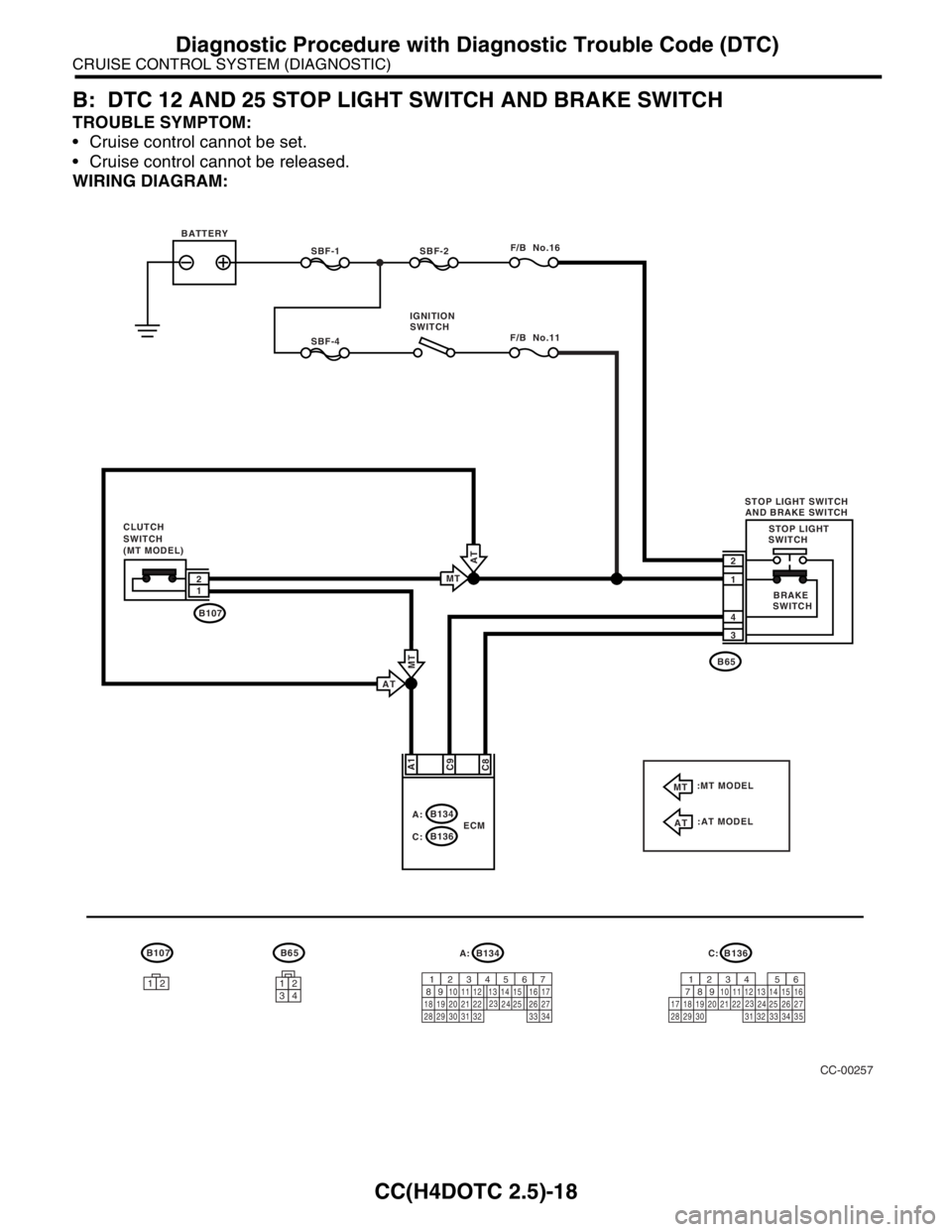
B: DTC 12 AND 25 STOP LIGHT SWITCH AND BRAKE SWITCH
TROUBLE SYMPTOM:
Cruise control cannot be set.
Cruise control cannot be released.
WIRING DIAGRAM:
CC-00257
B107B65
12
SBF-1SBF-2F/B No.16
2
1
B65
B1071
3
4
2
C8A1
C9
1234
STOP LIGHT
SWITCH CLUTCH
SWITCH
(MT MODEL)BATTERY
B134
A:
B136
C:ECM
B134
9
30 29 28 323120 19 18 222110 121114
24
34 3327 2617 16123456713
2315
258
B136
9
30 29 28 323120 19 18 22211012
1114
24
34 3327
261612345613
2315
25871735
C: A:
SBF-4F/B No.11
IGNITION
SWITCH
BRAKE
SWITCH STOP LIGHT SWITCH
AND BRAKE SWITCH
AT
:MT MODEL
:AT MODEL
AT
MT
MT
MT
AT
Page 631 of 2870

CC(H4DOTC 2.5)-19
CRUISE CONTROL SYSTEM (DIAGNOSTIC)
Diagnostic Procedure with Diagnostic Trouble Code (DTC)
Step Check Yes No
1 CHECK STOP LIGHT SWITCH AND BRAKE
SWITCH CIRCUIT.
1) Turn the ignition switch to OFF.
2) Disconnect the stop light switch and brake
switch harness connector.
3) Turn the ignition switch to ON.
4) Measure the voltage between harness con-
nector terminal and chassis ground.
Connector & terminal
(B65) No. 2 (+) — Chassis ground (
−): Is the voltage more than 10 V? Go to step 2. Check the fuse
No. 16 (in fuse &
relay box).
Check the har-
ness for open or
short between
stop light/brake
switch and fuse &
relay box.
2 CHECK STOP LIGHT SWITCH AND BRAKE
SWITCH CIRCUIT.
Measure the voltage between harness connec-
tor terminal and chassis ground.
Connector & terminal
(B65) No. 1 (+) — Chassis ground (
−): Is the voltage more than 10 V? Go to step 3. Check the fuse
No. 11 (in fuse &
relay box).
Check the har-
ness for open or
short between
stop light/brake
switch and fuse &
relay box.
Check the clutch
switch and circuit.
3 CHECK STOP LIGHT SWITCH AND BRAKE
SWITCH CIRCUIT.
1) Turn the ignition switch to OFF.
2) Disconnect the ECM harness connector.
3) Measure the resistance between ECM har-
ness connector terminal and stop light switch
and brake switch harness connector terminal.
Connector & terminal
(B136) No. 8 — (B65) No. 3:
(B136) No. 9 — (B65) No. 4: Is the resistance less than 10
Ω? Go to step 4.Repair the har-
ness.
4 CHECK STOP LIGHT SWITCH AND BRAKE
SWITCH.
Remove and check the stop light switch and
brake switch.
brake switch OK? Stop light switch
and brake switch
circuit are OK.Replace the stop
light switch and
brake switch.
Page 632 of 2870
CC(H4DOTC 2.5)-20
CRUISE CONTROL SYSTEM (DIAGNOSTIC)
Diagnostic Procedure with Diagnostic Trouble Code (DTC)
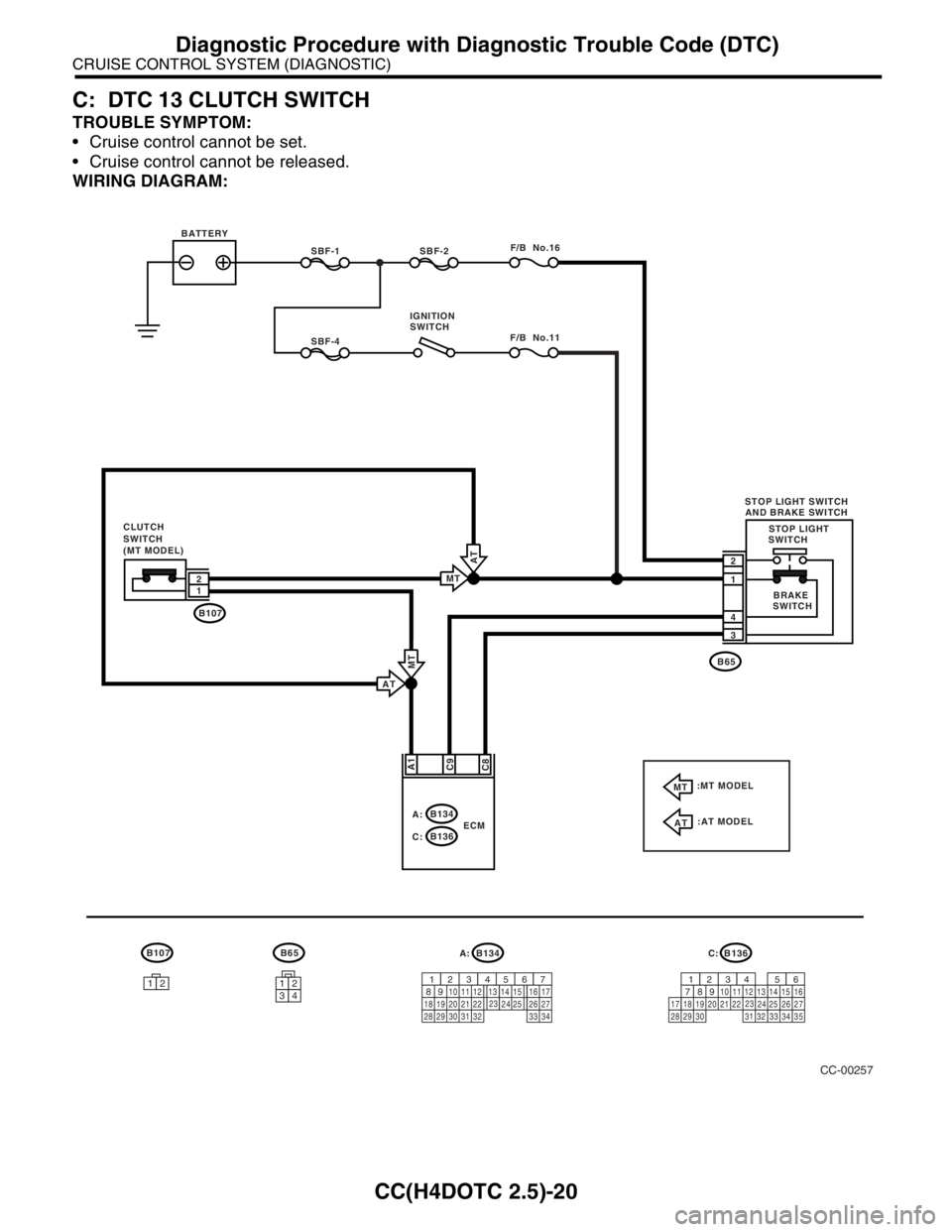
C: DTC 13 CLUTCH SWITCH
TROUBLE SYMPTOM:
Cruise control cannot be set.
Cruise control cannot be released.
WIRING DIAGRAM:
CC-00257
B107B65
12
SBF-1SBF-2F/B No.16
2
1
B65
B1071
3
4
2
C8A1
C9
1234
STOP LIGHT
SWITCH CLUTCH
SWITCH
(MT MODEL)BATTERY
B134
A:
B136
C:ECM
B134
9
30 29 28 323120 19 18 222110 121114
24
34 3327 2617 16123456713
2315
258
B136
9
30 29 28 323120 19 18 22211012
1114
24
34 3327
261612345613
2315
25871735
C: A:
SBF-4F/B No.11
IGNITION
SWITCH
BRAKE
SWITCH STOP LIGHT SWITCH
AND BRAKE SWITCH
AT
:MT MODEL
:AT MODEL
AT
MT
MT
MT
AT
Page 665 of 2870
FUJI HEAVY INDUSTRIES LTD. G8080GE6
2004 FORESTER SERVICE MANUAL QUICK REFERENCE INDEX
CHASSIS SECTION
This service manual has been prepared
to provide SUBARU service personnel
with the necessary information and data
for the correct maintenance and repair
of SUBARU vehicles.
This manual includes the procedures
for maintenance, disassembling, reas-
sembling, inspection and adjustment of
components and diagnostics for guid-
ance of experienced mechanics.
Please peruse and utilize this manual
fully to ensure complete repair work for
satisfying our customers by keeping
their vehicle in optimum condition.
When replacement of parts during
repair work is needed, be sure to use
SUBARU genuine parts.
All information, illustration and specifi-
cations contained in this manual are
based on the latest product information
available at the time of publication
approval.FRONT SUSPENSION FS
REAR SUSPENSION RS
WHEEL AND TIRE SYSTEM WT
DIFFERENTIAL DI
TRANSFER CASE TC
DRIVE SHAFT SYSTEM DS
ABS ABS
ABS (DIAGNOSTIC) ABS
BRAKE BR
PARKING BRAKE PB
POWER ASSISTED SYSTEM
(POWER STEERING)PS
Page 693 of 2870

SPC-4
SPECIFICATION
Forester
F: SUSPENSION
G: BRAKE
★: RHD model
H: TIRE
I: CAPACITY
★1: With oil pump★2: MT model with oil cooler Included★3: Model with ATF warmer Front Macpherson strut type, Independent, Coil spring
Rear Dual-link type, Independent, Coil spring
Model 2.0 L Non-turbo, 2.5 L Non-turbo
2.0 L Turbo, 2.5 L Non-turbo
★, 2.5 L Non-turbo
Service brake system Dual circuit hydraulic with vacuum suspended power unit
Front Ventilated disc brake
Rear Drum brake Disc brake
Parking brake Mechanical on rear brakes
Rim size 15×6J 16×6 1/2J
Tire size 205/70 R15 95H 215/60 R16 95V, P215/60 R16 94H
Type Steel belted radial, Tubeless
Model 2.0 L Non-turbo 2.0 L Turbo 2.5 L Non-turbo 2.5 L Turbo
Tr a n s m i s s i o n 5 M T 4 AT 5 M T 4 AT 5 M T 4 AT 5 M T 4 AT
Fuel tank2 (US gal, Imp gal) 60 (15.9, 13.2)
Engine oil
(When
replacing)2 (US qt, Imp qt) Approx. 4.0 (4.2, 3.5)
Tr a n s m i s -
sion gear oil2 (US qt, Imp qt)4.0
(4.2, 3.5)—3.5
(3.7, 3.1),
3.9
(4.1, 3.4)
★1
—4.0
(4.2, 3.5)—3.5
(3.7, 3.1)—
AT F2 (US qt, Imp qt) —8.4
(8.9, 7.4)—9.3
(9.8, 8.2)—9.3
(9.8, 8.2)—9.3
(9.8, 8.2)
Front differ-
ential gear
oil2 (US qt, Imp qt) —1.2
(1.3, 1.1)—1.2
(1.3, 1.1)—1.2
(1.3, 1.1)—1.2
(1.3, 1.1)
Rear differ-
ential gear
oil2 (US qt, Imp qt) 0.8 (0.8, 0.6)
Pow er
steering
fluid2 (US qt, Imp qt) 0.7 (0.7, 0.6)
Engine
coolant2 (US qt, Imp qt)6.6
(7.0, 5.8)6.5
(6.9, 5.7),
6.9
(7.3, 6.1)
★3
7.4
(7.8, 6.5)7.3
(7.7, 6.4)
★2
6.9
(7.3, 6.1)6.8
(7.2, 6.0)7.4
(7.8, 6.5)7.3
(7.7, 6.4)
Page 701 of 2870

PC-2
PRECAUTION
Precaution
1. Precaution
A: PRECAUTION
Please clearly understand and adhere to the follow-
ing general precautions. They must be strictly fol-
lowed to avoid minor or serious injury to the person
doing the work or people in the area.
1. ABS
Handle the ABS as a total system. Do not disas-
semble or attempt to repair individual parts. Doing
so could prevent the ABS system from operating
when needed or cause it to operate incorrectly and
result in injury.
2. BRAKE FLUID
If brake fluid gets in your eyes or on your skin, do
the following:
Wash out your eyes and seek immediate medical
attention.
Wash your skin with soap and then rinse thor-
oughly with water.
3. RADIATOR FAN
The radiator fan may rotate without warning, even
when the engine is not on. Do not place your hand,
cloth, tools, or other items near the fan at any time.
4. ROAD TESTS
Always conduct road tests in accordance with traf-
fic rules and regulations to avoid bodily injury and
interrupting traffic.
5. AIRBAG
To prevent bodily injury from unexpected deploy-
ment of airbags and unnecessary maintenance, fol-
low the instructions in this manual when performing
maintenance on airbag components or nearby, and
airbag wiring harnesses or nearby.
To prevent unexpected deployment, perform the
steps below and then wait at least 20 seconds to
discharge electricity before beginning work.
Step 1: Turn the ignition switch OFF.
Step 2: Disconnect the ground cable from bat-
tery.
6. AIRBAG DISPOSAL
To prevent bodily injury from unexpected airbag
deployment, do not dispose airbag modules in the
same way as other refuse. Follow all government
regulations concerning disposal of refuse.
7. AIRBAG MODULE
Adhere to the following when handling and storing
the airbag module to prevent bodily injury from un-
expected deployment:
Do not hold the harnesses or connectors to carry
module.
Do not face the bag in the direction that it opens
towards yourself or other people.
Do not face the bag in the direction that it opens
towards the floor or walls.
8. AIRBAG SPECIAL TOOLS
To prevent unexpected deployment, only use spe-
cial tools.
9. WINDOW
Always wear safety glasses when working around
any glass to prevent glass fragments from damag-
ing your eyes.
10.WINDOW ADHESIVE
Always use the recommended or alternative adhe-
sive when attaching glass to prevent it from coming
loose and falling, resulting in accidents and injury.