Page 2378 of 2870
4AT-65
AUTOMATIC TRANSMISSION
Control Valve Body
6) Fill liquid gasket to holes except for bolt holes
(three) of transmission case.
Liquid gasket:
THREE BOND 1217B (Part No. K0877YA020)
7) Install the oil pan with equally tighten the bolts.
Tightening torque:
5 N
⋅m (0.5 kgf-m, 3.6 ft-lb)
8) Pour ATF from the ATF charge pipe.
Recommended fluid:
DEXRON III type automatic transmission flu-
id
Capacity:
Pour fluid as same amount as drained fluid
from drain plug hole.
9) Bleed the air of control valve.
Air Bleeding of Control Valve.>
10) Check the ATF level.
matic Transmission Fluid.>
11) Execute the learning control promotion.
to 4AT(H4DOTC)-17, FACILITATION OF LEARN-
ING CONTROL, OPERATION, Subaru Select
Monitor.>
C: DISASSEMBLY
Non-turbo model only
1) Remove the oil strainer from lower control valve
body.
NOTE:
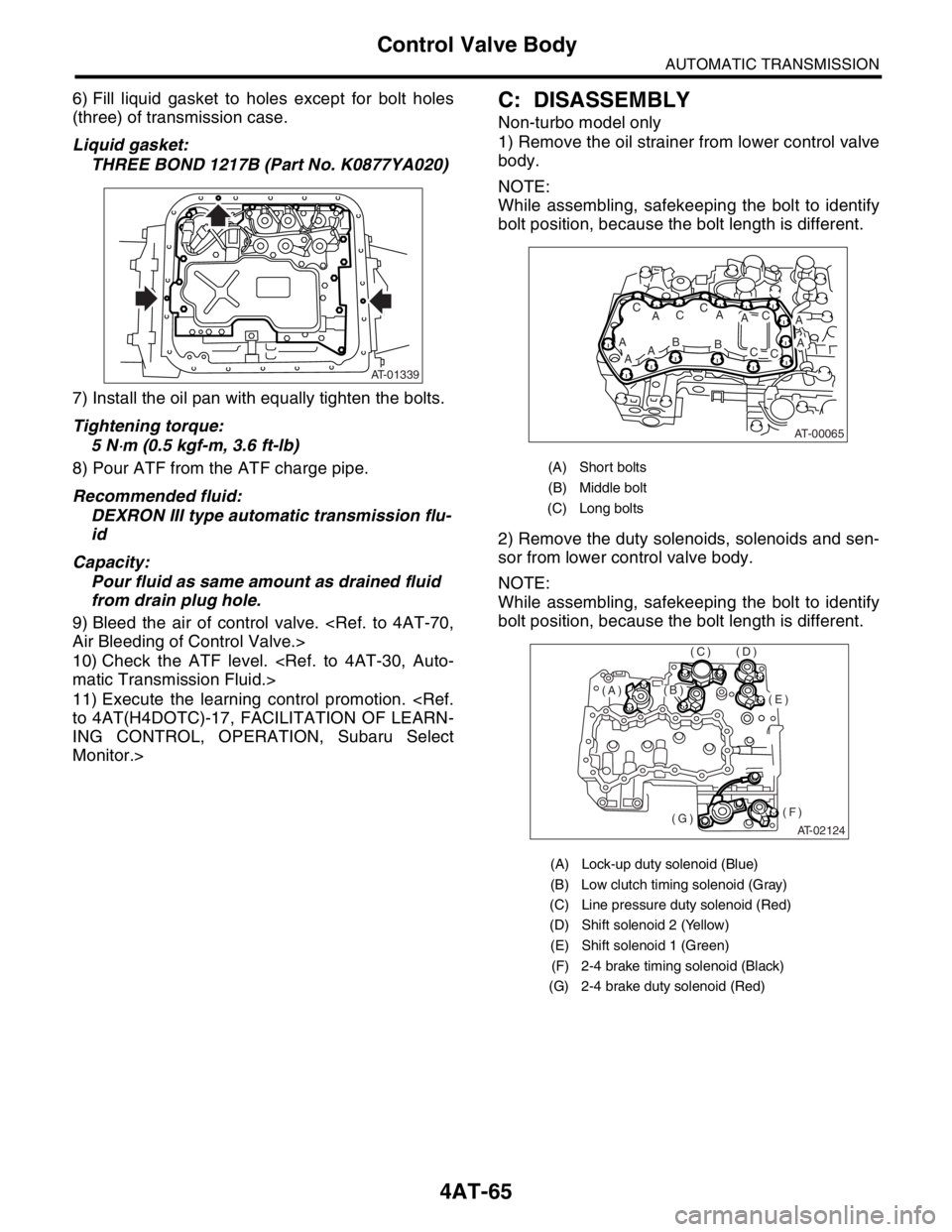
While assembling, safekeeping the bolt to identify
bolt position, because the bolt length is different.
2) Remove the duty solenoids, solenoids and sen-
sor from lower control valve body.
NOTE:
While assembling, safekeeping the bolt to identify
bolt position, because the bolt length is different.
AT-01339
(A) Short bolts
(B) Middle bolt
(C) Long bolts
(A) Lock-up duty solenoid (Blue)
(B) Low clutch timing solenoid (Gray)
(C) Line pressure duty solenoid (Red)
(D) Shift solenoid 2 (Yellow)
(E) Shift solenoid 1 (Green)
(F) 2-4 brake timing solenoid (Black)
(G) 2-4 brake duty solenoid (Red)
AT-00065
A
ABAA
AC
ACC
AB
AC
CC
AT-02124
(E)
(F)(G)
(D)(C)
(B)(A)
Page 2714 of 2870
5MT-2
MANUAL TRANSMISSION AND DIFFERENTIAL
General Description
1. General Description
A: SPECIFICATION
1. MANUAL TRANSMISSION AND DIFFERENTIAL
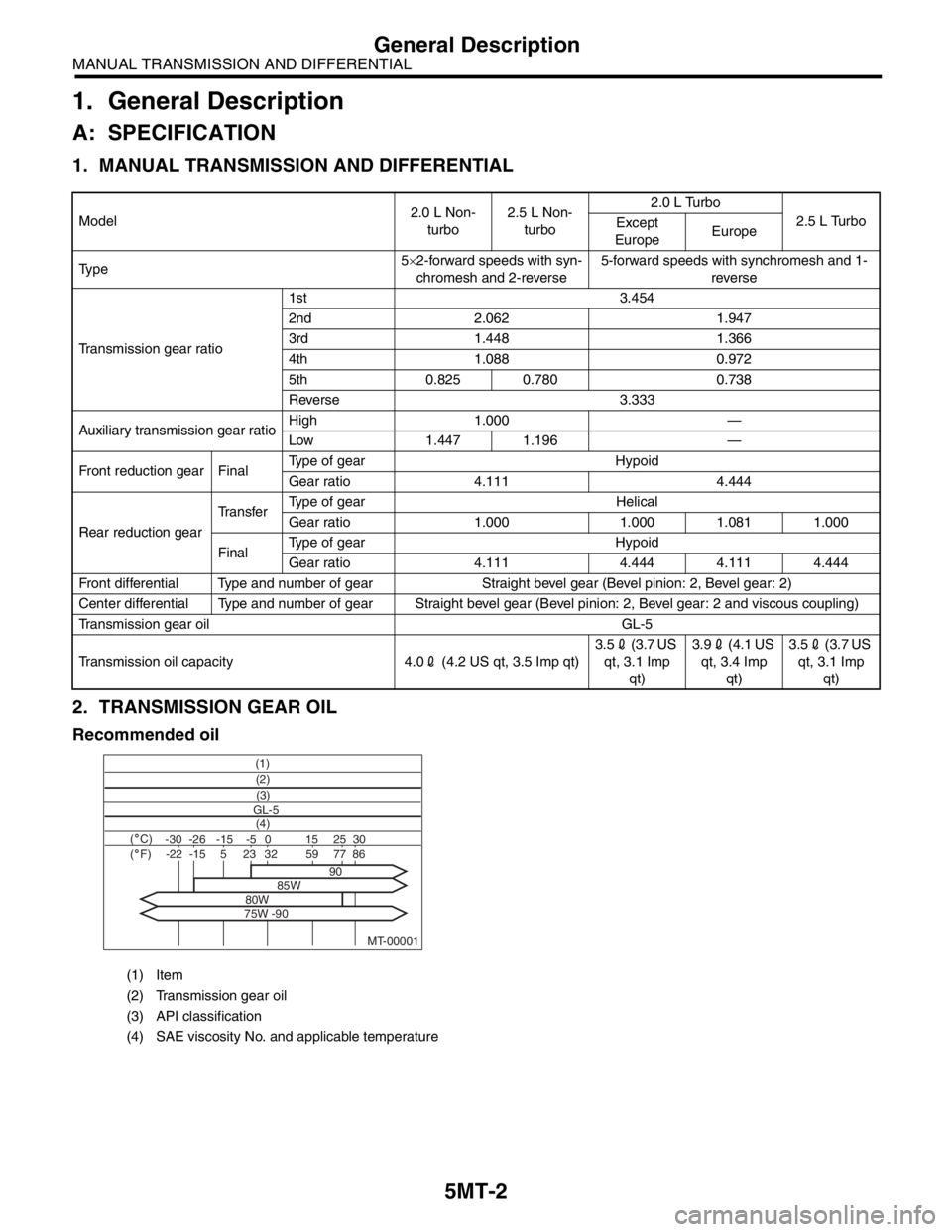
2. TRANSMISSION GEAR OIL
Recommended oil
Model2.0 L Non-
turbo2.5 L Non-
turbo2.0 L Turbo
2.5 L Turbo
Except
EuropeEurope
Ty p e5×2-forward speeds with syn-
chromesh and 2-reverse5-forward speeds with synchromesh and 1-
reverse
Transmission gear ratio1st 3.454
2nd 2.062 1.947
3rd 1.448 1.366
4th 1.088 0.972
5th 0.825 0.780 0.738
Reverse 3.333
Auxiliary transmission gear ratioHigh 1.000 —
Low 1.447 1.196 —
Front reduction gear FinalType of gear Hypoid
Gear ratio 4.111 4.444
Rear reduction gearTransferType of gear Helical
Gear ratio 1.000 1.000 1.081 1.000
FinalType of gear Hypoid
Gear ratio 4.111 4.444 4.111 4.444
Front differential Type and number of gear Straight bevel gear (Bevel pinion: 2, Bevel gear: 2)
Center differential Type and number of gear Straight bevel gear (Bevel pinion: 2, Bevel gear: 2 and viscous coupling)
Transmission gear oil GL-5
Transmission oil capacity 4.02 (4.2 US qt, 3.5 Imp qt)3.52 (3.7 US
qt, 3.1 Imp
qt)3.92 (4.1 US
qt, 3.4 Imp
qt)3.52 (3.7 US
qt, 3.1 Imp
qt)
(1) Item
(2) Transmission gear oil
(3) API classification
(4) SAE viscosity No. and applicable temperature
MT-00001
(1)
(4) GL-5(3) (2)
( C)( F)-30 -26 -15 15
90
85W
80W
75W -9025 30 -5 0-22-1523328659775
Page 2743 of 2870
5MT-31
MANUAL TRANSMISSION AND DIFFERENTIAL
Transmission Gear Oil
2. Transmission Gear Oil
A: INSPECTION
1) Park the vehicle on a level surface.
2) Turn the ignition switch to OFF, and wait until the
engine cools.
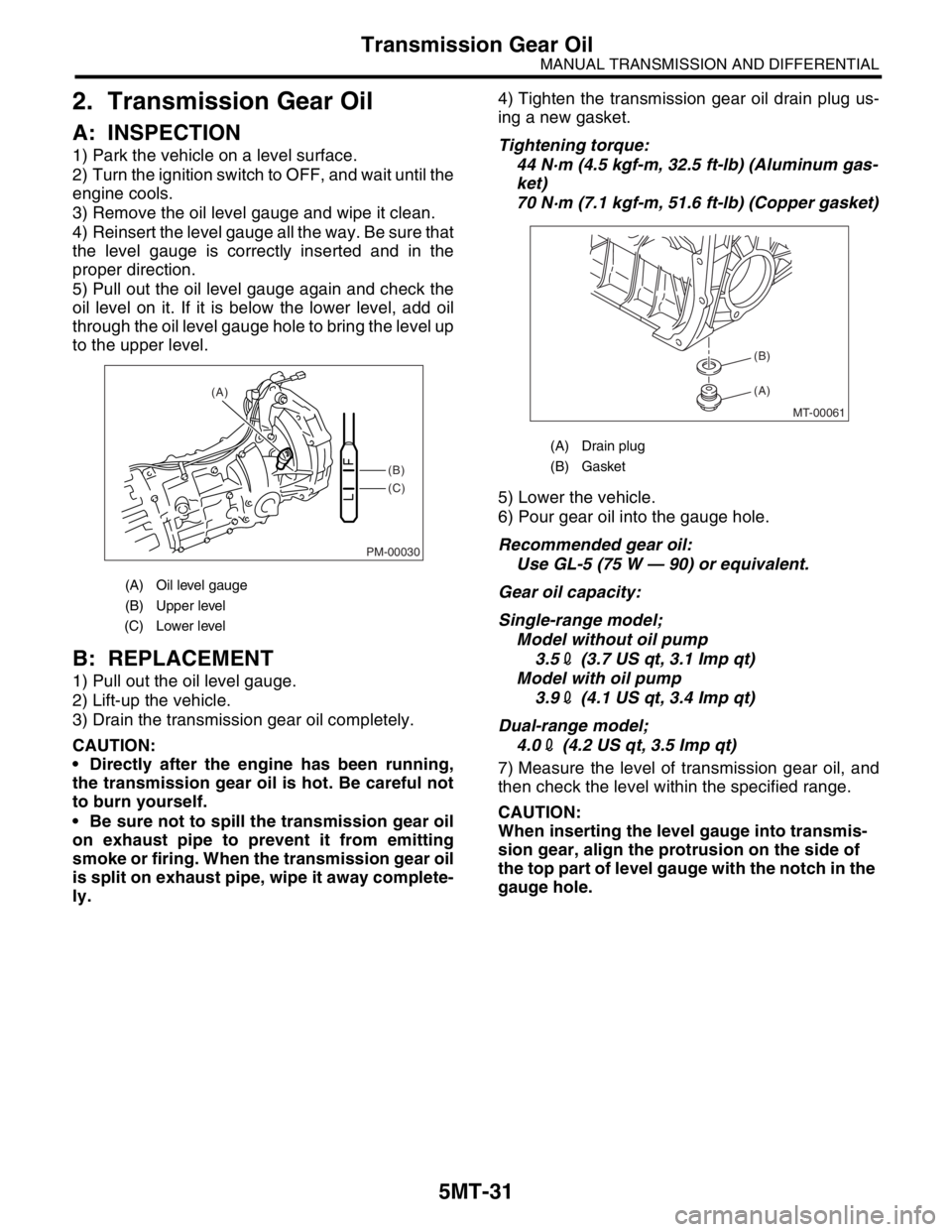
3) Remove the oil level gauge and wipe it clean.
4) Reinsert the level gauge all the way. Be sure that
the level gauge is correctly inserted and in the
proper direction.
5) Pull out the oil level gauge again and check the
oil level on it. If it is below the lower level, add oil
through the oil level gauge hole to bring the level up
to the upper level.
B: REPLACEMENT
1) Pull out the oil level gauge.
2) Lift-up the vehicle.
3) Drain the transmission gear oil completely.
CAUTION:
Directly after the engine has been running,
the transmission gear oil is hot. Be careful not
to burn yourself.
Be sure not to spill the transmission gear oil
on exhaust pipe to prevent it from emitting
smoke or firing. When the transmission gear oil
is split on exhaust pipe, wipe it away complete-
ly.4) Tighten the transmission gear oil drain plug us-
ing a new gasket.
Tightening torque:
44 N·m (4.5 kgf-m, 32.5 ft-lb) (Aluminum gas-
ket)
70 N·m (7.1 kgf-m, 51.6 ft-lb) (Copper gasket)
5) Lower the vehicle.
6) Pour gear oil into the gauge hole.
Recommended gear oil:
Use GL-5 (75 W — 90) or equivalent.
Gear oil capacity:
Single-range model;
Model without oil pump
3.52 (3.7 US qt, 3.1 Imp qt)
Model with oil pump
3.92 (4.1 US qt, 3.4 Imp qt)
Dual-range model;
4.02 (4.2 US qt, 3.5 Imp qt)
7) Measure the level of transmission gear oil, and
then check the level within the specified range.
CAUTION:
When inserting the level gauge into transmis-
sion gear, align the protrusion on the side of
the top part of level gauge with the notch in the
gauge hole.
(A) Oil level gauge
(B) Upper level
(C) Lower level
PM-00030
(B)
(C) (A)
(A) Drain plug
(B) Gasket
MT-00061
(A) (B)
Page 2825 of 2870

5MT-112
MANUAL TRANSMISSION AND DIFFERENTIAL
General Diagnostic
2. DIFFERENTIAL
Symptom Possible cause Remedy
1. Broken differential (case, gear, bear-
ing, etc.)
N
OTE:
Noise will develop and finally it will be-
come impossible to continue to run due to
broken pieces obstructing the gear revo-
lution. (a) Insufficient or improper oil Disassemble the differential and replace
broken components and at the same time
check other components for any trouble,
and replace if necessary.
(b) Use of vehicle under severe condi-
tions such as excessive load and
improper use of clutch Readjust the bearing preload and back-
lash and face contact of gears.
(c) Improper adjustment of taper roller
bearingAdjust.
(d) Improper adjustment of drive pinion
and hypoid driven gear Adjust.
(e) Excessive backlash due to worn dif-
ferential side gear, washer or differential
pinion vehicle under severe operating
conditions. Add recommended oil to specified level.
Do not use the vehicle under severe oper-
ating conditions.
(f) Loose hypoid driven gear clamping
boltsTighten.
2. Differential and hypoid gear noises
Troubles of the differential and hypoid
gear always appear as noise problems.
Therefore noise is the first indication of
the trouble. However noises from the
engine, muffler, tire, exhaust gas, bear-
ing, body, etc. are easily mistaken for the
differential noise. Pay special attention to
the hypoid gear noise because it is easily
confused with other gear noises. There
are the following four kinds of noises.
Gear noise when driving: If noise
increases as vehicle speed increases it
may be due to insufficient gear oil, incor-
rect gear engagement, damaged gears,
etc.
Gear noise when coasting: Damaged
gears due to maladjusted bearings and
incorrect shim adjustment
Bearing noise when driving or when
coasting: Cracked, broken or damaged
bearings
Noise which mainly occurs when turn-
ing: Unusual noise from differential side
gear, differential pinion, differential pinion
shaft, etc. (a) Insufficient oil Lubricate.
(b) Improper adjustment of hypoid driven
gear and drive pinionCheck tooth contact.
(c) Worn teeth of hypoid driven gear and
drive pinionReplace as a set.
Readjust the bearing preload.
(d) Loose roller bearing Readjust the hypoid driven gear to drive
pinion backlash and check tooth contact.
(e) Distorted hypoid driven gear or differ-
ential caseReplace.
(f) Worn washer and differential pinion
shaftReplace.
Page:
< prev 1-8 9-16 17-24