Page 2 of 128
22-12-2003
3YOUR PARTNER AT A GLANCE
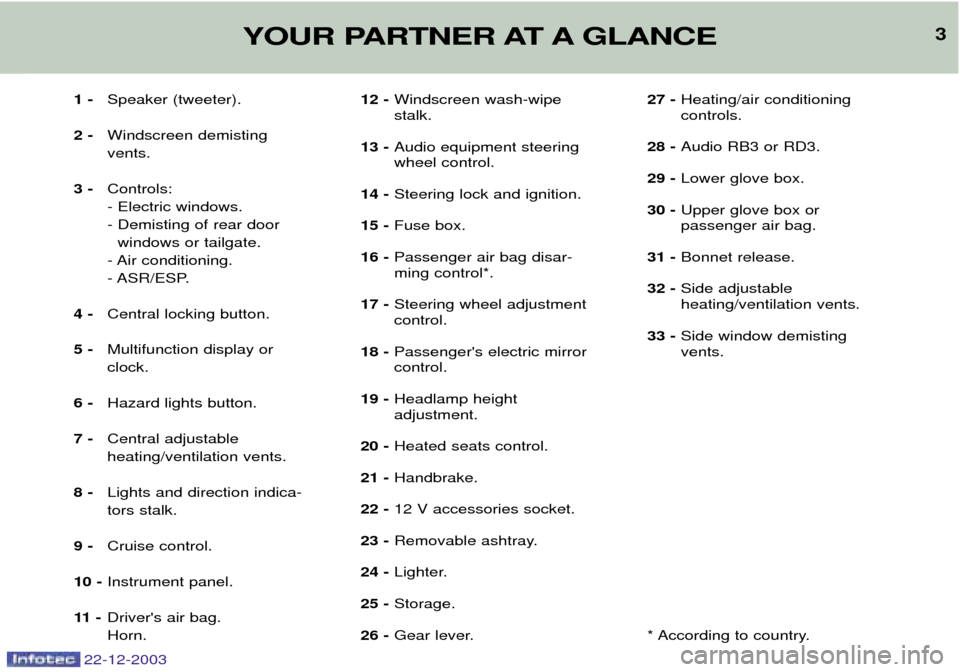
1 -Speaker (tweeter).
2 - Windscreen demisting vents.
3 - Controls:- Electric windows.
- Demisting of rear door
windows or tailgate.
- Air conditioning.
- ASR/ESP.
4 - Central locking button.
5 - Multifunction display or clock.
6 - Hazard lights button.
7 - Central adjustable heating/ventilation vents.
8 - Lights and direction indica-tors stalk.
9 - Cruise control.
10 - Instrument panel.
11 - Driver's air bag.Horn. 12 -
Windscreen wash-wipe stalk.
13 - Audio equipment steeringwheel control.
14 - Steering lock and ignition.
15 - Fuse box.
16 - Passenger air bag disar-ming control*.
17 - Steering wheel adjustmentcontrol.
18 - Passenger's electric mirrorcontrol.
19 - Headlamp height adjustment.
20 - Heated seats control.
21 - Handbrake.
22 - 12 V accessories socket.
23 - Removable ashtray.
24 - Lighter.
25 - Storage.
26 - Gear lever. 27 -
Heating/air conditioningcontrols.
28 - Audio RB3 or RD3.
29 - Lower glove box.
30 - Upper glove box or passenger air bag.
31 - Bonnet release.
32 - Side adjustableheating/ventilation vents.
33 - Side window demistingvents.
* According to country.
Page 5 of 128
6YOUR PARTNER AT A GLANCE
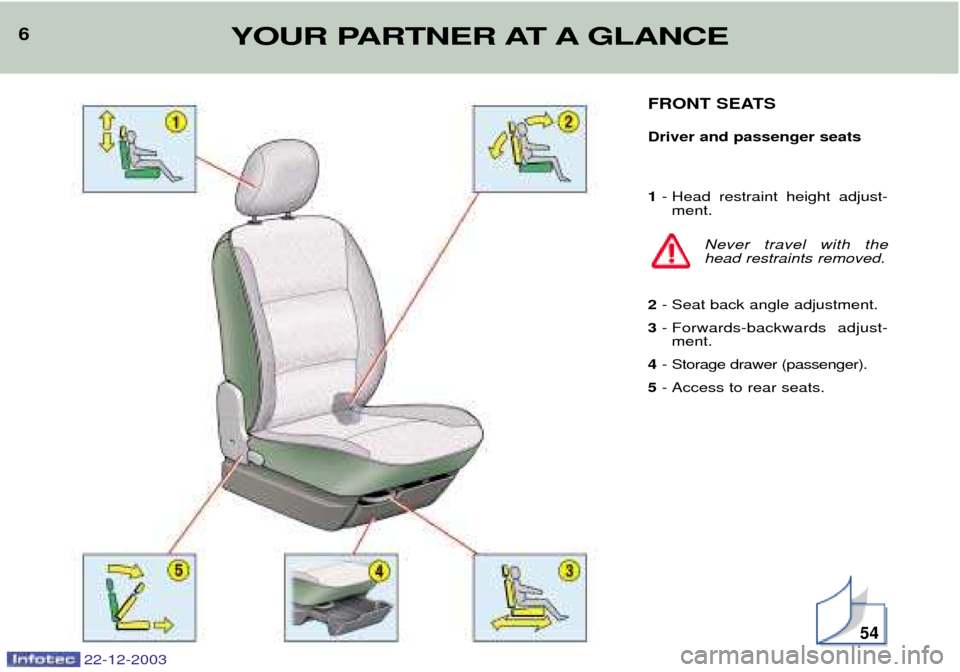
FRONT SEATS Driver and passenger seats 1- Head restraint height adjust-
ment.
Never travel with the head restraints removed.
2 - Seat back angle adjustment.
3 - Forwards-backwards adjust-
ment.
4 - Storage drawer (passenger).
5 - Access to rear seats.
54
22-12-2003
Page 54 of 128
22-12-2003
YOUR PARTNER IN DETAIL
54
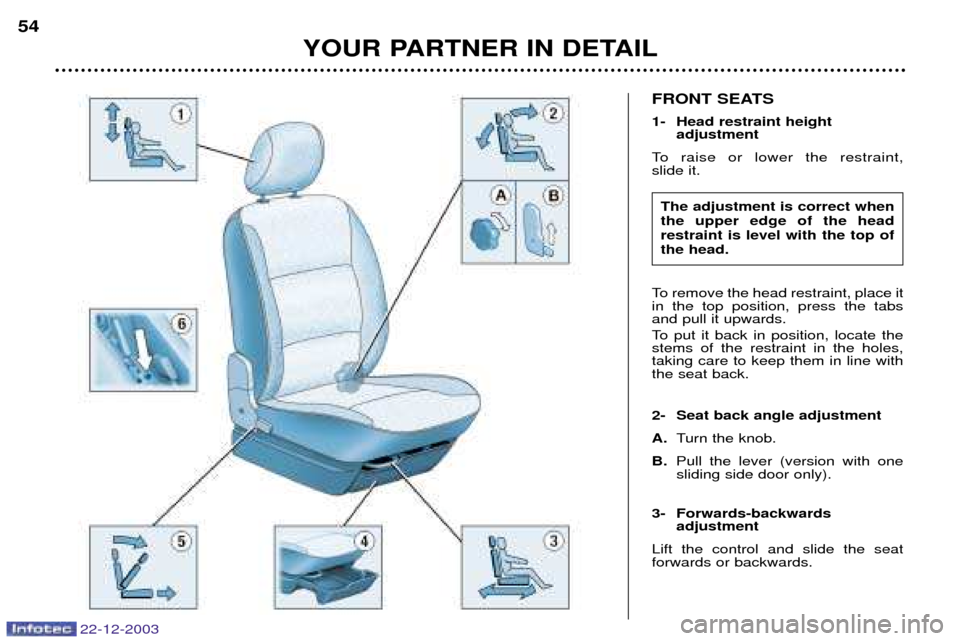
FRONT SEATS
1- Head restraint height
adjustment
To raise or lower the restraint, slide it.
To remove the head restraint, place it in the top position, press the tabsand pull it upwards.
To put it back in position, locate the stems of the restraint in the holes,taking care to keep them in line withthe seat back.
2- Seat back angle adjustment A. Turn the knob.
B. Pull the lever (version with one
sliding side door only).
3- Forwards-backwards adjustment
Lift the control and slide the seat forwards or backwards.
The adjustment is correct when the upper edge of the headrestraint is level with the top ofthe head.
Page 55 of 128
22-12-2003
YOUR PARTNER IN DETAIL55
Never drive with the head restraints removed; theymust be in place and correctly adjusted.
Do not place heavy objects in thedrawers.
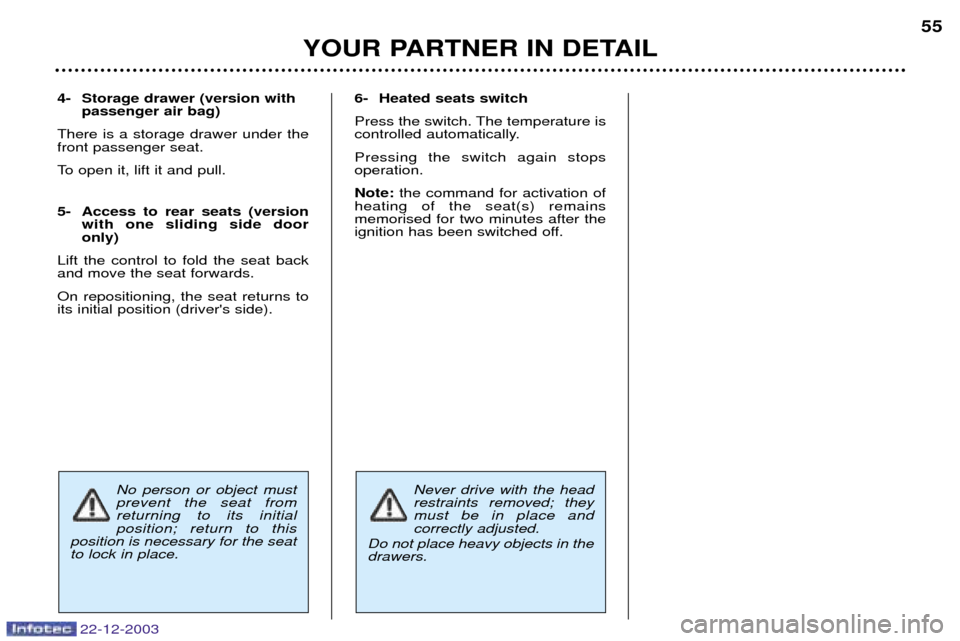
4- Storage drawer (version with passenger air bag)
There is a storage drawer under the front passenger seat.
To open it, lift it and pull.
5- Access to rear seats (version with one sliding side door only)
Lift the control to fold the seat backand move the seat forwards. On repositioning, the seat returns to its initial position (driver's side). 6- Heated seats switch
Press the switch. The temperature is
controlled automatically. Pressing the switch again stops operation. Note:
the command for activation of
heating of the seat(s) remains memorised for two minutes after the
ignition has been switched off.
No person or object mustprevent the seat fromreturning to its initial position; return to this
position is necessary for the seatto lock in place.
Page 57 of 128

YOUR PARTNER IN DETAIL57
22-12-2003
Rules for transporting children on the front passenger seat** Children under the age of 10 must not travel in the forwards facingposition, unless the rear seats arealready occupied by other childrenor the rear seats cannot be used(absent or folded). In this case,adjust the front passenger seat tothe intermediate position and leavethe passenger air bag armed. The transportation of children in the rearwards facing position is permit-ted. In this position, it is essential todisarm the passenger air bag.Otherwise, the child would risk beingkilled or seriously injured if the airbag were to inflate.GENERAL POINTS RELATING TO CHILD SEATS Although one of PEUGEOT's main criteria when designing your vehicle, the safety of your children also depends on you.
For maximum safety, please follow these precautions:
- Since 1992,
all children under the age of 10 must travel in approved child
seats* suited to their weight , on seats fitted with a seat belt.
- A child weighing less than 9 kg must travel in the rearwards facing
position both in the front and in the rear. PEUGEOT recommends thatchildren should travel in the "rearwards facing" position up to the age oftwo.
- Statistically, the safest seats in your vehicle for the transportation of children are the rear seats. PEUGEOT recommends that children travel inthe rear even when a "rearwards facing" child seat is used.
- If a child is travelling on a booster seat, check that the lap section of the seat belt passes over the child's thighs correctly. The chest section of the seat beltmust be positioned on the child's shoulder without touching the neck.
PEUGEOT recommends that you use a booster seat with a back, fitted with aseat belt guide at shoulder level.
- Remember to fasten the seat belt or the child seat harness keeping the slack
in relation to the child's body to a minimum , even for short journeys.
* According to current legislation in the country.
** Consult the relevant administration in your country for information regarding the rules for transporting children on the front passenger seat.
Page 58 of 128
22-12-2003
YOUR PARTNER IN DETAIL
58
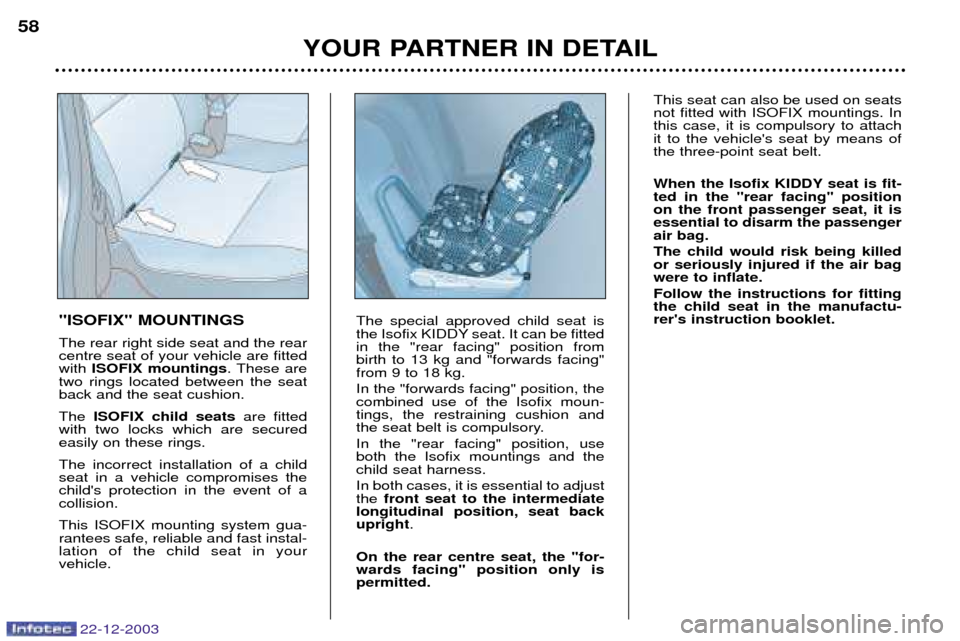
"ISOFIX" MOUNTINGS The rear right side seat and the rear centre seat of your vehicle are fittedwith ISOFIX mountings . These are
two rings located between the seatback and the seat cushion. The ISOFIX child seats are fitted
with two locks which are secured easily on these rings. The incorrect installation of a child seat in a vehicle compromises thechild's protection in the event of acollision. This ISOFIX mounting system gua- rantees safe, reliable and fast instal-lation of the child seat in yourvehicle. The special approved child seat is
the Isofix KIDDY seat. It can be fittedin the "rear facing" position frombirth to 13 kg and "forwards facing"from 9 to 18 kg. In the "forwards facing" position, the combined use of the Isofix moun-tings, the restraining cushion and
the seat belt is compulsory. In the "rear facing" position, use both the Isofix mountings and thechild seat harness. In both cases, it is essential to adjust the
front seat to the intermediate
longitudinal position, seat backupright .
On the rear centre seat, the "for-wards facing" position only ispermitted. This seat can also be used on seatsnot fitted with ISOFIX mountings. Inthis case, it is compulsory to attachit to the vehicle's seat by means ofthe three-point seat belt.
When the Isofix KIDDY seat is fit- ted in the "rear facing" positionon the front passenger seat, it isessential to disarm the passengerair bag. The child would risk being killed or seriously injured if the air bagwere to inflate. Follow the instructions for fitting the child seat in the manufactu-rer's instruction booklet.
Page 59 of 128
22-12-2003
YOUR PARTNER IN DETAIL59
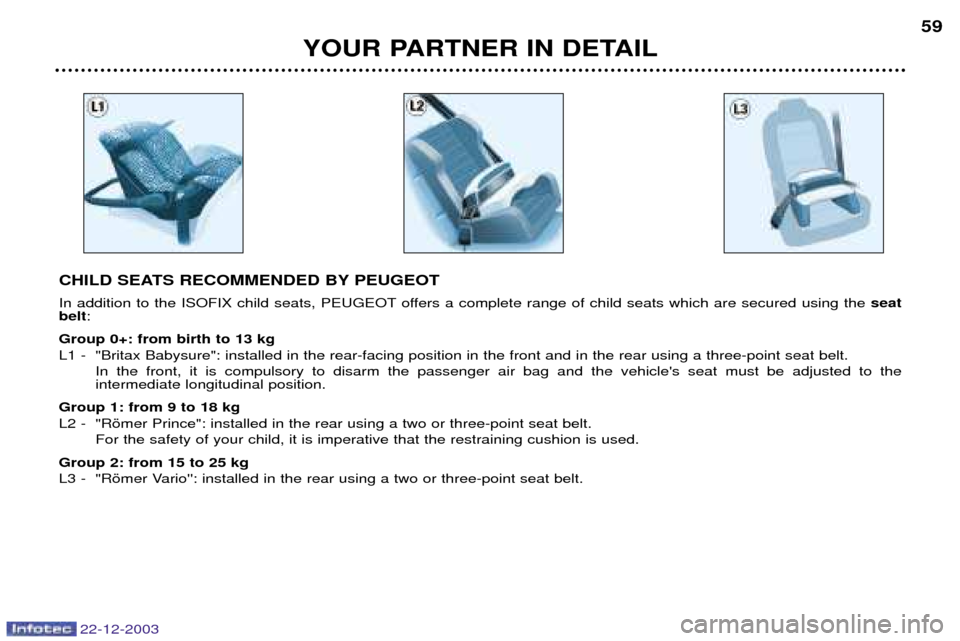
CHILD SEATS RECOMMENDED BY PEUGEOT
In addition to the ISOFIX child seats, PEUGEOT offers a complete range of child seats which are secured using the seat
belt :
Group 0+: from birth to 13 kg
L1 - "Britax Babysure": installed in the rear-facing position in the front and in the rear using a three-point seat belt. In the front, it is compulsory to disarm the passenger air bag and the vehicle's seat must be adjusted to the intermediate longitudinal position.
Group 1: from 9 to 18 kg
L2 - "Ršmer Prince": installed in the rear using a two or three-point seat belt. For the safety of your child, it is imperative that the restraining cushion is used.
Group 2: from 15 to 25 kg
L3 - "Ršmer Vario'': installed in the rear using a two or three-point seat belt.
Page 61 of 128
22-12-2003
YOUR PARTNER IN DETAIL61
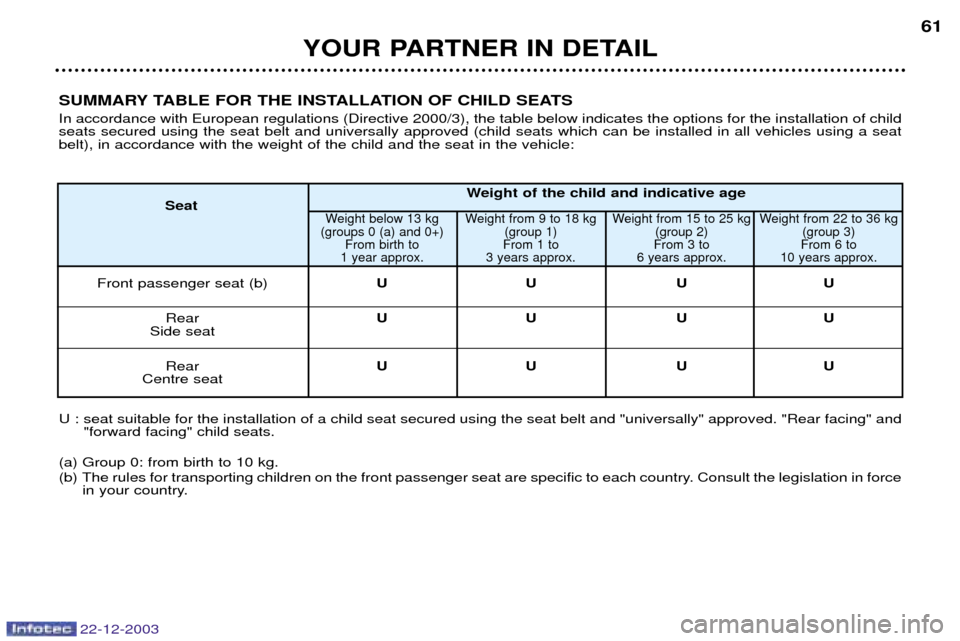
U : seat suitable for the installation of a child seat secured using the seat belt and "universally" approved. "Rear facing" an d
"forward facing" child seats.
(a) Group 0: from birth to 10 kg.
(b) The rules for transporting children on the front passenger seat are specific to each country. Consult the legislation in fo rce
in your country.
SUMMARY TABLE FOR THE INSTALLATION OF CHILD SEATS In accordance with European regulations (Directive 2000/3), the table below indicates the options for the installation of child seats secured using the seat belt and universally approved (child seats which can be installed in all vehicles using a seatbelt), in accordance with the weight of the child and the seat in the vehicle:
Weight of the child and indicative age
Seat
Weight below 13 kg Weight from 9 to 18 kg Weight from 15 to 25 kg Weight from 22 to 36 kg
(groups 0 (a) and 0+) (group 1) (group 2) (group 3) From birth to From 1 to From 3 to From 6 to
1 year approx. 3 years approx. 6 years approx. 10 years approx.
Front passenger seat (b) UU UU
Rear UU UU
Side seat
Rear UU UU
Centre seat