Page 117 of 128
PRACTICAL INFORMATION
110
22-12-2003
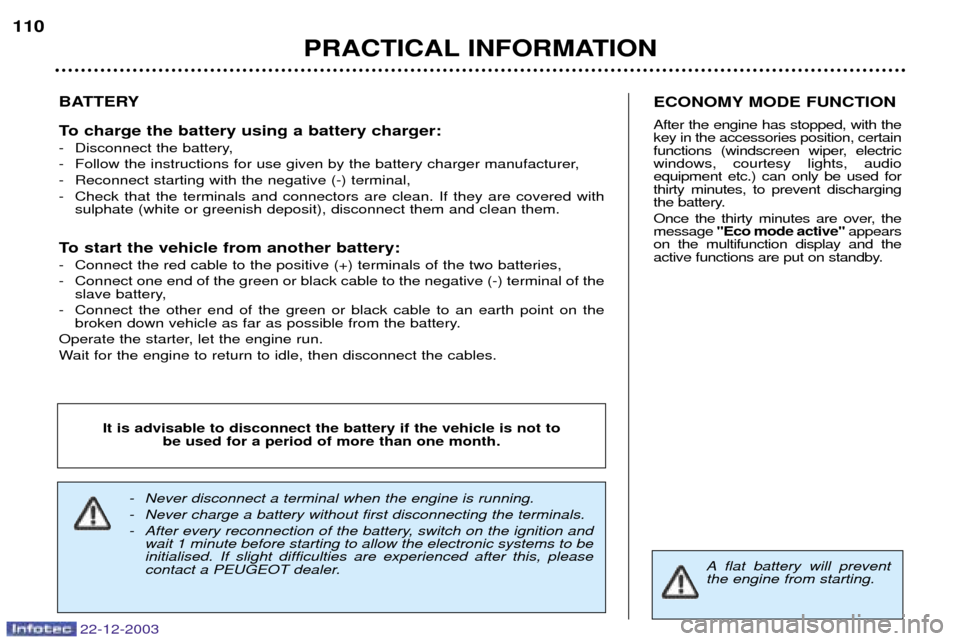
BATTERY
To charge the battery using a battery charger:
- Disconnect the battery,
- Follow the instructions for use given by the battery charger manufacturer,
- Reconnect starting with the negative (-) terminal,
- Check that the terminals and connectors are clean. If they are covered with
sulphate (white or greenish deposit), disconnect them and clean them.
To start the vehicle from another battery:
- Connect the red cable to the positive (+) terminals of the two batteries,
- Connect one end of the green or black cable to the negative (-) terminal of the slave battery,
- Connect the other end of the green or black cable to an earth point on the broken down vehicle as far as possible from the battery.
Operate the starter, let the engine run.
Wait for the engine to return to idle, then disconnect the cables.
- Never disconnect a terminal when the engine is running.
- Never charge a battery without first disconnecting the terminals.
- After every reconnection of the battery, switch on the ignition and wait 1 minute before starting to allow the electronic systems to be initialised. If slight difficulties are experienced after this, please
contact a PEUGEOT dealer. A flat battery will preventthe engine from starting.
It is advisable to disconnect the battery if the vehicle is not to
be used for a period of more than one month.
ECONOMY MODE FUNCTION After the engine has stopped, with the key in the accessories position, certain
functions (windscreen wiper, electricwindows, courtesy lights, audio equipment etc.) can only be used forthirty minutes, to prevent discharging
the battery.
Once the thirty minutes are over, the message "Eco mode active" appears
on the multifunction display and the
active functions are put on standby.
Page 120 of 128

TOWING A TRAILER,
CARAVAN, BOAT etc.
Only use original PEUGEOT tow bars that have been tested andapproved from the design stage of
your vehicle. The tow bar must be
fitted by a PEUGEOT dealer.
Your vehicle is primarily designed for transporting people and luggagebut it may also be used for towing a
trailer. Driving with a trailer subjects the towing vehicle to more significantstress and its driver must be particu-larly careful. Air density decreases with altitude, thus reducing engine performance.Above 1000 metres, the maximumtowing load must be reduced by 10% and so on for every 1000 metres of altitude.Driving advice Distribution of loads :
Distribute the
load in the trailer so that the heaviest items are as close as possible to theaxle and the nose weight approachesthe maximum permitted without exceeding it. Cooling : Towing a trailer on a slope
increases the temperature of the coolant. As the fan is electrically controlled, its cooling capacity is not dependenton the engine speed.
On the contrary, use a high gear to lower the engine speed and reduceyour speed. The maximum towing load on a long slope depends on the gradient andthe outside temperature. In all cases, pay attention to the coolant temperature. If the warning light comes on, stop
the vehicle and switch off the engineas soon as possible. Tyres :
Check the tyre pressures of
the towing vehicle and of the trailer,observing the recommended pressures. Braking : Towing increases the
braking distance.Lights : Check the electrical signalling
on the trailer.Side wind : Take into acount the
increased sensitivity to side wind.
PRACTICAL INFORMATION 113
22-12-2003
Page 122 of 128
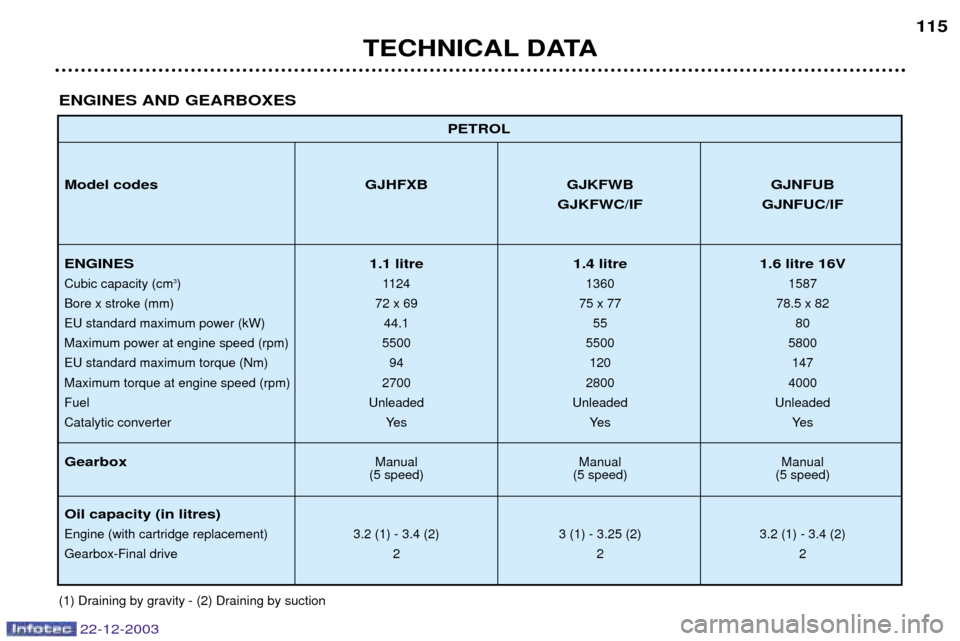
TECHNICAL DATA115
PETROL
Model codes GJHFXB GJKFWB GJNFUB GJKFWC/IF GJNFUC/IF
ENGINES 1.1 litre 1.4 litre 1.6 litre 16V
Cubic capacity (cm 3
) 1124 1360 1587
Bore x stroke (mm) 72 x 69 75 x 77 78.5 x 82
EU standard maximum power (kW) 44.1 55 80
Maximum power at engine speed (rpm) 5500 5500 5800
EU standard maximum torque (Nm) 94 120 147
Maximum torque at engine speed (rpm) 2700 2800 4000Fuel Unleaded Unleaded Unleaded
Catalytic converter Yes Yes Yes
GearboxManual Manual Manual
(5 speed) (5 speed) (5 speed)
Oil capacity (in litres)
Engine (with cartridge replacement) 3.2 (1) - 3.4 (2) 3 (1) - 3.25 (2) 3.2 (1) - 3.4 (2)Gearbox-Final drive 2 2 2
ENGINES AND GEARBOXES
(1) Draining by gravity - (2) Draining by suction
22-12-2003
Page 123 of 128
22-12-2003
TECHNICAL DATA
116
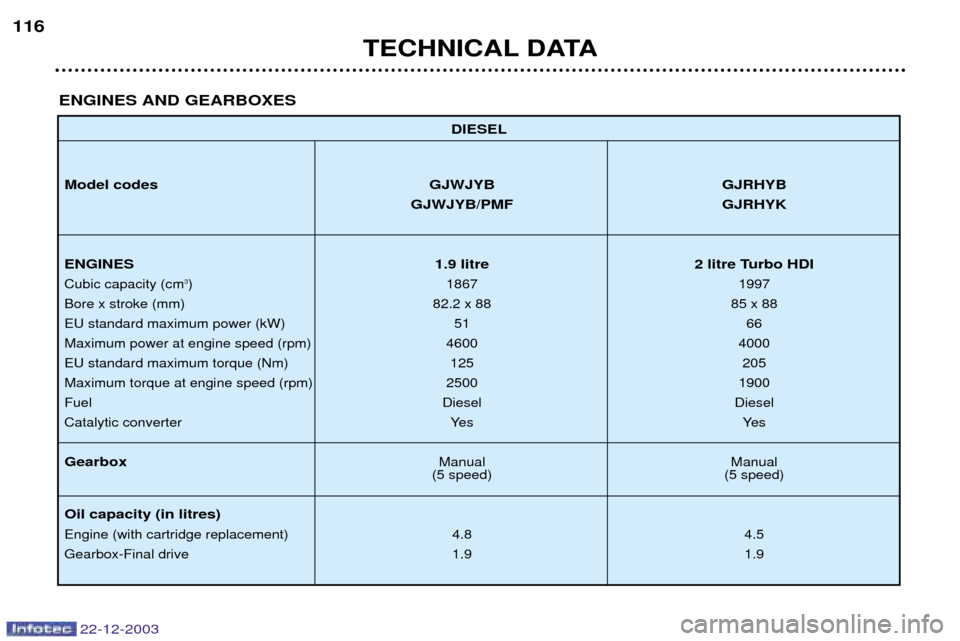
DIESEL
Model codes GJWJYB GJRHYB
GJWJYB/PMF GJRHYK
ENGINES 1.9 litre 2 litre Turbo HDI
Cubic capacity (cm3
) 1867 1997
Bore x stroke (mm) 82.2 x 8885 x 88
EU standard maximum power (kW) 51 66
Maximum power at engine speed (rpm) 4600 4000
EU standard maximum torque (Nm) 125 205
Maximum torque at engine speed (rpm) 2500 1900
Fuel DieselDiesel
Catalytic converter YesYes
GearboxManual Manual
(5 speed) (5 speed)
Oil capacity (in litres)
Engine (with cartridge replacement) 4.8 4.5
Gearbox-Final drive 1.91.9
ENGINES AND GEARBOXES
Page 124 of 128
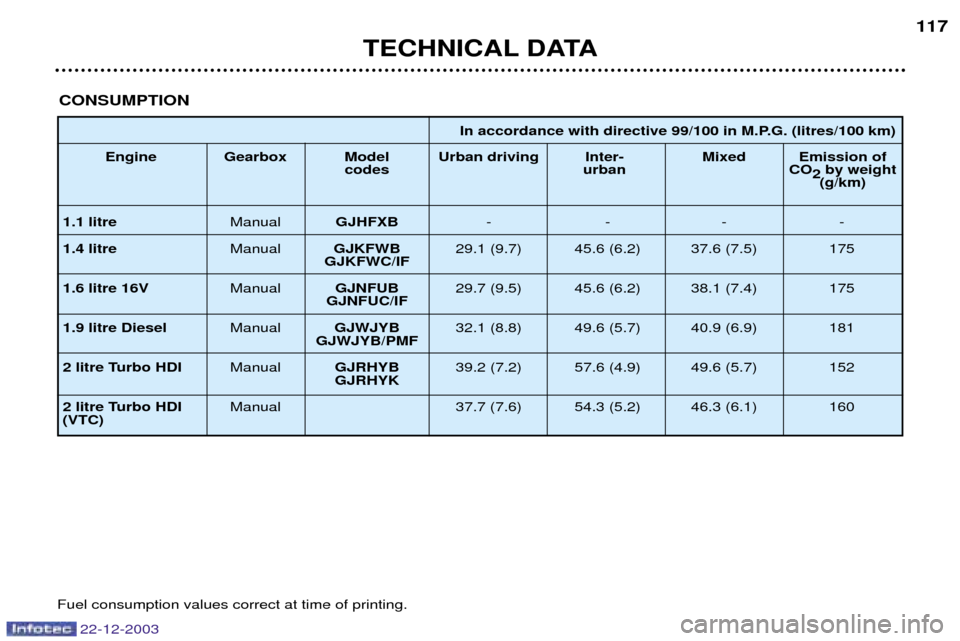
CONSUMPTION
Fuel consumption values correct at time of printing.In accordance with directive 99/100 in M.P.G. (litres/100 km)
Engine Gearbox Model Urban driving Inter- Mixed Emission of codes urban CO 2by weight
(g/km)
1.1 litre ManualGJHFXB ----
1.4 litre ManualGJKFWB 29.1 (9.7) 45.6 (6.2) 37.6 (7.5) 175
GJKFWC/IF
1.6 litre 16V ManualGJNFUB 29.7 (9.5) 45.6 (6.2) 38.1 (7.4) 175
GJNFUC/IF
1.9 litre Diesel ManualGJWJYB 32.1 (8.8) 49.6 (5.7) 40.9 (6.9) 181
GJWJYB/PMF
2 litre Turbo HDI ManualGJRHYB 39.2 (7.2) 57.6 (4.9) 49.6 (5.7) 152
GJRHYK
2 litre Turbo HDI Manual 37.7 (7.6) 54.3 (5.2) 46.3 (6.1) 160
(VTC)
TECHNICAL DATA 117
22-12-2003
Page 125 of 128
22-12-2003
TECHNICAL DATA
118
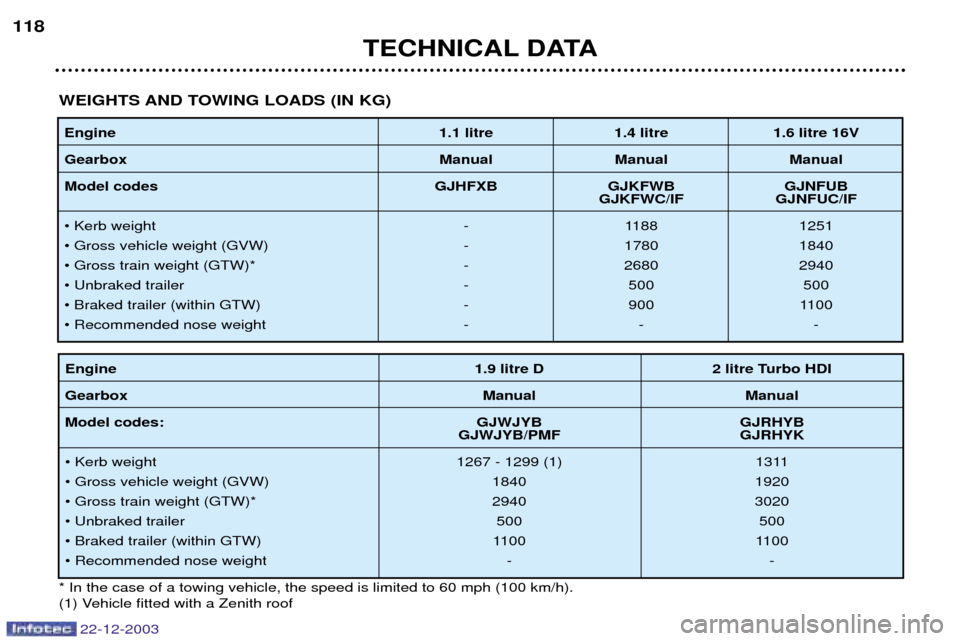
Engine
1.1 litre 1.4 litre 1.6 litre 16V
Gearbox Manual Manual Manual
Model codes GJHFXB GJKFWB GJNFUB
GJKFWC/IF GJNFUC/IF
¥ Kerb weight - 1188 1251
¥ Gross vehicle weight (GVW) - 1780 1840
¥ Gross train weight (GTW)* - 2680 2940¥ Unbraked trailer - 500 500
¥ Braked trailer (within GTW) - 900 1100
¥ Recommended nose weight - - -
WEIGHTS AND TOWING LOADS (IN KG) * In the case of a towing vehicle, the speed is limited to 60 mph (100 km/h).
(1) Vehicle fitted with a Zenith roof
Engine 1.9 litre D 2 litre Turbo HDI
Gearbox Manual Manual
Model codes: GJWJYB GJRHYB
GJWJYB/PMF GJRHYK
¥ Kerb weight 1267 - 1299 (1) 1311
¥ Gross vehicle weight (GVW) 1840 1920
¥ Gross train weight (GTW)* 2940 3020¥ Unbraked trailer 500 500
¥ Braked trailer (within GTW) 1100 1100
¥ Recommended nose weight - -