Page 102 of 128
22-12-2003
PRACTICAL INFORMATION
96
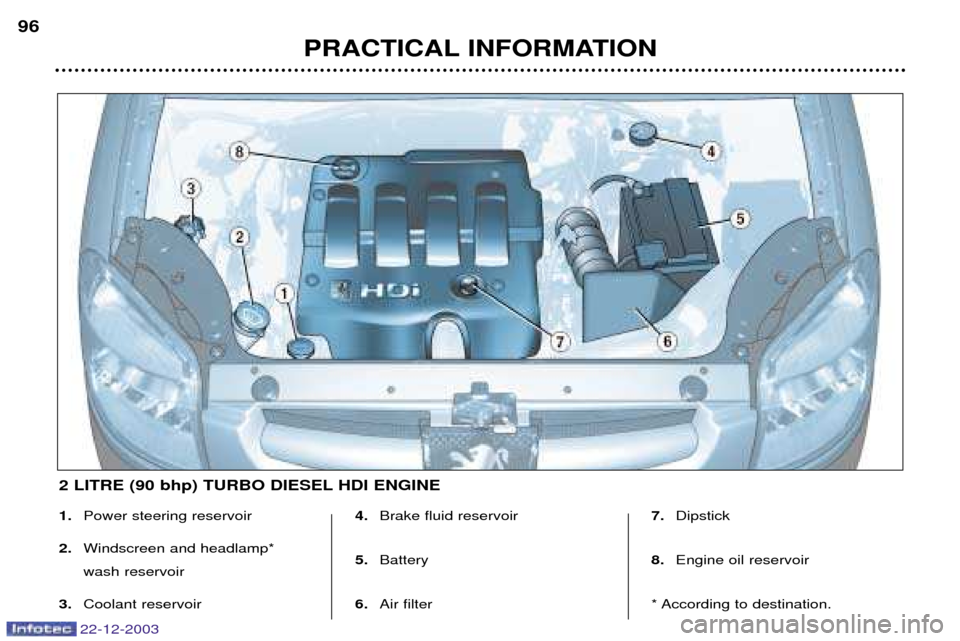
1.
Power steering reservoir
2. Windscreen and headlamp* wash reservoir
3. Coolant reservoir 4.
Brake fluid reservoir
5. Battery
6. Air filter 7.
Dipstick
8. Engine oil reservoir
* According to destination.
2 LITRE (90 bhp) TURBO DIESEL HDI ENGINE
Page 103 of 128
22-12-2003
CHECKING THE LEVELS Oil level �Check the level regularly and top
up between changes. The maxi-mum consumption is 0.5 l per600 miles (1000 km). Check the level with the vehicle level, engine cold, using the oillevel gauge on the instrumentpanel or the dipstick.
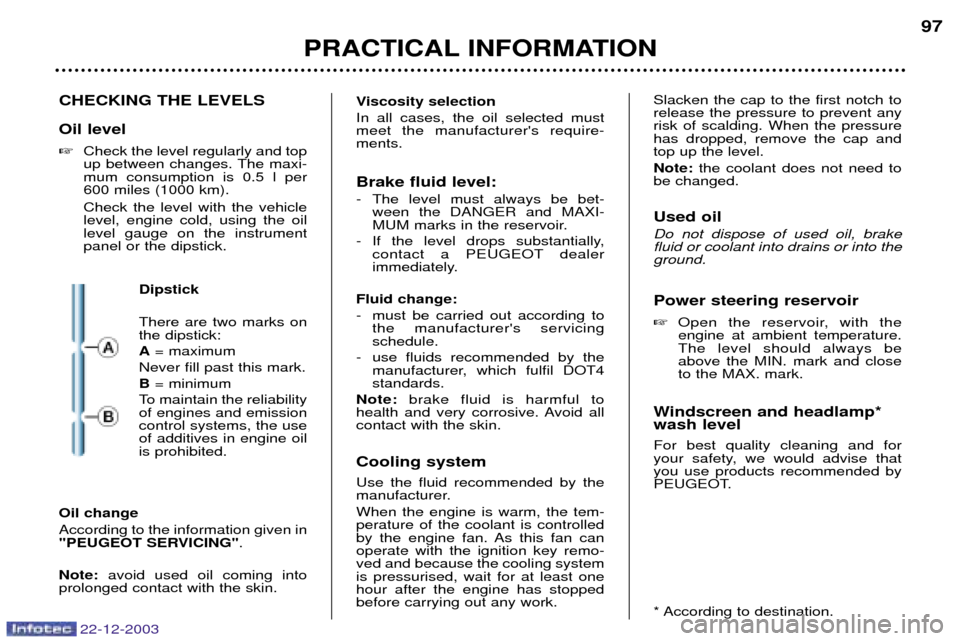
Dipstick There are two marks on the dipstick: A= maximum
Never fill past this mark. B = minimum
To maintain the reliability of engines and emissioncontrol systems, the useof additives in engine oilis prohibited.
PRACTICAL INFORMATION 97
Viscosity selection In all cases, the oil selected must meet the manufacturer's require-ments. Brake fluid level:
- The level must always be bet-
ween the DANGER and MAXI-
MUM marks in the reservoir.
- If the level drops substantially, contact a PEUGEOT dealer
immediately.
Fluid change:
- must be carried out according to the manufacturer's servicing schedule.
- use fluids recommended by the manufacturer, which fulfil DOT4standards.
Note: brake fluid is harmful to
health and very corrosive. Avoid allcontact with the skin. Cooling system Use the fluid recommended by the
manufacturer. When the engine is warm, the tem- perature of the coolant is controlled
by the engine fan. As this fan canoperate with the ignition key remo-ved and because the cooling systemis pressurised, wait for at least onehour after the engine has stoppedbefore carrying out any work. Slacken the cap to the first notch torelease the pressure to prevent anyrisk of scalding. When the pressurehas dropped, remove the cap andtop up the level. Note:
the coolant does not need to
be changed. Used oil Do not dispose of used oil, brake fluid or coolant into drains or into theground. Power steering reservoir � Open the reservoir, with the engine at ambient temperature.The level should always beabove the MIN. mark and closeto the MAX. mark.
Windscreen and headlamp*wash level For best quality cleaning and for
your safety, we would advise thatyou use products recommended by
PEUGEOT.
* According to destination.
Oil change According to the information given in
"PEUGEOT SERVICING" .
Note: avoid used oil coming into
prolonged contact with the skin.
Page 104 of 128
22-12-2003
PRACTICAL INFORMATION
98
CHECKS Battery
At the start of winter, have your battery checked by a PEUGEOT
dealer. Air filter and passenger compartment filter Have the filter elements replaced
regularly.
If you drive in dusty
conditions, change them twice asoften. Brake pads Brake pad wear depends on the style of driving, in particular forvehicles which are used in town,over short distances. It may be necessary to check the thickness of the pads, even betweenservices. Handbrake Where the handbrake travel is too great or there is a reduction in theperformance of the system, thehandbrake should be adjusted, evenbetween services. Have the system checked by a
PEUGEOT dealer. Oil filter
Change the filter regularly, in accor- dance with the servicing schedule. Manual gearbox This does not require an oil change. Check the level in accordance withthe manufacturer's servicing sche-dule.
Only use products recom-
mended by PEUGEOT.
To ensure best performan-
ce from components as important as the power steering and the bra-king system, PEUGEOT selectsand offers quite specific products.
To prevent damage to the electri- cal units, avoid washing the engine.
RUNNING OUT OF FUEL (DIESEL) If you should run out of fuel, it is necessary to re-prime the circuit:
- fill the fuel tank with at least five litres of diesel,
- operate the manual re-priming pump, under the bonnet under the
protective cover, until fuel appearsin the transparent pipe,
- operate the starter until the engine starts.
FUEL SUPPLY CUT-OFF (PETROL) In a serious collision, a mechanism prevents fuel from reaching the engine.
To re-establish the fuel supply, press the switch on the corner of the front
right-hand suspension assembly,under the bonnet.
Page 112 of 128
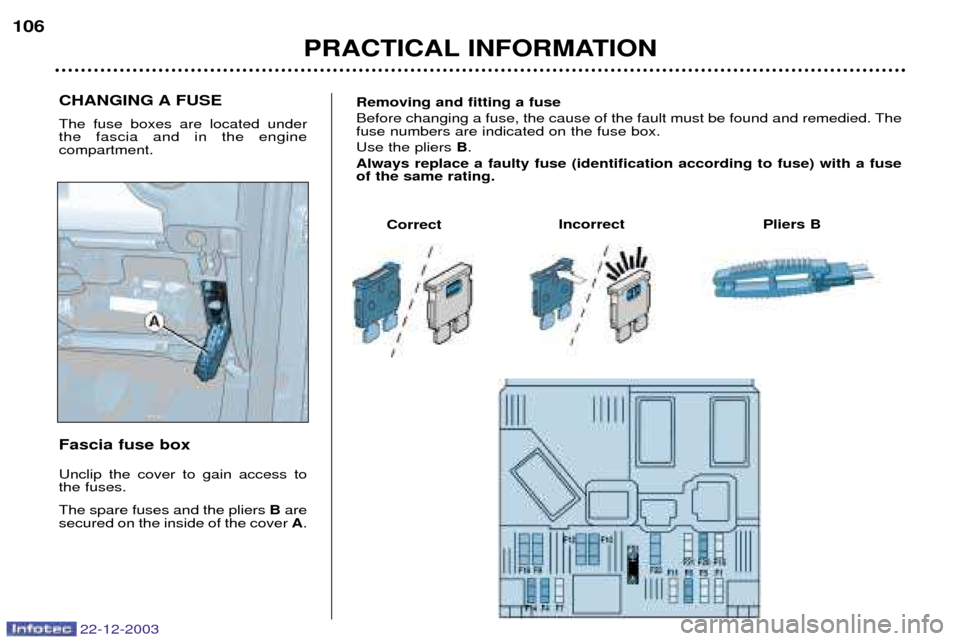
CHANGING A FUSE The fuse boxes are located under the fascia and in the engine compartment. Fascia fuse box Unclip the cover to gain access to the fuses. The spare fuses and the pliers Bare
secured on the inside of the cover A.
PRACTICAL INFORMATION
106
22-12-2003
Removing and fitting a fuse
Before changing a fuse, the cause of the fault must be found and remedied. The fuse numbers are indicated on the fuse box. Use the pliers
B.
Always replace a faulty fuse (identification according to fuse) with a fuse of the same rating.
Correct Pliers B
Incorrect
Page 113 of 128
22-12-2003
PRACTICAL INFORMATION
108
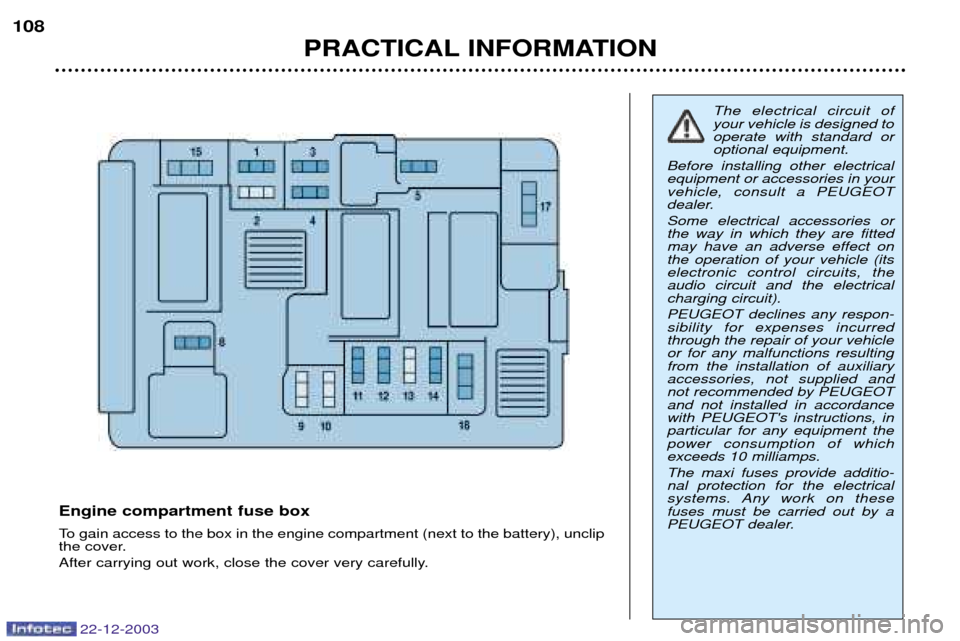
Engine compartment fuse box
To gain access to the box in the engine compartment (next to the battery), unclip
the cover.
After carrying out work, close the cover very carefully.
The electrical circuit of your vehicle is designed tooperate with standard oroptional equipment.
Before installing other electricalequipment or accessories in yourvehicle, consult a PEUGEOT
dealer. Some electrical accessories or the way in which they are fittedmay have an adverse effect onthe operation of your vehicle (itselectronic control circuits, theaudio circuit and the electricalcharging circuit). PEUGEOT declines any respon- sibility for expenses incurredthrough the repair of your vehicleor for any malfunctions resultingfrom the installation of auxiliaryaccessories, not supplied andnot recommended by PEUGEOTand not installed in accordancewith PEUGEOT's instructions, inparticular for any equipment thepower consumption of whichexceeds 10 milliamps. The maxi fuses provide additio- nal protection for the electrical
systems. Any work on thesefuses must be carried out by a
PEUGEOT dealer.
Page 114 of 128
PRACTICAL INFORMATION109
22-12-2003
Fuse N¡ Rating
Functions
1 10A Pre-heat unit (diesel) - Brake and clutch switches - Reversing light.
2 15A Fuel pump.
3 10A ABS control unit or ESP control unit.
4 10A Engine control unit.
5- Not used.
6 15A Front fog lamps.
7 20A Headlamp wash pump.
8 20A Fan assembly relay - Engine control unit.
9 15A Left-hand dipped beam.
10 15A Right-hand dipped beam.
11 10A Left-hand main beam.
12 10A Right-hand main beam.
13 15A Horns.
14 10A Front and rear windscreen wash pumps.
15 30A Oxygen sensor - Air flow sensor.
16 30A Air pump relay.
17 30A Front windscreen wiper.
18 40A Air conditioning fan.
Page 115 of 128
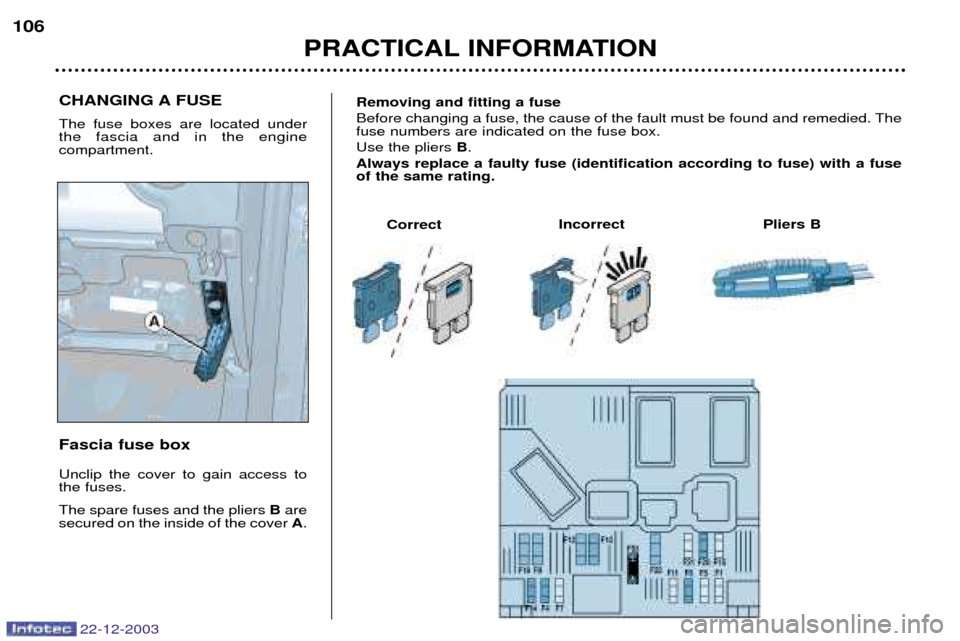
CHANGING A FUSE The fuse boxes are located under the fascia and in the engine compartment. Fascia fuse box Unclip the cover to gain access to the fuses. The spare fuses and the pliers Bare
secured on the inside of the cover A.
PRACTICAL INFORMATION
106
22-12-2003
Removing and fitting a fuse
Before changing a fuse, the cause of the fault must be found and remedied. The fuse numbers are indicated on the fuse box. Use the pliers
B.
Always replace a faulty fuse (identification according to fuse) with a fuse of the same rating.
Correct Pliers B
Incorrect
Page 116 of 128
Fuse RatingFunctions
1 15A Rear wiper (hinged doors) - Rear 12 V sockets.
4 20A Multi-function display - Instrument panel - Audio equipment - Steering wheel controls.
5 15A Alarm siren.
6 10A Diagnostic socket.
7 15A Alarm.
9 30A Heated seats - Zenith roof fan.
10 40A Rear screen and mirror demisting.
11 15A Rear windscreen wiper (tailgate).
12 30A Front electric windows - Sunroof.
14 10A Engine fuse box - Steering wheel controls - Rain sensor.
15 15A Instrument panel - Multi-function display - Audio equipment.
16 30A Locking/unlocking controls for doors, bonnet and boot.
20 10A Right-hand brake light.
21 15A Left-hand brake light.
22 20A Front courtesy light - Map reading light - Lighter - Front 12 V socket -
Electric mirror.
PRACTICAL INFORMATION 107
22-12-2003