Page 741 of 1833
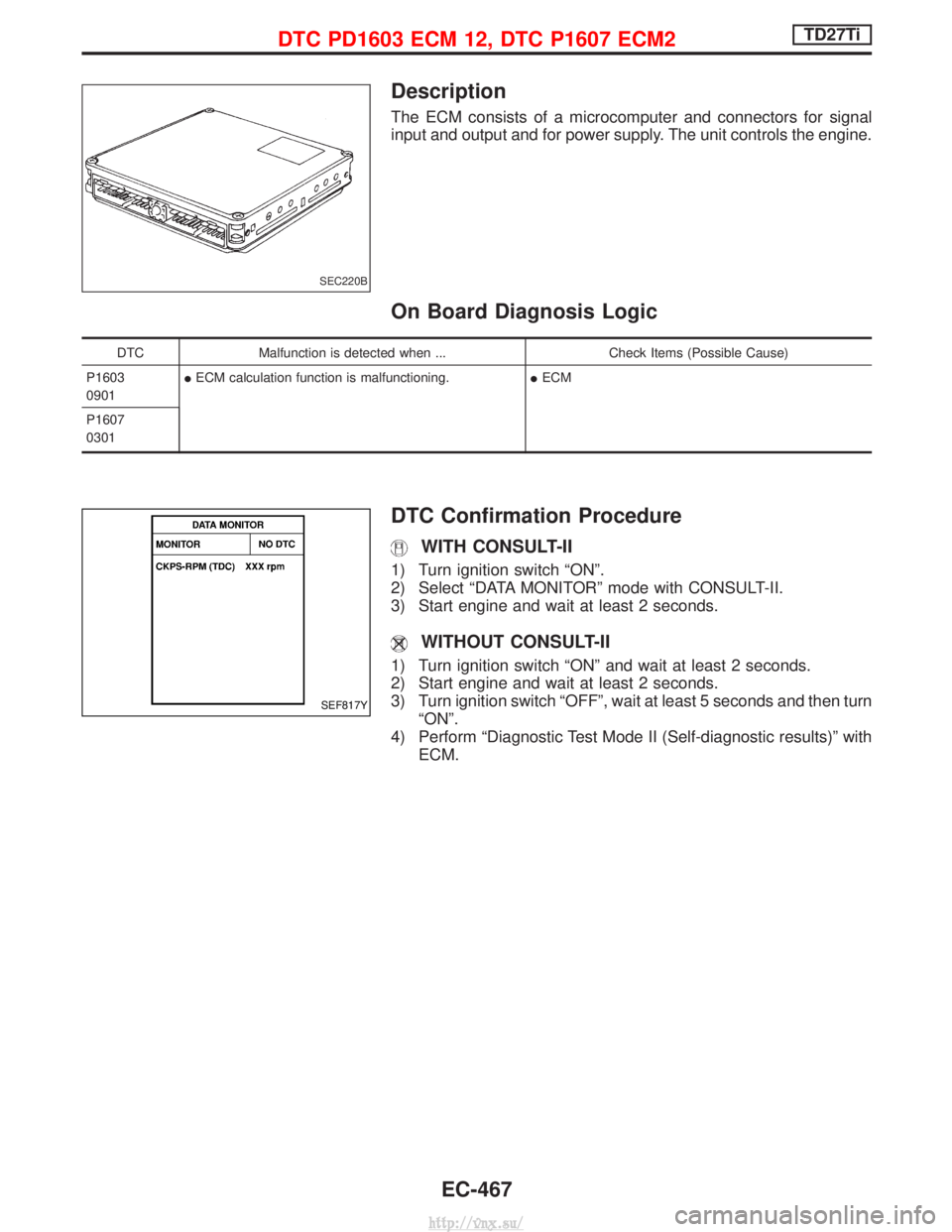
Diagnostic Procedure
INSPECTION START
(Air conditioner relay signal circuit)
CHECK POWER SUPPLY.
1. Turn ignition switch to ªLOCKº position.
2. Disconnect air conditioner relay har- ness connector.
3. Check voltage between air conditioner relay connector terminal q
2,q3and
engine ground.
Voltage: Battery voltage
OK
ENG Check the following:
I10A fuse
I Harness for open or
short between fuse block
and A/C relay
If NG, replace or repair the
parts attached.
CHECK INPUT SIGNAL CIRCUIT.
1. Turn ignition switch to ªLOCKº position.
2. Disconnect ECM harness connector.
3.Check harness continuity between ECM harness connector terminal
204and air
conditioner relay harness connector ter-
minal q
1. Refer to wiring diagram.
Continuity should exist.
If OK, check harness for short-
circuit.
OK
ENG Check the following:
IHarness connectors
M812,F120(LHD mod-
els)
I Harness for open or
short-circuit between
ECM and air conditioner
relay.
If NG, repair harness or
connectors.
CHECK AIR CONDITIONER RELAY.
Refer to HA section for inspection.
OK
ENG Replace air conditioner
relay.
Disconnect and reconnect harness
connectors in the circuit. Then retest.
Trouble is not fixed
Check ECM pin terminals for damage and
check the connection of ECM harness
connector. Reconnect ECM harness con-
nector and retest.
INSPECTION END
NEF512
PBIB0185E
H
H
H
H
H
H
DTC P1530 AIR CONDITIONER RLYTD27Ti
EC-466
http://vnx.su/
Page 742 of 1833
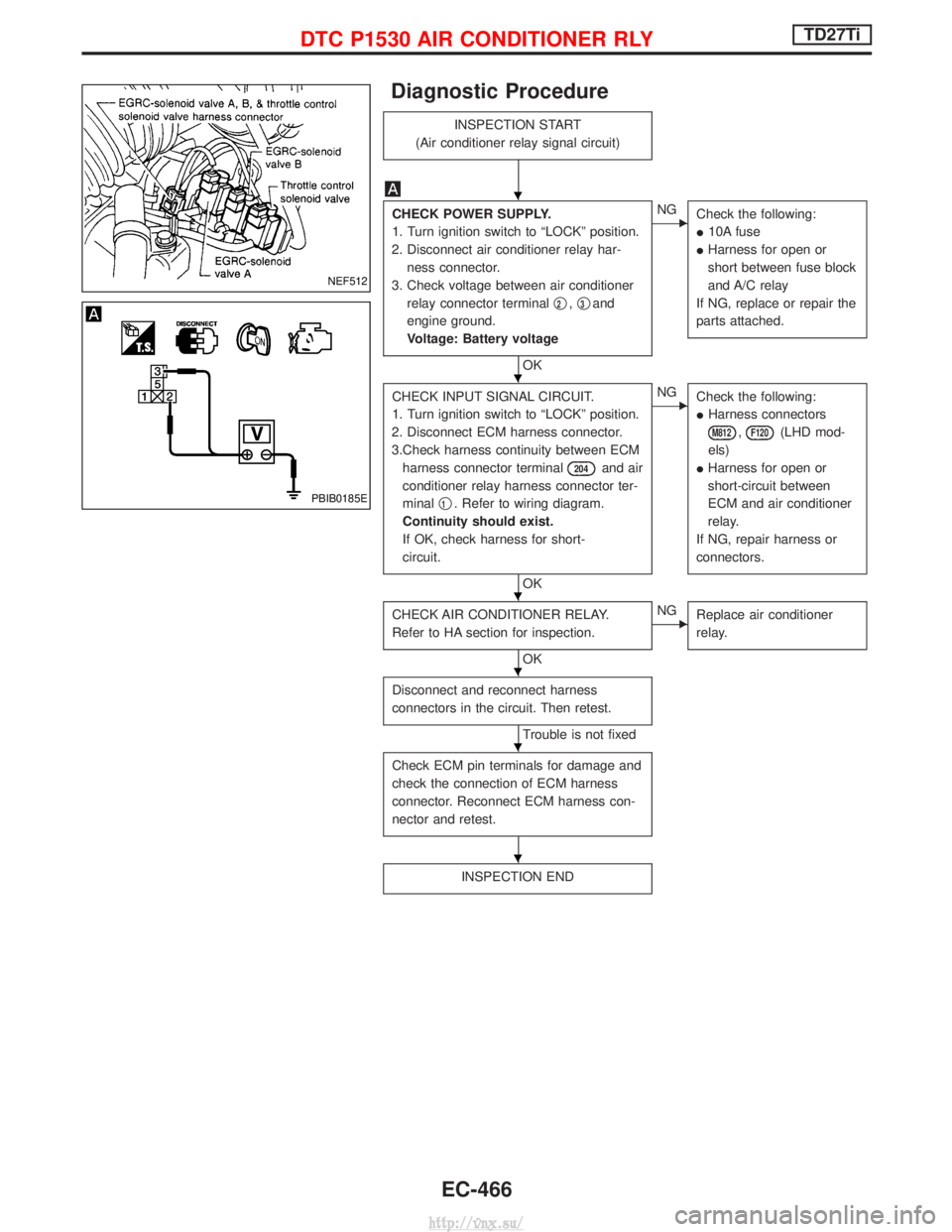
Description
The ECM consists of a microcomputer and connectors for signal
input and output and for power supply. The unit controls the engine.
On Board Diagnosis Logic
DTCMalfunction is detected when ... Check Items (Possible Cause)
P1603
0901 I
ECM calculation function is malfunctioning. IECM
P1607
0301
DTC Confirmation Procedure
WITH CONSULT-II
1) Turn ignition switch ªONº.
2) Select ªDATA MONITORº mode with CONSULT-II.
3) Start engine and wait at least 2 seconds.
WITHOUT CONSULT-II
1) Turn ignition switch ªONº and wait at least 2 seconds.
2) Start engine and wait at least 2 seconds.
3) Turn ignition switch ªOFFº, wait at least 5 seconds and then turn ªONº.
4) Perform ªDiagnostic Test Mode II (Self-diagnostic results)º with ECM.
SEC220B
SEF817Y
DTC PD1603 ECM 12, DTC P1607 ECM2TD27Ti
EC-467
http://vnx.su/
Page 748 of 1833
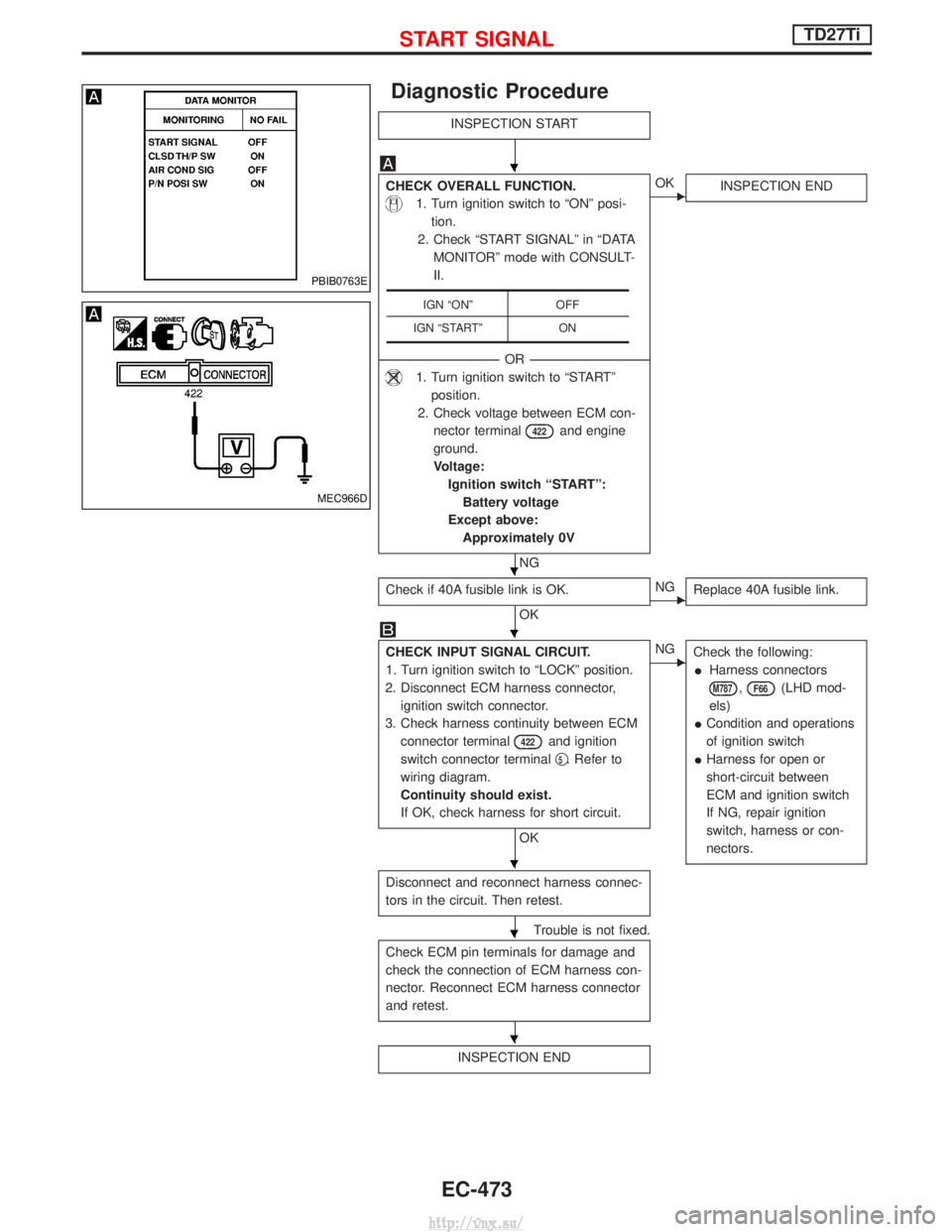
Diagnostic Procedure
INSPECTION START
CHECK OVERALL FUNCTION.
1. Turn ignition switch to ªONº posi-tion.
2. Check ªSTART SIGNALº in ªDATA MONITORº mode with CONSULT-
II.
------------------------------------------------------------------------------------------------------------------------------------- -OR--------------------------------------------------------------------------------------------------------------------------------------
1. Turn ignition switch to ªSTARTº
position.
2. Check voltage between ECM con- nector terminal
422and engine
ground.
Voltage: Ignition switch ªSTARTº:Battery voltage
Except above: Approximately 0V
NG
EOK INSPECTION END
Check if 40A fusible link is OK.
OKENGReplace 40A fusible link.
CHECK INPUT SIGNAL CIRCUIT.
1. Turn ignition switch to ªLOCKº position.
2. Disconnect ECM harness connector, ignition switch connector.
3. Check harness continuity between ECM connector terminal
422and ignition
switch connector terminal q
5. Refer to
wiring diagram.
Continuity should exist.
If OK, check harness for short circuit.
OK
ENG Check the following:
I Harness connectors
M787,F66(LHD mod-
els)
I Condition and operations
of ignition switch
I Harness for open or
short-circuit between
ECM and ignition switch
If NG, repair ignition
switch, harness or con-
nectors.
Disconnect and reconnect harness connec-
tors in the circuit. Then retest.
Trouble is not fixed.
Check ECM pin terminals for damage and
check the connection of ECM harness con-
nector. Reconnect ECM harness connector
and retest.
INSPECTION END
IGN ªONº OFF
IGN ªSTARTº ON
PBIB0763E
MEC966D
H
H
H
H
H
H
START SIGNALTD27Ti
EC-473
http://vnx.su/
Page 753 of 1833
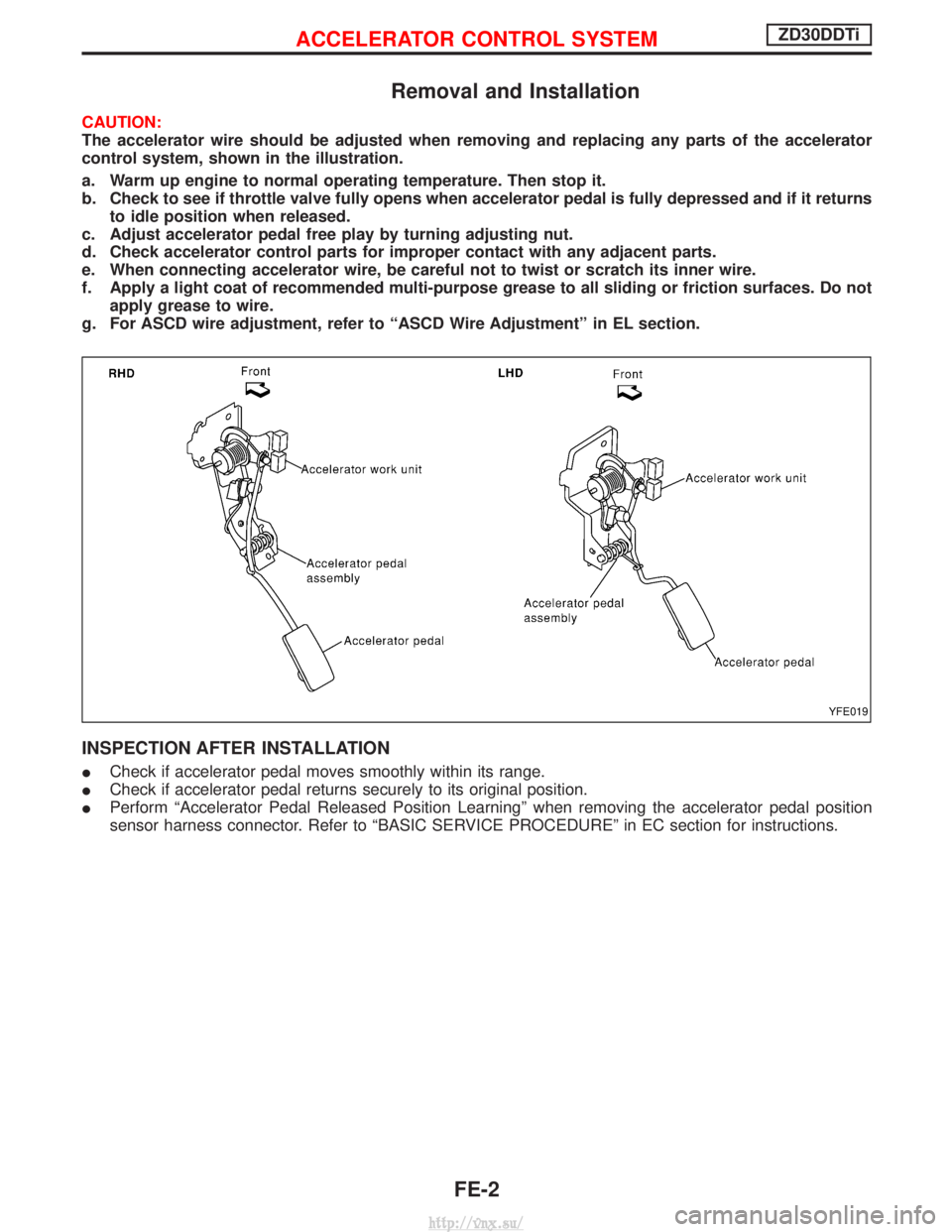
Removal and Installation
CAUTION:
The accelerator wire should be adjusted when removing and replacing any parts of the accelerator
control system, shown in the illustration.
a. Warm up engine to normal operating temperature. Then stop it.
b. Check to see if throttle valve fully opens when accelerator pedal is fully depressed and if it returnsto idle position when released.
c. Adjust accelerator pedal free play by turning adjusting nut.
d. Check accelerator control parts for improper contact with any adjacent parts.
e. When connecting accelerator wire, be careful not to twist or scratch its inner wire.
f. Apply a light coat of recommended multi-purpose grease to all sliding or friction surfaces. Do not apply grease to wire.
g. For ASCD wire adjustment, refer to ªASCD Wire Adjustmentº in EL section.
INSPECTION AFTER INSTALLATION
I Check if accelerator pedal moves smoothly within its range.
I Check if accelerator pedal returns securely to its original position.
I Perform ªAccelerator Pedal Released Position Learningº when removing the accelerator pedal position
sensor harness connector. Refer to ªBASIC SERVICE PROCEDUREº in EC section for instructions.
YFE019
ACCELERATOR CONTROL SYSTEMZD30DDTi
FE-2
http://vnx.su/
Page 756 of 1833
Adjusting Accelerator Cable
q1Pedal bracket
q
2Accelerator switch q
3Accelerator position sensor
q
4Accelerator cable q
5Return spring
q
6Accelerator pedal
INSPECTION AFTER INSTALLATION
I Check if accelerator pedal moves smoothly within its range.
I Check if accelerator pedal returns securely to its original position.
I Perform ªAccelerator Pedal Released Position Learningº when removing the accelerator pedal position
sensor harness connector. Refer to ªBASIC SERVICE PROCEDUREº in EC section for instructions.
I If MI illuminates after engine has started, refer to ªON BOARD DIAGNOSTIC SYSTEM DESCRIPTIONº
in EC section for instructions.
NFE032
ACCELERATOR CONTROL SYSTEMTD27Ti
FE-5
http://vnx.su/
Page 758 of 1833
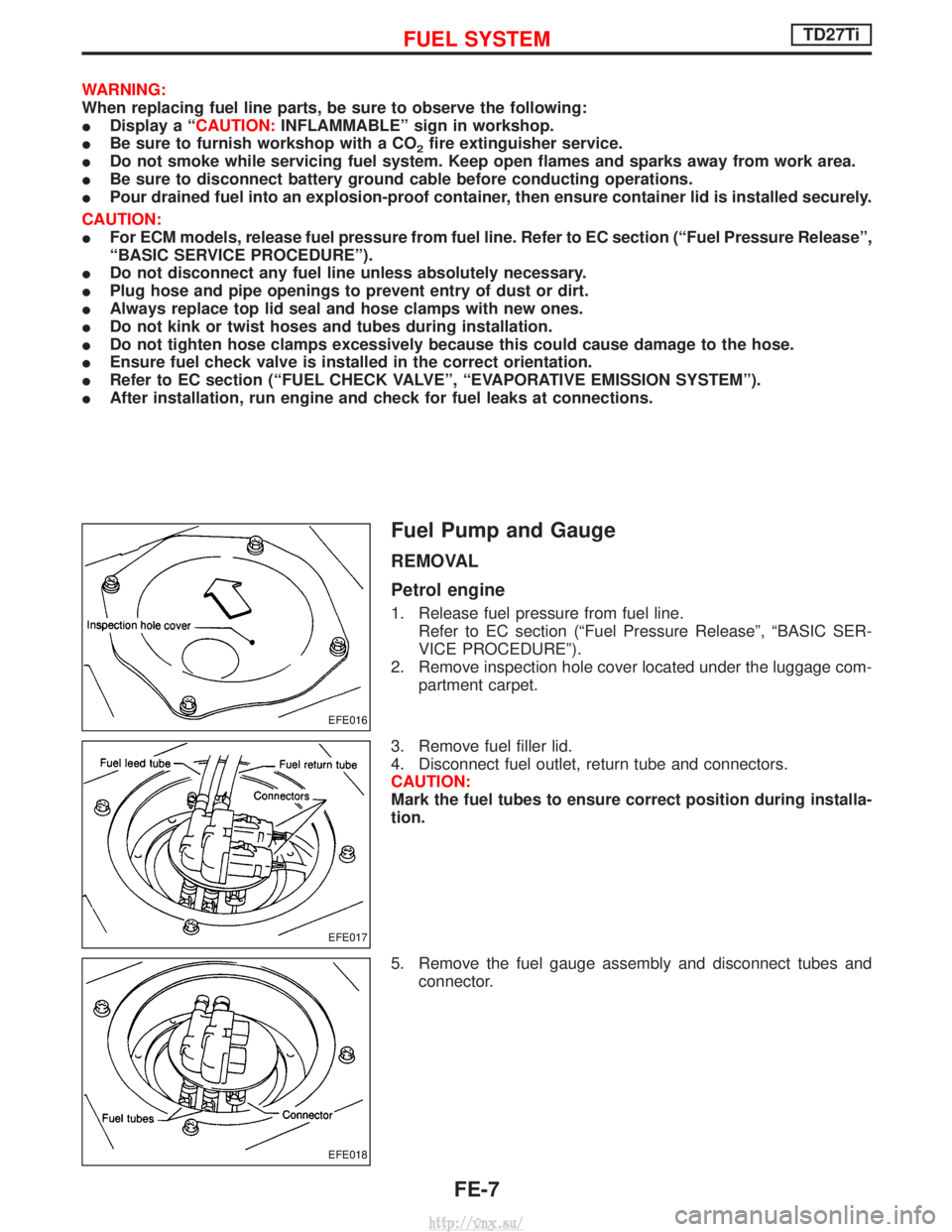
WARNING:
When replacing fuel line parts, be sure to observe the following:
IDisplay a ªCAUTION: INFLAMMABLEº sign in workshop.
I Be sure to furnish workshop with a CO
2fire extinguisher service.
I Do not smoke while servicing fuel system. Keep open flames and sparks away from work area.
I Be sure to disconnect battery ground cable before conducting operations.
I Pour drained fuel into an explosion-proof container, then ensure container lid is installed securely.
CAUTION:
I For ECM models, release fuel pressure from fuel line. Refer to EC section (ªFuel Pressure Releaseº,
ªBASIC SERVICE PROCEDUREº).
I Do not disconnect any fuel line unless absolutely necessary.
I Plug hose and pipe openings to prevent entry of dust or dirt.
I Always replace top lid seal and hose clamps with new ones.
I Do not kink or twist hoses and tubes during installation.
I Do not tighten hose clamps excessively because this could cause damage to the hose.
I Ensure fuel check valve is installed in the correct orientation.
I Refer to EC section (ªFUEL CHECK VALVEº, ªEVAPORATIVE EMISSION SYSTEMº).
I After installation, run engine and check for fuel leaks at connections.
Fuel Pump and Gauge
REMOVAL
Petrol engine
1. Release fuel pressure from fuel line.
Refer to EC section (ªFuel Pressure Releaseº, ªBASIC SER-
VICE PROCEDUREº).
2. Remove inspection hole cover located under the luggage com- partment carpet.
3. Remove fuel filler lid.
4. Disconnect fuel outlet, return tube and connectors.
CAUTION:
Mark the fuel tubes to ensure correct position during installa-
tion.
5. Remove the fuel gauge assembly and disconnect tubes and connector.
EFE016
EFE017
EFE018
FUEL SYSTEMTD27Ti
FE-7
http://vnx.su/
Page 761 of 1833
CAUTION:
IBe careful not to drop or damage catalytic converter.
I Never wet catalytic converter with water, oil, etc.
I Always replace exhaust gaskets with new ones when reas-
sembling.
If gasket is left on flange surface, scrape off complete as
shown at left.
I With engine running, check all tube connections for
exhaust gas leaks, and entire system for unusual noises.
I After installation, but before fully tightening exhaust joints,
check to ensure that mounting brackets and mounting
insulators are free from undue stress. If any of the above
parts are not installed properly, excessive noise or vibra-
tion may be transmitted to the vehicle body.
SFE180A
EXHAUST SYSTEMTD27Ti
FE-10
http://vnx.su/
Page 777 of 1833

General Specifications
CLUTCH CONTROL SYSTEM
Type of clutch controlHydraulic
CLUTCH MASTER CYLINDER
Inner diametermm (in) 15.87 (5/8)
CLUTCH OPERATING CYLINDER
Inner diameter mm (in)
LHD 17.46 (11/16)
RHD 19.05 (3/4)
CLUTCH DISC
Unit: mm (in)
EngineTD27Ti ZD30DDTi
Model 250 260
Facing size
(Outer dia. x inner dia. x
thickness) 250 x 160 x 3.7
(9.84 x 6.30 x 0.1457)
Thickness of disc assembly
under load 7.0 - 7.4 (0.276 - 0.291)
Under a load of 5,884 N (600 kg, 1,323 lb)
CLUTCH COVER
Engine TD27TiZD30DDTi
Model 250 260
Full load N (kg, lb) 5,884 (600, 1,323) 6,760 (689, 1,520)
Inspection and Adjustment
CLUTCH PEDAL
Unit: mm (in)
Handle LHDRHD
Pedal height* 227 - 237
(8.94 - 9.33) 210 - 220
(8.27 - 8.66)
Pedal stroke 155 - 160 (6.10 - 6.30)
Pedal free play
(Backlash at clevis) 1.0 - 3.0 (0.039 - 0.118)
*: Measured from surface of melt sheet to surface of pedal
pad
CLUTCH DISC
Unit: mm (in)
Engine TD27TiZD30DDTi
Disc model 250 260
Rear limit of facing
surface to rivet head 0.3 (0.012)
Runout limit of facing 1 (0.04)
Distance of runout
check point (from the
hub center) 120 (4.72)
Maximum of spline
backlash of spline (at
outer edge of disc) 1.0 (0.039)
CLUTCH COVER
Unit: mm (in)
Engine
TD27TiZD30DDTi
Cover model 250 260
Diaphragm spring height 36.5 - 38.5 (1.437 - 1.516)
Uneven limit of dia-
phragm spring toe height
ªAº 0.7 (0.028)
SERVICE DATA AND SPECIFICATIONS (SDS)
CL-14
http://vnx.su/