Page 40 of 374
6. To release the belt, push the red button marked PRESS
on the buckle. The belt will automatically retract to its
stowed position. If necessary, slide the latch plate down
the webbing to allow it to retract fully.
WARNING!
A frayed or torn belt could rip apart in a collision
and leave you with no protection. Inspect the belt
system periodically, checking for cuts, frays, or loose
parts. Damaged parts must be replaced immediately.
Do not disassemble or modify the system. Seat belt
assemblies must be replaced after an accident if they
have been damaged (bent retractor, torn webbing,
pretensioner, etc.).
Adjustable Upper Shoulder Belt Anchorage
In the front seat positions, the shoulder belt can be
adjusted upward or downward to position the belt away
from your neck. To lower the shoulder belt height, push
the button and slide the height adjuster down. To raise
the height of the shoulder belt, slide the height adjuster
up. Pull down on the height adjuster to make sure it is
locked in place.
40 THINGS TO KNOW BEFORE STARTING YOUR VEHICLE
Page 41 of 374
WARNING!
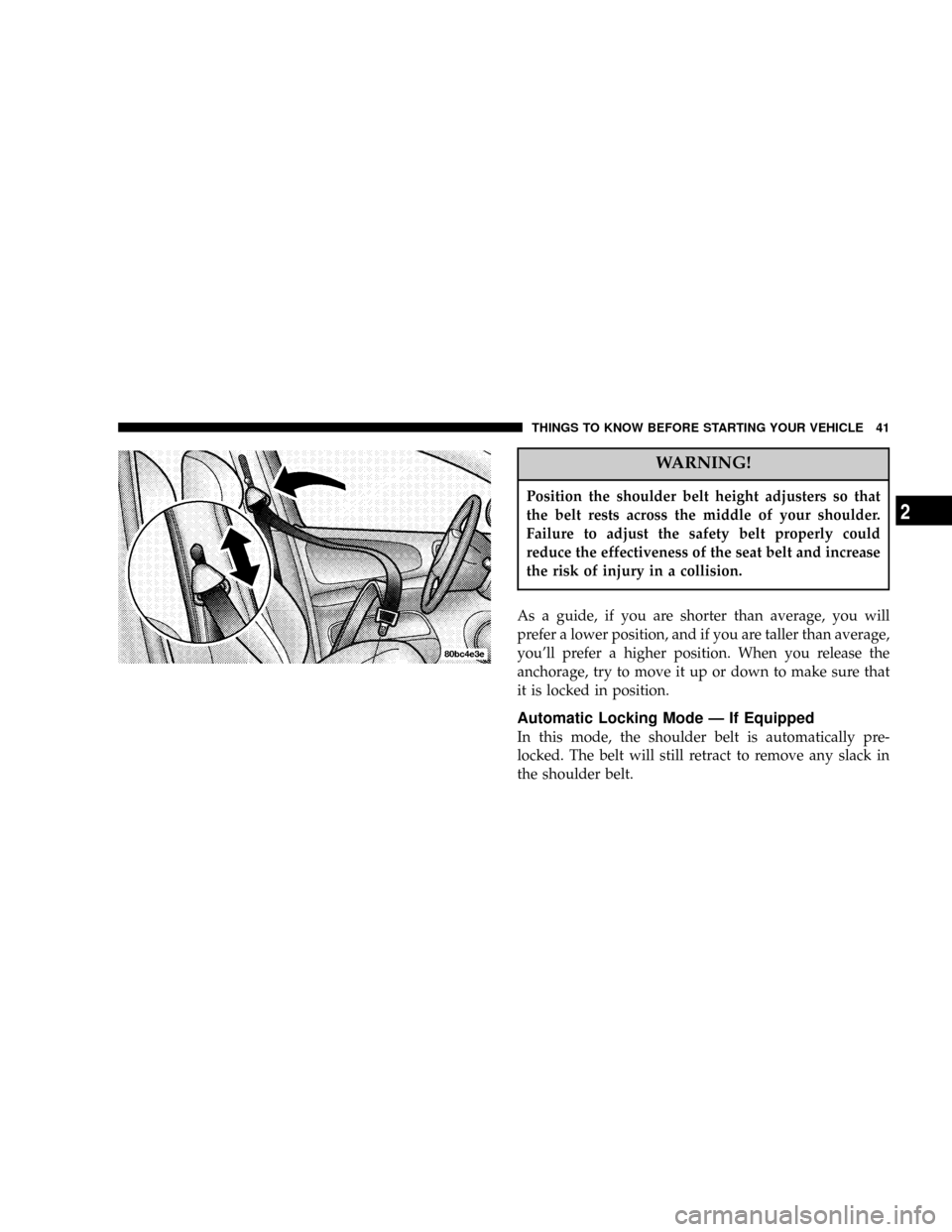
Position the shoulder belt height adjusters so that
the belt rests across the middle of your shoulder.
Failure to adjust the safety belt properly could
reduce the effectiveness of the seat belt and increase
the risk of injury in a collision.
As a guide, if you are shorter than average, you will
prefer a lower position, and if you are taller than average,
you'll prefer a higher position. When you release the
anchorage, try to move it up or down to make sure that
it is locked in position.
Automatic Locking Mode Ð If Equipped
In this mode, the shoulder belt is automatically pre-
locked. The belt will still retract to remove any slack in
the shoulder belt.
THINGS TO KNOW BEFORE STARTING YOUR VEHICLE 41
2
Page 61 of 374

Here are some tips for getting the most out of your child
restraint:
²Before buying any restraint system, make sure that it
has a label certifying that it meets all applicable Safety
Standards. The manufacturer recommends that you
try a child restraint in the vehicle seats where you will
use it before you buy it.
²The restraint must be appropriate for your child's
weight and height. Check the label on the restraint for
weight and height limits.
²Carefully follow the instructions that come with the
restraint. If you install the restraint improperly, it may
not work when you need it.
²The passenger seat belts are equipped with either
cinching latch plates or automatic locking retractors,
which are designed to keep the lap portion tight
around the child restraint so that it is not necessary touse a locking clip. If the seat belt has a cinching latch
plate, pulling up on the shoulder portion of the
lap/shoulder belt will tighten the belt. The cinching
latch plate will keep the belt tight, however, any seat
belt system will loosen with time, so check the belt
occasionally and pull it tight if necessary.
If the seat belt has a automatic locking retractor, it will
have a distinctive label. Pull the belt from the retractor
until there is enough to allow you to pass through the
child restraint and slide the latch plate into the buckle.
Then, pull the belt until it is all extracted from the
retractor. Allow the belt to return to the retractor,
pulling on the excess webbing to tighten the lap
portion about the child restraint. Refer to ªAutomatic
Locking Modeº earlier in this section.
²Buckle the child into the restraint exactly as the
manufacturer's instructions tell you.
THINGS TO KNOW BEFORE STARTING YOUR VEHICLE 61
2
Page 159 of 374

you understand and save you concern about these ªap-
parentº malfunctions, you must understand a point or
two about the transmission and reception of radio sig-
nals.
Two Types of Signals
There are two basic types of radio signals... AM or
Amplitude Modulation, in which the transmitted sound
causes the amplitude, or height, of the radio waves to
vary... and FM or Frequency Modulation, in which the
frequency of the wave is varied to carry the sound.
Electrical Disturbances
Radio waves may pick up electrical disturbances during
transmission. They mainly affect the wave amplitude,
and thus remain a part of the AM reception. They
interfere very little with the frequency variations that
carry the FM signal.
AM Reception
AM sound is based on wave amplitude, so AM reception
can be disrupted by such things as lightning, power lines
and neon signs.
FM Reception
Because FM transmission is based on frequency varia-
tions, interference that consists of amplitude variations
can be filtered out, leaving the reception relatively clear,
which is the major feature of FM radio.
UNDERSTANDING YOUR INSTRUMENT PANEL 159
4
Page 241 of 374
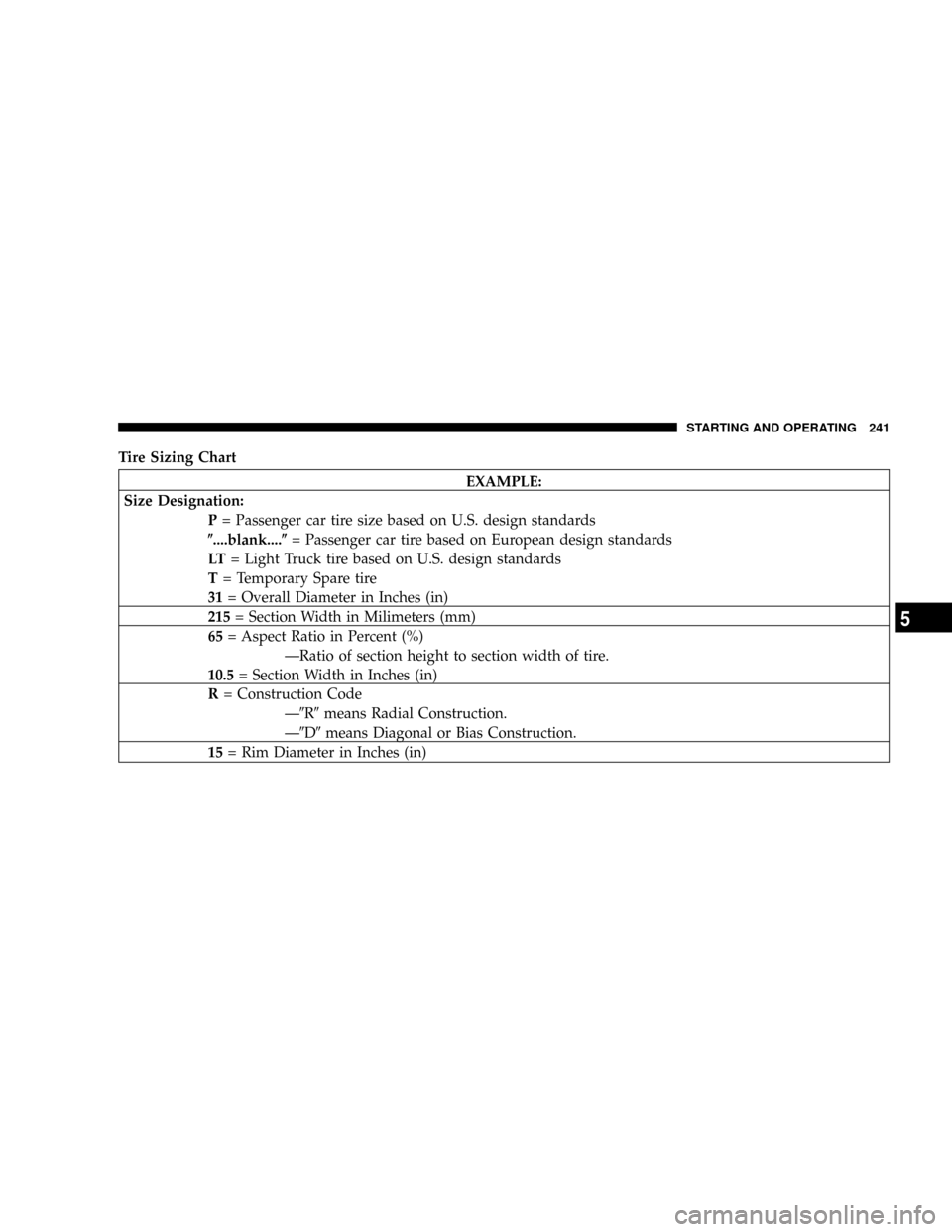
Tire Sizing Chart
EXAMPLE:
Size Designation:
P= Passenger car tire size based on U.S. design standards
(....blank....(= Passenger car tire based on European design standards
LT= Light Truck tire based on U.S. design standards
T= Temporary Spare tire
31= Overall Diameter in Inches (in)
215= Section Width in Milimeters (mm)
65= Aspect Ratio in Percent (%)
ÐRatio of section height to section width of tire.
10.5= Section Width in Inches (in)
R= Construction Code
Ð9R9means Radial Construction.
Ð9D9means Diagonal or Bias Construction.
15= Rim Diameter in Inches (in)
STARTING AND OPERATING 241
5